


What is the Photodetectors Cells Quantum Dots Market Size and Growth Rate?
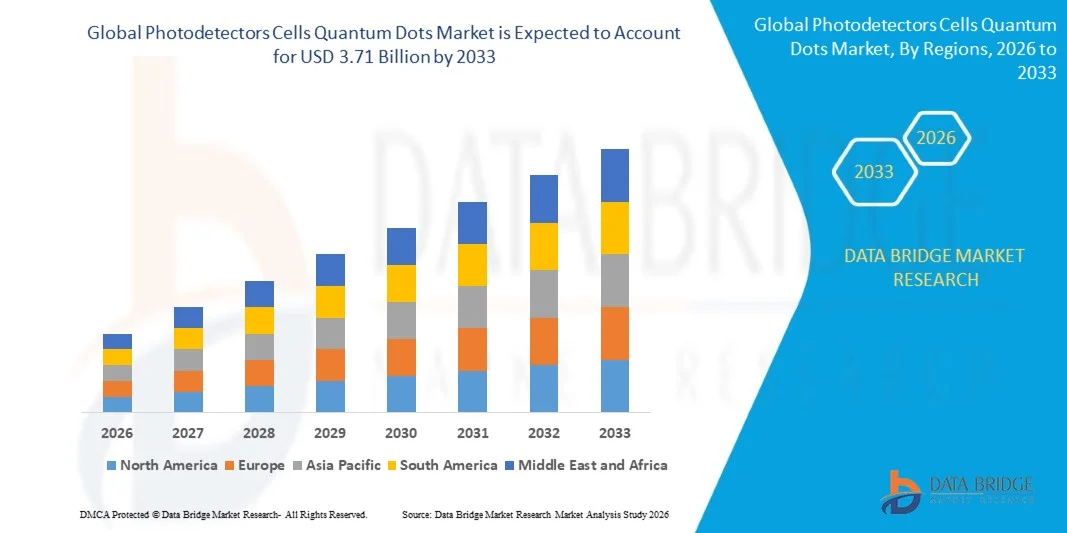
- As per Data Bridge Market Research analysis, the photodetectors cells quantum dots market was valued at USD 1.91 billion in 2025 and is projected to reach USD 3.71 billion by 2033, growing at a CAGR of 8.65% from 2026 to 2033.
- The market is experiencing steady growth driven by the rising demand for cost-effective short-wave infrared (SWIR) and near-infrared (NIR) imaging solutions, expanding adoption of quantum dot sensors in machine vision and autonomous systems, and increasing integration of quantum dot photodetector technology into consumer electronics and industrial sensing applications.
- The growing need for compact, low-cost, and highly sensitive photodetection solutions across imaging, spectroscopy, and optical communication is compelling semiconductor manufacturers and device integrators to adopt quantum dot-based photodetector technologies. Solution-processed colloidal quantum dot sensors are increasingly complementing and, in select applications, replacing traditional epitaxially grown infrared detector materials, offering lower manufacturing costs and CMOS-compatible integration.
- The convergence of quantum dot photodetector technology with artificial intelligence driven image processing algorithms is enabling new classes of intelligent imaging systems capable of extracting actionable insights from spectral data that were previously inaccessible with conventional visible-spectrum sensors alone.
Market Size & Forecast
- Global Market Value (2025): USD 1.91 Billion
- Expected Market Value (2033): USD 3.71 Billion
- Forecast CAGR (2026–2033): 8.65%
- Leading Region in 2025: North America
- Fastest Growing Region: Asia-Pacific
What are the Major Takeaways of the Photodetectors Cells Quantum Dots Market?
- North America dominated the global photodetectors cells quantum dots market with the largest revenue share of 35.74% in 2025, supported by strong aerospace and defense investment, extensive semiconductor R&D infrastructure, and early commercialization of quantum dot SWIR imaging technology.
- Asia-Pacific is expected to be the fastest-growing region at a CAGR of 10.7% from 2026 to 2033, fueled by expanding consumer electronics manufacturing, rising investment in semiconductor fabrication capacity, and growing adoption of machine vision systems across China, Japan, and South Korea.
- The lead sulfide quantum dots segment led the market with a 38.62% share in 2025, driven by its cost-effective synthesis, strong absorption across the near-infrared and short-wave infrared spectrum, and widespread use in commercial SWIR imaging sensors.
- The perovskite quantum dots segment is the fastest-growing material type, projected to register a CAGR of 11.4%, reflecting rising research interest in high-quantum-yield, tunable-bandgap materials for next-generation photodetector applications.
- The imaging & machine vision application segment dominated the application category with a 42.85% revenue share in 2025, led by rising deployment of quantum dot sensors in industrial automation, robotics, and autonomous vehicle vision systems.
- Hybrid CMOS-quantum dot sensors accounted for 54.36% of the market share among integration types in 2025, preferred for their ability to combine quantum dot infrared sensitivity with mature, low-cost silicon CMOS readout electronics.
- The biomedical & healthcare imaging application segment is the fastest-growing category, with a CAGR of 10.2%, driven by increasing adoption of quantum dot-based photodetectors in fluorescence imaging, optical coherence tomography, and point-of-care diagnostic devices.
- The industrial end-user segment held the largest share at 33.47% in 2025, driven by widespread adoption of quantum dot SWIR and NIR sensors in manufacturing quality inspection and semiconductor wafer analysis applications.
Report Scope and Photodetectors Cells Quantum Dots Market Segmentation
|
Attributes |
Photodetectors Cells Quantum Dots Key Market Insights |
|
Segments Covered |
|
|
Countries Covered |
North America
Europe
Asia-Pacific
Middle East and Africa
South America
|
|
Key Market Players |
|
|
Market Opportunities |
|
|
Value Added Data Infosets |
In addition to the insights on market scenarios such as market value, growth rate, segmentation, geographical coverage, and major players, the market reports curated by the Data Bridge Market Research also include in-depth expert analysis, geographically represented company-wise production and capacity, network layouts of distributors and partners, detailed and updated price trend analysis and deficit analysis of supply chain and demand. |
What is the Key Trend in the Photodetectors Cells Quantum Dots Market?
- Semiconductor manufacturers are increasingly integrating quantum dot photodetector layers directly onto standard CMOS silicon readout circuits, enabling low-cost, wafer-scale production of SWIR imaging sensors without the need for expensive III-V epitaxial growth processes.
- For instance, in March 2025, SWIR Vision Systems (subsequently acquired by ON Semiconductor) expanded commercial production of its CMOS-compatible quantum dot SWIR sensor platform, enabling significantly lower per-unit imaging costs for industrial machine vision applications.
- Growing research and commercial interest in perovskite and graphene quantum dot materials is enabling development of photodetectors with tunable spectral response, higher quantum yield, and improved responsivity compared to traditional lead-based quantum dot materials.
- Consumer electronics manufacturers are increasingly exploring quantum dot photodetector integration into smartphone camera modules and augmented reality devices to enable extended spectral sensitivity beyond the visible range at a fraction of the cost of conventional infrared sensor technologies.
- For instance, in February 2025, major consumer electronics component supply ecosystems featuring materials innovators like Nanosys advanced strategic integration pathways for NIR-sensitive quantum dot layers into next-generation smartphone camera sensor modules.
- Growing investment in hyperspectral imaging technology for agricultural, environmental monitoring, and food quality inspection applications is driving demand for quantum dot photodiode arrays capable of simultaneous multi-band spectral detection at significantly lower cost than traditional hyperspectral imaging systems.
- For instance, in January 2025, an agricultural technology company integrated quantum dot-based hyperspectral imaging modules into its crop health monitoring drones, enabling real-time detection of plant stress and nutrient deficiencies across large farming operations at a fraction of the cost of conventional hyperspectral cameras.
- As semiconductor manufacturers, imaging system integrators, and consumer electronics companies continue to prioritize cost-effective, high-performance photodetection solutions, the adoption of quantum dot photodetector technology is expected to accelerate, reinforcing its role as a disruptive alternative to conventional infrared detector materials.
What are the Key Drivers of the Photodetectors Cells Quantum Dots Market?
- The rapid growth of machine vision and industrial automation applications has significantly increased demand for cost-effective, high-sensitivity photodetectors capable of operating across visible, near-infrared, and short-wave infrared spectral ranges.
- For instance, in April 2025, SWIR Vision Systems expanded its manufacturing capacity for quantum dot SWIR camera modules to meet rising demand from industrial inspection, agricultural sorting, and semiconductor wafer inspection customers.
- The increasing adoption of quantum dot photodetectors in aerospace and defense applications, including night vision, surveillance, and target recognition systems, is driving sustained government and defense contractor investment in quantum dot infrared sensor development.
- For instance, in December 2024, Teledyne FLIR expanded its quantum dot infrared sensor research program to develop next-generation, low-cost SWIR imaging modules for defense surveillance and reconnaissance applications.
- Growing venture capital and government grant funding for quantum dot materials startups is accelerating commercialization timelines, enabling smaller specialized companies to scale production capacity and bring novel quantum dot photodetector chemistries to market more rapidly.
- For instance, in October 2024, UbiQD secured additional growth funding to expand production capacity for its heavy-metal-free quantum dot materials, targeting increased adoption across industrial sensing and agricultural technology applications.
- With rising demand for compact, low-cost infrared imaging across industrial, defense, automotive, and consumer electronics applications, quantum dot photodetector technology will remain a key enabler of next-generation sensing and imaging systems worldwide.
Which Factors are Challenging the Growth of the Photodetectors Cells Quantum Dots Market?
- Quantum dot photodetector technology faces persistent challenges related to long-term material stability, as certain colloidal quantum dot materials are susceptible to oxidation and performance degradation under prolonged exposure to heat, moisture, and light.
- These stability limitations require manufacturers to invest in specialized encapsulation and passivation techniques, adding to production complexity and cost, particularly for applications requiring long operational lifetimes such as aerospace and industrial sensing.
- For instance, in September 2024, findings published by ACS Applied Nano Materials and ACS Nano highlighted that lead-based colloidal and perovskite quantum dot configurations continued to experience performance degradation under severe thermal cycling, prompting accelerated work into inorganic shell passivation.
- Competition from established infrared detector technologies, including InGaAs and mercury cadmium telluride photodiodes, continues to limit quantum dot photodetector adoption in high-performance scientific and defense applications where absolute sensitivity and noise performance remain critical selection criteria.
- The regulatory restrictions on lead and cadmium-based materials in several regions, driven by environmental and health safety regulations, continue to limit the commercial adoption of certain high-performance quantum dot photodetector materials. This regulatory pressure is accelerating research into lead-free and cadmium-free alternatives, though these substitute materials often exhibit lower quantum efficiency, slowing the pace of broader market adoption despite growing demand for infrared sensing solutions.
How is the Photodetectors Cells Quantum Dots Market Segmented?
The photodetectors cells quantum dots market is segmented on the basis of material type, spectral range, application, end user, integration type, and technology.
- By Material Type
On the basis of material type, the global photodetectors cells quantum dots market is segmented into lead sulfide quantum dots, lead selenide quantum dots, mercury cadmium telluride quantum dots, graphene quantum dots, perovskite quantum dots, and others. The lead sulfide quantum dots segment dominated the market with a 38.62% share in 2025, owing to its cost-effective synthesis process, strong absorption across the near-infrared and short-wave infrared spectrum, and widespread commercial use in SWIR imaging sensors. These materials remain the preferred choice for imaging system developers seeking a mature, well-characterized quantum dot chemistry for infrared photodetector applications.
The perovskite quantum dots segment is projected to register the fastest growth at a CAGR of 11.4% from 2026 to 2033, driven by rising research interest in high-quantum-yield, tunable-bandgap materials offering improved responsivity and lower fabrication temperatures compared to traditional lead-based quantum dot materials. Advances in perovskite quantum dot stability and encapsulation techniques are accelerating segment expansion.
- By Spectral Range
On the basis of spectral range, the global photodetectors cells quantum dots market is segmented into visible, near-infrared, short-wave infrared, mid-wave infrared, and ultraviolet. The short-wave infrared segment led the market with a 34.17% share in 2025, supported by its critical role in applications such as semiconductor wafer inspection, agricultural sorting, and low-light surveillance imaging that cannot be effectively addressed by visible-spectrum sensors alone.
The near-infrared segment is expected to experience the fastest growth at a CAGR of 9.8% from 2026 to 2033, driven by increasing demand for NIR-sensitive quantum dot sensors in consumer electronics, biometric authentication, and augmented reality applications requiring extended spectral sensitivity beyond the visible range.
- By Application
On the basis of application, the global photodetectors cells quantum dots market is segmented into imaging & machine vision, spectroscopy, optical communication, biomedical & healthcare imaging, aerospace & defense, consumer electronics, and industrial sensing. The imaging & machine vision segment dominated the market with a share of 42.85% in 2025 due to rising deployment of quantum dot sensors in industrial automation, robotics, and autonomous vehicle vision systems requiring cost-effective, high-sensitivity infrared imaging. the continued expansion of automated manufacturing and quality-inspection systems is reinforcing the dominance of this segment.
The biomedical & healthcare imaging segment is expected to witness the fastest CAGR of 10.2% from 2026 to 2033, driven by this growth is fueled by increasing adoption of quantum dot-based photodetectors in fluorescence imaging, optical coherence tomography, and point-of-care diagnostic devices requiring compact, highly sensitive optical sensing components.
- By End User
On the basis of end user, the global photodetectors cells quantum dots market is segmented into consumer electronics manufacturers, automotive, aerospace & defense, healthcare & life sciences, industrial, and telecommunications. The industrial segment dominated the market with a share of 33.47% in 2025 due to widespread adoption of quantum dot SWIR and NIR sensors in manufacturing quality inspection, semiconductor wafer analysis, and agricultural sorting applications. the growing emphasis on automated, non-destructive inspection processes is reinforcing this segment’s leading position.
The automotive segment is expected to witness the fastest CAGR of 11.1% from 2026 to 2033, driven by rising integration of quantum dot infrared sensors into advanced driver-assistance systems and autonomous vehicle perception platforms requiring reliable, low-cost night vision and object-detection capabilities. additionally, growing investment by automotive suppliers in next-generation sensing technologies is further accelerating adoption across this segment.
- By Integration Type
On the basis of integration type, the global photodetectors cells quantum dots market is segmented into hybrid CMOS-quantum dot sensors, standalone quantum dot photodetectors, and quantum dot photodiode arrays. The hybrid CMOS-quantum dot sensors segment dominated the market with a share of 54.36% in 2025 due to its ability to combine quantum dot infrared sensitivity with mature, low-cost silicon CMOS readout electronics, enabling wafer-scale manufacturing and significant cost reduction compared to traditional III-V infrared detector technologies. established semiconductor foundry relationships continue to support this segment’s leading position.
The quantum dot photodiode arrays segment is expected to witness the fastest CAGR of 9.6% from 2026 to 2033, driven by the rising adoption of multi-pixel array configurations in spectroscopy and hyperspectral imaging applications requiring simultaneous detection across multiple spectral bands.
- By Technology
On the basis of technology, the global photodetectors cells quantum dots market is segmented into colloidal quantum dots, quantum dot-in-a-well, and quantum dot heterostructures. The colloidal quantum dots segment dominated the market with a share of 61.28% in 2025 due to its solution-processability, compatibility with low-cost roll-to-roll and spin-coating manufacturing techniques, and broad tunability of spectral response through particle size control. widespread commercial availability of colloidal quantum dot materials from established suppliers continues to reinforce this segment’s leading position.
The quantum dot heterostructures segment is expected to witness the fastest CAGR of 9.3% from 2026 to 2033, driven by increasing research and development investment in advanced multi-layer quantum dot architectures offering improved carrier confinement, higher responsivity, and reduced dark current for demanding aerospace and scientific imaging applications.
Which Region Holds the Largest Share of the Photodetectors Cells Quantum Dots Market?
- North America dominated the photodetectors cells quantum dots market and accounted for the largest revenue share of 35.74% in 2025, supported by strong aerospace and defense investment, extensive semiconductor research infrastructure, and early commercialization of quantum dot SWIR imaging technology by leading regional companies.
- The region also benefits from substantial government funding for defense-related infrared sensing research, a strong base of venture-backed quantum dot materials startups, and growing adoption of quantum dot sensors in industrial automation and machine vision applications. Continued focus on next-generation sensing technology development continues to strengthen North America’s leadership position in the global market.
U.S. Photodetectors Cells Quantum Dots Market Insight
The U.S. photodetectors cells quantum dots market holds the largest share within North America, driven by substantial defense and aerospace investment in infrared sensing technology, a strong concentration of quantum dot materials research institutions and startups, and growing commercial adoption across industrial machine vision applications. Rising investment by semiconductor companies in CMOS-compatible quantum dot sensor manufacturing is further supporting market growth. Additionally, continued government funding for next-generation sensor research is reinforcing the country’s position as a global leader in quantum dot photodetector innovation.
Canada Photodetectors Cells Quantum Dots Market Insight
Canada’s photodetectors, cells, and quantum dots market is gaining momentum, supported by strong research capabilities, government initiatives, and growing adoption of advanced photonic technologies. Quantum dots are increasingly explored for high-performance photodetectors, solar cells, imaging, sensing, displays, and telecommunications. Canada’s established quantum technology ecosystem and collaboration between academia, industry, and government are encouraging commercialization. Opportunities are particularly promising in cadmium-free quantum dots, infrared detection, medical imaging, energy-efficient devices, and next-generation optical sensing applications.
Asia-Pacific Photodetectors Cells Quantum Dots Market Insight
The Asia-Pacific photodetectors cells quantum dots market is expected to witness rapid growth, driven by expanding consumer electronics manufacturing, rising investment in semiconductor fabrication capacity, and growing adoption of machine vision and industrial sensing systems across countries such as China, Japan, and South Korea. Increasing government investment in domestic semiconductor research capabilities and rising demand for cost-effective infrared imaging solutions are supporting regional market expansion. Additionally, the growing presence of consumer electronics manufacturers exploring quantum dot sensor integration is accelerating adoption across the region.
China Photodetectors Cells Quantum Dots Market Insight
China photodetectors cells quantum dots market is growing rapidly, driven by expanding domestic semiconductor manufacturing capacity, rising investment in machine vision and industrial automation, and growing government support for advanced materials research. Growing adoption of quantum dot infrared sensors across manufacturing quality inspection and consumer electronics applications is significantly boosting market demand. In addition, rising domestic quantum dot materials production capabilities and increasing investment in semiconductor research institutions are positioning China as one of the fastest-growing markets for quantum dot photodetectors globally.
Japan Photodetectors Cells Quantum Dots Market Insight
The Japan photodetectors cells quantum dots market is witnessing consistent growth due to the country’s strong semiconductor and imaging sensor manufacturing base, advanced materials research capabilities, and increasing adoption of machine vision systems across automotive and industrial sectors. Leading imaging sensor and semiconductor companies continue to invest in quantum dot photodetector research for next-generation camera and sensing applications. Moreover, continued innovation in colloidal quantum dot synthesis and CMOS integration technologies is further contributing to market growth in Japan.
Which are the Top Companies in Photodetectors Cells Quantum Dots Market?
The photodetectors cells quantum dots industry is primarily led by well-established companies, including:
- SWIR Vision Systems, Inc. (U.S.)
- Emberion Oy (Finland)
- Nanoco Group plc (U.K.)
- UbiQD, Inc. (U.S.)
- Hamamatsu Photonics K.K. (Japan)
- Teledyne FLIR LLC (U.S.)
- Sony Semiconductor Solutions Corporation (Japan)
- Quantum Materials Corp (U.S.)
- Crystalplex Corporation (U.S.)
- Voxtel, Inc. (TT Electronics) (U.S.)
- Quantum Solutions LLC (U.A.E.)
- Nexdot SAS (France)
- ams OSRAM AG (Austria)
- Excelitas Technologies Corp. (U.S.)
- First Sensor AG (TE Connectivity) (Germany)
- QD Laser, Inc. (Japan)
- Edinburgh Instruments Ltd. (U.K.)
- Samsung Electronics Co., Ltd. (South Korea)
- Thorlabs, Inc. (U.S.)
- Hamamatsu Photonics Europe GmbH (Germany)
What are Latest Developments in Photodetectors Cells Quantum Dots Market?
- In September 2025, SWIR Vision Systems introduced a next-generation quantum dot SWIR camera module featuring improved quantum efficiency and expanded spectral sensitivity, targeting industrial inspection and agricultural sorting applications requiring higher-resolution infrared imaging at reduced system costs.
- In January 2025, Emberion Oy expanded its manufacturing capacity for quantum dot infrared sensor modules in Europe to meet rising demand from industrial machine vision and spectroscopy customers across the region.
- In November 2025, Nanoco Group announced a new supply agreement with a consumer electronics component manufacturer to provide cadmium-free quantum dot materials for next-generation NIR sensing applications, expanding its presence beyond display technology into the photodetector materials segment.
- In November 2024, Hamamatsu Photonics launched an upgraded quantum dot photodiode array product line featuring improved dark current performance, designed for demanding scientific and aerospace hyperspectral imaging applications.
- In June 2023, UbiQD partnered with several academic research institutions to conduct field validation of its heavy-metal-free quantum dot photodetector materials, demonstrating improved environmental compliance while maintaining competitive spectral sensitivity for industrial sensing applications.
- In August 2024, Quantum Solutions LLC expanded its production facility for colloidal quantum dot photodetector materials to increase manufacturing capacity and support growing demand from imaging sensor developers across Europe and the Middle East.

- Interactive Data Analysis Dashboard
- Company Analysis Dashboard for high growth potential opportunities
- Research Analyst Access for customization & queries
- Competitor Analysis with Interactive dashboard
- Latest News, Updates & Trend analysis
- Harness the Power of Benchmark Analysis for Comprehensive Competitor Tracking
Global Photodetectors Cells Quantum Dots Market, Supply Chain Analysis and Ecosystem Framework
To support market growth and help clients navigate the impact of geopolitical shifts, DBMR has integrated in-depth supply chain analysis into its Global Photodetectors Cells Quantum Dots Market research reports. This addition empowers clients to respond effectively to global changes affecting their industries. The supply chain analysis section includes detailed insights such as Global Photodetectors Cells Quantum Dots Market consumption and production by country, price trend analysis, the impact of tariffs and geopolitical developments, and import and export trends by country and HSN code. It also highlights major suppliers with data on production capacity and company profiles, as well as key importers and exporters. In addition to research, DBMR offers specialized supply chain consulting services backed by over a decade of experience, providing solutions like supplier discovery, supplier risk assessment, price trend analysis, impact evaluation of inflation and trade route changes, and comprehensive market trend analysis.
Data collection and base year analysis are done using data collection modules with large sample sizes. The stage includes obtaining market information or related data through various sources and strategies. It includes examining and planning all the data acquired from the past in advance. It likewise envelops the examination of information inconsistencies seen across different information sources. The market data is analysed and estimated using market statistical and coherent models. Also, market share analysis and key trend analysis are the major success factors in the market report. To know more, please request an analyst call or drop down your inquiry.
The key research methodology used by DBMR research team is data triangulation which involves data mining, analysis of the impact of data variables on the market and primary (industry expert) validation. Data models include Vendor Positioning Grid, Market Time Line Analysis, Market Overview and Guide, Company Positioning Grid, Patent Analysis, Pricing Analysis, Company Market Share Analysis, Standards of Measurement, Global versus Regional and Vendor Share Analysis. To know more about the research methodology, drop in an inquiry to speak to our industry experts.
Data Bridge Market Research is a leader in advanced formative research. We take pride in servicing our existing and new customers with data and analysis that match and suits their goal. The report can be customized to include price trend analysis of target brands understanding the market for additional countries (ask for the list of countries), clinical trial results data, literature review, refurbished market and product base analysis. Market analysis of target competitors can be analyzed from technology-based analysis to market portfolio strategies. We can add as many competitors that you require data about in the format and data style you are looking for. Our team of analysts can also provide you data in crude raw excel files pivot tables (Fact book) or can assist you in creating presentations from the data sets available in the report.













