


What is the Photoelectric Cells Market Size and Growth Rate?
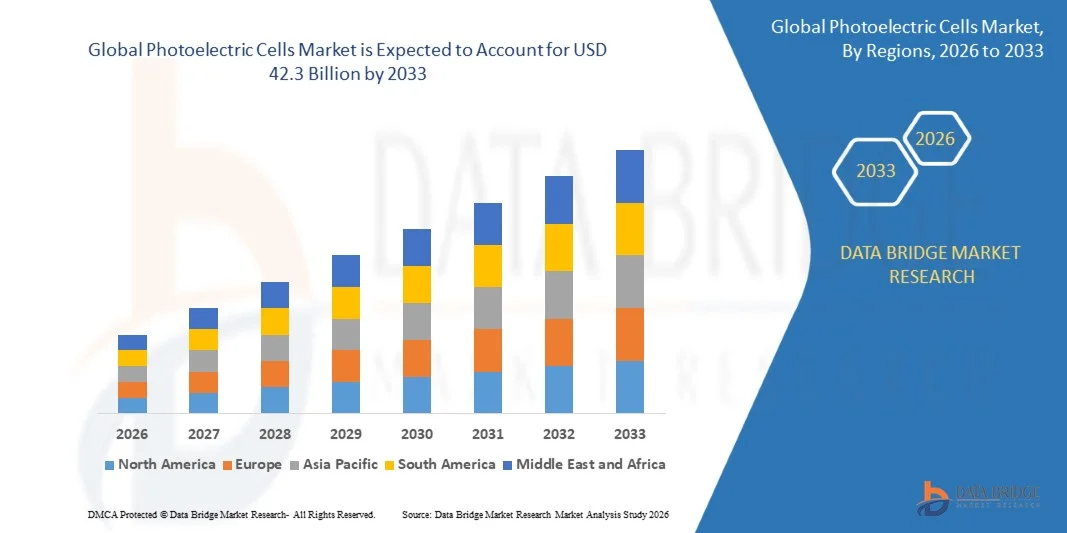
- As per market analysis, the global Photoelectric Cells Market was valued at USD 24.8 billion in 2025 and is projected to reach USD 42.3 billion by 2033, growing at a CAGR of 6.8% from 2026 to 2033.
- The market is witnessing growth driven by increasing adoption of renewable energy, expansion of industrial automation, growing integration of IoT-enabled sensors, and increasing deployment of smart grid. Photoelectric cells are increasingly used across photovoltaic systems, industrial automation, consumer electronics, automotive applications, healthcare equipment, and aerospace and defense systems.
- Growing photovoltaic installations, increasing factory automation, rising demand for optical sensing and detection technologies, expansion of smart buildings, and increasing adoption of connected industrial equipment are further supporting market growth. Photoelectric cells provide reliable light detection and energy-conversion capabilities for applications including solar power generation, object detection, position sensing, quality control, automatic lighting, energy management, medical imaging, and optical sensing systems.
Market Size & Forecast
- Market Value (2025): USD 24.8 billion
- Expected Market Value (2033): USD 42.3 billion
- Forecast CAGR (2026–2033): 6.8%
- Leading Region in 2025: North America
- Fastest Growing Region: Asia-Pacific
What are the Major Takeaways of the Photoelectric Cells Market?
- North America dominated the global Photoelectric Cells Market with share of 43.12% in 2025, supported by the strong presence of industrial automation, increasing adoption of advanced sensing technologies, expansion of smart manufacturing, and growing demand for photoelectric sensing solutions across manufacturing, automotive, electronics, and logistics applications.
- Asia-Pacific is expected to witness strong growth in the global Photoelectric Cells Market during the forecast period CAGR of 6.12% in 2026 to 2033, supported by rapid industrialization, expansion of manufacturing facilities, increasing factory automation, growing adoption of robotics and IoT-enabled equipment, and rising investments in smart manufacturing across China, Japan, South Korea, and India.
- Photovoltaic applications represented a key application segment of the Photoelectric Cells Market with share of 32.12% in 2025, supported by increasing renewable-energy deployment, expansion of solar power generation capacity, declining costs of photovoltaic technologies, and growing investments in clean-energy infrastructure.
- Industrial automation is expected to be among the fastest-growing application areas with market share of 33.11% in 2025, supported by increasing adoption of automated production systems, robotics, machine vision, object detection, and intelligent sensing technologies. The increasing integration of photoelectric sensors into manufacturing and logistics equipment is further supporting demand.
- Photovoltaic cells represent a major application category with market share of 55.11% in 2025, supported by increasing global solar-energy installations and the transition toward renewable electricity generation. Meanwhile, demand for photoelectric sensors and detection systems is being supported by expanding automation across manufacturing, packaging, material handling, automotive, and electronics industries.
Report Scope Photoelectric Cells Market Segmentation
|
Attributes |
Photoelectric Cells Market Key Market Insights |
|
Segments Covered |
|
|
Countries Covered |
North America
Europe
Asia-Pacific
Middle East and Africa
South America
|
|
Key Market Players |
|
|
Market Opportunities |
|
|
Value Added Data Infosets |
In addition to the market insights such as market value, growth rate, market segments, geographical coverage, market players, and market scenario, the market report curated by the Data Bridge Market Research team includes in-depth expert analysis, import/export analysis, pricing analysis, production consumption analysis, and pestle analysis. |
What is the Key Trend in the Photoelectric Cells Market?
- Increasing integration of photoelectric sensors with smart automation and iot-enabled systems is emerging as a key trend in the global Photoelectric Cells Market. Manufacturers are increasingly developing sensors with programmable functions, digital communication, and real-time monitoring capabilities for automated production, logistics, robotics, and material-handling applications.
- Miniaturization and space-efficient photoelectric sensing is another important trend, particularly in industrial automation equipment where installation space is increasingly constrained. Smaller sensors with high detection accuracy and reliable performance are being developed for compact machinery and automated systems.
- Integration of ai and advanced sensing technologies is increasingly supporting intelligent detection and quality-control applications. Photoelectric and vision-based sensing systems are being combined with ai algorithms to improve object detection, presence or absence verification, anomaly identification, and automated quality inspection.
- For instance, in June 2025, Longi announced a 33% conversion efficiency for a large-area crystalline silicon-perovskite tandem solar cell, certified by the U.S. national renewable energy laboratory (NRELL).
- Advancement of perovskite-silicon tandem technology represents another emerging direction in photovoltaic cells. CEA and 3sun reported a 30.8% efficiency record for a perovskite-on-silicon tandem solar cell, with the result independently certified. The development indicates continued efforts to improve conversion efficiency and facilitate the future commercialization and scaling of advanced photovoltaic technologies.
What are the Key Drivers of the Photoelectric Cells Market?
- Increasing adoption of industrial automation and smart manufacturing is a key driver of the global Photoelectric Cells Market. Manufacturers are increasingly deploying automated production lines, robotics, conveyor systems, and machine-monitoring equipment to improve operational efficiency and reduce manual intervention.
- Growing demand for advanced sensing and detection technologies is further supporting market growth. Photoelectric cells are increasingly used for object detection, counting, positioning, inspection, safety monitoring, and process control across automotive, electronics, packaging, food and beverage, pharmaceutical, and logistics industries.
- Expansion of solar energy installations is another important growth driver, particularly for photoelectric cells used in photovoltaic applications. Increasing investments in renewable energy, government initiatives supporting clean electricity generation, declining solar technology costs, and the global transition toward low-carbon energy systems are increasing demand for photovoltaic technologies.
- Recent industry developments are supporting technological advancement in photoelectric sensing. For instance, in 2025 and 2026, leading industrial automation companies continued to expand their sensor portfolios with compact photoelectric sensors, improved detection capabilities, io-link connectivity, and solutions designed for automated manufacturing and logistics applications. Such developments are supporting the integration of photoelectric sensing into increasingly connected and automated industrial environments.
- Technological advancements in photoelectric sensing are further driving adoption. Improvements in sensing accuracy, detection range, response speed, miniaturization, energy efficiency, connectivity, and resistance to demanding operating conditions are expanding the use of photoelectric cells across industrial and commercial applications.
Which Factors are Challenging the Growth of the Photoelectric Cells Market?
- High sensitivity to environmental conditions is a key challenge in the global Photoelectric Cells Market. Dust, moisture, temperature fluctuations, ambient light, vibration, and electromagnetic interference can affect the performance, detection accuracy, and reliability of photoelectric cells, particularly in outdoor and industrial applications.
- High-performance and specialized photoelectric cells can involve significant costs, particularly when advanced materials, high-precision optical components, specialized coatings, or sophisticated signal-processing technologies are required. These costs can create adoption barriers among small and medium-sized manufacturers and users.
- Technical limitations across different applications can also challenge market growth. Photoelectric cells need to operate reliably under varying light intensity, object colors, surface reflectivity, distances, and environmental conditions. Differences in application requirements can increase the need for application-specific calibration and system integration.
- For instance, in may 2025, sick expanded its photoelectric sensing portfolio with new sensor solutions designed for industrial automation applications, supporting demand for reliable object detection, positioning, and presence sensing in manufacturing and logistics environments.
- Increasing competition from alternative sensing technologies can restrain market expansion. Technologies such as ultrasonic sensors, inductive sensors, capacitive sensors, magnetic sensors, and machine-vision systems can provide alternative solutions for object detection, positioning, measurement, and automation applications, depending on operating conditions.
How Is the Photoelectric Cells Market Segmented?
The market is segmented on the basis of type, application, and end use.
- By Type
On the basis of type, the global Photoelectric Cells Market is segmented into photovoltaic cells, photoconductive cells, photodiodes, phototransistors, and others. The photovoltaic cells segment represents a key category of the market share of 43.12% in 2025, supported by increasing deployment of solar-energy systems, growing investments in renewable energy infrastructure, and rising demand for technologies capable of converting light energy into electrical energy.
The photodiodes segment is expected to witness significant growth during the forecast period CAGR of 6.12% in 2026 to 2033, supported by increasing adoption of optical sensing, communication systems, industrial automation, medical equipment, consumer electronics, and detection applications. Increasing demand for high-speed and high-sensitivity light detection is further supporting segment growth.
- By Application
On the basis of application, the global Photoelectric Cells Market can be segmented into solar energy generation, industrial automation, consumer electronics, automotive, healthcare, aerospace and defense, and others. The solar energy generation segment represents a major application area with market share of 33.12% in 2025, supported by increasing global photovoltaic installations and investments in renewable-energy infrastructure.
The industrial automation segment is expected to witness significant growth during the forecast period CAGR of 6.11% in 2206 to 2033, supported by increasing adoption of robotics, automated production lines, object detection systems, machine vision, and smart manufacturing technologies.
- By End-Users
On the basis of end-users, the global Photoelectric Cells Market is segmented into automotive, aerospace & military, and electronics & semiconductor. The electronics & semiconductor segment represents a key end-user category with market share of 44.11% in 2205, supported by increasing demand for optical sensing, automated inspection, semiconductor manufacturing, and electronic devices.
The automotive segment is supported by increasing vehicle automation, safety systems, optical sensing, and advanced electronic components with forecast period CAGR of 6.88% in 2026 to 2033. The demand for reliable optical detection and sensing technologies in specialized aerospace, defense, surveillance, and communication applications.
Which Region Holds the Largest Share of the Photoelectric Cells Market?
- North America dominated the global Photoelectric Cells Market in 2025, accounting for a 42.3% market share, supported by the region's strong photovoltaic manufacturing base, rapid expansion of renewable energy installations, increasing industrial automation, and growing adoption of photoelectric sensing technologies. China represents a major contributor to regional demand, while increasing renewable-energy investments in India, Japan, South Korea, and other Asian economies are further supporting market expansion.
- Asia-Pacific is also expected to witness strong growth in the global Photoelectric Cells Market during the forecast period 7.11% in 2026 to 2033, supported by increasing solar photovoltaic deployment, expansion of manufacturing and industrial automation, growing adoption of IoT-enabled sensing systems, and increasing investments in smart-grid infrastructure.
U.S. Photoelectric Cells Market Insight
The U.S. Photoelectric Cells Market is witnessing steady growth due to increasing adoption of industrial automation, smart manufacturing, and advanced sensing technologies across manufacturing, automotive, electronics, and logistics applications. Rising demand for accurate object detection, position sensing, safety systems, and automated inspection is supporting the deployment of photoelectric cells. Growing investments in robotics, connected industrial equipment, and IoT-enabled systems are further contributing to market expansion. In addition, the increasing use of photoelectric technologies in renewable energy, smart buildings, and energy management applications is creating new opportunities for market participants across the United States.
Europe Photoelectric Cells Market Insight
The Europe Photoelectric Cells Market is witnessing steady growth, supported by increasing adoption of industrial automation, smart manufacturing, renewable energy systems, and advanced optical sensing technologies. Growing deployment of photoelectric cells across automotive manufacturing, electronics, logistics, building automation, and energy applications is strengthening regional demand. European industries are increasingly adopting sensor-based systems to improve production efficiency, safety, quality control, and energy management. The expansion of smart factories, robotics, and connected industrial equipment is further supporting market development. Germany, France, the United Kingdom, and Italy remain important markets due to their established industrial and technology sectors.
U.K. Photoelectric Cells Market Insight
The U.K. Photoelectric Cells Market is witnessing steady growth due to increasing adoption of industrial automation, smart manufacturing, renewable energy systems, and advanced sensing technologies. Photoelectric cells are increasingly used for object detection, position sensing, automated lighting, safety systems, and control applications across manufacturing, automotive, electronics, and energy sectors. Growing investments in Industry 4.0, robotics, and connected industrial equipment are supporting demand for reliable optical sensing solutions. In addition, the expansion of energy-efficient technologies and smart infrastructure is expected to create further opportunities for photoelectric cell manufacturers and technology providers in the U.K.
Germany Photoelectric Cells Market Insight
Germany’s Photoelectric Cells Market is expanding with increasing adoption of industrial automation, smart manufacturing, renewable energy systems, and advanced sensing technologies. Growing investments in Industry 4.0, robotics, and automated production lines are supporting demand for photoelectric cells across automotive, electronics, manufacturing, logistics, and semiconductor applications. The country’s strong industrial base and focus on energy efficiency are further supporting market development. Increasing deployment of optical detection, positioning, counting, and safety systems is also contributing to demand. Technological advancements in compact, reliable, and high-precision photoelectric sensing solutions are expected to create further growth opportunities in Germany.
Asia-Pacific Photoelectric Cells Market Insight
The Asia-Pacific Photoelectric Cells Market is witnessing strong growth, supported by expanding renewable energy generation, rapid industrial automation, and increasing adoption of optical sensing technologies. China’s strong photovoltaic manufacturing base, along with increasing solar energy investments in India, Japan, and South Korea, is supporting regional demand. Growing deployment of smart manufacturing systems, IoT-enabled devices, automated equipment, and energy-efficient technologies is further contributing to the adoption of photoelectric cells across industrial, automotive, electronics, and energy applications.
Japan Photoelectric Cells Market Insight
Japan’s Photoelectric Cells Market is witnessing steady growth, supported by the country’s advanced manufacturing ecosystem, high adoption of industrial automation, and strong presence of automotive and electronics industries. Increasing deployment of robotics, smart manufacturing systems, optical sensing technologies, and automated inspection equipment is creating demand for reliable photoelectric sensing solutions. The expansion of renewable energy and energy-efficient technologies is also supporting photovoltaic cell applications. In addition, Japan’s focus on factory digitalization, precision manufacturing, and connected industrial equipment is expected to strengthen the adoption of photoelectric cells across automotive, electronics, semiconductor, aerospace, and industrial applications.
China Photoelectric Cells Market Insight
China’s Photoelectric Cells Market is expanding with increasing adoption of photovoltaic technologies, industrial automation, smart manufacturing, and optical sensing systems. Strong domestic solar cell manufacturing capabilities and continued investments in renewable energy infrastructure are supporting market development. The growing deployment of automated production lines, robotics, smart factories, and IoT-enabled equipment is further increasing demand for photoelectric sensing solutions. In addition, expanding applications across automotive, electronics and semiconductor, aerospace and defense, and consumer electronics sectors are contributing to market growth. Technological advancements in high-sensitivity, compact, and energy-efficient photoelectric cells are expected to create further opportunities in China.
Which Are the Top Companies In Photoelectric Cells Market?
The Photoelectric Cells Market industry is primarily led by well-established companies, including:
- QuantumScape Corporation (U.S.)
- Ilika plc (U.K.)
- Solid Power, Inc. (U.S.)
- BrightVolt, Inc., (U.S.)
- Cymbet Corporation (U.S.)
- Prieto Battery Inc. (U.S.)
- Sion Power Corporation (U.S.)
- Hitachi Zosen Corporation (Japan)
- ProLogium Technology CO., Ltd. (Taiwan)
- Johnson Energy Storage, Inc. (U.S.)
- PJP Eye LTD. (Japan)
- Factorial Inc. (Spain)
- Volkswagen AG (Germany)
- Front Edge Technology, Inc. (U.S.)
- I-TEN S.A. (Italy)
What Are Latest Developments in Photoelectric Cells Market?
- In March 2025,Panasonic Industry introduced new cylindrical, wide-beam, and convergent-reflective fiber products for photoelectric sensing applications, strengthening its industrial sensing portfolio.
- In July 2025, Panasonic Industry launched the FX-250 digital fiber sensor series, featuring an organic EL display and designed for industrial sensing applications.
- In August 2025, Panasonic Industry released the FT-PK40H1 heat-resistant U-shaped fiber for micro photoelectric sensor applications in high-temperature environments.
- In November 2025, Pepperl+Fuchs highlighted advanced photoelectric sensor solutions for automated packaging applications, including transparent-object detection and IO-Link integration.
- In December 2025, Pepperl+Fuchs expanded the application of its R10x and R20x photoelectric sensor series in automated filling and packaging systems for object detection and process monitoring.

- Interactive Data Analysis Dashboard
- Company Analysis Dashboard for high growth potential opportunities
- Research Analyst Access for customization & queries
- Competitor Analysis with Interactive dashboard
- Latest News, Updates & Trend analysis
- Harness the Power of Benchmark Analysis for Comprehensive Competitor Tracking
Data collection and base year analysis are done using data collection modules with large sample sizes. The stage includes obtaining market information or related data through various sources and strategies. It includes examining and planning all the data acquired from the past in advance. It likewise envelops the examination of information inconsistencies seen across different information sources. The market data is analysed and estimated using market statistical and coherent models. Also, market share analysis and key trend analysis are the major success factors in the market report. To know more, please request an analyst call or drop down your inquiry.
The key research methodology used by DBMR research team is data triangulation which involves data mining, analysis of the impact of data variables on the market and primary (industry expert) validation. Data models include Vendor Positioning Grid, Market Time Line Analysis, Market Overview and Guide, Company Positioning Grid, Patent Analysis, Pricing Analysis, Company Market Share Analysis, Standards of Measurement, Global versus Regional and Vendor Share Analysis. To know more about the research methodology, drop in an inquiry to speak to our industry experts.
Data Bridge Market Research is a leader in advanced formative research. We take pride in servicing our existing and new customers with data and analysis that match and suits their goal. The report can be customized to include price trend analysis of target brands understanding the market for additional countries (ask for the list of countries), clinical trial results data, literature review, refurbished market and product base analysis. Market analysis of target competitors can be analyzed from technology-based analysis to market portfolio strategies. We can add as many competitors that you require data about in the format and data style you are looking for. Our team of analysts can also provide you data in crude raw excel files pivot tables (Fact book) or can assist you in creating presentations from the data sets available in the report.













