


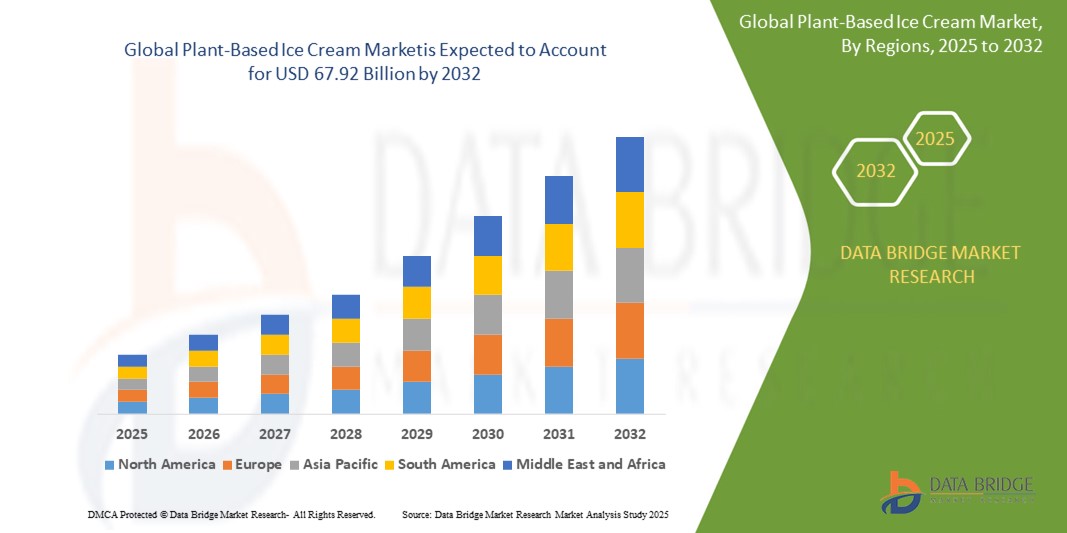
Plant-Based Ice Cream Market Size
- The global plant-based ice cream market was valued at USD 6.34 billion in 2024 and is expected to reach USD 67.92 billion by 2032
- During the forecast period of 2025 to 2032 the market is such as to grow at a CAGR of 34.50%, primarily driven by the increasing consumer demand for dairy-free and healthier dessert alternatives
- This growth is driven by factors such as the rising awareness of health benefits, growing preference for vegan and lactose-free diets, and the increasing availability of plant-based ice cream options in retail stores
Plant-Based Ice Cream Market Analysis
- In 2025, the plant-based ice cream market is experiencing notable growth as consumer preferences shift toward dairy-free and ethical dessert options
- Coconut milk-based ice creams are widely popular due to their rich texture and taste that closely resembles traditional dairy ice cream
- Fruit flavors such as strawberry, mango, and mixed berries are especially favored by consumers seeking refreshing and naturally sweet plant-based options
- Tubs are the most preferred packaging format for plant-based ice cream as they offer convenience and are well-suited for household use
- For instance, brands are launching creative flavors such as matcha and salted caramel to cater to adventurous consumers and broaden their appeal
- In conclusion, the plant-based ice cream market continues to grow as innovation and evolving consumer habits drive demand for healthier and more sustainable frozen treats
Report Scope and Plant-Based Ice Cream Market Segmentation
|
Attributes |
Plant-Based Ice Cream Key Market Insights |
|
Segments Covered |
|
|
Countries Covered |
North America
Europe
Asia-Pacific
Middle East and Africa
South America
|
|
Key Market Players |
|
|
Market Opportunities |
|
|
Value Added Data Infosets |
In addition to the insights on market scenarios such as market value, growth rate, segmentation, geographical coverage, and major players, the market reports curated by the Data Bridge Market Research also include in-depth expert analysis, pricing analysis, brand share analysis, consumer survey, demography analysis, supply chain analysis, value chain analysis, raw material/consumables overview, vendor selection criteria, PESTLE Analysis, Porter Analysis, and regulatory framework. |
Plant-Based Ice Cream Market Trends
“Evolving Preferences for Healthier Dessert Options”
- The plant-based ice cream market is experiencing significant growth as consumer demand for healthier, sustainable, and dairy-free dessert options increases
- Coconut milk-based ice creams are gaining popularity due to their rich texture and flavor, closely resembling traditional dairy ice cream
- Fruit-flavored plant-based ice creams, such as strawberry, mango, and mixed berries, are particularly favored by health-conscious consumers seeking refreshing and naturally sweet options
- Tubs remain the most preferred packaging format for plant-based ice cream, offering convenience and suitability for home consumption
- For instance, brands are introducing innovative flavors such as matcha and salted caramel to cater to adventurous consumers and expand their product offerings
- In conclusion, the plant-based ice cream market continues to evolve, driven by consumer preferences for indulgent yet healthier and more sustainable dessert options
Plant-Based Ice Cream Market Dynamics
Driver
“Rising Consumer Shift Toward Plant-Based Lifestyles”
- Consumers are shifting toward plant-based and dairy-free lifestyles due to increasing awareness of health benefits, environmental impact, and animal welfare concerns
- Plant-based ice creams made from coconut, almond, oat, and soy milk are preferred as they offer a similar texture and taste to traditional dairy options without cholesterol or lactose
- Many individuals with lactose intolerance or dairy allergies are opting for plant-based frozen desserts, contributing to rising demand in this category
- For instance, brands such as Oatly and So Delicious have expanded their ranges with innovative plant-based ice cream flavors made from oat milk and coconut milk respectively
- Social media influencers and food bloggers regularly share plant-based recipes and reviews, helping to normalize dairy-free choices and increase their popularity
- In conclusion, consumer interest in plant-based ice cream is growing rapidly and its availability in major retail stores has turned it into a mainstream frozen dessert choice
Opportunity
“Rising Innovation in Flavors and Ingredients”
- As consumer expectations rise, the plant-based ice cream market offers space for creative flavor innovations beyond traditional choices such as vanilla and chocolate
- Brands are experimenting with unique ingredients such as matcha, lavender, chai spice, and alcohol-infused options to appeal to adventurous and younger consumers
- Functional ingredients such as protein, probiotics, and adaptogens are being included to create ice cream that offers health benefits along with indulgence
- For instance, several new launches now feature oat or pea protein to enhance both nutrition and texture without compromising on flavor
- Products with clean labels and visible whole-food ingredients such as fruit pieces and nut swirls are increasingly gaining consumer interest
- In conclusion, innovation in flavor and formulation is helping brands expand their reach and connect with new consumer groups seeking better-for-you dessert options
Restraint/Challenge
“High Production Costs and Premium Pricing”
- The production of plant-based ice cream involves costly ingredients such as almond, cashew, and oat milk, which are more expensive than traditional dairy milk especially when sustainably sourced
- Replicating the creamy texture of dairy ice cream often requires natural stabilizers, emulsifiers, and advanced technology, increasing manufacturing complexity and cost
- The higher retail price makes these products less accessible to price-sensitive consumers, particularly in lower-income segments
- In many developing areas, limited infrastructure for plant-based processing adds to supply chain issues and restricts widespread availability
- For instance, smaller startups often face difficulty scaling production and competing with larger brands that can afford cost-cutting technologies and bulk sourcin
- In conclusion, high production and retail costs remain a major hurdle, making it essential for brands to innovate around affordability to reach a wider audience and sustain long-term growth
Plant-Based Ice Cream Market Scope
The market is segmented on the basis of product source, distribution channel, packaging, flavour, and form.
|
Segmentation |
Sub-Segmentation |
|
By Product Source |
|
|
By Distribution Channel |
|
|
By Packaging |
|
|
By Flavour |
|
|
By Form |
|
Plant-Based Ice Cream Market Regional Analysis
“North America is the Dominant Region in the Plant-Based Ice Cream Market”
- North America holds the largest share in the global plant-based ice cream market, driven by increasing consumer awareness and changing dietary preferences
- The U.S., in particular, exhibits a rising demand for vegan alternatives as more consumers adopt plant-based diets
- Flexitarianism, where individuals predominantly follow a plant-based diet with occasional animal products, is contributing to the growth of the market
- The region benefits from a high level of disposable income, enabling consumers to invest in premium plant-based ice cream options
- Retail giants and supermarkets in North America are expanding their plant-based product offerings, making these alternaftives more accessible to a broader audience
- In conclusion, a rising demand for vegan and dairy-free alternatives is being observed as more consumers adopt plant-based lifestyles
“Asia-Pacific is Projected to Register the Highest Growth Rate”
- The Asia-Pacific region is experiencing significant growth in the plant-based ice cream market due to increasing consumer awareness and demand for plant-based desserts
- Countries such as China and India are witnessing a shift in consumer preferences towards non-dairy-based ice cream products
- Rising health and fitness consciousness, along with innovative product launches, are contributing to the market's growth in this region
- Consumers are increasingly opting for coconut and almond-based ice creams, which are perceived as healthier and tastier alternatives to traditional dairy options
- The expansion of retail infrastructure and the availability of diverse plant-based ice cream options are further fueling the market's rapid growth in Asia-Pacific
- In conclusion, Asia-Pacific region is experiencing the fastest growth, driven by changing consumer preferences and increasing health awareness
Plant-Based Ice Cream Market Share
The market competitive landscape provides details by competitor. Details included are company overview, company financials, revenue generated, market potential, investment in research and development, new market initiatives, global presence, production sites and facilities, production capacities, company strengths and weaknesses, product launch, product width and breadth, application dominance. The above data points provided are only related to the companies' focus related to market.
The Major Market Leaders Operating in the Market Are:
- Chr. Hansen Holding A/S (Denmark)
- Yakult Honsha Co., Ltd (Japan)
- Nestlé (Switzerland)
- DuPont (US)
- MORINAGA & CO., LTD (Japan)
- BioGaia AB (Sweden)
- Protexin (UK)
- Daflorn Probiotics UK (UK)
- DANONE (France)
- Yakult U.S.A. Inc. (US)
- Deerland Enzymes, Inc. (US)
- UAS Laboratories (US)
- Goerlich Pharma GmbH (Germany)
- SANZYME BIOLOGICS PVT. LTD. (India)
- DSM (Netherlands)
- NutraScience Labs (US)
- Kerry Group plc (Ireland)
- Lallemand Inc. (Canada)
- Lonza (Switzerland)
- Winclove Probiotics (Netherlands)
- Probi (Sweden)
Latest Developments in Global Plant-Based Ice Cream Market
- In January 2025, Innova Market Insights reported a 6% increase in global ice cream and frozen yogurt product launches over the past year, driven by evolving consumer preferences. The report highlights that 36% of consumers prefer to limit unhealthy ingredients to make indulgent foods healthier. In response, product launches incorporating stevia, monk fruit extract, and preparations made with fruit pulp and juice concentrates have emerged, catering to this demand by offering products with reduced or no added sugar
- May 2024, Mintel's Global New Product Database (GNPD) reported that plant-based ice cream now comprises 7% of all global ice cream product launches, more than triple the previous share. Japan has emerged as a leader in ice cream innovation, accounting for 10% of global product launches and surpassing the United States in this regard. Japanese consumers' affinity for unique flavors and formats has propelled the country to the forefront of ice cream innovation, inspiring global trends
- In March 2024, Eclipse Foods introduced its plant-based ice cream bonbons in the United States. These non-dairy treats feature ultra-creamy ice cream encased in a velvety chocolate shell, available in flavors such as Chocolate Hazelnut Truffle, Peanut Butter Pretzel, and Coffee Almond Crunch. Developed by an award-winning chef, the bonbons aim to deliver a luxurious taste experience that mirrors traditional dairy-based desserts
- In February 2024, Magnum expanded its vegan offerings with the launch of the Chill Blueberry Cookie ice cream in the UK, Germany, Austria, and Switzerland. This new product features vanilla biscuit-flavored ice cream with cookie pieces and a blueberry sorbet core, all encased in vegan milk chocolate. Available as individual sticks or in packs of three, it is part of Magnum's "mood-inspired" range, which also includes the non-vegan Euphoria Pink Lemonade flavor
- In August 2021, Noto, a plant-based food brand, launched its range of vegan ice cream. The new offerings are designed to cater to consumers seeking healthier, dairy-free alternatives, using high-quality ingredients to deliver a rich, creamy texture. The ice cream comes in various unique flavors, aiming to appeal to both vegan and non-vegan customers looking for indulgent yet ethical dessert options

- Interactive Data Analysis Dashboard
- Company Analysis Dashboard for high growth potential opportunities
- Research Analyst Access for customization & queries
- Competitor Analysis with Interactive dashboard
- Latest News, Updates & Trend analysis
- Harness the Power of Benchmark Analysis for Comprehensive Competitor Tracking
Table of Content
1 INTRODUCTION
1.1 OBJECTIVES OF THE STUDY
1.2 MARKET DEFINITION
1.3 OVERVIEW OF GLOBAL PLANT-BASED ICE CREM MARKET
1.4 CURRENCY AND PRICING
1.5 LIMITATION
1.6 MARKETS COVERED
2 MARKET SEGMENTATION
2.1 KEY TAKEAWAYS
2.2 ARRIVING AT THE GLOBAL PLANT-BASED ICE CREM MARKET SIZE
2.2.1 VENDOR POSITIONING GRID
2.2.2 TECHNOLOGY LIFE LINE CURVE
2.2.3 MARKET GUIDE
2.2.4 COMPANY POSITIONING GRID
2.2.5 COMAPANY MARKET SHARE ANALYSIS
2.2.6 MULTIVARIATE MODELLING
2.2.7 DEMAND AND SUPPLY-SIDE VARIABLES
2.2.8 CONSUMPTION TREND OF END PRODUCTS
2.2.9 TOP TO BOTTOM ANALYSIS
2.2.10 STANDARDS OF MEASUREMENT
2.2.11 VENDOR SHARE ANALYSIS
2.2.12 DATA POINTS FROM KEY PRIMARY INTERVIEWS
2.2.13 DATA POINTS FROM KEY SECONDARY DATABASES
2.3 GLOBAL PLANT-BASED ICE CREM MARKET: RESEARCH SNAPSHOT
2.4 ASSUMPTIONS
3 MARKET OVERVIEW
3.1 DRIVERS
3.2 RESTRAINTS
3.3 OPPORTUNITIES
3.4 CHALLENGES
4 EXECUTIVE SUMMARY
5 PREMIUM INSIGHTS
5.1 SUPPLY CHAIN ANALYSIS
5.2 PRIVATE LABEL VS BRAND ANALYSIS
5.3 SHOPPING BEHAVIOUR AND DYNAMICS
5.3.1 RECOMMENDATION FROM FAMILY & FRIENDS
5.3.2 RESEARCH
5.3.3 IMPULSIVE
5.3.4 ADVERTISEMENT
5.4 PROMOTIONAL ACTIVITIES
5.5 NEW PRODUCT LAUNCH STRATEGY
5.5.1 NUMBER OF NEW PRODUCT LAUNCH
5.5.1.1. LINE EXTENSTION
5.5.1.2. NEW PACKAGING
5.5.1.3. RE-LAUNCHED
5.5.1.4. NEW FORMULATION
5.5.2 DIFFERNTIAL PRODUCT OFFERING
5.5.3 MEETING CONSUMER REQUIREMENT
5.5.4 PACKAGE DESIGNING
5.5.5 PRICING ANALYSIS
5.5.6 PRODUCT POSITIONING
5.6 FACTORS INFLUENCING PURCHASING DECISION OF CUSTOMERS
5.7 OVERVIEW ON YOGHURT BASED ICE CREAM
5.8 MARKETING STRATEGIES ADOPTED BY KEY MARKET PLAYERS
5.9 NEW PRODUCT LAUNCHES
6 IMPACT OF ECONOMIC SLOW DOWN ON MARKET
6.1 IMPACT ON PRICE
6.2 IMPACT ON SUPPLY CHAIN
6.3 IMPACT ON SHIPMENT
6.4 IMPACT ON COMPANY’S STRATEGIC DECISIONS
7 REGULATORY FRAMEWORK AND GUIDELINES
8 PRICING ANALYSIS
9 BRND OUTLOOK
9.1 COMPARATIVE BRAND ANALYSIS
9.2 PRODUCT VS BRAND OVERVIEW
10 GLOBAL PLANT-BASED ICE CREM MARKET, BY TYPE
10.1 OVERVIEW
10.2 IMPULSE ICE CREAM
10.3 RETAIL ARTISANAL ICE CREAM
10.4 TAKE HOME ICE CREAM
11 GLOBAL PLANT-BASED ICE CREM MARKET, BY SOURCES
11.1 OVERVIEW
11.2 SOY
11.3 ALMOND
11.4 OAT
11.5 CASHEW
11.6 RICE
11.7 HEMP
11.8 COCONUT
11.9 PEA
11.1 OTHERS
12 GLOBAL PLANT-BASED ICE CREM MARKET, BY FUNCTION CLAIMS
12.1 OVERVIEW
12.2 FORTIFIED
12.2.1 PROTEIN
12.2.2 VATAMIN
12.2.3 MINERALS
12.2.4 OTHERS
12.3 SUGAR FREE
12.4 LOW CALORIES
12.5 OTHERS
13 GLOBAL PORRIDGE MARKET, BY NATURE
13.1 OVERVIEW
13.2 ORGANIC
13.3 CONVENTIONAL
14 GLOBAL PORRIDGE MARKET, BY FLAVOURS
14.1 OVERVIEW
14.2 FRUIT
14.2.1 STRAWBERRIES
14.2.2 BLUEBERRIES
14.2.3 ORANGES
14.2.4 RASBERRY
14.2.5 BLACKBERRY
14.2.6 MANGO
14.2.7 BANANA
14.2.8 OTHERS
14.3 NUTS
14.3.1 ALMONDS
14.3.2 PEANUT
14.3.3 CASHEWNUTS
14.3.4 PISTACHIOS
14.3.5 RAISIN
14.3.6 MIXED
14.3.7 OTHERS
14.4 CHOCOLATES
14.5 VANILLA
14.6 COFFEE
14.7 ROSE
14.8 COCONUT
14.9 CARAMEL/ SEASALT CARAMEL
14.1 COOKIES AND CREAM
14.11 MINT
14.12 MIXED
14.13 OTHERS
15 GLOBAL PLANT-BASED ICE CREM MARKET, BY DISTRIBUTION CHANNEL
15.1 OVERVIEW
15.2 B2B
15.2.1 ONLINE
15.2.2 WHOLESALE TRADERS
15.2.3 OTHERS
15.3 B2C
15.3.1 ONLINE/E-COMMERCE
15.3.2 HYPERMARKETS/SUPERMARKETS
15.3.3 CONVEINIENCE STORES
15.3.4 GROCERY STORES
15.3.5 SPECIALTY STORES
15.3.6 VENDING MACHINES
15.3.7 OTHERS
16 GLOBAL PLANT-BASED ICE CREM MARKET, BY END USER
16.1 OVERVIEW
16.2 HOUSEHOLD
16.3 COMMERCIALS
16.3.1 FOOD SERVICE OUTLETS
16.3.2 HOTELS
16.3.3 RESTAURANTS & CAFES
16.3.4 INSTITUTIONAL FOOD SERVICES
16.3.5 CINEMA
16.3.6 AIRLINE & RAILWAY CATERING
16.3.7 SCHOOLS & OFFICE
16.3.8 HOSPITALS
17 GLOBAL PLANT-BASED ICE CREM MARKET, BY PACKAGING
17.1 OVERVIEW
17.2 CUP
17.3 STICK
17.4 CONE
17.5 BRICK
17.6 TUB
17.6.1 500 ML
17.6.2 250 ML
17.6.3 100 ML
17.6.4 OTHERS
17.7 OTHERS
18 GLOBAL PLANT-BASED ICE CREM MARKET, BY CATEGORY
18.1 OVERVIEW
18.2 INDIVIDUAL WRAP
18.3 FAMILY PACK
18.4 MULTIPACK
19 GLOBAL PLANT-BASED ICE CREM MARKET, BY INGREDIENTS
19.1 OVERVIEW
19.2 PLAIN
19.3 INCLUSION & TOPPINGS
19.3.1 SPRINKLES
19.3.2 CHOCOLATES
19.3.3 NUTS
19.3.4 CONFETTI
19.3.5 BAKED PIECES
19.3.6 PEARLS
19.3.7 DRAGEES
19.3.8 CARAMEL CRUNCHIES
19.3.9 OTHERS
20 GLOBAL PLANT-BASED ICE CREM MARKET, BY COUNTRY
GLOBAL PLANT-BASED ICE CREM MARKET, (ALL SEGMENTATION PROVIDED ABOVE IS REPRESENTED IN THIS CHAPTER BY COUNTRY)
20.1 NORTH AMERICA
20.1.1 U.S.
20.1.2 CANADA
20.1.3 MEXICO
20.2 EUROPE
20.2.1 GERMANY
20.2.2 U.K.
20.2.3 ITALY
20.2.4 FRANCE
20.2.5 SPAIN
20.2.6 SWITZERLAND
20.2.7 NETHERLANDS
20.2.8 BELGIUM
20.2.9 RUSSIA
20.2.10 DENMARK
20.2.11 SWEDEN
20.2.12 POLAND
20.2.13 TURKEY
20.2.14 REST OF EUROPE
20.3 ASIA-PACIFIC
20.3.1 JAPAN
20.3.2 CHINA
20.3.3 SOUTH KOREA
20.3.4 INDIA
20.3.5 AUSTRALIA
20.3.6 SINGAPORE
20.3.7 THAILAND
20.3.8 INDONESIA
20.3.9 MALAYSIA
20.3.10 PHILIPPINES
20.3.11 NEW ZEALAND
20.3.12 VIETNAM
20.3.13 REST OF ASIA-PACIFIC
20.4 SOUTH AMERICA
20.4.1 BRAZIL
20.4.2 ARGENTINA
20.4.3 REST OF SOUTH AMERICA
20.5 MIDDLE EAST AND AFRICA
20.5.1 SOUTH AFRICA
20.5.2 EGYPT
20.5.3 UAE
20.5.4 SAUDI ARABIA
20.5.5 ISRAEL
20.5.6 OMAN
20.5.7 QATAR
20.5.8 KUWAIT
20.5.9 REST OF MIDDLE EAST AND AFRICA
21 GLOBAL PLANT-BASED ICE CREM MARKET, COMPANY LANDSCAPE
21.1 COMPANY SHARE ANALYSIS: GLOBAL
21.2 COMPANY SHARE ANALYSIS: NORTH AMERICA
21.3 COMPANY SHARE ANALYSIS: EUROPE
21.4 COMPANY SHARE ANALYSIS: ASIA-PACIFIC
21.5 COMPANY SHARE ANALYSIS: MIDDLE EAST AND AFRICA
21.6 MERGERS & ACQUISITIONS
21.7 NEW PRODUCT DEVELOPMENT & APPROVALS
21.8 EXPANSIONS & PARTNERSHIP
21.9 REGULATORY CHANGES
22 GLOBAL PLANT-BASED ICE CREM MARKET, SWOT & DBMR ANALYSIS
23 GLOBAL PLANT-BASED ICE CREM MARKET, COMPANY PROFILE
23.1 DANONE
23.1.1 COMPANY OVERVIEW
23.1.2 REVENUE ANALYSIS
23.1.3 GEOGRAPHIC PRESENCE
23.1.4 PRODUCT PORTFOLIO
23.1.5 RECENT DEVELOPMENTS
23.2 UNILEVER
23.2.1 COMPANY OVERVIEW
23.2.2 REVENUE ANALYSIS
23.2.3 GEOGRAPHIC PRESENCE
23.2.4 PRODUCT PORTFOLIO
23.2.5 RECENT DEVELOPMENTS
23.3 OATLY AB
23.3.1 COMPANY OVERVIEW
23.3.2 REVENUE ANALYSIS
23.3.3 PRODUCT PORTFOLIO
23.3.4 GEOGRAPHIC PRESENCE
23.3.5 RECENT DEVELOPMENTS
23.4 ALPRO
23.4.1 COMPANY OVERVIEW
23.4.2 REVENUE ANALYSIS
23.4.3 PRODUCT PORTFOLIO
23.4.4 GEOGRAPHIC PRESENCE
23.4.5 RECENT DEVELOPMENTS
23.5 LA IBENSE
23.5.1 COMPANY OVERVIEW
23.5.2 REVENUE ANALYSIS
23.5.3 PRODUCT PORTFOLIO
23.5.4 GEOGRAPHIC PRESENCE
23.5.5 RECENT DEVELOPMENTS
23.6 DREAM POPS
23.6.1 COMPANY OVERVIEW
23.6.2 REVENUE ANALYSIS
23.6.3 PRODUCT PORTFOLIO
23.6.4 GEOGRAPHIC PRESENCE
23.6.5 RECENT DEVELOPMENTS
23.7 ARCTIC ZERO, INC
23.7.1 COMPANY OVERVIEW
23.7.2 REVENUE ANALYSIS
23.7.3 PRODUCT PORTFOLIO
23.7.4 GEOGRAPHIC PRESENCE
23.7.5 RECENT DEVELOPMENTS
23.8 BEN & JERRY’S HOMEMADE INC
23.8.1 COMPANY OVERVIEW
23.8.2 REVENUE ANALYSIS
23.8.3 PRODUCT PORTFOLIO
23.8.4 GEOGRAPHIC PRESENCE
23.8.5 RECENT DEVELOPMENTS
23.9 BLISS UNLIMITED LLC
23.9.1 COMPANY OVERVIEW
23.9.2 REVENUE ANALYSIS
23.9.3 GEOGRAPHIC PRESENCE
23.9.4 PRODUCT PORTFOLIO
23.9.5 RECENT DEVELOPMENTS
23.1 KLEIN'S REAL KOSHER
23.10.1 COMPANY OVERVIEW
23.10.2 REVENUE ANALYSIS
23.10.3 PRODUCT PORTFOLIO
23.10.4 GEOGRAPHIC PRESENCE
23.10.5 RECENT DEVELOPMENTS
23.11 LUV ICE CREAM LLC
23.11.1 COMPANY OVERVIEW
23.11.2 REVENUE ANALYSIS
23.11.3 PRODUCT PORTFOLIO
23.11.4 GEOGRAPHIC PRESENCE
23.11.5 RECENT DEVELOPMENTS
23.12 BOOJABOOJA
23.12.1 COMPANY OVERVIEW
23.12.2 REVENUE ANALYSIS
23.12.3 PRODUCT PORTFOLIO
23.12.4 GEOGRAPHIC PRESENCE
23.12.5 RECENT DEVELOPMENTS
23.13 TOFUTTI BRANDS INC
23.13.1 COMPANY OVERVIEW
23.13.2 REVENUE ANALYSIS
23.13.3 PRODUCT PORTFOLIO
23.13.4 GEOGRAPHIC PRESENCE
23.13.5 RECENT DEVELOPMENT
23.14 NESTLE SA
23.14.1 COMPANY OVERVIEW
23.14.2 REVENUE ANALYSIS
23.14.3 PRODUCT PORTFOLIO
23.14.4 GEOGRAPHIC PRESENCE
23.14.5 RECENT DEVELOPMENTS
23.15 NADAMOO!
23.15.1 COMPANY OVERVIEW
23.15.2 REVENUE ANALYSIS
23.15.3 PRODUCT PORTFOLIO
23.15.4 GEOGRAPHIC PRESENCE
23.15.5 RECENT DEVELOPMENTS
23.16 WONDERLAB’S DOOZY POTS
23.16.1 COMPANY OVERVIEW
23.16.2 REVENUE ANALYSIS
23.16.3 PRODUCT PORTFOLIO
23.16.4 GEOGRAPHIC PRESENCE
23.16.5 RECENT DEVELOPMENTS
23.17 O’MY! DAIRY FREE GELATO
23.17.1 COMPANY OVERVIEW
23.17.2 REVENUE ANALYSIS
23.17.3 PRODUCT PORTFOLIO
23.17.4 GEOGRAPHIC PRESENCE
23.17.5 RECENT DEVELOPMENTS
23.18 ALDEN’S ORGANIC
23.18.1 COMPANY OVERVIEW
23.18.2 REVENUE ANALYSIS
23.18.3 PRODUCT PORTFOLIO
23.18.4 GEOGRAPHIC PRESENCE
23.18.5 RECENT DEVELOPMENTS
23.19 MCCONNELL’S FINE ICE CREAMS
23.19.1 COMPANY OVERVIEW
23.19.2 REVENUE ANALYSIS
23.19.3 PRODUCT PORTFOLIO
23.19.4 GEOGRAPHIC PRESENCE
23.19.5 RECENT DEVELOPMENTS
Note: THE COMPANIES PROFILED IS NOT EXHAUSTIVE LIST AND IS AS PER OUR PREVIOUS CLIENT REQUIREMENT. WE PROFILE MORE THAN 100 COMPANIES IN OUR STUDY AND HENCE THE LIST OF COMPANIES CAN BE MODIFIED OR REPLACED ON REQUEST
24 RELATED REPORTS
25 QUESTIONNAIRE
26 ABOUT DATA BRIDGE MARKET RESEARCH

Global Plant Based Ice Cream Market, Supply Chain Analysis and Ecosystem Framework
To support market growth and help clients navigate the impact of geopolitical shifts, DBMR has integrated in-depth supply chain analysis into its Global Plant Based Ice Cream Market research reports. This addition empowers clients to respond effectively to global changes affecting their industries. The supply chain analysis section includes detailed insights such as Global Plant Based Ice Cream Market consumption and production by country, price trend analysis, the impact of tariffs and geopolitical developments, and import and export trends by country and HSN code. It also highlights major suppliers with data on production capacity and company profiles, as well as key importers and exporters. In addition to research, DBMR offers specialized supply chain consulting services backed by over a decade of experience, providing solutions like supplier discovery, supplier risk assessment, price trend analysis, impact evaluation of inflation and trade route changes, and comprehensive market trend analysis.
Data collection and base year analysis are done using data collection modules with large sample sizes. The stage includes obtaining market information or related data through various sources and strategies. It includes examining and planning all the data acquired from the past in advance. It likewise envelops the examination of information inconsistencies seen across different information sources. The market data is analysed and estimated using market statistical and coherent models. Also, market share analysis and key trend analysis are the major success factors in the market report. To know more, please request an analyst call or drop down your inquiry.
The key research methodology used by DBMR research team is data triangulation which involves data mining, analysis of the impact of data variables on the market and primary (industry expert) validation. Data models include Vendor Positioning Grid, Market Time Line Analysis, Market Overview and Guide, Company Positioning Grid, Patent Analysis, Pricing Analysis, Company Market Share Analysis, Standards of Measurement, Global versus Regional and Vendor Share Analysis. To know more about the research methodology, drop in an inquiry to speak to our industry experts.
Data Bridge Market Research is a leader in advanced formative research. We take pride in servicing our existing and new customers with data and analysis that match and suits their goal. The report can be customized to include price trend analysis of target brands understanding the market for additional countries (ask for the list of countries), clinical trial results data, literature review, refurbished market and product base analysis. Market analysis of target competitors can be analyzed from technology-based analysis to market portfolio strategies. We can add as many competitors that you require data about in the format and data style you are looking for. Our team of analysts can also provide you data in crude raw excel files pivot tables (Fact book) or can assist you in creating presentations from the data sets available in the report.













