


What is the Premium Personal Care FMCG Market Size and Overview?
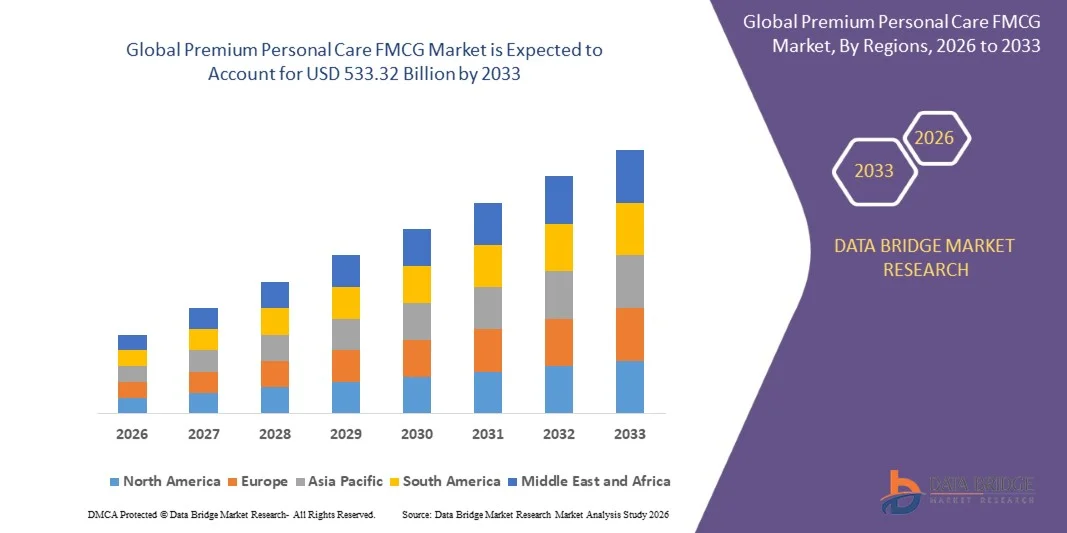
As per Data Bridge Market Research analysis the Premium Personal Care FMCG Market was valued at USD 265.7 Billion in 2025 and is projected to reach USD 533.32 Billion by 2033, growing at a CAGR of 9.1% from 2026 to 2033. The market is experiencing consistent growth driven by rising consumer spending on premium beauty and personal care products, increasing awareness regarding skincare and personal grooming, and growing demand for high-quality formulations with advanced ingredients. Expanding product innovation across skincare, haircare, fragrances, and cosmetics, coupled with the increasing influence of digital marketing and beauty influencers, is further supporting market expansion across developed and emerging economies.
The growing consumer preference for premium, personalized, and wellness-focused personal care products, combined with increasing demand for clean-label, organic, and sustainable formulations, is encouraging manufacturers to expand their premium product portfolios. Premium personal care brands are increasingly investing in advanced research, ingredient innovation, and omnichannel retail strategies to strengthen consumer engagement and brand loyalty. The rapid growth of e-commerce platforms and direct-to-consumer distribution models is further enhancing product accessibility, helping companies expand their customer base and accelerate market growth.
Market Size & Forecast
- Global Market Value (2025): USD 265.7 Billion
- Expected Market Value (2033): USD 533.32 Billion
- Forecast CAGR (2026–2033): 9.1%
- Leading Region in 2025: Asia-Pacific
- Fastest Growing Region: North America
Key Market Trends & Insights
- Asia-Pacific dominated the Premium Personal Care FMCG Market with the largest revenue share of 40.2% in 2025, supported by a large consumer base, rising disposable incomes, and increasing demand for premium beauty and personal care products
- The conventional segment led the market with a 62.4% share in 2025, driven by its extensive product availability, established consumer trust, and strong distribution networks
- North America is expected to be the fastest-growing region at a CAGR of 5.98% from 2026 to 2033, fueled by rising consumer spending on premium beauty products, increasing demand for personalized skincare, and growing preference for luxury wellness solutions
- Organic is the fastest-growing ingredient type, projected to register a CAGR of 10.6% from 2026 to 2033, supported by rising consumer awareness regarding clean-label beauty products and sustainable consumption
- The Skin Care segment dominated the product category with a 38.7% revenue share in 2025, led by increasing consumer focus on anti-aging, hydration, skin protection, and premium wellness routines
- Women accounted for 58.9% of the market in 2025, preferred by high spending on premium skincare, cosmetics, fragrances, and haircare products
- The perfume/fragrances segment is the fastest-growing product category, with a CAGR of 9.8% from 2026 to 2033, driven by increasing consumer preference for luxury self-care products and premium lifestyle experiences
Report Scope and Premium Personal Care FMCG Market Segmentation
|
Attributes |
Premium Personal Care FMCG Key Market Insights |
|
Segments Covered |
|
|
Countries Covered |
North America
Europe
Asia-Pacific
Middle East and Africa
South America
|
|
Key Market Players |
|
|
Market Opportunities |
|
|
Value Added Data Infosets |
In addition to the insights on market scenarios such as market value, growth rate, segmentation, geographical coverage, and major players, the market reports curated by the Data Bridge Market Research also include in-depth expert analysis, pricing analysis, brand share analysis, consumer survey, demography analysis, supply chain analysis, value chain analysis, raw material/consumables overview, vendor selection criteria, PESTLE Analysis, Porter Analysis, and regulatory framework. |
What is the Key Trend in the Premium Personal Care FMCG Market?
Trend: Rising Demand for Clean-Label and Sustainable Premium Personal Care Products
Consumers are increasingly preferring premium personal care products formulated with natural, organic, vegan, and sustainably sourced ingredients due to growing awareness regarding ingredient transparency, environmental impact, and product safety. Beauty brands are responding by expanding clean-label portfolios, adopting eco-friendly packaging solutions, and reducing the use of synthetic chemicals in premium formulations. Sustainability certifications and responsible sourcing practices are becoming important purchasing factors, particularly among younger consumers.
Companies such as L’Oréal Groupe have strengthened their sustainability commitments through programs focused on eco-designed packaging and renewable ingredients, while Unilever PLC continues to expand its portfolio of sustainable beauty and personal care products, supporting the growing shift toward environmentally responsible premium personal care consumption.
Premium Personal Care FMCG Market Dynamics
Key Market Driver: Increasing Consumer Spending on Premium Beauty and Personal Grooming Products
Rising disposable incomes, growing beauty consciousness, and increasing focus on self-care are significantly driving demand for premium personal care products worldwide. Consumers are increasingly willing to spend on high-performance skincare, premium haircare, luxury fragrances, and advanced cosmetic products that offer enhanced efficacy and personalized benefits. The premiumization trend is particularly strong among millennials and Gen Z consumers, who actively seek innovative and science-backed beauty solutions.
Major companies such as The Estée Lauder Companies and Shiseido Co., Ltd. continue to invest heavily in premium skincare innovation and digital consumer engagement strategies, reflecting the growing global demand for high-value beauty and personal care products.
Key Restraint/Challenge: Intense Competition from Emerging Direct-to-Consumer and Niche Beauty Brands
A major challenge in the Premium Personal Care FMCG market is the increasing competition from digitally native direct-to-consumer brands and specialized niche beauty companies. These emerging players often leverage social media marketing, influencer partnerships, and personalized product offerings to rapidly gain consumer attention and market share. Established premium brands face growing pressure to maintain customer loyalty while continuously investing in product innovation, branding, and digital transformation initiatives.
The acquisition of premium skincare brand Minimalist by Hindustan Unilever Limited in 2025 highlights how large FMCG companies are actively responding to the growing influence of emerging premium beauty brands and evolving consumer preferences within the personal care sector.
Key Market Opportunity: Growing Demand for Premium Men's Grooming Products
The increasing adoption of skincare, haircare, beard care, and fragrance products among male consumers is creating significant growth opportunities for the Premium Personal Care FMCG market. Changing lifestyle trends, growing awareness regarding personal grooming, and rising acceptance of specialized men's beauty products are expanding the addressable consumer base for premium brands. Companies are introducing targeted product lines designed specifically for male skincare concerns, grooming routines, and wellness needs.
Brands such as L’Oréal Groupe, Beiersdorf AG, and Procter & Gamble Co. continue to expand their men's grooming portfolios through premium skincare, shaving, and personal care offerings, supporting long-term growth opportunities across developed and emerging markets.
Premium Personal Care FMCG Market Scope
The premium personal care FMCG market is segmented on the basis of product, ingredient type, end use, and distribution channel.
- By Product
On the basis of product, the Premium Personal Care FMCG Market is segmented into Skin Care, Hair Care, Color Cosmetics, Shower and Bath, and Perfume/Fragrances. The Skin Care segment dominated the market with the largest share of 38.7% in 2025, driven by increasing consumer focus on anti-aging, hydration, skin protection, and premium wellness routines. Rising demand for scientifically formulated products containing active ingredients and natural extracts has strengthened segment growth. Premium skincare brands continue to introduce personalized and dermatologist-backed solutions to meet evolving consumer preferences. Growing awareness regarding skin health and beauty enhancement across all age groups further supports market leadership. Continuous product innovation and premium product positioning reinforce the segment’s dominance.
The Perfume/Fragrances segment is projected to register the fastest growth at a CAGR of 9.8% from 2026 to 2033, driven by increasing consumer preference for luxury self-care products and premium lifestyle experiences. Rising disposable incomes and growing demand for niche and personalized fragrances are accelerating market expansion. The popularity of long-lasting scents and exclusive fragrance collections is encouraging premium product adoption. Expanding influence of celebrity endorsements and social media marketing is creating strong consumer engagement. Increasing penetration of premium fragrances in emerging economies is further supporting rapid segment growth.
- By Ingredient Type
On the basis of ingredient type, the Premium Personal Care FMCG Market is segmented into Organic and Conventional. The Conventional segment dominated the market with a share of 62.4% in 2025, supported by its extensive product availability, established consumer trust, and strong distribution networks. Conventional formulations offer a broad range of specialized solutions for skincare, haircare, and cosmetic applications. Major manufacturers continue investing in advanced formulations that enhance product effectiveness and shelf life. Strong brand recognition and competitive pricing across premium categories contribute significantly to segment leadership. Continuous innovation in active ingredients further strengthens market dominance.
The Organic segment is projected to register the fastest growth at a CAGR of 10.6% from 2026 to 2033, driven by rising consumer awareness regarding clean-label beauty products and sustainable consumption. Growing concerns about synthetic chemicals and artificial additives are increasing demand for plant-based and naturally sourced formulations. Premium beauty brands are expanding organic product portfolios to meet evolving consumer expectations. Advancements in organic ingredient sourcing and certification standards are enhancing product credibility. Increasing preference for environmentally responsible personal care products is accelerating segment expansion globally.
- By End Use
On the basis of end use, the Premium Personal Care FMCG Market is segmented into Men, Women, and Unisex. The Women segment dominated the market with the largest share of 58.9% in 2025, driven by high spending on premium skincare, cosmetics, fragrances, and haircare products. Women represent the largest consumer base for beauty and personal care products due to strong emphasis on appearance, wellness, and self-care routines. Premium brands consistently launch innovative products targeting diverse beauty concerns and preferences. Growing adoption of personalized beauty solutions and luxury cosmetic products further supports segment growth. Strong brand loyalty and frequent product usage reinforce market leadership.
The Men segment is projected to register the fastest growth at a CAGR of 10.2% from 2026 to 2033, driven by increasing awareness of grooming, skincare, and personal wellness among male consumers. Rising acceptance of premium grooming products and expanding product availability are contributing to market growth. Brands are introducing specialized skincare, beard care, and fragrance products tailored to male preferences. Growing influence of social media and changing lifestyle trends are encouraging premium product adoption. Increasing disposable income among younger consumers is further accelerating segment expansion.
- By Distribution Channel
On the basis of distribution channel, the Premium Personal Care FMCG Market is segmented into Supermarkets & Hypermarkets, Specialty Beauty Stores, Pharmacies and Drugstores, Online/E-commerce, and Others. The Specialty Beauty Stores segment dominated the market with a share of 34.8% in 2025, supported by their ability to provide premium brand portfolios, personalized consultations, and exclusive product offerings. Consumers prefer specialty stores for product testing, expert guidance, and access to newly launched premium collections. Strong partnerships between luxury beauty brands and specialized retailers enhance product visibility. Premium shopping experiences and dedicated beauty advisors contribute significantly to consumer engagement. These advantages continue to strengthen segment dominance across major markets.
The Online/E-commerce segment is projected to register the fastest growth at a CAGR of 12.4% from 2026 to 2033, driven by increasing digital adoption and changing consumer purchasing behavior. E-commerce platforms provide convenient access to a wide range of premium personal care products along with personalized recommendations and promotional offers. Growing smartphone penetration and secure digital payment systems are supporting online sales growth. Beauty brands are investing heavily in direct-to-consumer channels and digital marketing strategies to expand reach. Rising preference for convenient shopping experiences and subscription-based beauty services is accelerating segment expansion.
Premium Personal Care FMCG Market Regional Analysis
Asia-Pacific dominated the premium personal care FMCG market and accounted for the largest revenue share of 40.2% in 2025, supported by a large consumer base, rising disposable incomes, and increasing demand for premium beauty and personal care products. The region benefits from rapid urbanization, growing beauty consciousness, and strong expansion of international and domestic premium brands. Increasing adoption of skincare, haircare, fragrances, and cosmetic products among younger consumers is accelerating market growth. Expanding e-commerce penetration and continuous product innovation are further strengthening regional market development.
China Premium Personal Care FMCG Market Insight
China held the largest share in the Asia-Pacific Premium Personal Care FMCG market in 2025, supported by its large middle-class population, strong consumer spending on beauty products, and well-developed retail infrastructure. The country has become a major market for premium skincare, cosmetics, and luxury fragrance brands due to increasing focus on personal grooming and wellness. Strong digital commerce ecosystems enable brands to reach consumers efficiently across urban and emerging cities. In addition, growing demand for personalized and premium beauty solutions is reinforcing China's leadership in the regional market.
India Premium Personal Care FMCG Market Insight
India is witnessing the fastest growth in the Asia-Pacific region, driven by rising disposable incomes, increasing awareness of personal grooming, and growing demand for premium beauty products. Expanding urban populations and changing lifestyle preferences are encouraging consumers to shift toward high-quality skincare, haircare, and fragrance products. Growing influence of social media and beauty influencers is significantly supporting premium product adoption. In addition, rapid expansion of e-commerce platforms and premium retail channels is accelerating long-term market growth.
Europe Premium Personal Care FMCG Market Insight
The Europe Premium Personal Care FMCG market is expanding steadily, supported by strong demand for luxury beauty products, organic formulations, and premium skincare solutions. Consumers across the region increasingly prefer high-performance products with natural ingredients and sustainable packaging. Strong presence of established beauty brands and advanced product innovation capabilities are contributing to market expansion. In addition, rising demand for anti-aging products and premium fragrances is supporting regional market development.
Germany Premium Personal Care FMCG Market Insight
Germany accounted for the largest share in the Europe Premium Personal Care FMCG market in 2025, driven by strong consumer spending on premium skincare, haircare, and wellness products. The country benefits from a well-established beauty and cosmetics industry supported by advanced product development and manufacturing capabilities. Growing preference for clean-label and dermatologically tested products is further strengthening market demand. In addition, strong retail distribution networks and increasing adoption of sustainable beauty products are reinforcing Germany’s leading market position.
U.K. Premium Personal Care FMCG Market Insight
The U.K. market is supported by increasing consumer demand for luxury beauty products, premium fragrances, and personalized skincare solutions. Growing awareness regarding skincare routines and self-care practices is driving adoption of premium personal care products across various age groups. The country is also witnessing rising demand for vegan, cruelty-free, and environmentally sustainable beauty products. In addition, expansion of online beauty retail platforms and direct-to-consumer brand strategies is further supporting market growth.
North America Premium Personal Care FMCG Market Insight
North America is projected to grow at the fastest CAGR of 5.98% from 2026 to 2033, driven by rising consumer spending on premium beauty products, increasing demand for personalized skincare, and growing preference for luxury wellness solutions. Strong adoption of advanced cosmetic formulations and high-performance personal care products is significantly supporting regional market expansion. Increasing popularity of clean beauty, organic ingredients, and sustainable packaging is further accelerating market growth. In addition, continuous innovation by leading beauty brands and expanding digital retail channels are boosting demand across the region.
U.S. Premium Personal Care FMCG Market Insight
The U.S. accounted for the largest share in the North America Premium Personal Care FMCG market in 2025, supported by strong demand for premium skincare, cosmetics, fragrances, and haircare products. The country benefits from high consumer purchasing power and widespread adoption of innovative beauty and wellness products. Growing interest in anti-aging solutions, personalized beauty products, and clean-label formulations is further strengthening market growth. In addition, increasing availability of premium brands through specialty stores and e-commerce platforms is reinforcing the U.S. leadership position in the regional market.
Which are the Top Companies in Premium Personal Care FMCG Market?
The premium personal care FMCG industry is primarily led by well-established companies, including:
- L’Oréal Groupe (France)
- Procter & Gamble Co. (U.S.)
- Shiseido Co., Ltd. (Japan)
- CHANEL (France)
- Unilever PLC (U.K.)
- The Estée Lauder Companies (U.S.)
- Amorepacific Corporation (South Korea)
- DIOR (France)
- Beiersdorf AG (Germany)
- Coty Inc. (U.S.)
- Puig S.L. (Spain)
- Kao Corporation (Japan)
- Natura & Co (Brazil)
- YSL Beauty (France)
- Oriflame Holding AG (Switzerland)
- LVMH (France)
- Elizabeth Arden (U.S.)
Latest Developments in Premium Personal Care FMCG Market
- In June 2026, L’Oréal announced the acquisition of a majority stake in Innovist, an India-based beauty and personal care company known for brands such as Bare Anatomy and Chemist at Play, to expand its footprint in high-growth beauty markets. The acquisition is expected to strengthen L’Oréal’s position in the premium haircare and skincare segments while enhancing its access to digitally driven consumers. The development highlights the increasing strategic focus of global beauty companies on emerging markets and digital-first premium brands. It is expected to support market expansion by increasing product innovation, distribution capabilities, and premium beauty penetration across Asia-Pacific
- In June 2025, L’Oréal Groupe announced the acquisition of a majority stake in British premium skincare brand Medik8 to strengthen its presence in the fast-growing premium skincare and dermocosmetics segment. The acquisition is expected to enhance L’Oréal’s premium skincare portfolio through Medik8’s science-backed and ingredient-focused product range. The move supports the growing consumer demand for clinically proven skincare solutions and expands the company’s reach across premium retail and e-commerce channels in Europe and North America. The development is expected to intensify innovation and competition within the Premium Personal Care FMCG Market
- In January 2025, Hindustan Unilever Limited (HUL) announced the acquisition of a majority stake in premium skincare brand Minimalist to strengthen its premium beauty and wellness portfolio in India. The acquisition is expected to expand HUL’s presence in the rapidly growing premium skincare category by leveraging Minimalist’s strong consumer base and direct-to-consumer business model. The move reflects increasing investments by major FMCG companies in science-based beauty products and supports the premiumization trend within the personal care industry. It is also expected to accelerate innovation and premium product adoption among younger consumers
- In June 2024, The Estée Lauder Companies announced the acquisition of DECIEM Beauty Group Inc., a Canada-based beauty company, to strengthen its premium skincare portfolio. The acquisition is expected to enhance the company’s presence in the fast-growing science-backed skincare segment through DECIEM’s flagship brand, The Ordinary. The move supports increasing consumer demand for ingredient-focused and clinically inspired beauty products across major markets such as Canada, the U.S., Germany, the U.K., and France. It is also expected to contribute to broader premium skincare market expansion through greater product accessibility and innovation
- In February 2024, L’Oréal Groupe and Prada announced a worldwide exclusive licensing agreement to create, develop, and distribute premium beauty products for Prada’s subsidiary brand Miu Miu. The collaboration is expected to strengthen both companies’ positions within the luxury beauty and fragrance categories. The planned launch of premium fragrance products supports growing consumer demand for high-end and designer beauty offerings. The partnership is anticipated to enhance brand diversification and stimulate growth within the Premium Personal Care FMCG Market through new product introductions and expanded consumer reach

- Interactive Data Analysis Dashboard
- Company Analysis Dashboard for high growth potential opportunities
- Research Analyst Access for customization & queries
- Competitor Analysis with Interactive dashboard
- Latest News, Updates & Trend analysis
- Harness the Power of Benchmark Analysis for Comprehensive Competitor Tracking
Data collection and base year analysis are done using data collection modules with large sample sizes. The stage includes obtaining market information or related data through various sources and strategies. It includes examining and planning all the data acquired from the past in advance. It likewise envelops the examination of information inconsistencies seen across different information sources. The market data is analysed and estimated using market statistical and coherent models. Also, market share analysis and key trend analysis are the major success factors in the market report. To know more, please request an analyst call or drop down your inquiry.
The key research methodology used by DBMR research team is data triangulation which involves data mining, analysis of the impact of data variables on the market and primary (industry expert) validation. Data models include Vendor Positioning Grid, Market Time Line Analysis, Market Overview and Guide, Company Positioning Grid, Patent Analysis, Pricing Analysis, Company Market Share Analysis, Standards of Measurement, Global versus Regional and Vendor Share Analysis. To know more about the research methodology, drop in an inquiry to speak to our industry experts.
Data Bridge Market Research is a leader in advanced formative research. We take pride in servicing our existing and new customers with data and analysis that match and suits their goal. The report can be customized to include price trend analysis of target brands understanding the market for additional countries (ask for the list of countries), clinical trial results data, literature review, refurbished market and product base analysis. Market analysis of target competitors can be analyzed from technology-based analysis to market portfolio strategies. We can add as many competitors that you require data about in the format and data style you are looking for. Our team of analysts can also provide you data in crude raw excel files pivot tables (Fact book) or can assist you in creating presentations from the data sets available in the report.













