


Probiotics in Animal Feed Market Size
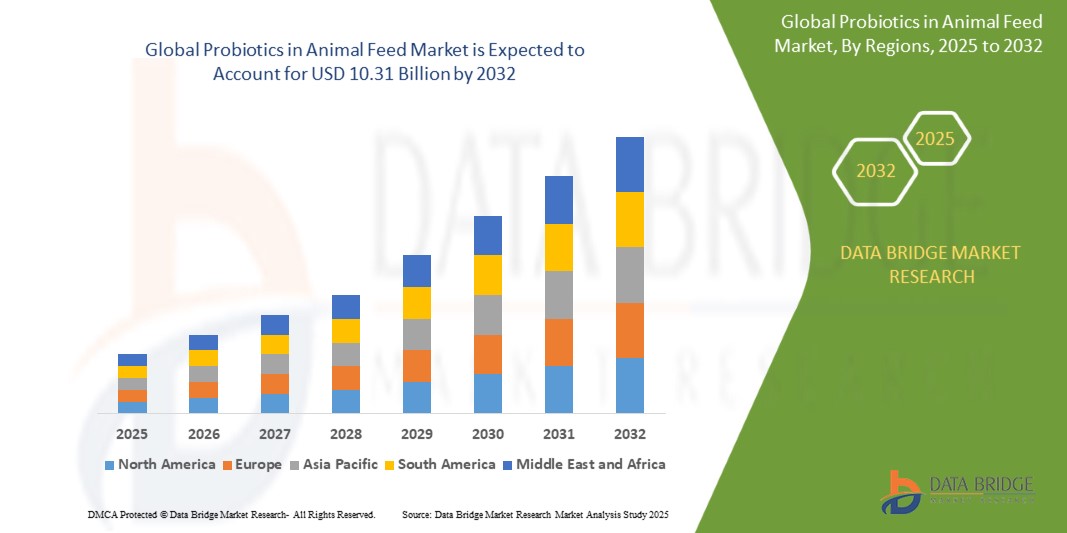
- The global probiotics in animal feed market was valued at USD 5.59 billion in 2024 and is expected to reach USD 10.31 billion by 2032
- During the forecast period of 2025 to 2032 the market is likely to grow at a CAGR of 7.95% primarily driven by the increasing demand for high-quality animal nutrition and sustainable farming practices
- This growth is driven by factors such as the rising awareness about the benefits of probiotics in enhancing livestock health and productivity
Probiotics in Animal Feed Market Analysis
- Probiotics in animal feed are live microorganisms, typically bacteria or yeast, added to livestock feed to promote gut health, improve digestion, enhance immune function, and support overall animal health and productivity
- The probiotics in animal feed market is growing due to the increasing demand for natural additives that enhance animal health and productivity, with probiotics helping improve digestive health and nutrient absorption in livestock
- For instance, the use of probiotics in poultry feed to reduce gut inflammation and improve overall health
- Probiotics are gaining popularity as natural alternatives to antibiotics, as they promote a healthy gut microbiota, which is essential for animal growth and performance, reducing reliance on chemical treatments
- For instance, probiotics have been used in dairy cattle to improve milk production and reduce infections
- Farmers and feed manufacturers are increasingly adopting probiotics to improve feed efficiency, leading to healthier animals and better productivity
- For instance, in the aquaculture industry, probiotics help reduce disease outbreaks and improve fish growth
- Consumer awareness regarding animal welfare and food quality is pushing the market, as more consumers demand ethically sourced animal products, prompting farmers to use healthier, natural feed ingredients
- For instance, probiotics are widely used in organic farming to maintain sustainable animal husbandry practices
- Probiotics are being incorporated into various animal feeds, including for poultry, cattle, and aquaculture, with companies such as Chr. Hansen and DuPont providing advanced probiotic solutions to meet the growing demand in the animal feed industry
Report Scope and Probiotics in Animal Feed Market Segmentation
|
Attributes |
Probiotics in Animal Feed Key Market Insights |
|
Segments Covered |
|
|
Countries Covered |
North America
Europe
Asia-Pacific
Middle East and Africa
South America
|
|
Key Market Players |
|
|
Market Opportunities |
|
|
Value Added Data Infosets |
In addition to the insights on market scenarios such as market value, growth rate, segmentation, geographical coverage, and major players, the market reports curated by the Data Bridge Market Research also include in-depth expert analysis, pricing analysis, brand share analysis, consumer survey, demography analysis, supply chain analysis, value chain analysis, raw material/consumables overview, vendor selection criteria, PESTLE Analysis, Porter Analysis, and regulatory framework. |
Probiotics in Animal Feed Market Trends
“Increasing Adoption of Probiotics Across Various Animal Types”
- The adoption of probiotics in poultry feed is increasing to improve gut health and reduce digestive issues, leading to better growth rates and egg production
- For instance, probiotics are used in broiler chickens to enhance feed efficiency and immune response, with companies such as Kemin Industries offering probiotic solutions to boost poultry health
- In cattle farming, probiotics are being used to improve milk production and reduce digestive diseases
- For instance, probiotics in dairy cows help to enhance digestion, increase milk yield, and reduce the risk of infections such as mastitis, as seen with products such as Lactobacillus in dairy herds to improve milk quality and animal health
- Probiotics are becoming a key part of aquaculture feed to improve fish health and growth rates
- For instance, probiotics are used in tilapia farming to control pathogens and improve water quality, ensuring better fish health and productivity, with companies such as Probiotics International offering solutions to boost the immune system of farmed fish
- The use of probiotics in swine feed is also growing, with benefits such as improved gut health and better nutrient absorption
- For instance, probiotics are used in pigs to enhance growth and reduce the incidence of gastrointestinal diseases, with probiotics such as Enterococcus faecium being added to pig feed to improve growth rates and reduce diarrhea outbreaks
- The increasing preference for natural alternatives to antibiotics is driving the growth of probiotics in animal feed, with many farmers opting for probiotics to boost immunity and improve overall animal health without relying on antibiotics, as seen with the rise of probiotic feed solutions in organic farming to maintain sustainable animal husbandry practices
Probiotics in Animal Feed Market Dynamics
Driver
“Rising Consumer Demand for Natural and Sustainable Animal Products”
- Rising consumer demand for natural and sustainable animal products is driving the growth of probiotics in animal feed, as health-conscious consumers prefer products without harmful antibiotics or synthetic additives
- For instance, companies such as Nestlé have started offering dairy products from antibiotic-free cows to meet consumer preferences
- Probiotics are increasingly used in poultry feed to prevent gut-related issues and improve feed conversion rates, leading to healthier birds and higher production rates
- For instance, probiotics such as Lactobacillus are used in broiler chickens to enhance immune response and promote better growth
- In dairy farming, probiotics are added to cattle feed to improve milk yield and quality
- For instance, the incorporation of probiotics such as Bifidobacterium in dairy cows has been shown to improve milk production and overall herd health
- The growing trend of "clean-label" and organic products has fueled the adoption of probiotics, with consumers seeking safe, chemical-free animal products, such as organic eggs produced with the help of probiotics to ensure gut health in poultry
- Stricter government regulations on antibiotic use in livestock farming are encouraging the adoption of probiotics as a natural alternative, as seen in the European Union, where regulations on antibiotic use in animal farming are pushing for more sustainable solutions such as probiotics to enhance animal health
Opportunity
“Increasing Demand for Sustainable and Organic Farming Practices”
- The increasing demand for sustainable and organic farming practices presents a major opportunity for probiotics in animal feed, as farmers seek effective and environmentally friendly alternatives
- For instance, the rise in organic livestock farming in Europe and North America is fueling demand for probiotics
- Probiotics are a natural solution that fits within the growing push for sustainable agriculture, helping improve animal health without harming the environment, as seen in the growing use of probiotics in organic poultry and dairy farming to enhance productivity naturally
- Consumer preference for organic products and a focus on animal welfare are opening new markets for probiotics, with consumers increasingly demanding products from organically raised animals
- For instance, the use of probiotics in organic eggs to maintain the health of laying hens
- The adoption of probiotics in aquaculture is expanding due to the growing demand for sustainable fish and seafood products, probiotics improve fish gut health, enhance growth rates, and reduce disease outbreaks, with companies such as Probiotics International offering tailored probiotic solutions for aquaculture
- Companies are capitalizing on the demand for probiotics by developing specialized formulations tailored to different animal types, which broadens the market
- For instance, specific probiotics are being formulated for different species, such as pigs, cattle, and poultry, to address their unique health needs
Restraint/Challenge
“High Cost of Production”
- One of the significant challenges in the probiotics in animal feed market is the high cost of production, as producing effective probiotics requires stringent quality control measures, specialized formulations, and advanced manufacturing techniques, which can drive up production expenses
- Developing probiotic solutions that are tailored to specific animal species, such as poultry, cattle, or fish, requires considerable research and development, which further increases costs,
- For instance, creating a custom probiotic mix for aquaculture requires thorough testing to ensure the correct strains are effective for different fish species
- The need for maintaining a high level of consistency and potency in probiotic products adds to the cost, as probiotics must be carefully preserved and transported under controlled conditions to maintain their effectiveness, which requires additional investment in infrastructure
- In addition, the formulation of probiotics often involves using specific microorganisms, which can be expensive to cultivate, making the end product costly for farmers, especially in comparison to traditional feed additives
- These high production costs may limit the adoption of probiotics in developing regions or among smaller-scale farmers who have more limited budgets, thereby slowing the widespread use of probiotics in animal feed across various markets
Probiotics in Animal Feed Market Scope
The market is segmented on the basis of source, livestock, form, and function
|
Segmentation |
Sub-Segmentation |
|
By Source |
|
|
By Livestock |
|
|
By Form |
|
|
By Function |
|
Probiotics in Animal Feed Market Regional Analysis
“North America is the Dominant Region in the Probiotics in Animal Feed Market”
- North America leads the probiotics in animal feed market due to its advanced livestock industry and a strong regulatory framework that promotes the use of natural feed additives
- Farmers in the region are increasingly adopting probiotics as a replacement for antibiotics, driven by growing consumer demand for clean-label and organic meat and dairy products
- The U.S. is witnessing widespread use of probiotics across both conventional and organic farming systems, especially in poultry and dairy farming
- Companies based in North America are investing heavily in research and development to create species-specific probiotic solutions tailored for cattle, poultry, swine, and aquaculture
- A combination of innovation, consumer awareness, and strong agricultural infrastructure continues to position North America as the dominant force in the global probiotics in animal feed market
“Asia-Pacific is Projected to Register the Highest Growth Rate”
- Asia-Pacific is the fastest growing region in the probiotics in animal feed market, driven by rapid growth in livestock production and a shift toward sustainable farming practices
- Countries such as China and India are experiencing rising demand for natural alternatives to antibiotics, supported by increasing awareness of animal health and food safety
- Governments in the region are promoting the use of probiotics through agricultural modernization efforts and quality improvement initiatives in livestock farming
- In India, the expansion of aquaculture and poultry farming has significantly boosted the adoption of probiotics to enhance feed efficiency and animal welfare
- The combination of advanced farming techniques and increasing consumer demand for high-quality animal products makes Asia-Pacific a rapidly expanding and highly dynamic market for probiotics in animal feed
Probiotics in Animal Feed Market Share
The market competitive landscape provides details by competitor. Details included are company overview, company financials, revenue generated, market potential, investment in research and development, new market initiatives, global presence, production sites and facilities, production capacities, company strengths and weaknesses, product launch, product width and breadth, application dominance. The above data points provided are only related to the companies' focus related to market.
The Major Market Leaders Operating in the Market Are:
- Chr. Hansen A/S, part of Novonesis (Denmark)
- dsm-firmenich (Switzerland)
- DuPont (U.S.)
- Land O'Lakes, Inc. (U.S.)
- Kerry Group plc. (Ireland)
- Novus International, Inc. (U.S.)
- Novozymes A/S (Denmark)
- Lesaffre (France)
- Lallemand Inc. (Canada)
- Alltech (U.S.)
- Adisseo (France)
- ASAHI GROUP HOLDINGS, LTD (Japan)
- Suguna Foods Private Limited (India)
- Provita Animal Health (U.K.)
Latest Developments in Global Probiotics in Animal Feed Market
- In January 2023, Chr. Hansen, a global bioscience company, launched BOVAMINE DEFEND Plus, an advanced probiotic solution for feedlot cattle. This product combines four synergistic bacterial strains to enhance digestive and immune functions in cattle. By supporting gut health and feed efficiency, it aims to improve overall cattle productivity and reduce stress-related issues. The introduction of BOVAMINE DEFEND Plus strengthens Chr. Hansen's position in the North American probiotics market, offering a comprehensive solution for modern livestock management
- In February 2023, Evonik Industries introduced PhytriCare IM, its first plant-based premix designed to enhance animal health. Developed in collaboration with Dr. Eckel Animal Nutrition, this product combines selected plant extracts rich in flavonoids known for their anti-inflammatory properties. PhytriCare IM aims to alleviate inflammation in sows, laying hens, and dairy cows, thereby improving animal welfare and productivity. Its launch expands Evonik's Gut Health Solutions portfolio, offering farmers a natural alternative to antibiotics
- In September 2022, BASF and Evonik entered into a strategic partnership to enhance sustainability in the feed and animal protein industries. Through this collaboration, Evonik integrated BASF's digital sustainability platform, Opteinics, into its global feed consultancy services. Opteinics enables the measurement, analysis, and reduction of the environmental footprint in animal feed production, focusing on areas such as greenhouse gas emissions and resource use. This partnership aims to provide the livestock industry with data-driven insights to promote more sustainable farming practices. By combining BASF's digital expertise with Evonik's industry knowledge, the initiative supports the transition towards more environmentally responsible animal protein production

- Interactive Data Analysis Dashboard
- Company Analysis Dashboard for high growth potential opportunities
- Research Analyst Access for customization & queries
- Competitor Analysis with Interactive dashboard
- Latest News, Updates & Trend analysis
- Harness the Power of Benchmark Analysis for Comprehensive Competitor Tracking
Table of Content
1 INTRODUCTION
1.1 OBJECTIVES OF THE STUDY
1.2 MARKET DEFINITION
1.3 OVERVIEW OF GLOBAL PROBIOTICS IN ANIMAL FEED MARKET
1.4 CURRENCY AND PRICING
1.5 LIMITATION
1.6 MARKETS COVERED
2 MARKET SEGMENTATION
2.1 KEY TAKEAWAYS
2.2 ARRIVING AT THE GLOBAL PROBIOTICS IN ANIMAL FEED MARKET SIZE
2.2.1 VENDOR POSITIONING GRID
2.2.2 TECHNOLOGY LIFE LINE CURVE
2.2.3 MARKET GUIDE
2.2.4 COMPANY POSITIONING GRID
2.2.5 COMAPANY MARKET SHARE ANALYSIS
2.2.6 MULTIVARIATE MODELLING
2.2.7 DEMAND AND SUPPLY-SIDE VARIABLES
2.2.8 CONSUMPTION TREND OF END PRODUCTS
2.2.9 TOP TO BOTTOM ANALYSIS
2.2.10 STANDARDS OF MEASUREMENT
2.2.11 VENDOR SHARE ANALYSIS
2.2.12 DATA POINTS FROM KEY PRIMARY INTERVIEWS
2.2.13 DATA POINTS FROM KEY SECONDARY DATABASES
2.3 GLOBAL PROBIOTICS IN ANIMAL FEED MARKET: RESEARCH SNAPSHOT
2.4 ASSUMPTIONS
3 MARKET OVERVIEW
3.1 DRIVERS
3.2 RESTRAINTS
3.3 OPPORTUNITIES
3.4 CHALLENGES
4 EXECUTIVE SUMMARY
5 PREMIUM INSIGHTS
5.1 VALUE CHAIN ANALYSIS
5.2 SUPPLY CHAIN ANALYSIS
5.3 IMPORT-EXPORT ANALYSIS
5.4 PORTER’S FIVE FORCES ANALYSIS
5.4.1 BARGAINING POWER OF SUPPLIERS
5.4.2 BARGAINING POWER OF BUYERS/CONSUMERS
5.4.3 THREAT OF NEW ENTRANTS
5.4.4 THREAT OF SUBSTITUTE PRODUCTS
5.4.5 INTENSITY OF COMPETITIVE RIVALRY
5.5 RAW MATERIAL SOURCING ANALYSIS
5.6 OVERVIEW OF TECHNOLOGICAL INNOVATIONS
5.7 INDUSTRY TRENDS AND FUTURE PERSPECTIVE
5.8 GROWTH STRATEGIES ADOPTED BY KEY MARKET PLAYERS
5.9 FACTORS INFLUENCING PURCHASING DECISION OF END-USERS
6 IMPACT OF ECONOMIC SLOW DOWN ON MARKET
6.1 IMPACT ON PRICE
6.2 IMPACT ON SUPPLY CHAIN
6.3 IMPACT ON SHIPMENT
6.4 IMPACT ON COMPANY’S STRATEGIC DECISIONS
7 REGULATORY FRAMEWORK AND GUIDELINES
8 PRICING INDEX (PRICE AT B2B END & PRICES AT FOB)
9 PRODUCTION CAPACITY OF KEY MANUFACTURERES
10 RUSSIA-UKRAINE WAR IMPACT
11 GLOBAL PROBIOTICS IN ANIMAL FEED MARKET, BY STRAIN
11.1 OVERVIEW
11.2 BACTERIA
11.2.1 LACTOBACILLUS
11.2.1.1. LACTOBACILLUS ACIDOPHILUS
11.2.1.2. LACTOBACILLUS RHAMNOSUS
11.2.1.3. LACTOBACILLUS CASEI
11.2.1.4. LACTOBACILLUS REUTERI
11.2.1.5. LACTOBACILLUS FERMENTUM
11.2.1.6. LACTOBACILLUS GASSERI
11.2.1.7. LACTOBACILLUS JOHNSONII
11.2.1.8. LACTOBACILLUS PARACASEI
11.2.1.9. LACTOBACILLUS PLANTARUM
11.2.1.10. LACTOBACILLUS SALIVARIUS
11.2.1.11. LACTOBACILLUS THERMOPHILUS
11.2.1.12. LACTOBACILLUS BULGARICUS
11.2.1.13. OTHERS
11.2.2 BIFIDOBACTERIUM
11.2.2.1. BIFIDOBACTERIUM ADOLESCENTIS
11.2.2.2. BIFIDOBACTERIUM ANIMALIS
11.2.2.3. BIFIDOBACTERIUM BIFIDUM
11.2.2.4. BIFIDOBACTERIUM BREVE
11.2.2.5. BIFIDOBACTERIUM LONGUM
11.2.2.6. BIFIDOBACTERUM BIFIDUS
11.2.2.7. BIFIDOBACTERIUM THERMOPHILUS
11.2.2.8. OTHERS
11.2.3 STREPTOCOCCUS THERMOPHILUS
11.2.4 BACILLUS
11.2.4.1. AMYLOLIQUEFACIENS
11.2.4.2. TOYONENSIS
11.2.4.3. LICHENIFORMIS
11.2.4.4. SUBTILIS
11.2.4.5. OTHERS
11.2.5 ENTEROCOCCUS
11.2.6 PEDIOCOCCUS
11.2.6.1. ACIDILACTICI
11.2.6.2. PARVULUS
11.2.7 PROPIONIBACTERIUM
11.2.8 CLOSTRIDIUM
11.2.9 ASPERGILLUS
11.2.10 OTHER BACTERIAL
11.3 YEAST AND FUNGI
11.3.1 SACCHAROMYCES BOULARDII
11.3.2 SACCHAROMYCES CEREVISIAE
11.3.3 ASPERGILLUS ORYZAE
11.3.4 CANDIDA PINTOLOPESII
11.3.5 OTHER YEAST AND FUNGI
12 GLOAL PROBIOTICS IN ANIMAL FEED MARKET, BY TYPE
12.1 OVERVIEW
12.2 SINGLE STRAIN PROBIOTICS
12.3 MULTI-STRAIN PROBIOTICS
13 GLOBAL PROBIOTICS IN ANIMAL FEED MARKET, BY CATEGORY
13.1 OVERVIEW
13.2 GMO
13.3 NON-GMO
14 GLOBAL PROBIOTICS IN ANIMAL FEED MARKET, BY FORM
14.1 OVERVIEW
14.2 DRY
14.3 LIQUD
15 GLOBAL PROBIOTICS IN ANIMAL FEED MARKET, BY FUNCTION
15.1 OVERVIEW
15.2 NUTRITION
15.3 GUT HEALTH
15.4 YIELD
15.5 IMMUNITY
15.6 PRODUCTIVITY
15.7 SKIN HEALTH
15.8 OTHERS
16 GLOBAL PROBIOTICS IN ANIMAL FEED MARKET, BY LIFECYCLE
16.1 OVERVIEW
16.2 GROWER FEED
16.3 FINISHER FEED
16.4 STARTER FEED
16.5 BROODER FEED
17 GLOBAL PROBIOTICS IN ANIMAL FEED MARKET, BY LIVESTOCK
17.1 OVERVIEW
17.2 RUMINANTS
17.2.1 CALVES
17.2.2 DAIRY CATLE
17.2.3 BEEF CATLE
17.2.4 DAIRY CATTLE
17.2.5 OTHERS
17.2.6 RUMINANTS, BY PRODUCT TYPE
17.2.6.1. BACTERIA
17.2.6.2. YEAST AND FUNGI
17.3 SWINE
17.3.1 STARTER
17.3.2 GROWER
17.3.3 SOW
17.3.4 SWINE, BY PRODUCT TYPE
17.3.4.1. BACTERIA
17.3.4.2. YEAST AND FUNGI
17.4 POULTRY
17.4.1 CHICKEN
17.4.1.1. BROILERS
17.4.1.2. LAYERS
17.4.1.3. BREEDERS
17.4.2 TURKEY
17.4.3 GEESE
17.4.4 DUCKS
17.4.5 GUINEA FOWL
17.4.6 QUAIL
17.4.7 OTHERS
17.4.8 POULTRY, BY PRODUCT TYPE
17.4.8.1. BACTERIA
17.4.8.2. YEAST AND FUNGI
17.4.8.3.
17.5 AQUACULTURE
17.5.1 FISH
17.5.1.1. TILAPIA
17.5.1.2. SALMON
17.5.1.3. CARP
17.5.1.4. TROUT
17.5.1.5. OTHERS
17.5.2 CRUSTACEANS
17.5.2.1. SHRIMP
17.5.2.2. CRABS
17.5.2.3. KRILL
17.5.2.4. OTHERS
17.5.3 MOLLUSKS
17.5.3.1. OYSTERS
17.5.3.2. MUSSELS
17.5.3.3. OTHERS
17.5.4 AQUACULTURE, BY PRODUCT TYPE
17.5.4.1. BACTERIA
17.5.4.2. YEAST AND FUNGI
17.6 PETS
17.6.1 CATS
17.6.2 DOGS
17.6.3 RABBITS
17.6.4 OTHERS
17.6.5 PETS, BY PRODUCT TYPE
17.6.5.1. BACTERIA
17.6.5.2. YEAST AND FUNGI
17.7 EQUINE
17.7.1 EQUINE, BY PRODUCT TYPE
17.7.1.1. BACTERIA
17.7.1.2. YEAST AND FUNGI
17.8 BIRDS
17.8.1 BIRDS, BY PRODUCT TYPE
17.8.1.1. BACTERIA
17.8.1.2. YEAST AND FUNGI
17.8.1.3.
17.9 OTHERS
18 GLOBAL PROBIOTICS IN ANIMAL FEED MARKET, BY END USER
18.1 OVERVIEW
18.2 FEED MANUFACTURERS
18.3 CONTRACT MANUFACTURERS
18.4 LIVESTOCK PRODUCERS
19 GLOBAL PROBIOTICS IN ANIMAL FEED MARKET, BY COUNTRY
GLOBAL PROBIOTICS IN ANIMAL FEED MARKET, (ALL SEGMENTATION PROVIDED ABOVE IS REPRESENTED IN THIS CHAPTER BY COUNTRY)
19.1 NORTH AMERICA
19.1.1 U.S.
19.1.2 CANADA
19.1.3 MEXICO
19.2 EUROPE
19.2.1 GERMANY
19.2.2 U.K.
19.2.3 ITALY
19.2.4 FRANCE
19.2.5 SPAIN
19.2.6 SWITZERLAND
19.2.7 NETHERLANDS
19.2.8 BELGIUM
19.2.9 RUSSIA
19.2.10 DENMARK
19.2.11 SWEDEN
19.2.12 POLAND
19.2.13 TURKEY
19.2.14 REST OF EUROPE
19.3 ASIA-PACIFIC
19.3.1 JAPAN
19.3.2 CHINA
19.3.3 SOUTH KOREA
19.3.4 INDIA
19.3.5 AUSTRALIA
19.3.6 SINGAPORE
19.3.7 THAILAND
19.3.8 INDONESIA
19.3.9 MALAYSIA
19.3.10 PHILIPPINES
19.3.11 NEW ZEALAND
19.3.12 VIETNAM
19.3.13 REST OF ASIA-PACIFIC
19.4 SOUTH AMERICA
19.4.1 BRAZIL
19.4.2 ARGENTINA
19.4.3 REST OF SOUTH AMERICA
19.5 MIDDLE EAST AND AFRICA
19.5.1 SOUTH AFRICA
19.5.2 UAE
19.5.3 SAUDI ARABIA
19.5.4 OMAN
19.5.5 QATAR
19.5.6 KUWAIT
19.5.7 REST OF MIDDLE EAST AND AFRICA
20 GLOBAL PROBIOTICS IN ANIMAL FEED MARKET, COMPANY LANDSCAPE
20.1 COMPANY SHARE ANALYSIS: GLOBAL
20.2 COMPANY SHARE ANALYSIS: NORTH AMERICA
20.3 COMPANY SHARE ANALYSIS: EUROPE
20.4 COMPANY SHARE ANALYSIS: ASIA-PACIFIC
20.5 COMPANY SHARE ANALYSIS: MIDDLE EAST AND AFRICA
20.6 MERGERS & ACQUISITIONS
20.7 NEW PRODUCT DEVELOPMENT & APPROVALS
20.8 EXPANSIONS & PARTNERSHIP
20.9 REGULATORY CHANGES
21 GLOBAL PROBIOTICS IN ANIMAL FEED MARKET, SWOT & DBMR ANALYSIS
22 GLOBAL PROBIOTICS IN ANIMAL FEED MARKET, COMPANY PROFILE
22.1 CHR. HANSEN
22.1.1 COMPANY OVERVIEW
22.1.2 REVENUE ANALYSIS
22.1.3 GEOGRAPHIC PRESENCE
22.1.4 PRODUCT PORTFOLIO
22.1.5 RECENT DEVELOPMENTS
22.2 KONINKLIJKE DSM N.V.
22.2.1 COMPANY OVERVIEW
22.2.2 REVENUE ANALYSIS
22.2.3 GEOGRAPHIC PRESENCE
22.2.4 PRODUCT PORTFOLIO
22.2.5 RECENT DEVELOPMENTS
22.3 DUPONT
22.3.1 COMPANY OVERVIEW
22.3.2 REVENUE ANALYSIS
22.3.3 GEOGRAPHIC PRESENCE
22.3.4 PRODUCT PORTFOLIO
22.3.5 RECENT DEVELOPMENTS
22.4 EVONIK INDUSTRIES
22.4.1 COMPANY OVERVIEW
22.4.2 REVENUE ANALYSIS
22.4.3 GEOGRAPHIC PRESENCE
22.4.4 PRODUCT PORTFOLIO
22.4.5 RECENT DEVELOPMENTS
22.5 LAND O'LAKES
22.5.1 COMPANY OVERVIEW
22.5.2 REVENUE ANALYSIS
22.5.3 GEOGRAPHIC PRESENCE
22.5.4 PRODUCT PORTFOLIO
22.5.5 RECENT DEVELOPMENTS
22.6 OHLY
22.6.1 COMPANY OVERVIEW
22.6.2 REVENUE ANALYSIS
22.6.3 GEOGRAPHIC PRESENCE
22.6.4 PRODUCT PORTFOLIO
22.6.5 RECENT DEVELOPMENTS
22.7 LESAFFRE
22.7.1 COMPANY OVERVIEW
22.7.2 REVENUE ANALYSIS
22.7.3 GEOGRAPHIC PRESENCE
22.7.4 PRODUCT PORTFOLIO
22.7.5 RECENT DEVELOPMENTS
22.8 ALLTECH
22.8.1 COMPANY OVERVIEW
22.8.2 REVENUE ANALYSIS
22.8.3 GEOGRAPHIC PRESENCE
22.8.4 PRODUCT PORTFOLIO
22.8.5 RECENT DEVELOPMENTS
22.9 UNIQUE BIOTECH
22.9.1 COMPANY OVERVIEW
22.9.2 REVENUE ANALYSIS
22.9.3 GEOGRAPHIC PRESENCE
22.9.4 PRODUCT PORTFOLIO
22.9.5 RECENT DEVELOPMENTS
22.1 PURE CULTURES
22.10.1 COMPANY OVERVIEW
22.10.2 REVENUE ANALYSIS
22.10.3 GEOGRAPHIC PRESENCE
22.10.4 PRODUCT PORTFOLIO
22.10.5 RECENT DEVELOPMENTS
22.11 PROVITA EUROTECH
22.11.1 COMPANY OVERVIEW
22.11.2 REVENUE ANALYSIS
22.11.3 GEOGRAPHIC PRESENCE
22.11.4 PRODUCT PORTFOLIO
22.11.5 RECENT DEVELOPMENTS
22.12 DR. BATA ZRT.
22.12.1 COMPANY OVERVIEW
22.12.2 REVENUE ANALYSIS
22.12.3 GEOGRAPHIC PRESENCE
22.12.4 PRODUCT PORTFOLIO
22.12.5 RECENT DEVELOPMENTS
22.13 PRINOVA GROUP
22.13.1 COMPANY OVERVIEW
22.13.2 REVENUE ANALYSIS
22.13.3 GEOGRAPHIC PRESENCE
22.13.4 PRODUCT PORTFOLIO
22.13.5 RECENT DEVELOPMENTS
22.14 ORFFA
22.14.1 COMPANY OVERVIEW
22.14.2 REVENUE ANALYSIS
22.14.3 GEOGRAPHIC PRESENCE
22.14.4 PRODUCT PORTFOLIO
22.14.5 RECENT DEVELOPMENTS
22.15 LALLEMAND INC.
22.15.1 COMPANY OVERVIEW
22.15.2 REVENUE ANALYSIS
22.15.3 GEOGRAPHIC PRESENCE
22.15.4 PRODUCT PORTFOLIO
22.15.5 RECENT DEVELOPMENTS
22.16 ADISSEO
22.16.1 COMPANY OVERVIEW
22.16.2 REVENUE ANALYSIS
22.16.3 GEOGRAPHIC PRESENCE
22.16.4 PRODUCT PORTFOLIO
22.16.5 RECENT DEVELOPMENTS
22.17 VIT-E-MEN COMPANY
22.17.1 COMPANY OVERVIEW
22.17.2 REVENUE ANALYSIS
22.17.3 GEOGRAPHIC PRESENCE
22.17.4 PRODUCT PORTFOLIO
22.17.5 RECENT DEVELOPMENTS
22.18 INDOGULF COMPANY
22.18.1 COMPANY OVERVIEW
22.18.2 REVENUE ANALYSIS
22.18.3 GEOGRAPHIC PRESENCE
22.18.4 PRODUCT PORTFOLIO
22.18.5 RECENT DEVELOPMENTS
22.19 CARGILL INCORPORATED
22.19.1 COMPANY OVERVIEW
22.19.2 REVENUE ANALYSIS
22.19.3 GEOGRAPHIC PRESENCE
22.19.4 PRODUCT PORTFOLIO
22.19.5 RECENT DEVELOPMENTS
22.2 VETANCO
22.20.1 COMPANY OVERVIEW
22.20.2 REVENUE ANALYSIS
22.20.3 GEOGRAPHIC PRESENCE
22.20.4 PRODUCT PORTFOLIO
22.20.5 RECENT DEVELOPMENTS
22.21 MYSTICAL BIOTECH PVT LTD.
22.21.1 COMPANY OVERVIEW
22.21.2 REVENUE ANALYSIS
22.21.3 GEOGRAPHIC PRESENCE
22.21.4 PRODUCT PORTFOLIO
22.21.5 RECENT DEVELOPMENTS
22.22 VERONA HEALTH SOLUTIONS INC.
22.22.1 COMPANY OVERVIEW
22.22.2 REVENUE ANALYSIS
22.22.3 GEOGRAPHIC PRESENCE
22.22.4 PRODUCT PORTFOLIO
22.22.5 RECENT DEVELOPMENTS
22.23 CHEMBOND CHEMICALS LIMITED
22.23.1 COMPANY OVERVIEW
22.23.2 REVENUE ANALYSIS
22.23.3 GEOGRAPHIC PRESENCE
22.23.4 PRODUCT PORTFOLIO
22.23.5 RECENT DEVELOPMENTS
22.24 PROBYN INTERNATIONAL INC.
22.24.1 COMPANY OVERVIEW
22.24.2 REVENUE ANALYSIS
22.24.3 GEOGRAPHIC PRESENCE
22.24.4 PRODUCT PORTFOLIO
22.24.5 RECENT DEVELOPMENTS
22.25 PANDO NUTRITION INC
22.25.1 COMPANY OVERVIEW
22.25.2 REVENUE ANALYSIS
22.25.3 GEOGRAPHIC PRESENCE
22.25.4 PRODUCT PORTFOLIO
22.25.5 RECENT DEVELOPMENTS
NOTE: THE COMPANIES PROFILED IS NOT EXHAUSTIVE LIST AND IS AS PER OUR PREVIOUS CLIENT REQUIREMENT. WE PROFILE MORE THAN 100 COMPANIES IN OUR STUDY AND HENCE THE LIST OF COMPANIES CAN BE MODIFIED OR REPLACED ON REQUEST
23 RELATED REPORTS
24 QUESTIONNAIRE
25 ABOUT DATA BRIDGE MARKET RESEARCH

Global Probiotics In Animal Feed Market, Supply Chain Analysis and Ecosystem Framework
To support market growth and help clients navigate the impact of geopolitical shifts, DBMR has integrated in-depth supply chain analysis into its Global Probiotics In Animal Feed Market research reports. This addition empowers clients to respond effectively to global changes affecting their industries. The supply chain analysis section includes detailed insights such as Global Probiotics In Animal Feed Market consumption and production by country, price trend analysis, the impact of tariffs and geopolitical developments, and import and export trends by country and HSN code. It also highlights major suppliers with data on production capacity and company profiles, as well as key importers and exporters. In addition to research, DBMR offers specialized supply chain consulting services backed by over a decade of experience, providing solutions like supplier discovery, supplier risk assessment, price trend analysis, impact evaluation of inflation and trade route changes, and comprehensive market trend analysis.
Data collection and base year analysis are done using data collection modules with large sample sizes. The stage includes obtaining market information or related data through various sources and strategies. It includes examining and planning all the data acquired from the past in advance. It likewise envelops the examination of information inconsistencies seen across different information sources. The market data is analysed and estimated using market statistical and coherent models. Also, market share analysis and key trend analysis are the major success factors in the market report. To know more, please request an analyst call or drop down your inquiry.
The key research methodology used by DBMR research team is data triangulation which involves data mining, analysis of the impact of data variables on the market and primary (industry expert) validation. Data models include Vendor Positioning Grid, Market Time Line Analysis, Market Overview and Guide, Company Positioning Grid, Patent Analysis, Pricing Analysis, Company Market Share Analysis, Standards of Measurement, Global versus Regional and Vendor Share Analysis. To know more about the research methodology, drop in an inquiry to speak to our industry experts.
Data Bridge Market Research is a leader in advanced formative research. We take pride in servicing our existing and new customers with data and analysis that match and suits their goal. The report can be customized to include price trend analysis of target brands understanding the market for additional countries (ask for the list of countries), clinical trial results data, literature review, refurbished market and product base analysis. Market analysis of target competitors can be analyzed from technology-based analysis to market portfolio strategies. We can add as many competitors that you require data about in the format and data style you are looking for. Our team of analysts can also provide you data in crude raw excel files pivot tables (Fact book) or can assist you in creating presentations from the data sets available in the report.













