


What is the Produce Packaging Market Size and Growth Rate?
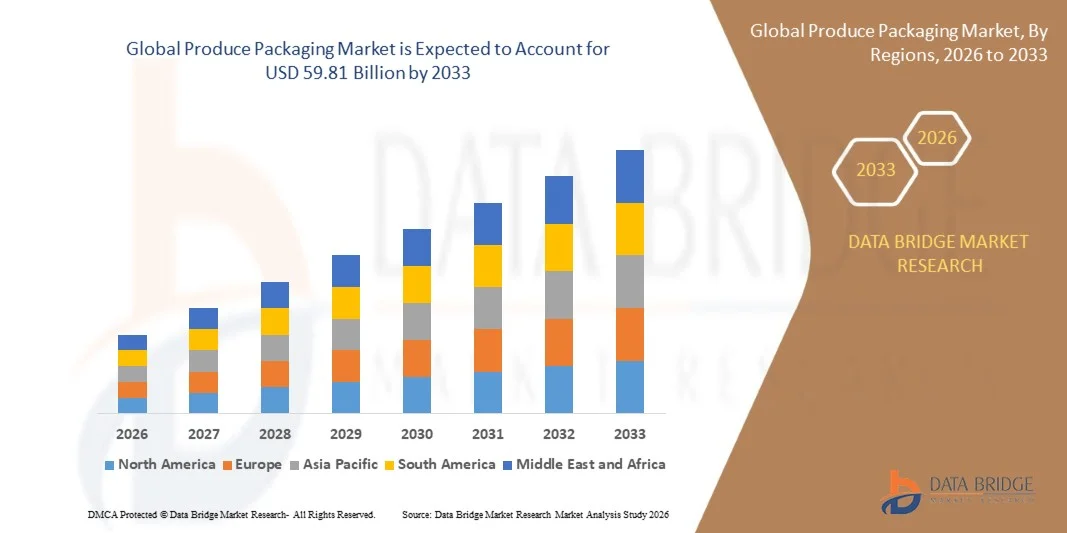
As per Data Bridge Market Research Analysis the Produce Packaging Market was valued at USD 40.18 billion in 2025 and is projected to reach USD 59.81 billion by 2033, growing at a CAGR of 5.10% from 2026 to 2033. The market is experiencing steady growth driven by increasing consumption of fresh fruits and vegetables, rising demand for safe and sustainable food packaging solutions, and the rapid expansion of organized retail and e-commerce grocery distribution channels. Growing emphasis on reducing food waste, extending shelf life, and maintaining product quality throughout transportation and storage is further supporting market expansion worldwide.
The increasing global trade of fresh produce, combined with stricter food safety regulations and evolving consumer preferences for convenience and sustainability, is encouraging growers, food processors, and retailers to adopt advanced produce packaging solutions. Modern packaging formats such as recyclable containers, breathable films, clamshells, punnets, and modified atmosphere packaging are increasingly replacing conventional packaging methods in many markets. These solutions help protect produce from physical damage, moisture loss, and microbial contamination while preserving freshness and visual appeal. In addition, advancements in biodegradable materials, smart packaging technologies, and eco-friendly packaging designs are enabling manufacturers to meet sustainability goals while improving supply chain efficiency, creating significant growth opportunities across both developed and emerging economies.
Market Size & Forecast
- Global Market Value (2025): USD 40.18 Billion
- Expected Market Value (2033): USD 59.81 Billion
- Forecast CAGR (2026–2033): 5.10%
- Leading Region in 2025: North America
- Fastest Growing Region: Asia-Pacific
Key Market Trends & Insights
- North America dominated the produce packaging market with the largest revenue share of 35.8% in 2025, supported by strong demand for packaged fresh fruits and vegetables, advanced cold chain infrastructure, and stringent food safety regulations.
- Asia-Pacific is expected to be the fastest-growing region, recording a CAGR of 8.1% from 2026 to 2033. Growth is driven by rapid urbanization, rising disposable incomes, expansion of supermarket and e-commerce grocery platforms, and improving cold chain logistics across emerging economies.
- The Corrugated Boxes segment held the largest market revenue share of approximately 38.6% in 2025 driven by its widespread use in transporting fresh fruits, vegetables, and food grains across domestic and international supply chains. Corrugated packaging offers superior stacking strength, ventilation, cost-effectiveness, and recyclability, making it the preferred solution for growers, exporters, and retailers. Growing fresh produce exports and increasing demand for sustainable packaging solutions continue to support segment dominance.
- The Plastic Containers segment is projected to register the fastest growth at a CAGR of 7.9% from 2026 to 2033, driven by increasing adoption of lightweight, transparent, and protective packaging formats for fresh produce. Plastic containers provide enhanced product visibility, moisture resistance, and damage protection during transportation and retail display. Rising demand for clamshell packaging, recyclable PET containers, and modified atmosphere packaging applications is accelerating segment expansion across developed and emerging markets.
- The Fruits segment held the largest market revenue share of approximately 44.3% in 2025 driven by high packaging requirements for berries, apples, citrus fruits, grapes, and tropical fruits. Fresh fruits require protective packaging solutions to minimize bruising, extend shelf life, and maintain visual appeal throughout distribution channels. Growing international fruit trade and rising consumer demand for fresh and packaged fruit products continue to strengthen segment growth.
- The Vegetables segment is projected to register the fastest growth at a CAGR of 8.2% from 2026 to 2033, driven by increasing consumption of fresh-cut vegetables, salad mixes, and convenience food products. Retailers and food service operators are increasingly adopting advanced packaging technologies to preserve freshness and reduce spoilage. Rising health awareness and expansion of organized grocery retail channels are further contributing to segment growth.
- The Growers and Shippers segment held the largest market revenue share of approximately 47.8% in 2025 driven by growing demand for bulk transportation packaging and export-oriented produce handling solutions. Growers and exporters require durable, ventilated, and cost-efficient packaging systems capable of protecting produce during harvesting, storage, and long-distance transportation. Expansion of global agricultural trade and increasing fresh produce exports continue to support segment leadership.
- The Retail Stores segment is projected to register the fastest growth at a CAGR of 8.5% from 2026 to 2033, driven by rising demand for consumer-ready packaging, sustainable packaging formats, and enhanced product presentation. Supermarkets, hypermarkets, and specialty grocery chains are increasingly investing in attractive and recyclable produce packaging to improve customer experience and reduce food waste. Growing penetration of modern retail formats and e-commerce grocery platforms is accelerating segment expansion globally.
Report Scope and Produce Packaging Market Segmentation
|
Attributes |
Produce Packaging Key Market Insights |
|
Segments Covered |
· By Packaging Type: Corrugated Boxes, Bags and Liners, Plastic Containers, Trays and Others · By Application: Food grains, Vegetables and Fruits · By End User: Growers and Shippers, Repackers and Retail Stores |
|
Countries Covered |
North America
Europe
Asia-Pacific
Middle East and Africa
South America
|
|
Key Market Players |
|
|
Market Opportunities |
|
|
Value Added Data Infosets |
|
What is the Key Trend in the Produce Packaging Market?
Trend: Rising Adoption Of Sustainable And Smart Fresh Produce Packaging Solutions
Increasing demand for sustainable, lightweight, and shelf-life-extending packaging solutions across the global fresh fruits and vegetables industry is transforming the produce packaging market. Conventional packaging materials are facing growing scrutiny due to environmental concerns, plastic waste regulations, and changing consumer preferences, encouraging growers, distributors, and retailers to adopt recyclable, biodegradable, compostable, and smart packaging alternatives with improved sustainability profiles.
Major food retailers and produce suppliers are increasingly implementing recyclable PET clamshells, fiber-based trays, and compostable films to reduce environmental impact while maintaining product freshness. For instance, leading supermarket chains across North America and Europe have expanded the use of recyclable packaging for berries, leafy greens, and fresh-cut produce to comply with sustainability commitments and consumer expectations. Modified atmosphere packaging (MAP) technologies are also gaining traction by extending produce shelf life and reducing spoilage throughout transportation and storage.
The rapid growth of online grocery platforms and cross-border fresh produce trade is further increasing demand for packaging solutions that provide durability, traceability, and product protection. In addition, smart packaging technologies incorporating freshness indicators, QR-based traceability systems, and temperature-monitoring labels are being adopted to improve supply chain visibility and food safety. In 2025, several large produce exporters in Europe reported shelf-life improvements of approximately 20–30% after implementing advanced breathable film packaging systems for fresh fruits and vegetables during long-distance transportation.
Produce Packaging Market Dynamics
Key Market Driver: Growing Demand For Fresh Produce Preservation And Food Waste Reduction
Food waste reduction has become a major priority for governments, retailers, and food supply chain operators worldwide. Fresh fruits and vegetables are highly perishable and vulnerable to moisture loss, contamination, and physical damage during transportation and storage, creating strong demand for packaging solutions capable of preserving product quality and extending shelf life.
Produce growers, food processors, and retailers are increasingly deploying advanced packaging formats such as modified atmosphere packaging, vented containers, absorbent pads, and breathable films to minimize spoilage and improve freshness retention. For instance, berry producers and leafy vegetable suppliers are adopting high-performance clamshell packaging systems to reduce product damage and maintain quality throughout distribution networks. Retail chains are also investing in packaging innovations to reduce inventory losses and improve customer satisfaction.
Similarly, global food waste reduction initiatives are encouraging adoption of packaging technologies that optimize storage conditions and enhance product longevity. Industry studies conducted across major produce distribution networks in North America and Europe during 2024 demonstrated that advanced produce packaging solutions reduced post-harvest losses by approximately 15–25% compared to conventional packaging methods, supporting improved supply chain efficiency and profitability.
Key Restraint/Challenge: Rising Raw Material Costs And Sustainability Compliance Pressures
The produce packaging industry faces increasing challenges associated with volatile raw material prices and evolving environmental regulations. Manufacturers are under pressure to balance performance, cost efficiency, and sustainability requirements while transitioning toward recyclable and biodegradable packaging materials.
The cost of paperboard, recycled plastics, bio-based polymers, and specialty packaging films has increased significantly in recent years, impacting overall packaging production expenses. In addition, compliance with packaging waste regulations, extended producer responsibility programs, and single-use plastic restrictions requires continuous investment in product redesign and material innovation. Smaller packaging manufacturers often face difficulties in absorbing these additional costs while maintaining competitive pricing.
Furthermore, achieving optimal performance from sustainable materials remains challenging in high-moisture and extended-storage applications. Commercial evaluations conducted during 2024 indicated that certain biodegradable packaging materials demonstrated shorter durability cycles and higher production costs than conventional plastic alternatives, creating adoption barriers for cost-sensitive produce suppliers and distributors.
Key Market Opportunity: Expansion Of E-Commerce Grocery And Sustainable Packaging Innovations
The rapid growth of online grocery retailing, direct-to-consumer produce delivery services, and international fresh food trade is creating substantial opportunities for advanced produce packaging solutions. Fresh produce distributed through e-commerce channels requires enhanced protection, temperature stability, and shelf-life management throughout increasingly complex logistics networks.
Retailers and packaging manufacturers are developing innovative packaging formats, For instance insulated containers, recyclable protective trays, and intelligent freshness-monitoring systems, to support growing demand for home-delivered fruits and vegetables. In consumer markets, rising preference for environmentally responsible packaging is accelerating adoption of compostable materials, molded fiber packaging, and plant-based films. Sustainable packaging initiatives launched by major food retailers are further encouraging investment in next-generation packaging technologies.
In addition, advancements in active packaging, antimicrobial coatings, and smart labeling technologies are improving produce preservation and supply chain transparency. Pilot projects conducted across fresh produce supply chains in 2025 reported spoilage reductions of approximately 18–25% and logistics efficiency improvements exceeding 15% following implementation of intelligent packaging systems incorporating freshness monitoring and real-time traceability capabilities.
How is the Produce Packaging Market Segmented?
The market is segmented on the basis of packaging type, application, and end user.
- By Packaging Type
On the basis of packaging type, the produce packaging market is segmented into Corrugated Boxes, Bags and Liners, Plastic Containers, Trays, and Others. The Corrugated Boxes segment held the largest market revenue share of approximately 38.6% in 2025 driven by its widespread use in transporting fresh fruits, vegetables, and food grains across domestic and international supply chains. Corrugated packaging offers superior stacking strength, ventilation, cost-effectiveness, and recyclability, making it the preferred solution for growers, exporters, and retailers. Growing fresh produce exports and increasing demand for sustainable packaging solutions continue to support segment dominance.
The Plastic Containers segment is projected to register the fastest growth at a CAGR of 7.9% from 2026 to 2033, driven by increasing adoption of lightweight, transparent, and protective packaging formats for fresh produce. Plastic containers provide enhanced product visibility, moisture resistance, and damage protection during transportation and retail display. Rising demand for clamshell packaging, recyclable PET containers, and modified atmosphere packaging applications is accelerating segment expansion across developed and emerging markets.
- By Application
On the basis of application, the produce packaging market is segmented into Food Grains, Vegetables, and Fruits. The Fruits segment held the largest market revenue share of approximately 44.3% in 2025 driven by high packaging requirements for berries, apples, citrus fruits, grapes, and tropical fruits. Fresh fruits require protective packaging solutions to minimize bruising, extend shelf life, and maintain visual appeal throughout distribution channels. Growing international fruit trade and rising consumer demand for fresh and packaged fruit products continue to strengthen segment growth.
The Vegetables segment is projected to register the fastest growth at a CAGR of 8.2% from 2026 to 2033, driven by increasing consumption of fresh-cut vegetables, salad mixes, and convenience food products. Retailers and food service operators are increasingly adopting advanced packaging technologies to preserve freshness and reduce spoilage. Rising health awareness and expansion of organized grocery retail channels are further contributing to segment growth.
- By End User
On the basis of end user, the produce packaging market is segmented into Growers and Shippers, Repackers, and Retail Stores. The Growers and Shippers segment held the largest market revenue share of approximately 47.8% in 2025 driven by growing demand for bulk transportation packaging and export-oriented produce handling solutions. Growers and exporters require durable, ventilated, and cost-efficient packaging systems capable of protecting produce during harvesting, storage, and long-distance transportation. Expansion of global agricultural trade and increasing fresh produce exports continue to support segment leadership.
The Retail Stores segment is projected to register the fastest growth at a CAGR of 8.5% from 2026 to 2033, driven by rising demand for consumer-ready packaging, sustainable packaging formats, and enhanced product presentation. Supermarkets, hypermarkets, and specialty grocery chains are increasingly investing in attractive and recyclable produce packaging to improve customer experience and reduce food waste. Growing penetration of modern retail formats and e-commerce grocery platforms is accelerating segment expansion globally.
Which Region Holds the Largest Share of the Produce Packaging Market?
North America Produce Packaging Market Insight
North America dominated the produce packaging market with the largest revenue share of 35.8% in 2025, supported by strong demand for packaged fresh fruits and vegetables, advanced cold chain infrastructure, and stringent food safety regulations. Produce suppliers and retailers in the region highly value packaging solutions that extend shelf life, reduce food waste, and maintain product quality during transportation and storage. The widespread adoption of sustainable packaging materials, combined with growing consumer preference for convenience and freshness, continues to strengthen market growth across retail and food service sectors.
U.S. Produce Packaging Market Insight
The U.S. produce packaging market captured the largest revenue share in 2025 within North America, fueled by increasing consumption of fresh produce and the expansion of organized retail distribution networks. Food retailers are increasingly prioritizing packaging solutions that improve freshness retention, traceability, and product protection. The growing demand for ready-to-eat fruits, packaged salads, and fresh-cut vegetables, combined with rising adoption of recyclable and compostable packaging materials, further propels the industry. Moreover, the rapid growth of online grocery delivery services is contributing significantly to market expansion.
Europe Produce Packaging Market Insight
The Europe produce packaging market is expected to witness the fastest growth rate from 2026 to 2033, primarily driven by strict environmental regulations and increasing demand for sustainable food packaging solutions. The region's focus on reducing packaging waste and improving circular economy practices is accelerating adoption of recyclable, biodegradable, and fiber-based produce packaging materials. European consumers are increasingly seeking environmentally responsible packaging formats while retailers continue investing in innovative packaging technologies. The market is experiencing strong growth across fresh fruits, vegetables, and organic produce applications.
U.K. Produce Packaging Market Insight
The U.K. produce packaging market is expected to witness the fastest growth rate from 2026 to 2033, driven by rising demand for sustainable packaging and increasing consumption of packaged fresh produce. Retailers are actively replacing conventional plastic packaging with recyclable and compostable alternatives to meet sustainability commitments and regulatory requirements. In addition, growing demand for convenience foods, fresh produce delivery services, and premium packaged fruits and vegetables is encouraging wider adoption of advanced produce packaging solutions throughout the country.
Germany Produce Packaging Market Insight
The Germany produce packaging market is expected to witness the fastest growth rate from 2026 to 2033, fueled by increasing awareness of sustainable packaging practices and strong demand for environmentally friendly food packaging solutions. Germany's well-established food retail sector and emphasis on waste reduction are supporting adoption of recyclable and reusable produce packaging formats. The integration of innovative packaging technologies designed to improve product freshness and reduce spoilage is becoming increasingly prevalent. Strong consumer preference for sustainable products continues to support market growth.
Asia-Pacific Produce Packaging Market Insight
The Asia-Pacific produce packaging market is expected to witness the fastest growth rate from 2026 to 2033, supported by rapid urbanization, rising disposable incomes, and increasing consumption of packaged fresh food products. Expanding supermarket networks, improving cold chain logistics, and growing fresh produce exports are driving demand for advanced packaging solutions across the region. Furthermore, increasing government initiatives aimed at reducing food waste and improving food safety standards are accelerating adoption of modern produce packaging technologies.
Japan Produce Packaging Market Insight
The Japan produce packaging market is expected to witness the fastest growth rate from 2026 to 2033 due to the country's strong focus on food quality, safety, and product presentation. Japanese consumers place significant importance on freshness and convenience, encouraging widespread use of premium produce packaging solutions. The adoption of high-performance packaging materials, smart labeling technologies, and freshness-preserving packaging formats is increasing across retail channels. Moreover, growing demand for packaged fresh fruits and vegetables among urban consumers is supporting market expansion.
China Produce Packaging Market Insight
The China produce packaging market accounted for the largest market revenue share in Asia Pacific in 2025, attributed to the country's expanding food retail sector, growing middle-class population, and increasing demand for packaged fresh produce. China represents one of the world's largest fruit and vegetable markets, creating substantial demand for efficient packaging solutions across domestic and export supply chains. The rapid growth of e-commerce grocery platforms, improvements in cold chain infrastructure, and rising adoption of sustainable packaging materials are key factors driving market growth in China.
Which are the Top Companies in Produce Packaging Market?
The Produce Packaging industry is primarily led by well-established companies, including:
• Amcor plc (Switzerland)
• Bemis Company Inc. (U.S.)
• Tetra Laval International SA (Switzerland)
• Mondi plc (U.K.)
• WestRock Company (U.S.)
• BASF SE (Germany)
• Sonoco Products Company (U.S.)
• Smurfit Kappa Group plc (Ireland)
• Sealed Air Corporation (U.S.)
• Huhtamaki Oyj (Finland)
• Gerresheimer AG (Germany)
• Ball Corporation (U.S.)
• Ardagh Group S.A. (Luxembourg)
• Crown Holdings, Inc. (U.S.)
• DS Smith plc (U.K.)
• Berry Global Inc. (U.S.)
• Reynolds Packaging (U.S.)
• Genpak LLC (U.S.)
• DuPont (U.S.)
• Evergreen Packaging LLC (U.S.)
What are Latest Developments in Produce Packaging Market?
- In January 2026, Amcor (AU) announced an expansion of its Wisconsin bioplastics facility, a capacity enhancement initiative aimed at increasing production of PLA-based produce packaging by 50% by Q3 2026 while integrating a closed-loop recycling system. This development is expected to strengthen supply chain efficiency, improve recycled material utilization, and reinforce Amcor’s position in sustainable fresh produce packaging across North America.
- In December 2025, Sealed Air (US) completed the acquisition of a Brazilian flexible packaging converter, a strategic expansion move designed to increase annual pouch production capacity by approximately 12,000 metric tons near key fruit-producing regions. This acquisition is likely to improve regional supply responsiveness, reduce logistics costs, and enhance Sealed Air’s competitiveness in Latin American produce packaging markets.
- In November 2025, Mondi plc (U.K.) launched a paper-based produce punnet line across 15 European markets in collaboration with major retailers including Tesco, Carrefour, and Rewe, a commercial rollout aimed at replacing plastic trays with recyclable fiber-based alternatives. This initiative is expected to accelerate retail adoption of sustainable packaging and strengthen Mondi’s leadership in eco-friendly produce packaging solutions.
- In September 2025, Berry Global Inc. (U.S.) introduced a new range of compostable packaging solutions for fruits and vegetables, a product innovation initiative focused on reducing plastic waste in the fresh produce supply chain. This launch is expected to attract sustainability-focused retailers and consumers while expanding Berry Global’s market share in the biodegradable packaging segment.
- In August 2025, Amcor plc (AU) entered a partnership with an agricultural technology firm to develop biodegradable packaging solutions for fresh produce, a collaborative innovation effort aimed at improving sustainability and compliance with tightening environmental regulations. This initiative is expected to enhance Amcor’s product portfolio and strengthen its positioning in eco-friendly packaging across global retail networks.

- Interactive Data Analysis Dashboard
- Company Analysis Dashboard for high growth potential opportunities
- Research Analyst Access for customization & queries
- Competitor Analysis with Interactive dashboard
- Latest News, Updates & Trend analysis
- Harness the Power of Benchmark Analysis for Comprehensive Competitor Tracking
Global Produce Packaging Market, Supply Chain Analysis and Ecosystem Framework
To support market growth and help clients navigate the impact of geopolitical shifts, DBMR has integrated in-depth supply chain analysis into its Global Produce Packaging Market research reports. This addition empowers clients to respond effectively to global changes affecting their industries. The supply chain analysis section includes detailed insights such as Global Produce Packaging Market consumption and production by country, price trend analysis, the impact of tariffs and geopolitical developments, and import and export trends by country and HSN code. It also highlights major suppliers with data on production capacity and company profiles, as well as key importers and exporters. In addition to research, DBMR offers specialized supply chain consulting services backed by over a decade of experience, providing solutions like supplier discovery, supplier risk assessment, price trend analysis, impact evaluation of inflation and trade route changes, and comprehensive market trend analysis.
Data collection and base year analysis are done using data collection modules with large sample sizes. The stage includes obtaining market information or related data through various sources and strategies. It includes examining and planning all the data acquired from the past in advance. It likewise envelops the examination of information inconsistencies seen across different information sources. The market data is analysed and estimated using market statistical and coherent models. Also, market share analysis and key trend analysis are the major success factors in the market report. To know more, please request an analyst call or drop down your inquiry.
The key research methodology used by DBMR research team is data triangulation which involves data mining, analysis of the impact of data variables on the market and primary (industry expert) validation. Data models include Vendor Positioning Grid, Market Time Line Analysis, Market Overview and Guide, Company Positioning Grid, Patent Analysis, Pricing Analysis, Company Market Share Analysis, Standards of Measurement, Global versus Regional and Vendor Share Analysis. To know more about the research methodology, drop in an inquiry to speak to our industry experts.
Data Bridge Market Research is a leader in advanced formative research. We take pride in servicing our existing and new customers with data and analysis that match and suits their goal. The report can be customized to include price trend analysis of target brands understanding the market for additional countries (ask for the list of countries), clinical trial results data, literature review, refurbished market and product base analysis. Market analysis of target competitors can be analyzed from technology-based analysis to market portfolio strategies. We can add as many competitors that you require data about in the format and data style you are looking for. Our team of analysts can also provide you data in crude raw excel files pivot tables (Fact book) or can assist you in creating presentations from the data sets available in the report.













