


Rapid Influenza Diagnostic Tests (RIDTs) Market Size
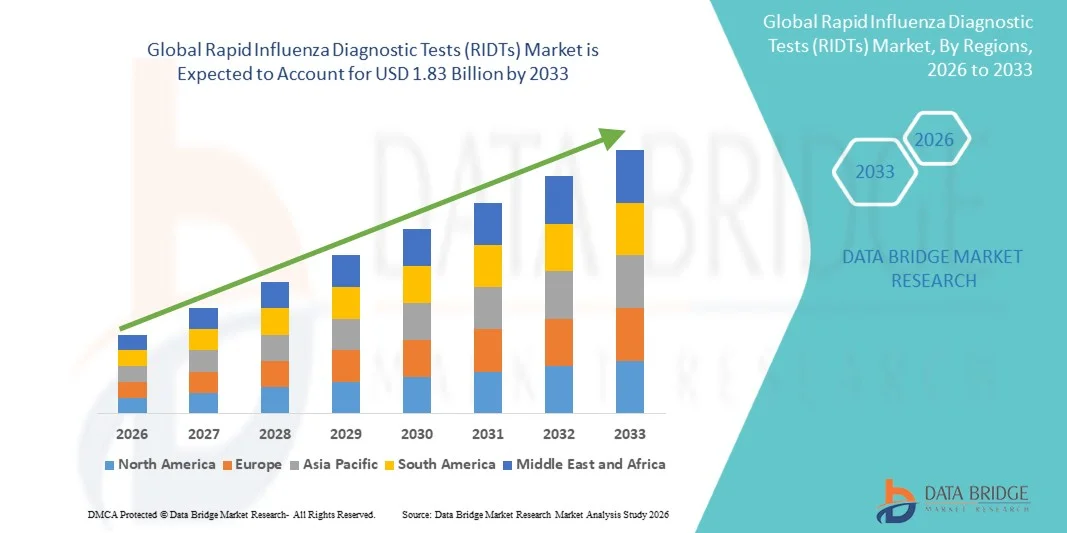
- The global Rapid Influenza Diagnostic Tests (RIDTs) market size was valued at USD 1.22 billion in 2025 and is expected to reach USD 1.83 billion by 2033, at a CAGR of 5.25% during the forecast period
- The market growth is largely fueled by the increasing prevalence of seasonal influenza outbreaks, rising awareness regarding early disease detection, and the growing need for rapid, point-of-care diagnostic solutions across healthcare settings, leading to enhanced testing adoption in both clinical and decentralized environments
- Furthermore, advancements in diagnostic technologies, including improved sensitivity and specificity of RIDTs, along with expanding healthcare infrastructure and government initiatives for infectious disease control, are establishing RIDTs as a critical tool for timely influenza management. These converging factors are accelerating the adoption of rapid influenza diagnostic solutions, thereby significantly boosting the industry's growth
Rapid Influenza Diagnostic Tests (RIDTs) Market Analysis
- Rapid Influenza Diagnostic Tests (RIDTs), enabling quick identification of influenza A and B infections at the point of care, are increasingly vital in modern healthcare systems due to their ability to deliver fast results, support early clinical decision-making, and improve outbreak management in both hospital and outpatient settings
- The escalating demand for RIDTs is primarily fueled by the rising burden of seasonal influenza, growing emphasis on early diagnosis and timely treatment initiation, and increasing adoption of rapid, point-of-care testing solutions across emergency care and primary healthcare facilities
- North America dominated the Rapid Influenza Diagnostic Tests (RIDTs) market with the largest revenue share of 41.6% in 2025, supported by advanced healthcare infrastructure, high diagnostic awareness, and widespread use of rapid testing in hospitals and clinics, with the U.S. witnessing strong adoption driven by influenza surveillance programs and routine seasonal testing practices
- Asia-Pacific is expected to be the fastest growing region in the Rapid Influenza Diagnostic Tests (RIDTs) market during the forecast period due to increasing population density, rising healthcare access, expanding diagnostic capabilities, and growing awareness of infectious disease screening and prevention
- RIDT for Influenza A segment dominated the Rapid Influenza Diagnostic Tests (RIDTs) market with a significant share of 56.8% in 2025, driven by the higher prevalence of Influenza A strains and their stronger association with seasonal outbreaks and pandemics
Report Scope and Rapid Influenza Diagnostic Tests (RIDTs) Market Segmentation
|
Attributes |
Rapid Influenza Diagnostic Tests (RIDTs) Key Market Insights |
|
Segments Covered |
|
|
Countries Covered |
North America
Europe
Asia-Pacific
Middle East and Africa
South America
|
|
Key Market Players |
|
|
Market Opportunities |
|
|
Value Added Data Infosets |
In addition to the insights on market scenarios such as market value, growth rate, segmentation, geographical coverage, and major players, the market reports curated by the Data Bridge Market Research also include in-depth expert analysis, patient epidemiology, pipeline analysis, pricing analysis, and regulatory framework |
Rapid Influenza Diagnostic Tests (RIDTs) Market Trends
“Rising Adoption of AI-Enabled and Multiplex Point-of-Care Testing”
- A significant and accelerating trend in the global Rapid Influenza Diagnostic Tests (RIDTs) market is the integration of AI-assisted diagnostic interpretation and multiplex respiratory testing platforms that improve speed, accuracy, and clinical decision-making efficiency in point-of-care settings
- For instance, several modern RIDT platforms are increasingly being designed to differentiate between influenza A, influenza B, and other respiratory pathogens such as RSV within a single test, improving diagnostic efficiency in hospitals and clinics
- AI integration in RIDTs enables enhanced result interpretation support, reduced human error in visual test reading, and improved outbreak detection through automated data aggregation and reporting systems used in healthcare networks
- Furthermore, the adoption of digital connectivity features in RIDT devices allows real-time transmission of test results to hospital information systems and public health databases, enabling faster epidemiological tracking and response
- The growing use of compact, portable RIDT kits in decentralized healthcare settings such as pharmacies and community clinics is expanding access to rapid influenza testing beyond traditional hospital environments
- This trend towards more intelligent, connected, and multiplex diagnostic solutions is fundamentally reshaping expectations for rapid infectious disease testing, driving demand for next-generation RIDT platforms across healthcare facilities
- The demand for advanced RIDTs with integrated digital reporting and multi-pathogen detection capabilities is growing rapidly across both developed and emerging markets as healthcare systems prioritize faster and more comprehensive respiratory disease diagnosis
Rapid Influenza Diagnostic Tests (RIDTs) Market Dynamics
Driver
“Rising Burden of Influenza Outbreaks and Demand for Rapid Point-of-Care Diagnosis”
- The increasing frequency and severity of seasonal influenza outbreaks, coupled with growing demand for rapid and accurate point-of-care diagnostic solutions, is a significant driver for the expansion of the RIDTs market globally
- For instance, in April 2025, multiple healthcare systems strengthened influenza surveillance programs and expanded rapid testing capacity in emergency departments to improve early detection and patient triage efficiency
- As healthcare providers focus on reducing diagnostic delays and improving patient outcomes, RIDTs offer quick turnaround times that support timely antiviral treatment decisions and infection control measures
- Furthermore, the rising burden on centralized laboratory infrastructure during peak flu seasons is increasing reliance on decentralized testing solutions such as RIDTs in clinics, hospitals, and urgent care centers
- The convenience of rapid results within minutes, combined with ease of use and portability, is driving adoption of RIDTs in both developed healthcare systems and resource-limited settings
- Expanding government initiatives for influenza preparedness and pandemic response planning are further supporting large-scale procurement and deployment of RIDT kits in public healthcare systems
- Increasing awareness of early influenza diagnosis benefits among healthcare professionals and patients is further accelerating the adoption of RIDTs across global healthcare networks
Restraint/Challenge
“Limited Sensitivity and Seasonal Variability Impacting Diagnostic Reliability”
- Concerns regarding the relatively lower sensitivity of RIDTs compared to molecular diagnostic methods such as RT-PCR present a significant challenge to wider market adoption in clinical practice
- For instance, during peak influenza seasons, variability in viral load among patients can lead to false-negative results in some RIDT applications, impacting diagnostic confidence among healthcare providers
- Addressing accuracy limitations through improved assay design, enhanced antigen detection technologies, and combination testing approaches is critical for strengthening clinical reliability
- In addition, the seasonal nature of influenza circulation creates demand fluctuations, which can limit consistent utilization rates of RIDT products throughout the year in many healthcare facilities
- The availability of more advanced molecular diagnostic alternatives in well-equipped laboratories also restricts the preference for RIDTs in certain high-resource clinical settings
- Regulatory approval complexities and stringent validation requirements for new rapid diagnostic technologies can delay product launches and market entry for manufacturers
- Overcoming these challenges through technological improvements, better clinical validation, and integration with confirmatory testing strategies is essential for sustaining long-term market growth
Rapid Influenza Diagnostic Tests (RIDTs) Market Scope
The market is segmented on the basis of product, patient, end-use, and type.
- By Product
On the basis of product, the RIDTs market is segmented into RIDT for Influenza A and RIDT for Influenza B. The RIDT for Influenza A segment dominated the market with the largest market revenue share of 56.8% in 2025, driven by the higher prevalence of Influenza A strains and their stronger association with seasonal epidemics and global outbreaks. Influenza A testing is prioritized in clinical settings due to its higher mutation rate and pandemic potential, requiring rapid and frequent screening. Hospitals and emergency care centers heavily rely on Influenza A RIDTs for quick triage and treatment decisions during peak flu seasons. In addition, widespread surveillance programs focus more on Influenza A detection, further supporting its dominance. The availability of optimized test kits with improved antigen detection for Influenza A also contributes to its strong adoption. Its critical role in outbreak control and early intervention continues to reinforce its market leadership.
The RIDT for Influenza B segment is expected to witness the fastest growth rate from 2026 to 2033, driven by increasing recognition of Influenza B’s clinical burden, especially among children and young adults. Rising co-circulation of Influenza A and B strains is pushing demand for more comprehensive diagnostic coverage. Healthcare providers are increasingly adopting dual testing strategies to improve diagnostic accuracy during flu seasons. Growing awareness of Influenza B-related complications, including hospitalization in pediatric populations, is further supporting adoption. Advancements in multiplex testing platforms are also improving detection efficiency for Influenza B. Expanding vaccination monitoring programs and surveillance initiatives are In addition boosting segment growth.
- By Patient
On the basis of patient, the RIDTs market is segmented into pediatric and adult. The pediatric segment dominated the market with the largest market revenue share of 58.3% in 2025, driven by the higher susceptibility of children to influenza infections and faster transmission rates in school environments. Pediatric patients are more frequently tested due to higher fever incidence and respiratory infection rates. Hospitals and clinics prioritize rapid diagnosis in children to prevent complications such as pneumonia and dehydration. Schools and daycare outbreak management programs further increase testing demand in this group. Parents and caregivers increasingly seek quick diagnostic solutions to enable early treatment decisions. The availability of child-focused testing protocols and pediatric-friendly sampling methods further strengthens this segment’s dominance.
The adult segment is expected to witness the fastest growth rate from 2026 to 2033, driven by increasing awareness of early influenza diagnosis in working-age populations and elderly care management. Rising workforce mobility and urban population density are contributing to higher testing demand among adults. Occupational health programs in corporate and industrial settings are increasingly incorporating RIDTs for infection control. Adults with chronic conditions such as asthma and diabetes are also being prioritized for rapid influenza screening. Growing use of urgent care centers and outpatient clinics is further supporting adoption in this segment. Increasing focus on reducing hospital admissions through early intervention is accelerating segment growth.
- By End-use
On the basis of end-use, the RIDTs market is segmented into hospitals, diagnostic centers, and research laboratories. The hospitals segment dominated the market with the largest market revenue share of 52.4% in 2025, driven by high patient inflow during seasonal influenza outbreaks and the need for immediate diagnostic decisions in emergency and inpatient care. Hospitals rely on RIDTs for rapid triage and infection control measures to prevent nosocomial spread. Integration of RIDTs into emergency departments supports faster clinical workflows and treatment initiation. The availability of on-site testing facilities reduces dependency on centralized laboratories. Hospitals also play a key role in influenza surveillance programs, increasing test utilization. Strong procurement capabilities and established diagnostic infrastructure further reinforce hospital dominance.
The diagnostic centers segment is expected to witness the fastest growth rate from 2026 to 2033, driven by increasing preference for outpatient and walk-in diagnostic services. Rising healthcare decentralization is shifting testing volumes away from hospitals to independent diagnostic facilities. Patients prefer diagnostic centers for faster service turnaround and lower waiting times. Expanding private diagnostic chains and franchise networks are increasing accessibility to RIDTs. Technological upgrades in point-of-care testing equipment are enhancing testing efficiency in these centers. Growing insurance coverage for outpatient diagnostics is further supporting segment expansion.
- By Type
On the basis of type, the RIDTs market is segmented into digital RIDTs and conventional RIDTs. The conventional RIDTs segment dominated the market with the largest market revenue share of 61.7% in 2025, driven by their low cost, ease of use, and widespread availability in both developed and developing healthcare systems. Conventional tests require minimal infrastructure and are suitable for rapid deployment during seasonal outbreaks. They are extensively used in primary care settings due to their quick turnaround time and simplicity. Strong adoption in resource-limited regions further supports their dominance. Established clinical familiarity and regulatory approvals contribute to continued preference. Their affordability compared to advanced diagnostic systems ensures sustained demand globally.
The digital RIDTs segment is expected to witness the fastest growth rate from 2026 to 2033, driven by increasing adoption of connected healthcare technologies and demand for higher diagnostic accuracy. Digital RIDTs offer automated result interpretation, reducing human error in test reading. Integration with hospital information systems enables real-time reporting and surveillance tracking. Growing use of AI-assisted diagnostic platforms is enhancing performance efficiency. Healthcare providers are increasingly adopting digital solutions to improve data-driven decision-making. Rising investment in smart healthcare infrastructure is further accelerating segment growth.
Rapid Influenza Diagnostic Tests (RIDTs) Market Regional Analysis
- North America dominated the Rapid Influenza Diagnostic Tests (RIDTs) market with the largest revenue share of 41.6% in 2025, supported by advanced healthcare infrastructure, high diagnostic awareness, and widespread use of rapid testing in hospitals and clinics
- Healthcare providers in the region highly value the speed, accuracy, and accessibility offered by RIDTs, enabling rapid clinical decision-making, timely antiviral treatment, and effective infection control during influenza outbreaks
- This widespread adoption is further supported by high healthcare expenditure, advanced diagnostic awareness, and strong government-led influenza surveillance and testing programs, establishing RIDTs as a standard tool in hospitals, urgent care centers, and outpatient clinics
U.S. Rapid Influenza Diagnostic Tests (RIDTs) Market Insight
The U.S. RIDTs market captured the largest revenue share of 79% in 2025 within North America, fueled by the high burden of seasonal influenza and strong adoption of point-of-care diagnostic testing across healthcare facilities. Healthcare providers are increasingly prioritizing rapid detection of influenza infections to enable timely antiviral treatment and reduce hospital admissions. The growing integration of RIDTs in emergency departments, urgent care centers, and outpatient clinics further supports market expansion. Moreover, the presence of advanced healthcare infrastructure, strong influenza surveillance programs, and high awareness of early diagnosis significantly contributes to the country’s leadership in the RIDTs market.
Europe Rapid Influenza Diagnostic Tests (RIDTs) Market Insight
The Europe RIDTs market is projected to expand at a substantial CAGR throughout the forecast period, primarily driven by increasing influenza surveillance initiatives and strong public healthcare systems focused on early disease detection. The rising incidence of seasonal flu outbreaks, coupled with government-backed infection control programs, is fostering wider adoption of RIDTs. European healthcare providers are also emphasizing rapid diagnostics to reduce laboratory burden and improve patient management efficiency. In addition, growing awareness of respiratory disease control and expanding use of point-of-care testing in hospitals and clinics are supporting steady market growth across the region.
U.K. Rapid Influenza Diagnostic Tests (RIDTs) Market Insight
The U.K. RIDTs market is anticipated to grow at a noteworthy CAGR during the forecast period, driven by increasing demand for rapid diagnostic solutions in both public and private healthcare systems. Rising seasonal influenza cases and strong focus on NHS-led infection control programs are encouraging wider adoption of RIDTs. The need for quick triage in emergency care settings is further boosting demand for rapid testing solutions. In addition, growing awareness among healthcare professionals and patients regarding early influenza detection is supporting the shift toward decentralized diagnostic approaches across the country.
Germany Rapid Influenza Diagnostic Tests (RIDTs) Market Insight
The Germany RIDTs market is expected to expand at a considerable CAGR during the forecast period, driven by strong healthcare infrastructure and increasing emphasis on early diagnosis of infectious diseases. The country’s focus on precision medicine and efficient hospital workflows is supporting the adoption of rapid diagnostic tools. Rising seasonal influenza cases and demand for faster clinical decision-making are further contributing to market growth. In addition, integration of RIDTs into hospital infection control systems and growing awareness of respiratory disease management are reinforcing their usage across clinical settings.
Asia-Pacific Rapid Influenza Diagnostic Tests (RIDTs) Market Insight
The Asia-Pacific RIDTs market is poised to grow at the fastest CAGR of 22% during 2026 to 2033, driven by rising influenza incidence, increasing healthcare accessibility, and expanding diagnostic infrastructure across emerging economies. Growing population density and rapid urbanization are contributing to higher transmission rates, boosting demand for quick diagnostic solutions. Government initiatives for infectious disease surveillance and improved healthcare spending are further accelerating adoption. In addition, increasing availability of affordable RIDT kits and expanding use in decentralized healthcare settings are strengthening market penetration across the region.
Japan Rapid Influenza Diagnostic Tests (RIDTs) Market Insight
The Japan RIDTs market is gaining momentum due to its advanced healthcare system, high health awareness, and strong focus on early disease detection. The country experiences recurring seasonal influenza outbreaks, driving consistent demand for rapid testing solutions. Integration of RIDTs into hospitals and clinics supports efficient patient management and reduces diagnostic delays. In addition, Japan’s aging population increases vulnerability to respiratory infections, further supporting demand for quick and accurate influenza diagnosis in both residential and healthcare environments.
India Rapid Influenza Diagnostic Tests (RIDTs) Market Insight
The India RIDTs market accounted for the largest market revenue share in Asia Pacific in 2025, attributed to rapid urbanization, increasing healthcare awareness, and rising burden of infectious diseases. Expanding access to diagnostic services and growing adoption of point-of-care testing are key drivers of market growth. Government initiatives to strengthen disease surveillance and outbreak preparedness are further boosting RIDT adoption. In addition, increasing affordability of rapid diagnostic kits and expansion of private healthcare networks are making influenza testing more accessible across urban and semi-urban populations.
Rapid Influenza Diagnostic Tests (RIDTs) Market Share
The Rapid Influenza Diagnostic Tests (RIDTs) industry is primarily led by well-established companies, including:
- QuidelOrtho Corporation (U.S.)
- BD (U.S.)
- Abbott (U.S.)
- Thermo Fisher Scientific Inc. (U.S.)
- F. Hoffmann-La Roche Ltd (Switzerland)
- Sekisui Diagnostics, LLC (U.S.)
- Siemens Healthineers AG (Germany)
- BIOMÉRIEUX (France)
- Meridian Bioscience, Inc. (U.S.)
- DiaSorin S.p.A. (Italy)
- Hologic, Inc. (U.S.)
- Danaher Corporation (U.S.)
- Cepheid (U.S.)
- ACCESS BIO, INC. (U.S.)
- Princeton BioMeditech Corporation (U.S.)
- LifeSign LLC (U.S.)
- SA Scientific, Ltd. (U.S.)
- Quidel Corporation (U.S.)
- iHealth Labs Inc. (U.S.)
- Healgen Scientific LLC (U.S.)
What are the Recent Developments in Global Rapid Influenza Diagnostic Tests (RIDTs) Market?
- In January 2025, the CDC issued an updated advisory encouraging faster influenza A subtyping in hospitalized patients to strengthen outbreak monitoring and response. The guidance was driven by concerns over rising influenza activity and potential co-circulation of multiple strains. It emphasized the importance of rapid diagnostic workflows to identify high-risk infections more efficiently
- In October 2024, the U.S. FDA authorized the Healgen Rapid Check COVID-19/Flu A&B Antigen Test, marking a major advancement in over-the-counter rapid respiratory diagnostics. The test enables users to detect Influenza A and B along with COVID-19 using a single nasal swab with results in about 15 minutes, supporting faster at-home decision-making and early treatment initiation
- In October 2024, the CDC updated its influenza diagnostic guidance to expand recommendations for rapid influenza diagnostic tests (RIDTs) in clinical and outpatient settings. The update highlighted FDA-cleared RIDTs capable of detecting Influenza A and B within 10–15 minutes, supporting faster clinical decision-making. It emphasized broader use of rapid testing during seasonal outbreaks to improve patient triage and infection control
- In June 2024, Roche received FDA authorization for its cobas liat SARS-CoV-2, Influenza A/B & RSV test, a rapid molecular diagnostic system designed for near-patient testing. The system delivers results in approximately 20 minutes, enabling simultaneous detection and differentiation of multiple respiratory infections. This development significantly improves clinical workflow efficiency in emergency and urgent care settings
- In March 2023, multiple diagnostic manufacturers accelerated the launch of multiplex respiratory rapid test panels capable of detecting Influenza A, Influenza B, RSV, and COVID-19 in a single assay. These RIDT-based platforms significantly reduce diagnostic time and improve efficiency in emergency departments and outpatient clinics. The development supports better patient triaging during overlapping seasonal respiratory outbreaks

- Interactive Data Analysis Dashboard
- Company Analysis Dashboard for high growth potential opportunities
- Research Analyst Access for customization & queries
- Competitor Analysis with Interactive dashboard
- Latest News, Updates & Trend analysis
- Harness the Power of Benchmark Analysis for Comprehensive Competitor Tracking
Data collection and base year analysis are done using data collection modules with large sample sizes. The stage includes obtaining market information or related data through various sources and strategies. It includes examining and planning all the data acquired from the past in advance. It likewise envelops the examination of information inconsistencies seen across different information sources. The market data is analysed and estimated using market statistical and coherent models. Also, market share analysis and key trend analysis are the major success factors in the market report. To know more, please request an analyst call or drop down your inquiry.
The key research methodology used by DBMR research team is data triangulation which involves data mining, analysis of the impact of data variables on the market and primary (industry expert) validation. Data models include Vendor Positioning Grid, Market Time Line Analysis, Market Overview and Guide, Company Positioning Grid, Patent Analysis, Pricing Analysis, Company Market Share Analysis, Standards of Measurement, Global versus Regional and Vendor Share Analysis. To know more about the research methodology, drop in an inquiry to speak to our industry experts.
Data Bridge Market Research is a leader in advanced formative research. We take pride in servicing our existing and new customers with data and analysis that match and suits their goal. The report can be customized to include price trend analysis of target brands understanding the market for additional countries (ask for the list of countries), clinical trial results data, literature review, refurbished market and product base analysis. Market analysis of target competitors can be analyzed from technology-based analysis to market portfolio strategies. We can add as many competitors that you require data about in the format and data style you are looking for. Our team of analysts can also provide you data in crude raw excel files pivot tables (Fact book) or can assist you in creating presentations from the data sets available in the report.













