


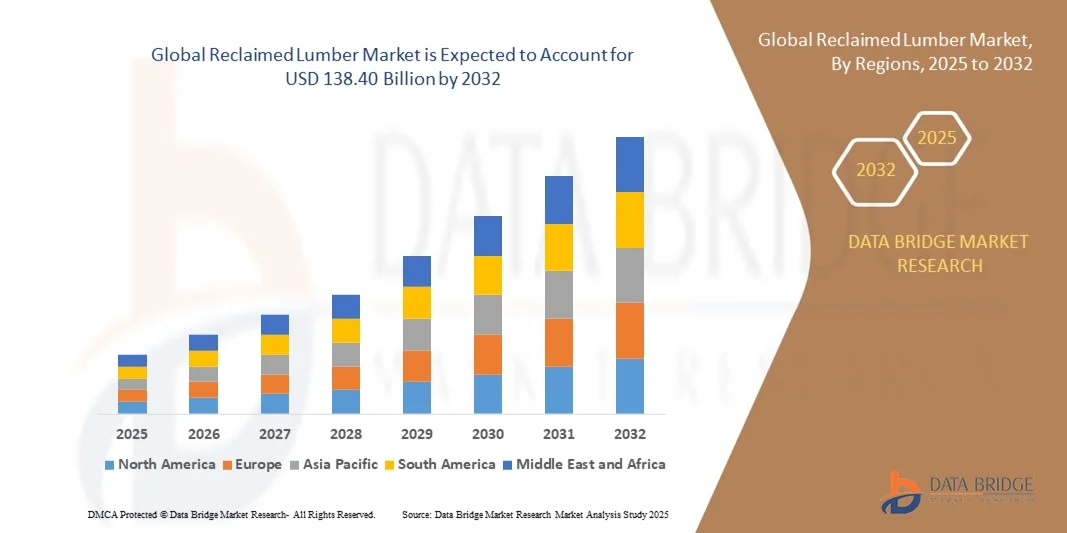
What is the Global Reclaimed Lumber Market Size and Growth Rate?
- The global reclaimed lumber market size was valued at USD 65.51 billion in 2024 and is expected to reach USD 138.40 billion by 2032, at a CAGR of 9.8% during the forecast period
- Factors such as the superior structural features, increasing need from end-use industries, the growing interest in recycling, and escalating perseverance to deal with waste management issues a that will further boost the growth of the reclaimed lumber market in the forecast period
- Furthermore, the increasing of the environmental alertness and the increasing need for reclaimed lumber products, such as flooring, paneling and siding, furniture, and architectural millwork
What are the Major Takeaways of Reclaimed Lumber Market?
- The recovery of the fly ash lagoons short-, medium-, and long-term impact analysis are to further extend advantageous opportunities in the near future
- The limited source of raw material and the absence of quality control across emerging nations are the factors that are anticipated to most likely hamper the growth of the reclaimed lumber market in the coming years
- North America dominated the reclaimed lumber market with the largest revenue share of 36.24% in 2024, driven by growing demand for sustainable building materials, increasing green construction initiatives, and strong awareness of eco-friendly resource management
- The Asia-Pacific reclaimed lumber market is poised to grow at the fastest CAGR of 9.24% during the forecast period from 2025 to 2032, driven by rapid urbanization, expanding construction activities, and rising awareness about sustainability in countries such as China, Japan, and India
- The Gray Cenosphere segment dominated the market in 2024, capturing a market revenue share of 61.5%, driven by its widespread use in high-strength, lightweight applications across construction, aerospace, and oil & gas industries. Its superior thermal insulation, compressive strength, and chemical stability make it ideal for reinforcing composites, concrete, and coatings
Report Scope and Reclaimed Lumber Market Segmentation
|
Attributes |
Reclaimed Lumber Key Market Insights |
|
Segments Covered |
|
|
Countries Covered |
North America
Europe
Asia-Pacific
Middle East and Africa
South America
|
|
Key Market Players |
|
|
Market Opportunities |
|
|
Value Added Data Infosets |
In addition to the insights on market scenarios such as market value, growth rate, segmentation, geographical coverage, and major players, the market reports curated by the Data Bridge Market Research also include in-depth expert analysis, pricing analysis, brand share analysis, consumer survey, demography analysis, supply chain analysis, value chain analysis, raw material/consumables overview, vendor selection criteria, PESTLE Analysis, Porter Analysis, and regulatory framework. |
What is the Key Trend in the Reclaimed Lumber Market?
Sustainability and Smart Integration
- A significant trend shaping the global reclaimed lumber market is the increasing focus on sustainable sourcing combined with smart technology integration. Manufacturers are leveraging AI, IoT, and advanced processing methods to enhance usability, efficiency, and eco-friendliness of reclaimed lumber products
- For instance, some leading furniture and construction companies are introducing AI-assisted design tools that optimize the use of reclaimed wood, reducing waste while ensuring structural integrity and aesthetic appeal
- Smart integration in reclaimed lumber solutions includes sensors and IoT-enabled devices embedded in panels, flooring, or furniture to monitor environmental conditions, structural performance, and durability over time. Such innovations help in predictive maintenance and improve lifecycle management
- This seamless incorporation of smart technology into reclaimed lumber applications allows architects, builders, and consumers to manage wood utilization, moisture content, and maintenance schedules efficiently, creating a more connected and sustainable construction ecosystem
- Consequently, companies such as Vintage Timberworks Inc. (U.S.) are developing reclaimed lumber products with AI-enabled processing, digital tracking, and eco-certification, driving both environmental compliance and operational efficiency
- The demand for smart, sustainable, and high-quality reclaimed lumber is growing rapidly across residential, commercial, and industrial sectors as stakeholders increasingly prioritize eco-conscious building practices and intelligent material management
What are the Key Drivers of Reclaimed Lumber Market?
- Rising environmental awareness, stricter regulations on deforestation, and the push toward sustainable building materials are driving the demand for reclaimed lumber globally
- For instance, in 2025, Petra India Group (India) expanded its reclaimed lumber offerings for green construction projects, supporting government initiatives on sustainable infrastructure. Such strategic moves are expected to accelerate market growth
- Reclaimed lumber offers cost-effective alternatives to new timber while minimizing environmental impact, attracting architects, builders, and homeowners committed to green building practices
- The increasing adoption of modular construction, eco-friendly furniture, and DIY home improvement projects is further boosting demand
- In addition, the superior durability, aesthetic appeal, and versatility of reclaimed wood in residential, commercial, and industrial applications make it a preferred choice for premium construction, flooring, paneling, and decorative elements, fostering widespread adoption
Which Factor is Challenging the Growth of the Reclaimed Lumber Market?
- Limited availability of high-quality reclaimed wood, inconsistent supply chains, and the labor-intensive processing requirements pose challenges to the broader market expansion
- For instance, high variability in wood type, age, and condition requires specialized treatment and quality control, which increases production costs and operational complexity
- Companies such as Cenosphere India Pvt. Ltd. (India) and Omya AG (Switzerland) are addressing these challenges through advanced sorting, treatment, and AI-assisted inventory management, but adoption barriers remain in developing regions
- In addition, higher initial costs compared to conventional lumber, combined with consumer concerns about performance and safety in structural applications, can limit market penetration
- While sustainable initiatives and smart processing are mitigating some constraints, achieving consistent quality and affordability continues to require technological innovation, skilled labor, and strategic investment
How is the Reclaimed Lumber Market Segmented?
The market is segmented on the basis of type, end-use industry, application, and source.
- By Type
On the basis of type, the market is segmented into Gray Cenosphere and White Cenosphere. The Gray Cenosphere segment dominated the market in 2024, capturing a market revenue share of 61.5%, driven by its widespread use in high-strength, lightweight applications across construction, aerospace, and oil & gas industries. Its superior thermal insulation, compressive strength, and chemical stability make it ideal for reinforcing composites, concrete, and coatings.
The White Cenosphere segment is expected to witness the fastest CAGR of 14.2% from 2025 to 2032, fueled by increasing demand in specialty coatings, paints, and syntactic foam applications. The segment’s lower density and aesthetic advantages make it attractive for premium applications, enhancing the adoption of White Cenosphere in niche industrial sectors.
- By End-use Industry
On the basis of end-use industry, the market is segmented into Refractory, Construction, Oil and Gas, Automotive, Paints and Coatings, Aerospace, Syntactic Foams, Specialty Cements, Building Materials, and Others. The Construction segment held the largest market revenue share of 38.7% in 2024, driven by the increasing use of cenospheres to reduce concrete density, improve insulation, and enhance durability in commercial and residential projects.
The Automotive segment is anticipated to witness the fastest CAGR of 13.8% from 2025 to 2032, due to growing adoption of lightweight composite materials for fuel efficiency, crashworthiness, and sustainability objectives in vehicles. The increasing focus on carbon footprint reduction and eco-friendly material alternatives is accelerating the use of cenospheres in advanced automotive applications.
- By Application
On the basis of application, the market is segmented into Flooring, Paneling and Siding, Beams and Boards, Furniture, and Others. The Beams and Boards segment dominated the market in 2024, holding a 42.1% revenue share, as cenospheres improve strength-to-weight ratio, fire resistance, and thermal insulation in structural elements.
The Flooring segment is projected to record the fastest CAGR of 14.5% from 2025 to 2032, driven by the rising demand for lightweight, insulated, and decorative flooring solutions in commercial and residential buildings. Enhanced durability, moisture resistance, and eco-friendly credentials are key factors fueling adoption across flooring applications.
- By Source
On the basis of source, the market is segmented into Post-industrial Reclaimed, Post-Consumer Reclaimed, Water Reclaimed, Orchard Salvage Reclaimed, and Forest Floor Salvage Reclaimed. The Post-industrial Reclaimed segment dominated the market in 2024 with a revenue share of 55.2%, owing to its controlled quality, consistent composition, and ease of collection from industrial by-products.
The Post-Consumer Reclaimed segment is expected to witness the fastest CAGR of 12.9% from 2025 to 2032, driven by increasing emphasis on circular economy practices, sustainability regulations, and consumer preference for eco-conscious materials in construction, furniture, and decorative applications. The trend toward maximizing recycled content is expected to strengthen this segment in the coming years.
Which Region Holds the Largest Share of the Reclaimed Lumber Market?
- North America dominated the reclaimed lumber market with the largest revenue share of 36.24% in 2024, driven by growing demand for sustainable building materials, increasing green construction initiatives, and strong awareness of eco-friendly resource management
- Consumers in the region highly value the durability, aesthetic appeal, and environmental benefits of Reclaimed Lumber, which is increasingly used in residential, commercial, and industrial applications
- This widespread adoption is further supported by strong government policies promoting recycling and sustainable construction, high disposable incomes, and established supply chains, establishing Reclaimed Lumber as a preferred solution in North American markets
U.S. Reclaimed Lumber Market Insight
The U.S. reclaimed lumber market captured the largest revenue share of 72% in 2024 within North America, fueled by rising demand for eco-conscious construction and interior design solutions. Increasing renovation projects, green building certifications, and urban redevelopment initiatives are encouraging the use of Reclaimed Lumber. Moreover, the availability of organized recycling programs and domestic suppliers is significantly contributing to the market’s expansion.
Canada Reclaimed Lumber Market Insight
The Canada reclaimed lumber market is anticipated to grow at a notable CAGR during the forecast period, supported by government incentives for sustainable building practices and adoption of environmentally friendly materials. The increasing popularity of Reclaimed Lumber in commercial and residential construction, coupled with initiatives promoting circular economy practices, is fostering market growth.
Which Region is the Fastest Growing Region in the Reclaimed Lumber Market?
The Asia-Pacific reclaimed lumber market is poised to grow at the fastest CAGR of 9.24% during the forecast period from 2025 to 2032, driven by rapid urbanization, expanding construction activities, and rising awareness about sustainability in countries such as China, Japan, and India. Government initiatives promoting eco-friendly materials and green building certifications are further boosting adoption.
China Reclaimed Lumber Market Insight
The China reclaimed lumber market accounted for the largest revenue share in Asia-Pacific in 2024, attributed to rising urbanization, growing demand for premium construction materials, and increased focus on sustainability. Strong domestic manufacturing capabilities and competitive pricing further facilitate the market expansion.
Japan Reclaimed Lumber Market Insight
The Japan reclaimed lumber market is gaining momentum due to technological adoption, increasing renovation projects, and government-led sustainability programs. Rising awareness among consumers and designers about environmentally friendly materials is driving demand in residential, commercial, and hospitality sectors.
India Reclaimed Lumber Market Insight
The India reclaimed lumber market is expected to witness rapid growth, driven by urban development, increasing real estate activities, and government initiatives promoting recycling and green construction. Rising disposable incomes and growing preference for premium and sustainable interior solutions are further fueling market expansion.
Which are the Top Companies in Reclaimed Lumber Market?
The reclaimed lumber industry is primarily led by well-established companies, including:
- Petra India Group (India)
- Cenosphere India Pvt. Ltd. (India)
- Durgesh Merchandise Pvt. Ltd. (India)
- Omya AG (Switzerland)
- Qingdao Eastchem Inc. (China)
- Envirospheres (Australia)
- Scotash Limited (U.K.)
- PR Ecoenergy Pvt. Ltd. (India)
- Carpentier (Belgium)
- Recycling the Past, LLC (U.S.)
- Vintage Timberworks Inc. (U.S.)
- Longleaf Lumber Inc. (U.S.)
- AtlanticReclaimedLumber (U.S.)
- IMONDI FLOORING (Germany)
- Jarmak (U.S.)
- Elmwood Reclaimed Timber (U.S.)
- The G.R. Plume Company (U.S.)
- Olde Wood Limited (U.S.)
- Koninklijke Ten Cate bv. (Netherlands)
- NAUE GmbH & Co. KG (Germany)
- GSE Environmental (U.S.)
- Officine Maccaferri Spa (Italy)
- Ceno Technologies (India)
- Reslab Microfiller (India)
What are the Recent Developments in Global Reclaimed Lumber Market?
- In March 2025, Pioneer Millworks introduced the Sunset Collection, a new line of reclaimed engineered oak flooring, utilizing wood sourced from historic four-rail fences in America’s pasturelands and repurposing it into premium flooring that highlights the wood’s natural grains and character, marking a significant advancement in sustainable and aesthetically appealing flooring solutions
- In March 2021, Travel Leisure released news on the Flophouze Shipping Container Hotel in Texas, U.S., recognized as an eco-friendly and innovative hotel for its unique design and construction using repurposed shipping containers, demonstrating the growing trend of sustainable and creative reuse in the hospitality sector
- In January 2020, USA Millwork acquired Mission Bell, an architectural millwork manufacturer in Northern California, aiming to expand its national platform, enhance capacity and capabilities, and provide engineers and contractors with market-leading practices, strengthening its footprint in the reclaimed wood and architectural millwork industry

- Interactive Data Analysis Dashboard
- Company Analysis Dashboard for high growth potential opportunities
- Research Analyst Access for customization & queries
- Competitor Analysis with Interactive dashboard
- Latest News, Updates & Trend analysis
- Harness the Power of Benchmark Analysis for Comprehensive Competitor Tracking
Global Reclaimed Lumber Market, Supply Chain Analysis and Ecosystem Framework
To support market growth and help clients navigate the impact of geopolitical shifts, DBMR has integrated in-depth supply chain analysis into its Global Reclaimed Lumber Market research reports. This addition empowers clients to respond effectively to global changes affecting their industries. The supply chain analysis section includes detailed insights such as Global Reclaimed Lumber Market consumption and production by country, price trend analysis, the impact of tariffs and geopolitical developments, and import and export trends by country and HSN code. It also highlights major suppliers with data on production capacity and company profiles, as well as key importers and exporters. In addition to research, DBMR offers specialized supply chain consulting services backed by over a decade of experience, providing solutions like supplier discovery, supplier risk assessment, price trend analysis, impact evaluation of inflation and trade route changes, and comprehensive market trend analysis.
Data collection and base year analysis are done using data collection modules with large sample sizes. The stage includes obtaining market information or related data through various sources and strategies. It includes examining and planning all the data acquired from the past in advance. It likewise envelops the examination of information inconsistencies seen across different information sources. The market data is analysed and estimated using market statistical and coherent models. Also, market share analysis and key trend analysis are the major success factors in the market report. To know more, please request an analyst call or drop down your inquiry.
The key research methodology used by DBMR research team is data triangulation which involves data mining, analysis of the impact of data variables on the market and primary (industry expert) validation. Data models include Vendor Positioning Grid, Market Time Line Analysis, Market Overview and Guide, Company Positioning Grid, Patent Analysis, Pricing Analysis, Company Market Share Analysis, Standards of Measurement, Global versus Regional and Vendor Share Analysis. To know more about the research methodology, drop in an inquiry to speak to our industry experts.
Data Bridge Market Research is a leader in advanced formative research. We take pride in servicing our existing and new customers with data and analysis that match and suits their goal. The report can be customized to include price trend analysis of target brands understanding the market for additional countries (ask for the list of countries), clinical trial results data, literature review, refurbished market and product base analysis. Market analysis of target competitors can be analyzed from technology-based analysis to market portfolio strategies. We can add as many competitors that you require data about in the format and data style you are looking for. Our team of analysts can also provide you data in crude raw excel files pivot tables (Fact book) or can assist you in creating presentations from the data sets available in the report.













