


What Is the Global Rehabilitation Equipment Market Size?
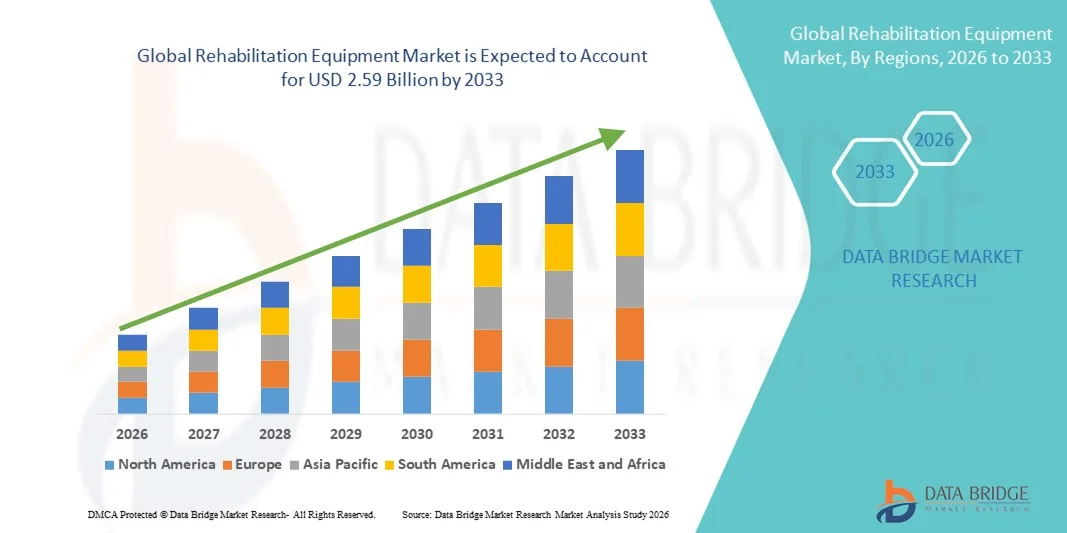
- As per Data Bridge Market Research analysis that the global rehabilitation equipment market size was valued at USD 1.74 billion in 2025 and is expected to reach USD 2.59 billion by 2033, at a CAGR of 5.10% during the forecast period
- The market growth is largely fueled by the rising prevalence of chronic diseases, musculoskeletal disorders, and neurological conditions, along with the growing geriatric population worldwide, leading to increased demand for physical therapy and mobility support solutions across healthcare settings
- Furthermore, increasing awareness regarding early rehabilitation, technological advancements in robotic-assisted therapy and smart rehabilitation devices, and expanding home healthcare services are establishing rehabilitation equipment as an essential component of modern patient recovery and long-term care management. These converging factors are accelerating the adoption of advanced rehabilitation solutions, thereby significantly boosting the industry's growth
Market Size & Forecast
- Global Market Value (2025): USD 1.74 Billion
- Expected Market Value (2033): USD 2.59 Billion
- Forecast CAGR (2026–2033): 5.10%
What are the Major Takeaways of Rehabilitation Equipment Market?
- Rehabilitation equipment, encompassing devices designed to aid recovery, improve mobility, and restore physical function, has become an essential component of modern healthcare systems across hospitals, rehabilitation centers, and home care settings due to its critical role in enhancing patient outcomes and supporting long-term therapy programs
- The escalating demand for rehabilitation equipment is primarily fueled by the rising prevalence of chronic diseases, increasing incidence of sports and accident-related injuries, expanding geriatric population, and growing awareness regarding the benefits of early and continuous physical therapy
- North America dominated the rehabilitation equipment market with the largest revenue share of 38.9% in 2025, characterized by advanced healthcare infrastructure, favorable reimbursement frameworks, and a high adoption rate of technologically advanced rehabilitation solutions, with the U.S. witnessing significant growth in demand for robotic-assisted therapy systems and home-based rehabilitation devices
- Asia-Pacific is expected to be the fastest growing region in the rehabilitation equipment market during the forecast period due to rapid healthcare infrastructure development, rising healthcare expenditure, increasing medical tourism, and growing awareness about post-operative and neurological rehabilitation services
- Mobility equipment segment dominated the rehabilitation equipment market with a market share of 41.5% in 2025, driven by strong demand for wheelchairs, walkers, and scooters owing to the expanding elderly population and increasing cases of mobility impairments worldwide
Report Scope and Rehabilitation Equipment Market Segmentation
|
Attributes |
Rehabilitation Equipment Key Market Insights |
|
Segments Covered |
|
|
Countries Covered |
North America
Europe
Asia-Pacific
Middle East and Africa
South America
|
|
Key Market Players |
|
|
Market Opportunities |
|
|
Value Added Data Infosets |
In addition to the insights on market scenarios such as market value, growth rate, segmentation, geographical coverage, and major players, the market reports curated by the Data Bridge Market Research also include in-depth expert analysis, patient epidemiology, pipeline analysis, pricing analysis, and regulatory framework |
What is the Key Trend in the Rehabilitation Equipment Market?
Rising Adoption of Robotic-Assisted and Smart Rehabilitation Systems
- A significant and accelerating trend in the global rehabilitation equipment market is the increasing integration of robotic-assisted technologies, wearable sensors, and AI-enabled therapy systems into clinical and home-based rehabilitation programs. This convergence of technologies is substantially improving therapy precision, patient engagement, and measurable recovery outcomes
- For instance, robotic gait training systems and exoskeleton devices are being increasingly deployed in advanced rehabilitation centers to assist patients with spinal cord injuries and stroke-related mobility impairments, enabling repetitive and data-driven movement therapy. Similarly, AI-powered rehabilitation platforms provide personalized exercise regimens and real-time performance tracking
- AI integration in rehabilitation equipment enables features such as motion tracking, adaptive resistance adjustment, and predictive analytics to optimize therapy sessions based on patient progress. For instance, certain smart rehabilitation devices utilize embedded sensors to monitor biomechanical parameters and deliver intelligent feedback to therapists. Furthermore, connected systems allow clinicians to remotely supervise patient adherence and recovery milestones
- The seamless integration of rehabilitation equipment with telehealth platforms and electronic health records facilitates coordinated care and centralized monitoring of patient recovery journeys. Through unified digital interfaces, healthcare providers can manage therapy protocols, track outcomes, and adjust treatment plans efficiently across multiple care settings
- This trend toward more intelligent, personalized, and technology-driven rehabilitation solutions is fundamentally reshaping patient expectations for recovery and functional independence. Consequently, companies are developing advanced robotic and sensor-based rehabilitation systems featuring automated therapy modes and remote connectivity capabilities
- The demand for technologically advanced and data-enabled rehabilitation equipment is growing rapidly across hospitals, specialty rehabilitation centers, and home care environments, as healthcare providers increasingly prioritize outcome-based treatment models and long-term patient engagement
- In addition, the growing incorporation of virtual reality-based therapy solutions is enhancing patient motivation and therapy adherence, creating immersive rehabilitation experiences that support faster and more engaging recovery processes
Rehabilitation Equipment Market Dynamics
Driver
Growing Need Due to Rising Prevalence of Chronic Diseases and Aging Population
- The increasing incidence of chronic diseases, musculoskeletal disorders, and neurological conditions, coupled with the rapidly expanding global geriatric population, is a significant driver for the heightened demand for rehabilitation equipment
- For instance, rising cases of stroke, osteoarthritis, and spinal injuries have led healthcare facilities to invest in advanced physical therapy and mobility restoration devices to improve patient recovery timelines and functional outcomes. Such strategic investments by healthcare institutions are expected to drive the rehabilitation equipment market growth in the forecast period
- As awareness regarding early intervention and structured rehabilitation programs increases, rehabilitation equipment offers essential support for restoring mobility, strength, and independence, thereby reducing long-term disability and healthcare costs
- Furthermore, the expansion of home healthcare services and post-acute care programs is making rehabilitation equipment an integral component of recovery pathways, enabling patients to continue therapy outside traditional hospital environments
- The convenience of portable rehabilitation devices, customizable therapy programs, and improved patient monitoring capabilities are key factors propelling the adoption of rehabilitation equipment in both clinical and home settings. The growing emphasis on value-based healthcare models further contributes to market expansion
- Government initiatives promoting disability support programs and rehabilitation services are further strengthening infrastructure development and funding allocation for advanced therapy equipment
- In addition, increasing participation in sports and rising awareness about injury rehabilitation among younger populations are contributing to sustained demand for modern rehabilitation solutions
Restraint/Challenge
High Equipment Costs and Limited Reimbursement Coverage
- Concerns surrounding the high cost of advanced rehabilitation equipment, including robotic systems and technologically sophisticated therapy devices, pose a significant challenge to broader market penetration, particularly in cost-sensitive regions
- For instance, premium robotic rehabilitation systems and exoskeleton devices often require substantial capital investment, making them less accessible to smaller clinics and rehabilitation centers with limited budgets
- Addressing these cost-related barriers through flexible financing options, scalable product offerings, and expanded reimbursement frameworks is crucial for ensuring wider accessibility. In addition, inconsistent reimbursement policies across different countries can restrict patient access to advanced rehabilitation technologies
- Moreover, the need for trained professionals to operate complex rehabilitation systems and interpret performance data adds to operational costs and may limit adoption in under-resourced healthcare facilities
- While technological advancements are gradually improving affordability and usability, the perception of high upfront investment and uncertain reimbursement coverage can still hinder widespread adoption, especially in developing healthcare market
- Limited awareness about advanced rehabilitation technologies in certain emerging economies further constrains market penetration and slows adoption rates
- Overcoming these challenges through cost optimization strategies, broader insurance coverage, targeted training initiatives, and awareness programs will be vital for sustaining long-term growth in the global rehabilitation equipment market
How is the Rehabilitation Equipment Market Segmented?
The market is segmented on the basis of product, application, and end user.
- By Product
On the basis of product, the rehabilitation equipment market is segmented into daily living aids, mobility equipment, walking assist devices, exercise equipment, body support devices, and therapy equipment. The mobility equipment segment dominated the market with the largest market revenue share of 41.5% in 2025, driven by its critical role in enabling movement and independence for patients with reduced mobility due to aging, injury, or neurological disorders. Hospitals, rehabilitation centers, and home care settings heavily rely on mobility aids such as wheelchairs, walkers, and scooters to support patient rehabilitation and daily activities. The demand is also fueled by the growing geriatric population and rising awareness about enhancing quality of life through mobility solutions. Technological advancements such as powered wheelchairs, smart mobility devices, and sensor-integrated scooters are further improving safety and functionality. Mobility equipment also aids therapists in delivering effective physical rehabilitation programs and supports patients in performing exercises that improve strength and endurance. Its widespread use across clinical and home settings underscores its dominance in the rehabilitation equipment market.
The daily living aids segment is anticipated to witness the fastest growth rate during the forecast period, driven by increasing demand for devices that enable patients to perform everyday activities independently. Products such as adaptive utensils, dressing aids, reachers, and grab bars are gaining traction in home care and outpatient rehabilitation environments. Rising awareness among elderly populations and post-operative patients about the importance of independent living is fueling adoption. Innovation in ergonomic design, lightweight materials, and integration with smart home technologies is further enhancing usability and appeal. Daily living aids are increasingly being incorporated into personalized therapy programs to ensure continuity of care and patient adherence. In addition, government initiatives promoting home-based rehabilitation and aging-in-place solutions are driving market expansion for this subsegment.
- By Application
On the basis of application, the rehabilitation equipment market is segmented into physical rehabilitation & training, occupational rehabilitation & training, strength and endurance, and pain reduction. The physical rehabilitation & training segment dominated the market in 2025, driven by the widespread need for restoring functional abilities and mobility after injury, surgery, or neurological conditions. This application includes therapeutic exercises, gait training, and functional mobility programs implemented across hospitals, physiotherapy centers, and rehabilitation facilities. The segment benefits from the integration of robotic-assisted therapy devices and AI-enabled exercise equipment, which improve therapy precision and patient engagement. Demand is fueled by rising incidences of stroke, orthopedic disorders, and post-surgical rehabilitation requirements. Real-time monitoring and data-driven adjustments by therapists further enhance outcomes and patient adherence. The segment’s dominance is reinforced by insurance coverage and reimbursement policies supporting structured rehabilitation programs.
The strength and endurance segment is expected to witness the fastest growth during the forecast period due to increasing awareness of preventive and post-injury rehabilitation programs. It includes resistance training devices, functional exercise machines, and smart therapy equipment designed to enhance muscular strength, stamina, and overall endurance. The growth is supported by the rising adoption of home-based rehabilitation programs and tele-rehabilitation platforms. Patients recovering from sports injuries, orthopedic surgeries, or chronic conditions increasingly rely on strength-focused rehabilitation equipment to accelerate functional recovery. Integration with wearable sensors and digital platforms allows clinicians to remotely track progress and provide personalized exercise regimens. Furthermore, growing investments in rehabilitation-focused fitness technologies are boosting market adoption.
- By End User
On the basis of end user, the rehabilitation equipment market is segmented into rehabilitation centres, physiotherapy centres, home care settings, hospitals & clinics, and others. Hospitals & clinics dominated the market with the largest revenue share in 2025, as they remain primary centers for inpatient and outpatient rehabilitation services. Advanced rehabilitation devices such as robotic therapy systems, mobility aids, body support equipment, and smart exercise machines are widely deployed to improve patient outcomes. Hospitals benefit from structured rehabilitation programs, trained therapists, and centralized facilities that optimize equipment utilization. Government initiatives, insurance coverage, and healthcare funding further support adoption of high-end rehabilitation solutions. Integration of rehabilitation devices into multidisciplinary care teams enables faster recovery, reduced readmission rates, and improved patient satisfaction. The high prevalence of chronic diseases and post-surgical rehabilitation needs reinforces the dominance of this end-user segment.
Home care settings are expected to be the fastest growing end-user segment due to increasing preference for in-home rehabilitation solutions and adoption of portable, connected, and AI-enabled rehabilitation devices. Home-based equipment allows patients to continue therapy outside clinical environments, promoting independence and long-term adherence. Tele-rehabilitation platforms and wearable sensors facilitate remote monitoring by clinicians, ensuring continuity of care. The growth is further supported by the aging population, rising chronic conditions, and expansion of home healthcare services globally. Convenience, cost-effectiveness, and personalized therapy programs are key drivers of adoption. Government policies and insurance support for home-based rehabilitation are also enhancing penetration of this segment.
Which Region Holds the Largest Share of the Rehabilitation Equipment Market?
- North America dominated the rehabilitation equipment market with the largest revenue share of 38.9% in 2025, characterized by advanced healthcare infrastructure, favorable reimbursement frameworks, and a high adoption rate of technologically advanced rehabilitation solutions
- Healthcare providers and patients in the region increasingly value equipment that enhances recovery outcomes, including robotic-assisted therapy devices, mobility aids, and AI-enabled exercise equipment, which support personalized and efficient rehabilitation programs
- This widespread adoption is further supported by high healthcare expenditure, favorable insurance coverage, government initiatives promoting rehabilitation services, and the presence of trained medical professionals, establishing advanced rehabilitation equipment as a preferred choice in hospitals, clinics, and home care settings across the U.S. and Canada
U.S. Rehabilitation Equipment Market Insight
The U.S. rehabilitation equipment market captured the largest revenue share of 82% in 2025 within North America, driven by advanced healthcare infrastructure, high adoption of technology-enabled therapy devices, and the growing geriatric population. Patients and healthcare providers increasingly prioritize equipment that supports efficient recovery, including robotic-assisted therapy systems, mobility aids, and AI-enabled exercise devices. The rising trend of home-based rehabilitation and tele-rehabilitation platforms further propels the market. Government initiatives, insurance coverage, and reimbursement policies supporting rehabilitation programs also contribute to growth. In addition, the presence of leading medical device manufacturers and strong R&D activities are expanding the availability of innovative solutions.
Europe Rehabilitation Equipment Market Insight
The Europe rehabilitation equipment market is projected to grow at a steady CAGR during the forecast period, driven by rising healthcare expenditure, increasing prevalence of chronic diseases, and stringent healthcare standards. Countries such as Germany, France, and Italy are witnessing strong adoption of advanced rehabilitation devices in hospitals, clinics, and physiotherapy centers. Urbanization and a growing elderly population are boosting demand for mobility aids, daily living aids, and exercise equipment. European consumers value high-quality, technology-driven solutions that improve patient outcomes and functional independence. The market also benefits from government initiatives promoting post-acute care and home-based rehabilitation programs.
U.K. Rehabilitation Equipment Market Insight
The U.K. rehabilitation equipment market is anticipated to grow at a notable CAGR during the forecast period, driven by rising healthcare awareness, increasing demand for home-based rehabilitation, and government support for chronic disease management. Adoption of portable and connected rehabilitation devices is increasing among patients recovering from orthopedic surgery, stroke, or neurological conditions. The U.K.’s robust healthcare infrastructure, combined with technological advancements in smart therapy devices, supports market growth. Rising concerns about mobility impairment and quality of life are encouraging healthcare providers and patients to invest in rehabilitation equipment. In addition, the growing tele-rehabilitation and remote monitoring trend is further stimulating market expansion.
Germany Rehabilitation Equipment Market Insight
The Germany rehabilitation equipment market is expected to expand at a strong CAGR during the forecast period, driven by advanced healthcare facilities, a focus on technological innovation, and increasing awareness of post-acute care. The country’s well-developed rehabilitation centers and hospitals are integrating robotic-assisted therapy, body support devices, and mobility aids into patient care plans. Demand for eco-friendly, ergonomic, and data-enabled rehabilitation solutions is growing steadily. The government’s focus on geriatric care and chronic disease management further supports adoption. Integration of rehabilitation devices with telehealth platforms is enhancing accessibility and monitoring efficiency, promoting long-term use.
Asia-Pacific Rehabilitation Equipment Market Insight
The Asia-Pacific rehabilitation equipment market is poised to grow at the fastest CAGR during the forecast period, driven by rapid urbanization, rising disposable incomes, and technological advancements in countries such as China, Japan, and India. The region’s growing awareness of rehabilitation benefits and the expansion of home healthcare services are fueling adoption. Increasing government initiatives promoting digital health and rehabilitation infrastructure are supporting market growth. Moreover, APAC’s emergence as a manufacturing hub for rehabilitation devices is improving affordability and accessibility. Growing demand in hospitals, physiotherapy centers, and home care settings is further propelling the market.
Japan Rehabilitation Equipment Market Insight
The Japan rehabilitation equipment market is gaining momentum due to the country’s aging population, high-tech healthcare infrastructure, and focus on patient convenience. Adoption of smart therapy devices, wearable sensors, and robotic-assisted rehabilitation systems is increasing in hospitals, clinics, and home care environments. Tele-rehabilitation and remote monitoring solutions are gaining popularity to enhance therapy adherence. The government’s focus on elderly care and chronic disease management is supporting market growth. Cultural emphasis on quality of life and independence drives preference for advanced rehabilitation equipment. Integration with connected health platforms allows clinicians to track patient recovery efficiently.
India Rehabilitation Equipment Market Insight
The India rehabilitation equipment market accounted for the largest revenue share in Asia-Pacific in 2025, driven by rapid urbanization, a growing middle class, and increasing awareness about rehabilitation and physical therapy. Hospitals, home care settings, and physiotherapy centers are adopting mobility aids, daily living aids, and exercise equipment at a fast pace. Government initiatives promoting healthcare infrastructure and digital health are further boosting adoption. Affordability and availability of locally manufactured rehabilitation devices are attracting consumers and healthcare providers alike. Rising incidence of chronic diseases and orthopedic injuries is contributing to sustained demand. The growing focus on home-based rehabilitation and tele-rehabilitation solutions is also accelerating market growth.
Which are the Top Companies in Rehabilitation Equipment Market?
The Rehabilitation Equipment industry is primarily led by well-established companies, including:
- Invacare International Holdings Corp. (U.S.)
- Enovis (U.S.)
- Ottobock SE & Co. KGaA (Germany)
- ReWalk Robotics Ltd. (Israel)
- Ekso Bionics Holdings, Inc. (U.S.)
- Cyberdyne, Inc. (Japan)
- Hocoma AG (Switzerland)
- Tyromotion GmbH (Austria)
- Bionik Laboratories Corp. (Canada)
- Dynasplint Systems, Incorporated (U.S.)
- Caremax Rehabilitation Equipment Co., Ltd (China)
- GF Health Products, Inc. (U.S.)
- Medline Industries, LP (U.S.)
- Arjo AB (Sweden)
- Handicare Group AB (Sweden)
- LINET Group SE (Czech Republic)
- Guldmann A/S (Denmark)
- Sunrise Medical LLC (U.S.)
- Prism Medical UK Ltd. (U.K.)
What are the Recent Developments in Global Rehabilitation Equipment Market?
- In October 2025, wearable technology involving smart braces, exoskeletons, and digital recovery tools was highlighted in a World Health publication as transforming injury rehabilitation by enabling real‑time tracking, personalized therapy adjustments, and integrated patient progress reporting showing how consumer and clinical wearables are shifting traditional rehabilitation paradigms
- In October 2025, researchers from the University of Queensland began trials of a world‑first lightweight ankle‑focused exoskeleton for people with Motor Neurone Disease (MND), designed to improve mobility confidence and delay reliance on wheelchairs through real‑world wearable robotics
- In July 2025, AI‑powered exoskeletons from Wandercraft helped paralyzed patients walk again in clinical settings, with the company collaborating with Nvidia and AWS to enhance balance and mobility technology, pushing toward broader home use and Medicare reimbursement support
- In April 2025, Tyromotion opened a new European headquarters in Vienna, strengthening its presence and ability to innovate across robotic and sensor‑based rehabilitation devices to support expansion and advanced product development in rehabilitation technology
- In June 2025, Wandercraft secured a USD 75 million Series D funding round to accelerate development and global deployment of its AI‑powered rehabilitation exoskeletons, including expanded clinical use of Atalante X and commercialization of the personal exoskeleton Eve designed for everyday hands‑free walking

- Interactive Data Analysis Dashboard
- Company Analysis Dashboard for high growth potential opportunities
- Research Analyst Access for customization & queries
- Competitor Analysis with Interactive dashboard
- Latest News, Updates & Trend analysis
- Harness the Power of Benchmark Analysis for Comprehensive Competitor Tracking
Data collection and base year analysis are done using data collection modules with large sample sizes. The stage includes obtaining market information or related data through various sources and strategies. It includes examining and planning all the data acquired from the past in advance. It likewise envelops the examination of information inconsistencies seen across different information sources. The market data is analysed and estimated using market statistical and coherent models. Also, market share analysis and key trend analysis are the major success factors in the market report. To know more, please request an analyst call or drop down your inquiry.
The key research methodology used by DBMR research team is data triangulation which involves data mining, analysis of the impact of data variables on the market and primary (industry expert) validation. Data models include Vendor Positioning Grid, Market Time Line Analysis, Market Overview and Guide, Company Positioning Grid, Patent Analysis, Pricing Analysis, Company Market Share Analysis, Standards of Measurement, Global versus Regional and Vendor Share Analysis. To know more about the research methodology, drop in an inquiry to speak to our industry experts.
Data Bridge Market Research is a leader in advanced formative research. We take pride in servicing our existing and new customers with data and analysis that match and suits their goal. The report can be customized to include price trend analysis of target brands understanding the market for additional countries (ask for the list of countries), clinical trial results data, literature review, refurbished market and product base analysis. Market analysis of target competitors can be analyzed from technology-based analysis to market portfolio strategies. We can add as many competitors that you require data about in the format and data style you are looking for. Our team of analysts can also provide you data in crude raw excel files pivot tables (Fact book) or can assist you in creating presentations from the data sets available in the report.













