


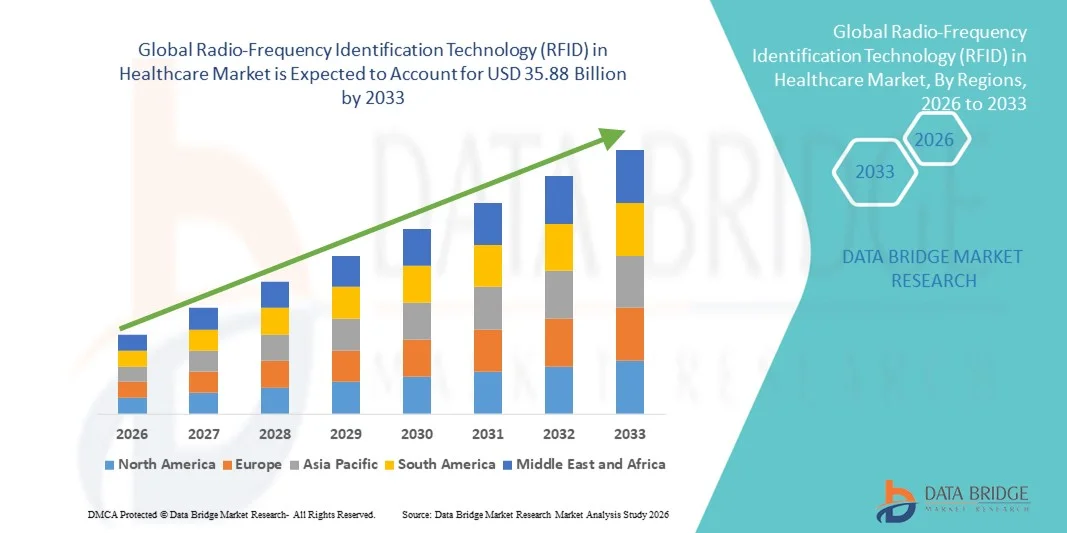
Radio-Frequency Identification Technology (RFID) in Healthcare Market Size
- The global Radio-Frequency Identification Technology (RFID) in healthcare market size was valued at USD 6.98 billion in 2025 and is expected to reach USD 35.88 billion by 2033, at a CAGR of 22.70% during the forecast period
- The market growth is largely driven by the increasing need for real-time tracking, inventory management, and patient safety solutions within hospitals and healthcare facilities, coupled with the integration of advanced IoT and data analytics technologies
- Furthermore, rising demand for streamlined operations, enhanced asset management, and improved patient care is positioning RFID technology as a critical tool in modern healthcare settings. These factors are accelerating the adoption of RFID solutions, thereby significantly propelling the market’s growth
Radio-Frequency Identification Technology (RFID) in Healthcare Market Analysis
- Radio-Frequency Identification Technology (RFID) in healthcare, enabling real-time tracking of assets, inventory, and patients, is becoming an essential component of modern hospital and clinical operations due to its ability to enhance efficiency, reduce errors, and integrate seamlessly with healthcare management systems
- The increasing adoption of Radio-Frequency Identification Technology (RFID) in healthcare is primarily driven by the need for improved patient safety, streamlined inventory and asset management, and regulatory compliance, alongside growing investments in smart hospital infrastructure and IoT-enabled healthcare solutions
- North America dominated the Radio-Frequency Identification Technology (RFID) in healthcare market with the largest revenue share of 39.4% in 2025, attributed to advanced healthcare infrastructure, high adoption of digital health solutions, and a strong presence of leading RFID solution providers, with the U.S. witnessing extensive deployment of RFID for patient tracking, surgical instruments, and medication management, supported by innovations in cloud-based and AI-enabled RFID platforms
- Asia-Pacific is expected to be the fastest-growing region in the Radio-Frequency Identification Technology (RFID) in healthcare market during the forecast period due to rising healthcare spending, increasing hospital modernization initiatives, and government support for technology-driven patient care solutions
- Asset tracking segment dominated the Radio-Frequency Identification Technology (RFID) in healthcare market with a market share of 42% in 2025, driven by the critical need for efficient management of medical equipment, inventory, and supply chain operations within healthcare facilities
Report Scope and Radio-Frequency Identification Technology (RFID) in Healthcare Market Segmentation
|
Attributes |
Radio-Frequency Identification Technology (RFID) in Healthcare Key Market Insights |
|
Segments Covered |
|
|
Countries Covered |
North America
Europe
Asia-Pacific
Middle East and Africa
South America
|
|
Key Market Players |
|
|
Market Opportunities |
|
|
Value Added Data Infosets |
In addition to the insights on market scenarios such as market value, growth rate, segmentation, geographical coverage, and major players, the market reports curated by the Data Bridge Market Research also include in-depth expert analysis, patient epidemiology, pipeline analysis, pricing analysis, and regulatory framework |
Radio-Frequency Identification Technology (RFID) in Healthcare Market Trends
Real-Time Operational Efficiency Through AI and IoT Integration
- A significant and accelerating trend in the global Radio-Frequency Identification Technology (RFID) in healthcare market is the increasing integration with artificial intelligence (AI) and Internet of Things (IoT) platforms, enabling real-time tracking and predictive analytics for assets, patients, and inventory
- For instance, Zebra Technologies’ RFID-enabled smart hospital solution integrates with AI-driven analytics to optimize equipment usage and reduce patient wait times, enhancing operational efficiency
- AI integration in RFID systems allows predictive maintenance of medical equipment, automated alerts for inventory replenishment, and intelligent patient flow management. For instance, some Impinj RFID solutions utilize AI to track high-risk patients and optimize hospital workflow in real time
- The seamless integration of RFID with IoT platforms facilitates centralized control over medical assets, inventory, and patient data, allowing healthcare administrators to manage resources across multiple departments through a unified interface
- This trend toward intelligent, interconnected, and data-driven RFID systems is transforming hospital operations, with companies such as STid developing AI-enabled RFID solutions that provide automated alerts for equipment maintenance and patient movement tracking
- The demand for RFID systems with AI and IoT capabilities is growing rapidly across hospitals and healthcare facilities, as administrators prioritize efficiency, safety, and data-driven operational insights. For instance, hospitals in Europe are adopting RFID-enabled smart beds that automatically adjust patient allocation and monitor occupancy levels in real time, improving patient management
- Increasing collaborations between RFID solution providers and healthcare software developers are creating integrated platforms for end-to-end hospital management, enhancing interoperability and workflow optimization
Radio-Frequency Identification Technology (RFID) in Healthcare Market Dynamics
Driver
Increasing Need for Enhanced Patient Safety and Operational Management
- The rising demand for improved patient safety, streamlined asset management, and efficient hospital operations is a significant driver for the adoption of RFID technology in healthcare
- For instance, in March 2025, Honeywell introduced a new RFID-enabled medication tracking solution to prevent errors and ensure compliance with regulatory standards, driving healthcare facility adoption
- As hospitals seek to reduce errors, prevent asset loss, and ensure timely patient care, RFID systems provide real-time tracking, automated alerts, and detailed logs, offering a clear advantage over manual processes
- Furthermore, the increasing deployment of smart hospital initiatives and IoT-enabled healthcare infrastructure is making RFID a critical tool for seamless operations and data-driven decision-making
- The ability to track medical equipment, monitor patient movement, and manage inventory in real time through RFID applications is propelling adoption in both large hospitals and outpatient clinics, while integration with hospital information systems further enhances operational efficiency
- For instance, some hospitals in the U.S. are using RFID wristbands to track patient vital signs and medication schedules, reducing manual errors and improving patient safety
- Government initiatives promoting digital health infrastructure and smart hospital programs are further driving investment and adoption of RFID solutions across public healthcare facilities
Restraint/Challenge
High Implementation Costs and Data Security Concerns
- Concerns regarding patient data security and the high initial costs of RFID deployment pose challenges to broader adoption within healthcare facilities, as systems require robust infrastructure and cybersecurity measures
- For instance, reports of unauthorized access to RFID patient tracking data have made some healthcare providers cautious about implementing connected solutions across their hospitals
- Addressing these concerns through secure authentication protocols, encryption standards, and compliance with healthcare data regulations is crucial for building trust and ensuring successful deployment. For instance, STid emphasizes advanced encryption and HIPAA-compliant security features in its RFID solutions
- In addition, the relatively high upfront investment for RFID hardware, software, and integration can be a barrier, particularly for smaller clinics or hospitals in developing regions
- While costs are gradually decreasing with technological advancements, perceived premium pricing can still hinder adoption, especially for institutions that do not immediately perceive operational benefits from RFID systems
- Overcoming these challenges through enhanced cybersecurity, cost optimization, and training programs for hospital staff will be vital for sustained growth of the RFID in healthcare market. For instance, some healthcare providers are implementing phased RFID adoption strategies to manage costs and minimize operational disruptions during deployment
- Lack of standardized protocols for RFID data interoperability between different hospital systems can create integration challenges, necessitating collaboration between vendors and healthcare IT departments for seamless implementation
Radio-Frequency Identification Technology (RFID) in Healthcare Market Scope
The market is segmented on the basis of product, application, and end-user.
- By Product
On the basis of product, the RFID in healthcare market is segmented into systems & software, tags, readers, printers, and others. The systems & software segment dominated the market with the largest revenue share in 2025, driven by the critical role of RFID software in managing real-time data, asset allocation, patient monitoring, and inventory control. Hospitals and healthcare facilities prioritize advanced software platforms for their ability to integrate with electronic health records (EHR) and IoT devices, ensuring seamless workflow automation. The demand for robust RFID systems is further fueled by the need to comply with regulatory standards, reduce operational inefficiencies, and optimize resource utilization. In addition, software solutions enable predictive analytics, reporting, and alerts for potential operational risks, which is essential for large hospitals and multi-department facilities. Vendors offering cloud-based and AI-integrated software solutions are seeing strong adoption across global markets, reinforcing the segment's dominance.
The tags segment is anticipated to witness the fastest growth rate from 2026 to 2033, propelled by rising adoption in hospitals, pharmacies, and laboratories for asset and patient tracking. RFID tags are increasingly used for real-time monitoring of medical equipment, surgical instruments, and critical medications, providing high visibility and reducing loss or misplacement. The growth is supported by advancements in printable and flexible tag technology, which lowers costs and facilitates widespread deployment. Tags are also essential for pharmaceutical tracking and blood management, meeting strict compliance requirements and improving patient safety. The ease of integration with existing RFID readers and systems further enhances adoption in diverse healthcare settings.
- By Application
On the basis of application, the market is segmented into asset tracking, patient tracking, pharmaceutical tracking, blood tracking, and others. The asset tracking segment dominated the market in 2025 with a market share of 42%, driven by the critical need to monitor medical equipment, devices, and hospital inventory in real time. Hospitals face significant challenges in managing high-value medical assets, and RFID-based asset tracking ensures efficient allocation, reduces downtime, and minimizes operational losses. This application also supports preventive maintenance schedules and compliance reporting, making it indispensable for large healthcare facilities. Integration with hospital information systems and IoT devices further enhances operational efficiency, making asset tracking a core function of RFID deployment. Leading hospitals are increasingly adopting RFID asset tracking to streamline workflows and optimize costs across departments.
The patient tracking segment is expected to witness the fastest CAGR from 2026 to 2033, fueled by increasing focus on patient safety, personalized care, and real-time monitoring of patient movements. RFID wristbands and tags are used to track patient location, monitor vitals, and ensure timely medication administration, reducing human errors and enhancing care quality. Hospitals are adopting these solutions for pediatric, geriatric, and high-risk patient groups, ensuring accurate identification and monitoring. The growth is further supported by integration with EHR systems and AI-driven analytics, which improve workflow automation and operational efficiency. Patient tracking adoption is rapidly expanding across smart hospitals and large-scale healthcare facilities, driving this segment’s growth.
- By End-User
On the basis of end-user, the RFID in healthcare market is segmented into hospitals, pharmaceutical, and others. The hospitals segment dominated the market with the largest revenue share in 2025, as hospitals require real-time visibility of assets, patients, and inventory to ensure efficient operations and compliance with healthcare regulations. Large hospitals and multi-specialty facilities are increasingly investing in RFID solutions to improve operational efficiency, reduce human error, and enhance patient safety. Integration with existing hospital information systems and IoT infrastructure further strengthens adoption, making hospitals the primary end-user of RFID technology in healthcare.
The pharmaceutical segment is expected to witness the fastest growth from 2026 to 2033, driven by the growing need for track-and-trace solutions to prevent counterfeit drugs, ensure regulatory compliance, and improve supply chain visibility. RFID solutions enable pharmaceutical companies to monitor production, distribution, and storage of medications in real time, minimizing losses and ensuring patient safety. The growth is supported by increasing government regulations and initiatives for serialization and anti-counterfeiting measures. In addition, RFID-based pharmaceutical tracking improves inventory management, reduces expiration-related waste, and enhances operational efficiency across the supply chain.
Radio-Frequency Identification Technology (RFID) in Healthcare Market Regional Analysis
- North America dominated the Radio-Frequency Identification Technology (RFID) in healthcare market with the largest revenue share of 39.4% in 2025, attributed to advanced healthcare infrastructure, high adoption of digital health solutions, and a strong presence of leading RFID solution providers
- Healthcare facilities in the region highly value the ability of RFID systems to provide real-time asset tracking, patient monitoring, and inventory management, improving operational efficiency and patient safety
- This widespread adoption is further supported by high healthcare spending, favorable government initiatives promoting smart hospital infrastructure, and the growing integration of IoT and AI technologies, establishing RFID as a critical tool in hospital operations and clinical workflows
U.S. Radio-Frequency Identification Technology (RFID) in Healthcare Market Insight
The U.S. RFID in healthcare market captured the largest revenue share of 82% in 2025 within North America, fueled by the rapid adoption of digital health solutions and smart hospital initiatives. Healthcare providers are increasingly prioritizing patient safety, asset tracking, and inventory management through real-time RFID monitoring systems. The growing deployment of AI-enabled and IoT-integrated RFID solutions further propels market growth. In addition, hospitals are adopting RFID for medication tracking, surgical instrument management, and patient identification to reduce errors and ensure compliance. The robust presence of leading RFID solution providers and government support for healthcare digitalization significantly contributes to the expansion of the U.S. market.
Europe Radio-Frequency Identification Technology (RFID) in Healthcare Market Insight
The Europe RFID in healthcare market is projected to expand at a substantial CAGR throughout the forecast period, primarily driven by stringent regulatory requirements and a growing focus on patient safety and operational efficiency. Increasing hospital modernization initiatives, coupled with the adoption of connected healthcare devices, are fostering the deployment of RFID systems. European healthcare facilities are leveraging RFID technology for asset tracking, patient monitoring, and pharmaceutical management. The region is witnessing strong growth across hospitals, clinics, and pharmaceutical supply chains, with RFID systems being incorporated into both new infrastructure projects and healthcare facility upgrades.
U.K. Radio-Frequency Identification Technology (RFID) in Healthcare Market Insight
The U.K. RFID in healthcare market is anticipated to grow at a noteworthy CAGR during the forecast period, driven by the increasing need for secure patient data management, real-time asset tracking, and regulatory compliance. Concerns regarding patient safety and operational efficiency are encouraging hospitals and clinics to adopt RFID-enabled solutions. The U.K.’s healthcare system is increasingly embracing digital solutions, supported by government initiatives promoting smart hospital infrastructure and IoT integration. RFID deployment in the U.K. is further strengthened by robust healthcare IT infrastructure and the growing emphasis on reducing errors in medication and equipment management.
Germany Radio-Frequency Identification Technology (RFID) in Healthcare Market Insight
The Germany RFID in healthcare market is expected to expand at a considerable CAGR during the forecast period, fueled by advanced healthcare infrastructure, a strong emphasis on innovation, and government-backed digital healthcare programs. Hospitals in Germany are increasingly deploying RFID systems for real-time tracking of medical equipment, patient monitoring, and pharmaceutical management. The integration of RFID with IoT and AI solutions enhances operational efficiency and ensures compliance with strict healthcare regulations. Germany’s focus on sustainability and technology-driven patient care is also driving the adoption of RFID solutions across hospitals and research facilities.
Asia-Pacific Radio-Frequency Identification Technology (RFID) in Healthcare Market Insight
The Asia-Pacific RFID in healthcare market is poised to grow at the fastest CAGR of 25% during the forecast period of 2026 to 2033, driven by increasing healthcare spending, modernization of hospital infrastructure, and government initiatives promoting smart hospitals in countries such as China, Japan, and India. The region’s growing focus on patient safety, asset management, and operational efficiency is boosting adoption of RFID systems. Furthermore, technological advancements, rising awareness of digital health solutions, and the presence of regional RFID solution providers are enhancing affordability and accessibility, supporting wider deployment across hospitals, clinics, and pharmaceutical facilities.
Japan Radio-Frequency Identification Technology (RFID) in Healthcare Market Insight
The Japan RFID in healthcare market is gaining momentum due to the country’s high-tech healthcare ecosystem, advanced hospital infrastructure, and emphasis on patient safety. RFID adoption is driven by the increasing number of smart hospitals and connected healthcare facilities. Integration of RFID systems with IoT and AI platforms enables real-time monitoring of patients, medical equipment, and pharmaceuticals, improving operational efficiency. Japan’s aging population and focus on preventive healthcare are also such likely to drive demand for automated patient tracking and inventory management solutions.
India Radio-Frequency Identification Technology (RFID) in Healthcare Market Insight
The India RFID in healthcare market accounted for the largest market revenue share in Asia-Pacific in 2025, attributed to the country’s expanding healthcare infrastructure, rising private and public healthcare investment, and increasing adoption of digital health technologies. Hospitals and clinics are deploying RFID for patient monitoring, asset tracking, and pharmaceutical management to improve efficiency and safety. The push toward smart hospitals, government initiatives for healthcare digitization, and cost-effective RFID solutions from domestic and regional providers are key factors driving market growth in India.
Radio-Frequency Identification Technology (RFID) in Healthcare Market Share
The Radio-Frequency Identification Technology (RFID) in Healthcare industry is primarily led by well-established companies, including:
- GAO Group (U.S.)
- Honeywell International Inc. (U.S.)
- Impinj, Inc. (U.S.)
- Mobile Aspects, (U.S.)
- Alien Technology, LLC. (U.S.)
- STiD (France)
- Radianse (U.S.)
- RF Technologies, Inc. (U.S.)
- Securitas Healthcare LLC (U.S.)
- Sato Corporation (Japan)
- NewAge Industries, Inc. (U.S.)
- IBM (U.S.)
- Avery Dennison Corporation (U.S.)
- Zebra Technologies Corp (U.S.)
- Applied Wireless Identifications Group, Inc. (U.S.)
- CAEN RFID S.r.l. (Italy)
- Invengo Information Technology Ltd. Co. (China)
- Logi-Tag Systems (U.S.)
- CCL Industries (Canada)
- CenTrak Inc. (U.S.)
What are the Recent Developments in Global Radio-Frequency Identification Technology (RFID) in Healthcare Market?
- In April 2025, Biolog‑id was awarded an innovation partnership by the French Blood Establishment (EFS) to deploy its Smart Access Kit a connected RFID‑based enclosure that ensures secure, optimized blood product distribution, especially to remote areas, thereby improving continuity and traceability in France’s national blood supply chain
- In December 2024, Biolog‑id, in partnership with Kuwait’s Advanced Technology Company (ATC), rolled out a nationwide RFID‑based blood‑product tracking solution across all blood banks in Kuwait. Bags are tagged with e‑Labels capturing type, quantity, collection date, and expiry, enabling real-time visibility across the country’s blood supply chain
- In December 2023, Biolog‑id secured a multi-year contract with IPST (Portugal’s National Blood Institute), funded by the European Commission, to implement its full transfusion RFID solution (tags + readers + software) for tracking plasma units, improving traceability, transport, and inventory management across Portuguese blood centers
- In July 2023, Biolog‑id signed a long-term agreement with CHMT Hospital Center in Portugal to deploy its end-to-end transfusion solution covering encoding, transport, inventory, and x-match modules streamlining the hospital’s blood component management with RFID‑driven visibility
- In October 2022, Biolog‑id launched a high-density (HD) RFID kit designed for large blood centers and hospital blood banks. The kit supports multiple cold-room fridges, features RFID-friendly bins, and offers full traceability of blood units during storage and transport, addressing scale and process integration challenges

- Interactive Data Analysis Dashboard
- Company Analysis Dashboard for high growth potential opportunities
- Research Analyst Access for customization & queries
- Competitor Analysis with Interactive dashboard
- Latest News, Updates & Trend analysis
- Harness the Power of Benchmark Analysis for Comprehensive Competitor Tracking
Data collection and base year analysis are done using data collection modules with large sample sizes. The stage includes obtaining market information or related data through various sources and strategies. It includes examining and planning all the data acquired from the past in advance. It likewise envelops the examination of information inconsistencies seen across different information sources. The market data is analysed and estimated using market statistical and coherent models. Also, market share analysis and key trend analysis are the major success factors in the market report. To know more, please request an analyst call or drop down your inquiry.
The key research methodology used by DBMR research team is data triangulation which involves data mining, analysis of the impact of data variables on the market and primary (industry expert) validation. Data models include Vendor Positioning Grid, Market Time Line Analysis, Market Overview and Guide, Company Positioning Grid, Patent Analysis, Pricing Analysis, Company Market Share Analysis, Standards of Measurement, Global versus Regional and Vendor Share Analysis. To know more about the research methodology, drop in an inquiry to speak to our industry experts.
Data Bridge Market Research is a leader in advanced formative research. We take pride in servicing our existing and new customers with data and analysis that match and suits their goal. The report can be customized to include price trend analysis of target brands understanding the market for additional countries (ask for the list of countries), clinical trial results data, literature review, refurbished market and product base analysis. Market analysis of target competitors can be analyzed from technology-based analysis to market portfolio strategies. We can add as many competitors that you require data about in the format and data style you are looking for. Our team of analysts can also provide you data in crude raw excel files pivot tables (Fact book) or can assist you in creating presentations from the data sets available in the report.













