


What is the Rice Bran Oil Market Size and Growth Rate?
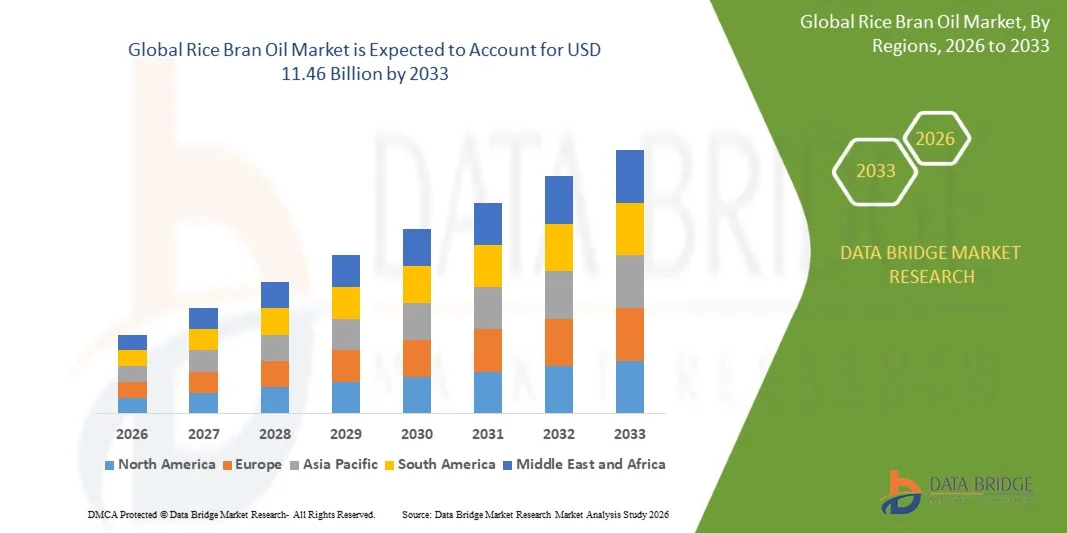
- As per Data Bridge Market Research analysis, the rice bran oil market was valued at USD 6.57 billion in 2025 and is projected to reach USD 11.46 billion by 2033, growing at a CAGR of 7.21% from 2026 to 2033.
- The market is experiencing consistent growth driven by rising consumer awareness of the nutritional benefits of rice bran oil, increasing demand for healthier edible oils, and its expanding applications across food processing, nutraceuticals, cosmetics, and personal care products.
- The growing concerns regarding cardiovascular health, increasing preference for oils containing antioxidants and beneficial fatty acids, and rising consumption of functional food products are encouraging consumers and food manufacturers to adopt rice bran oil. The expanding foodservice sector and growing availability of refined and organic rice bran oil through retail and online channels are further supporting market growth.
Market Size & Forecast
- Global Market Value (2025): USD 6.57 Billion
- Expected Market Value (2033): USD 11.46 Billion
- Forecast CAGR (2026–2033): 7.21%
- Leading Region in 2025: North America
- Fastest Growing Region: Asia Pacific
What are the Major Takeaways of the Rice Bran Oil Market?
- North America dominated the rice bran oil market with the largest revenue share of 35.2% in 2025, supported by growing consumer awareness of the health benefits of rice bran oil, increasing demand for healthier cooking oils, and expanding applications in food, nutraceuticals, cosmetics, and personal care products.
- Asia-Pacific is expected to be the fastest-growing region at a CAGR of 6.8% from 2026 to 2033, fueled by rising rice production, abundant availability of rice bran, increasing health consciousness, expanding food processing industries, and growing consumption of rice bran oil
- The refined segment led the market with a 75.3% share in 2025, driven by its neutral taste, high smoke point, oxidative stability, and suitability for everyday cooking and food processing.
- Organic are the fastest-growing product type, projected to register a CAGR of 10.75%, reflecting the surge consumer preference for clean-label, naturally sourced, and minimally processed food products.
- The solvent extraction segment dominated the processing category with a 70% revenue share in 2025, led by its high oil-recovery efficiency and suitability for processing large volumes of rice bran
- Food and beverages accounted for 59.80% of the market share in 2025, preferred by extensive use of rice bran oil in household cooking, frying, food processing, bakery products, snacks, and foodservice applications
- The cosmetics segment is the fastest-growing application category, with a CAGR of 9.91%, driven by increasing demand for plant-derived oils in skincare, haircare, and cosmetic formulations.
Report Scope and Rice Bran Oil Market Segmentation
|
Attributes |
Rice Bran Oil Key Market Insights |
|
Segments Covered |
|
|
Countries Covered |
North America
Europe
Asia-Pacific
Middle East and Africa
South America
|
|
Key Market Players |
|
|
Market Opportunities |
|
|
Value Added Data Infosets |
In addition to the insights on market scenarios such as market value, growth rate, segmentation, geographical coverage, and major players, the market reports curated by the Data Bridge Market Research also include in-depth expert analysis, pricing analysis, brand share analysis, consumer survey, demography analysis, supply chain analysis, value chain analysis, raw material/consumables overview, vendor selection criteria, PESTLE Analysis, Porter Analysis, and regulatory framework. |
What is the Key Trend in the Rice Bran Oil Market?
- Manufacturers are increasingly positioning rice bran oil as a functional and health-oriented edible oil, supported by its naturally occurring γ-oryzanol, phytosterols, tocopherols, and tocotrienols, which enhance its nutritional and antioxidant profile.
- For instance, in December 2025, research published in Food Chemistry demonstrated that enzyme-assisted aqueous extraction combined with supercritical CO₂ produced rice bran oil with higher γ-oryzanol and α-tocopherol retention and stronger antioxidant activity, supporting the development of bioactive-rich rice bran oil.
- Food manufacturers are increasingly exploring rice bran oil in functional foods, bakery products, spreads, snacks, and fortified products to capitalize on its nutritional properties and oxidative stability.
- Growing interest in value-added extraction and preservation of bioactive compounds is also encouraging the development of specialized rice bran oil products with higher concentrations of γ-oryzanol and other antioxidants.
- For instance, in February 2025, a study published in Antioxidants demonstrating optimized supercritical-fluid extraction of rice bran to recover γ-oryzanol-rich extracts with improved antioxidant activity, supporting the development of higher-value, bioactive-rich rice bran oil products.
- As consumers increasingly prioritize healthier edible oils and manufacturers seek multifunctional ingredients with nutritional and processing advantages, the development of premium, functional, and bioactive-rich rice bran oil products is expected to accelerate, strengthening the market's position within the broader healthy-oils industry.
What are the Key Drivers of the Rice Bran Oil Market?
- The growing consumer awareness of cardiovascular health and healthier dietary choices is increasing demand for rice bran oil, which contains unsaturated fatty acids, phytosterols, tocopherols, tocotrienols, and γ-oryzanol with recognized nutritional value.
- For instance, in August 2024, a study published in Lipids in Health and Disease found that consuming 30 g/day of rice bran oil for 8 weeks significantly reduced total cholesterol and LDL cholesterol while increasing HDL cholesterol and total antioxidant capacity in overweight/obese adults with metabolic syndrome, supporting demand for healthier edible oils
- Food manufacturers, restaurants, and households are increasingly replacing conventional cooking oils with alternatives perceived as healthier, while rice bran oil's high smoke point and neutral flavor support its suitability for frying, cooking, and food processing.
- For instance, in December 2024, a study published in Nutrients analyzed 11 randomized controlled trials involving 572 participants and found that rice bran consumption significantly reduced triglycerides by 15.13 mg/dL, total cholesterol by 11.80 mg/dL, and LDL cholesterol by 15.11 mg/dL; rice bran oil showed greater effects on total and LDL cholesterol than whole rice bran.
- With rising health consciousness, expanding processed-food consumption, and increasing demand for oils offering both nutritional and functional advantages, rice bran oil is expected to gain wider adoption across household, foodservice, and food-manufacturing applications.
Which Factors are Challenging the Growth of the Rice Bran Oil Market?
- Rice bran oil production remains constrained by the availability and quality of rice bran, as bran is highly susceptible to enzymatic deterioration and requires rapid stabilization after milling to preserve oil quality.
- For instance, in February 2024, a study published in the Journal of Agricultural and Food Chemistry highlighted that rice bran's high susceptibility to rancidity significantly restricts its wider utilization, with lipase-driven lipid hydrolysis being a major technical challenge requiring stabilization immediately after milling
- Delays between rice milling and stabilization can increase free fatty acids and adversely affect oil recovery, creating additional processing requirements and costs for manufacturers.
- Rice bran oil producers also face competition from widely established edible oils such as soybean, palm, sunflower, canola, and olive oil, which benefit from extensive production networks, consumer familiarity, and broad distribution.
- For instance, in December 2024, research article published in the Journal of the Science of Food and Agriculture reported that Bangladesh was projected to generate approximately 4.87 million tons of rice bran during fiscal year 2023–2024, while technological and socioeconomic barriers, including stabilization and postharvest losses, continue to hinder its higher-value utilization for rice bran oil and other products.
- The need for rapid bran stabilization, specialized extraction infrastructure, and competition from large-scale conventional edible-oil industries continues to increase production complexity and limit the ability of rice bran oil to achieve broader penetration in price-sensitive markets.
How is the Rice Bran Oil Market Segmented?
The rice bran oil market is segmented on the basis of product type, processing, application, end-user, and sales channel.
- By Product Type
On the basis of product type, the rice bran oil market is segmented into refined, crude, organic, conventional/non-organic, blended, and fortified rice bran oil. The refined rice bran oil segment dominated the market with 75.3% share in 2025, owing to its neutral taste, high smoke point, oxidative stability, and suitability for everyday cooking and food processing. Refined oil undergoes purification processes that remove impurities, free fatty acids, odors, and undesirable compounds, making it highly suitable for mass-market consumption. It is extensively used by households, restaurants, foodservice operators, and packaged-food manufacturers. The growing preference for healthier cooking oils with stable performance at high temperatures is further supporting demand. Increasing availability through supermarkets, hypermarkets, and online retail channels is also strengthening the segment.
The organic rice bran oil segment is projected to register the fastest growth at 10.75% CAGR from 2026 to 2033, driven by increasing consumer preference for clean-label, naturally sourced, and minimally processed food products. Organic rice bran oil is gaining popularity among health-conscious consumers seeking edible oils produced without conventional agricultural chemicals. Growing awareness of sustainable agriculture and environmentally responsible food production is encouraging manufacturers to introduce certified organic variants. Premium positioning also allows producers to target consumers willing to pay higher prices for perceived health and quality benefits. Expansion of organic food retailing and e-commerce is improving the availability of organic rice bran oil across developed markets. Increasing demand for natural ingredients in food, nutraceutical, and personal care applications is further supporting growth.
- By Processing
On the basis of processing, the rice bran oil market is segmented into solvent extraction, cold pressing, hot extraction, physical refining, and chemical refining. The solvent extraction segment dominated the processing category with 70% share in 2025, supported by its high oil-recovery efficiency and suitability for processing large volumes of rice bran. Rice bran contains a relatively moderate amount of oil, making efficient extraction important for commercial producers. Solvent-based processes enable manufacturers to recover a greater proportion of available oil from the bran compared with some mechanical extraction techniques. The technology is particularly suitable for large-scale rice-milling and oil-processing facilities. Continuous improvements in extraction and solvent-recovery systems are helping producers improve operational efficiency. Established industrial infrastructure and economies of scale further support widespread adoption.
The cold-pressing segment is projected to register the fastest growth at 6.8% CAGR from 2026 to 2033, driven by rising consumer demand for minimally processed and premium edible oils. Cold pressing generally involves mechanical extraction without intensive thermal treatment, making it attractive for consumers seeking products positioned as natural and less processed. Growing interest in clean-label and premium cooking oils is encouraging manufacturers to expand cold-pressed offerings. These products are increasingly marketed through specialty food stores, health-food retailers, and e-commerce platforms. Cold-pressed rice bran oil also benefits from the growing popularity of functional and wellness-oriented diets. Although extraction yields can be lower than those achieved through industrial solvent extraction, premium pricing can improve commercial attractiveness.
- By Application
On the basis of application, the rice bran oil market is segmented into pharmaceuticals, food and beverages, personal care, and cosmetics. The food and beverages segment dominated the application category with 59.8% share in 2025, supported by extensive use of rice bran oil in household cooking, frying, food processing, bakery products, snacks, and foodservice applications. Its high smoke point and relatively neutral flavor make it suitable for different cooking processes. Rice bran oil also contains compounds such as γ-oryzanol, tocopherols, tocotrienols, and phytosterols, increasing its appeal among health-conscious consumers. Food manufacturers are increasingly incorporating healthier vegetable oils into processed-food formulations. Rising consumption of packaged and convenience foods is creating additional demand from food-processing companies. Growing consumer awareness of healthier edible-oil alternatives is further supporting adoption.
The cosmetics segment is projected to register the fastest growth at 9.91% CAGR from 2026 to 2033, supported by increasing demand for plant-derived oils in skincare, haircare, and cosmetic formulations. Rice bran oil contains fatty acids, vitamin E compounds, and antioxidant components that make it attractive for moisturizing and conditioning applications. Cosmetic manufacturers are increasingly incorporating naturally derived oils into formulations as consumers seek cleaner and more recognizable ingredients. Growing interest in botanical and multifunctional ingredients is expanding the use of rice bran oil beyond traditional food applications. It is increasingly used in facial oils, creams, lotions, soaps, hair treatments, and other personal care products. Premium and natural cosmetics markets are providing additional opportunities for rice bran oil suppliers.
- By End-user
On the basis of end-user, the rice bran oil market is segmented into household, commercial, industrial, institutional, and food manufacturers. The household segment dominated the end-user category with 42.5% in 2025, supported by widespread use of rice bran oil as a cooking and frying oil. The segment accounted for approximately one-third of overall demand, reflecting the large consumer base for edible oils across major Asian markets. Health-conscious households increasingly consider rice bran oil an alternative to conventional edible oils because of its nutritional profile and high-temperature cooking performance. Increasing disposable incomes and urbanization are supporting demand for packaged and branded cooking oils. Retail availability through supermarkets, hypermarkets, convenience stores, and online platforms is improving consumer access. Manufacturers are also investing in consumer education and health-oriented marketing to increase product awareness. Growing preference for convenient, packaged, and premium edible oils is strengthening household consumption.
The food manufacturers segment is projected to register the fastest growth, with growth estimated at 7.9% CAGR through the forecast period, supported by increasing incorporation of rice bran oil into processed foods, snacks, bakery products, sauces, and other commercial food formulations. Food manufacturers value the oil for its neutral flavor, thermal stability, and functional characteristics. Growing demand for healthier formulations is encouraging processors to substitute or blend conventional oils with alternative vegetable oils. Expansion of packaged-food production in emerging economies is creating new bulk procurement opportunities. Manufacturers are also responding to clean-label and nutritional-positioning trends by using oils perceived as healthier. Increasing investments in food processing and ready-to-eat food production are expected to further expand demand.
- By Sales Channel
On the basis of sales channel, the rice bran oil market is segmented into supermarkets and hypermarkets, convenience stores, and specialty stores. The supermarkets and hypermarkets segment dominated the sales-channel category with 46.8% share in 2025, owing to extensive product assortment, established supply chains, and the ability to offer multiple rice bran oil brands and package sizes. These retail formats provide consumers with convenient access to branded edible oils and enable manufacturers to achieve broad geographic distribution. Promotional campaigns, discounts, loyalty programs, and private-label products further encourage purchases through large-format retailers. Rising urbanization is increasing consumer reliance on organized retail for routine grocery purchases. Supermarkets and hypermarkets also provide greater visibility for premium, organic, and fortified rice bran oil products.
The specialty stores segment is projected to register strong growth, estimated at 8.10% CAGR through the forecast period, driven by rising consumer interest in health foods, organic products, natural ingredients, and premium edible oils. Specialty retailers provide an effective platform for positioning organic, cold-pressed, fortified, and other value-added rice bran oil products. Health-conscious consumers often use these stores to discover products with specific nutritional or clean-label characteristics. Increasing demand for premium food products is encouraging manufacturers to expand distribution through natural-food and health-focused retailers. Specialty stores also provide greater opportunities for product education and differentiated marketing compared with conventional grocery channels. The expansion of organic and wellness-oriented retail networks is creating additional distribution opportunities.
Which Region Holds the Largest Share of the Rice Bran Oil Market?
- North America dominated the rice bran oil market with the largest revenue share of 35.2% in 2025, supported by growing consumer awareness of the health benefits of rice bran oil, increasing demand for healthier cooking oils, and expanding applications in food, nutraceuticals, cosmetics, and personal care products.
- The region also benefits from rising demand for clean-label and plant-based ingredients, increasing adoption of premium cooking oils, and strong distribution through supermarkets, specialty retailers, and e-commerce platforms. Growing interest in the nutritional properties of γ-oryzanol, tocopherols, tocotrienols, and phytosterols is further strengthening regional demand, while expanding health-conscious consumer preferences continue to support North America's leadership in the global market.
U.S. Rice Bran Oil Market Insight
The U.S. rice bran oil market is witnessing steady growth due to rising consumer awareness of healthier cooking oils, increasing demand for functional food ingredients, and growing interest in plant-based and clean-label products. The country’s developed food and beverage industry, along with expanding applications of rice bran oil in nutraceuticals, personal care, and cosmetics, is driving demand across household and commercial applications. In addition, increasing consumer focus on cardiovascular health and the nutritional benefits of γ-oryzanol, tocopherols, tocotrienols, and phytosterols is accelerating adoption across the U.S. market.
Asia-Pacific Rice Bran Oil Market Insight
The Asia-Pacific rice bran oil market is expected to witness rapid growth, driven by abundant rice production, expanding rice-milling industries, and rising consumption of healthier edible oils across countries such as India, China, Japan, and Thailand. Growing health consciousness, increasing disposable incomes, and rising demand for functional food products are supporting regional market expansion. In addition, the availability of rice bran as a major milling by-product and increasing investments in oil extraction and refining infrastructure are accelerating rice bran oil production and consumption across the region.
Japan Rice Bran Oil Market Insight
The Japan rice bran oil market is witnessing consistent growth due to strong consumer awareness of nutritional oils, established rice-processing infrastructure, and increasing demand for functional food ingredients. Food manufacturers and households are increasingly adopting rice bran oil for cooking and food preparation because of its neutral flavor, high smoke point, and nutritional properties. Moreover, growing interest in γ-oryzanol, antioxidants, and naturally derived ingredients is further contributing to market growth and supporting the use of rice bran oil in food, nutraceutical, and personal care applications.
China Rice Bran Oil Market Insight
The China rice bran oil market is growing rapidly, driven by the country’s large rice-processing industry, increasing urbanization, and rising consumer preference for healthier edible oils. Growing adoption of rice bran oil across household cooking, food processing, and nutraceutical applications is significantly boosting market demand. In addition, increasing investments in rice-bran utilization, expanding organized food retail, rising health awareness, and technological advancements in extraction and refining are positioning China as one of the major and fastest-growing markets for rice bran oil globally.
U.K. Rice Bran Oil Market Insight
The U.K. rice bran oil market is experiencing steady growth, supported by increasing consumer demand for healthier, plant-based, and premium cooking oils. Growing interest in clean-label food products and functional ingredients is contributing to the adoption of rice bran oil across household cooking, food manufacturing, nutraceuticals, and personal care applications. Furthermore, expanding specialty food retail and e-commerce distribution, along with rising awareness of rice bran oil’s antioxidant compounds and favorable fatty-acid profile, is supporting market growth in the U.K.
Germany Rice Bran Oil Market Insight
The Germany rice bran oil market is expanding steadily due to increasing consumer interest in healthy edible oils, organic food products, and plant-derived functional ingredients. Food manufacturers, specialty retailers, and health-conscious consumers are increasingly exploring rice bran oil as a premium alternative to conventional cooking oils. Continuous growth in organic and clean-label food consumption, along with expanding applications of rice bran oil in nutraceuticals, cosmetics, and personal care products, is further driving market development in Germany.
Which are the Top Companies in Rice Bran Oil Market?
The rice bran oil industry is primarily led by well-established companies, including:
- Sethia Oil Industries Ltd. (India)
- AWL Agri Business (India)
- Marico (India)
- Gemini Edibles & Fats India Limited (India)
- Modi Naturals Limited (India)
- B.L. Agro Industries Limited (India)
- SKM Animal Feeds & Foods (India)
- Emami Agrotech Limited (India)
- Mother Dairy Fruit & Vegetable Pvt. Ltd. (India)
- Patanjali Ayurved Limited (India)
- Kaleesuwari Refinery Private Limited. (India)
- M.K. Agrotech Private Limited (India)
- BCL Industries Limited (India)
- J.R. Agro Industries Pvt. Ltd. (India)
- Kamal Solvent Extractions Pvt. Ltd. (India)
- Abhay Solvents Pvt. Ltd. (India)
- TSUNO FOOD INDUSTRIAL CO., LTD. (Japan)
- Surin Bran Oil Co., Ltd. (Thailand)
- Riceland Foods, Inc. (U.S.)
What are Latest Developments in Rice Bran Oil Market?
- In October 2025, India lifted its two-year ban on exports of de-oiled rice bran with immediate effect, following a government decision. Before the restriction, India exported around 500,000 metric tons of de-oiled rice bran annually, valued at approximately USD 10 billion. Industry representatives said the policy change could improve the economics of rice milling and solvent extraction and encourage greater utilization of rice bran, including for rice bran oil production. The development is expected to strengthen the rice-bran processing ecosystem and improve value realization from rice-milling by-products.
- In July 2025, Gemini Edibles & Fats India Limited announced an investment of USD 39.17 million to establish a greenfield edible-oils refinery in Telangana with a capacity of 700 tonnes per day. The facility is planned to include 300 tonnes per day of rice bran and palm oil refining capacity, alongside sunflower-oil refining, solvent extraction, and cold-pressed oil production. The investment highlights the expansion of large-scale refining infrastructure and growing processing capacity for rice bran oil in India.
- In February 2025, BCL Industries announced that its subsidiary, BCL BIO Energy Private Limited, had successfully commenced production at a new 300-tonnes-per-day edible-oil extraction facility in Burdwan, West Bengal. The facility produces rice bran oil along with mustard oil, de-oiled rice bran, and rapeseed extraction, strengthening domestic rice-bran processing capacity and expanding the company's edible-oil production infrastructure.
- In October 2022, Bangladesh-based Emerald Oil Industries established a branch in Tokyo as part of its plans to export rice bran oil to Japan. The company reported that buyers had expressed demand for approximately 3,000 tonnes of oil, while Japan was estimated by the company to have demand of around 6,000 tonnes per month. Establishing a local branch was intended to facilitate export processing and market access. The move demonstrates increasing international commercialization of rice bran oil and expanding trade opportunities between Asian producers and Japanese buyers.
- In June 2021, India's National Agricultural Cooperative Marketing Federation of India Ltd. (NAFED) launched fortified rice bran oil through an e-launch by the Department of Food and Public Distribution. The product was designed to contain additional nutrients and vitamins, with NAFED making it available through its stores and online platforms. The initiative was also intended to reduce India's dependence on imported edible oils and provide greater opportunities for domestic edible-oil manufacturers. The launch highlighted the growing role of fortified rice bran oil in India's nutritional and edible-oil strategy.

- Interactive Data Analysis Dashboard
- Company Analysis Dashboard for high growth potential opportunities
- Research Analyst Access for customization & queries
- Competitor Analysis with Interactive dashboard
- Latest News, Updates & Trend analysis
- Harness the Power of Benchmark Analysis for Comprehensive Competitor Tracking
Global Rice Bran Oil Market, Supply Chain Analysis and Ecosystem Framework
To support market growth and help clients navigate the impact of geopolitical shifts, DBMR has integrated in-depth supply chain analysis into its Global Rice Bran Oil Market research reports. This addition empowers clients to respond effectively to global changes affecting their industries. The supply chain analysis section includes detailed insights such as Global Rice Bran Oil Market consumption and production by country, price trend analysis, the impact of tariffs and geopolitical developments, and import and export trends by country and HSN code. It also highlights major suppliers with data on production capacity and company profiles, as well as key importers and exporters. In addition to research, DBMR offers specialized supply chain consulting services backed by over a decade of experience, providing solutions like supplier discovery, supplier risk assessment, price trend analysis, impact evaluation of inflation and trade route changes, and comprehensive market trend analysis.
Data collection and base year analysis are done using data collection modules with large sample sizes. The stage includes obtaining market information or related data through various sources and strategies. It includes examining and planning all the data acquired from the past in advance. It likewise envelops the examination of information inconsistencies seen across different information sources. The market data is analysed and estimated using market statistical and coherent models. Also, market share analysis and key trend analysis are the major success factors in the market report. To know more, please request an analyst call or drop down your inquiry.
The key research methodology used by DBMR research team is data triangulation which involves data mining, analysis of the impact of data variables on the market and primary (industry expert) validation. Data models include Vendor Positioning Grid, Market Time Line Analysis, Market Overview and Guide, Company Positioning Grid, Patent Analysis, Pricing Analysis, Company Market Share Analysis, Standards of Measurement, Global versus Regional and Vendor Share Analysis. To know more about the research methodology, drop in an inquiry to speak to our industry experts.
Data Bridge Market Research is a leader in advanced formative research. We take pride in servicing our existing and new customers with data and analysis that match and suits their goal. The report can be customized to include price trend analysis of target brands understanding the market for additional countries (ask for the list of countries), clinical trial results data, literature review, refurbished market and product base analysis. Market analysis of target competitors can be analyzed from technology-based analysis to market portfolio strategies. We can add as many competitors that you require data about in the format and data style you are looking for. Our team of analysts can also provide you data in crude raw excel files pivot tables (Fact book) or can assist you in creating presentations from the data sets available in the report.













