


What is the Rigid Food Packaging Market Size and Growth Rate?
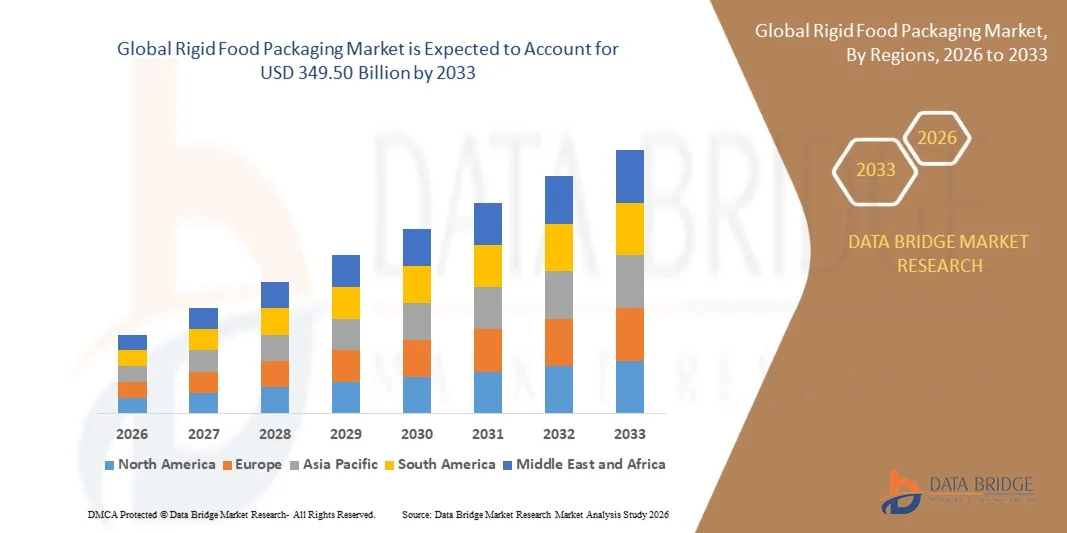
- As per Data Bridge Market Research analysis, the rigid food packaging market was valued at USD 241.30 billion in 2025 and is projected to reach USD 349.50 billion by 2033, growing at a CAGR of 4.70% from 2026 to 2033.
- The market is experiencing consistent growth driven by rising demand for convenient and durable food packaging solutions, increasing consumption of packaged and ready-to-eat foods, and growing adoption of recyclable and lightweight rigid packaging materials across the food and beverage industry.
- The increasing demand for extended shelf life and safe food transportation, combined with stricter food safety and packaging regulations, is compelling food manufacturers and retailers to adopt advanced rigid packaging solutions. Plastic containers, bottles, trays, cans, and other rigid formats are gaining adoption by offering protection against contamination, product damage, moisture, and environmental exposure while supporting efficient storage and distribution.
Market Size & Forecast
- Global Market Value (2025): USD 241.30 Billion
- Expected Market Value (2033): USD 349.50 Billion
- Forecast CAGR (2026–2033): 4.70%
- Leading Region in 2025: North America
- Fastest Growing Region: Asia Pacific
What are the Major Takeaways of the Rigid Food Packaging Market?
- North America dominated the rigid food packaging market with the largest revenue share of 30.0% in 2025, supported by a well-established food processing industry, high consumption of packaged foods, and strong demand for convenient and durable packaging solutions.
- Asia-Pacific is expected to be the fastest-growing region at a CAGR of 5.3% from 2026 to 2033, fueled by expanding food processing capacity, rising urbanization, increasing packaged food consumption, and growing investments in modern packaging infrastructure
- The plastic segment led the market with a 68.0% share in 2025, driven by its versatility, lightweight characteristics, cost-effectiveness, and strong barrier properties
- Paperboard are the fastest-growing material type, projected to register a CAGR of 5.3%, reflecting the surge in demand for recyclable and environmentally preferable packaging solutions
- The bottles & jars segment dominated the product type category with a 39.0% revenue share in 2025, led by widespread use across dairy products, sauces, condiments, processed foods, and other packaged food categories.
- Dairy products accounted for 30.0% of the market share in 2025, preferred by the extensive use of rigid packaging for milk, yogurt, cheese, butter, cream, and other dairy products
- The ready-to-eat meals segment is the fastest-growing application category, with a CAGR of 5.6%, driven by urbanization, busy lifestyles, and growing consumer preference for convenient meal solutions
Report Scope and Rigid Food Packaging Market Segmentation
|
Attributes |
Rigid Food Packaging Key Market Insights |
|
Segments Covered |
|
|
Countries Covered |
North America
Europe
Asia-Pacific
Middle East and Africa
South America
|
|
Key Market Players |
|
|
Market Opportunities |
|
|
Value Added Data Infosets |
In addition to the insights on market scenarios such as market value, growth rate, segmentation, geographical coverage, and major players, the market reports curated by the Data Bridge Market Research also include import export analysis, production capacity overview, production consumption analysis, price trend analysis, climate change scenario, supply chain analysis, value chain analysis, raw material/consumables overview, vendor selection criteria, PESTLE Analysis, Porter Analysis, and regulatory framework. |
What is the Key Trend in the Rigid Food Packaging Market?
- Rigid food packaging is increasingly shifting toward recyclable and circular formats as food brands seek to reduce virgin plastic usage, improve recyclability, and meet growing consumer and regulatory expectations for sustainable packaging solutions globally today.
- For instance, in February 2025, Klöckner Pentaplast launched a UK pilot with Tesco and Hilton Foods using 100% recycled PET trays made from recovered food trays, supporting closed-loop recycling for food packaging systems.
- Packaging manufacturers are developing lightweight rigid formats that maintain barrier protection, shelf life, convenience, and structural performance while reducing material consumption and improving transportation efficiency across food processing, retail, and foodservice applications worldwide.
- Ready-to-eat meals, frozen foods, and convenience products are increasing demand for rigid trays, tubs, cups, and containers that provide portability, microwave compatibility, product protection, and extended shelf life for increasingly urban consumers worldwide today.
- For instance, in June 2025, Coveris launched BarrierFresh MAP trays for meat, fish, and poultry, reducing plastic usage by 90% while maintaining recyclability, hermetic sealing, and a reported 21-day shelf life performance.
- As sustainability requirements intensify, packaging companies are expanding recyclable and lower-material solutions while maintaining food safety, product visibility, and operational compatibility, positioning circularity and lightweighting as central trends shaping rigid food packaging innovation globally.
What are the Key Drivers of the Rigid Food Packaging Market?
- The rising consumption of packaged, processed, and ready-to-eat foods is increasing demand for rigid packaging that provides durability, product protection, portability, contamination resistance, and extended shelf life across retail and foodservice channels globally.
- For instance, in June 2025, Amcor announced a bespoke three-compartment rigid tray for Cofigeo’s new range of single-serve ambient microwaveable ready meals, with the lightweight polypropylene tray designed for recyclability and intended for five William Saurin Mon Trio Gourmand recipes, demonstrating growing demand for convenient, ready-to-eat meal packaging.
- Food manufacturers are increasingly adopting recyclable rigid packaging to address sustainability targets, evolving consumer preferences, and regulatory requirements while maintaining barrier performance, food safety, shelf stability, and compatibility with existing filling and processing equipment.
- For instance, in July 2025, Klöckner Pentaplast launched kp Elite Nova, a next-generation modified-atmosphere rigid tray that is around 10% lighter than competing trays, while maintaining barrier performance, sealing integrity, and mechanical strength for high-speed protein packaging lines, reflecting continued demand for efficient and high-performance food packaging format
- Growing investments in food processing, cold-chain logistics, modern retail, and delivery infrastructure are strengthening demand for rigid containers, trays, tubs, and bottles that withstand handling, temperature variation, transportation, and distribution requirements effectively worldwide.
What Factors are Challenging the Growth of the Rigid Food Packaging Market?
- Rigid food packaging can require higher material usage and transportation costs than lightweight flexible alternatives, creating cost pressures for manufacturers and retailers while encouraging substitution toward lower-weight packaging formats in price-sensitive markets.
- For instance, in May 2025, Plastics Recyclers Europe reported that rigid HDPE and PP recycling capacity had stagnated, with only 42% of collected rigid polyolefin waste undergoing adequate sorting, while higher inflation, energy costs, and lower-cost imports continued to pressure recycling economics.
- Recycling rigid food packaging can remain challenging when formats combine multiple materials, barrier layers, adhesives, or incompatible components, potentially reducing recyclability and increasing sorting and processing requirements for waste management systems globally.
- Volatility in petrochemical-based resin prices can increase production costs for rigid plastic food packaging manufacturers, making pricing and procurement decisions more difficult and potentially reducing margins across the packaging value chain.
- For instance, in March 2025, Closed Loop Partners reported that food-grade and non-food-grade PP are commonly blended together at material recovery facilities because they cannot be easily differentiated, making it difficult to secure sufficient quantities of food-grade recycled PP for packaging applications.
- Stricter food-contact safety requirements and recycling regulations can increase compliance, testing, and material-development costs, particularly when manufacturers adopt recycled plastics while maintaining the required safety, barrier performance, and quality standards for food applications.
How is the Rigid Food Packaging Market Segmented?
The rigid food packaging market is segmented on the basis of material, product type, application, and distribution channel.
- By Material
On the basis of material, the rigid food packaging market is segmented into plastic, metal, paperboard, and others. The plastic segment dominated the market with a 68.0% share in 2025, owing to its versatility, lightweight characteristics, cost-effectiveness, and strong barrier properties. Plastic materials such as PET, PP, HDPE, and PS are extensively used across dairy, meat, bakery, sauces, ready-to-eat meals, and processed food applications. Their resistance to moisture, oxygen, impact, and contamination makes them suitable for protecting food products during transportation and storage. Plastic packaging also integrates efficiently with high-speed filling, sealing, labeling, and automated packaging lines. Increasing adoption of recyclable PET, recycled-content plastics, and mono-material structures is helping the segment respond to sustainability requirements.
The paperboard segment is projected to register the fastest growth at a CAGR of 5.3% from 2026 to 2033, driven by increasing demand for recyclable and environmentally preferable packaging solutions. Paperboard is gaining traction as food manufacturers seek alternatives to conventional plastic packaging and respond to sustainability targets. The material can be converted into rigid cartons, trays, sleeves, and containers suitable for bakery, dairy, frozen food, and ready-to-eat applications. Improvements in coatings and barrier technologies are enhancing its resistance to moisture and grease. Increasing regulatory pressure to reduce single-use plastics is further encouraging brands to evaluate fiber-based packaging. Paperboard also provides a large printable surface, supporting product branding and consumer communication.
- By Product Type
On the basis of product type, the rigid food packaging market is segmented into bottles & jars, trays & clamshells, tubs, cups & pots, cans, boxes & containers, and others. The bottles & jars segment dominated the market with 39.0% share in 2025, supported by widespread use across dairy products, sauces, condiments, processed foods, and other packaged food categories. Bottles and jars provide strong structural protection while enabling convenient filling, storage, dispensing, and resealing. Their standardized shapes and closures allow food manufacturers to use established filling and packaging infrastructure efficiently. Transparent plastic and glass formats also provide product visibility, which is valuable for consumer-facing food products. The segment benefits from extensive availability across retail channels and compatibility with different food formulations and portion sizes.
The trays & clamshells segment is projected to witness the fastest growth at CAGR of 7.0% from 2026 to 2033, supported by increasing demand for fresh foods, ready-to-eat meals, bakery products, and convenience-oriented packaged foods. These formats provide structural rigidity and help protect products against crushing, leakage, and physical damage during transportation. Transparent clamshells enable consumers to inspect food products before purchase, making them particularly attractive for fresh produce, bakery, and prepared food applications. Trays are increasingly used with automated sealing systems and modified-atmosphere packaging technologies designed to preserve food quality. Growth in online grocery and food delivery is further increasing demand for packaging that can withstand handling and transportation. Rising adoption of portion-controlled meals and heat-resistant food containers is also supporting the segment
- By Application
On the basis of application, the rigid food packaging market is segmented into dairy products, meat, poultry & seafood, bakery & confectionery, ready-to-eat meals, fruits & vegetables, sauces & dressings, baby food, pet food, and others. The dairy products segment dominated the market with 30.0% share in 2025, driven by the extensive use of rigid packaging for milk, yogurt, cheese, butter, cream, and other dairy products. Dairy products require packaging with strong contamination resistance, structural integrity, and effective protection against moisture and oxygen. Rigid cups, tubs, bottles, containers, and cartons are widely used because they support cold-chain storage and transportation. Increasing consumption of value-added dairy products such as probiotic yogurt, flavored milk, and single-serve products is generating additional packaging demand.
The ready-to-eat meals segment is projected to register the fastest growth at a CAGR of 5.6% from 2026 to 2033, driven by increasing urbanization, busy lifestyles, and growing consumer preference for convenient meal solutions. Ready-to-eat meals require packaging that can protect food during storage, transportation, reheating, and consumption. Rigid trays, tubs, bowls, and containers are increasingly used because they provide durability, portion control, and convenient handling. The expansion of online food delivery, cloud kitchens, meal kits, and retail-ready prepared foods is creating additional demand for leak-resistant and impact-resistant packaging. Microwave-compatible and resealable rigid containers are becoming increasingly important as consumers seek greater convenience. Growth in frozen and chilled prepared meals is also increasing the need for packaging capable of maintaining product integrity throughout distribution.
- By Distribution Channel
On the basis of distribution channel, the rigid food packaging market is segmented into retail, foodservice, and e-commerce. The retail segment dominated the market with 55.0% share in 2025, supported by the extensive distribution of packaged dairy products, meat, bakery items, sauces, canned foods, snacks, and ready-to-eat meals through supermarkets, hypermarkets, convenience stores, and other organized retail outlets. Retail food products require rigid packaging that provides protection during transportation, shelf storage, product display, and consumer handling. Bottles, jars, cans, tubs, cups, trays, and boxes are extensively used across retail food categories. The established infrastructure of supermarkets and grocery stores provides manufacturers with broad market access and high-volume distribution capabilities. Rigid packaging also supports product visibility, labeling, tamper evidence, and shelf presentation, which are important considerations in retail environments.
The e-commerce segment is projected to witness the fastest growth at CAGR of 8.0% from 2026 to 2033, driven by the expansion of online grocery, food delivery, quick-commerce platforms, and direct-to-consumer food brands. Online distribution requires packaging capable of protecting products against repeated handling, vibration, stacking, and transportation-related damage. Rigid containers provide greater structural strength and help reduce leakage, crushing, and product deformation during last-mile delivery. The growing popularity of ready-to-eat meals, packaged fresh foods, meal kits, dairy products, and convenience foods is creating additional demand for durable rigid packaging. E-commerce also encourages the use of tamper-evident, resealable, and easy-to-handle formats that improve the consumer delivery experience. Increasing online grocery penetration is further expanding demand for packaging designed for efficient last-mile distribution.
Which Region Holds the Largest Share of the Rigid Food Packaging Market?
- North America dominated the rigid food packaging market with the largest revenue share of 30.0% in 2025, supported by a well-established food processing industry, high consumption of packaged foods, and strong demand for convenient and durable packaging solutions.
- The region also benefits from widespread adoption of ready-to-eat meals, processed foods, dairy products, and packaged fresh foods, along with strong demand for durable, recyclable, and convenient packaging formats. Increasing investments in sustainable packaging technologies, recyclable materials, and advanced food-packaging solutions continue to strengthen North America's leadership position in the global market.
U.S. Rigid Food Packaging Market Insight
The U.S. rigid food packaging market is witnessing strong growth due to rising demand for packaged, processed, and convenience foods, along with increasing adoption of durable and sustainable packaging solutions. The country’s mature food and beverage industry, extensive retail infrastructure, and growing consumption of ready-to-eat meals, dairy products, meat, and packaged fresh foods are driving demand across major applications. In addition, growing emphasis on recyclable materials, lightweight packaging, and advanced packaging technologies is accelerating the adoption of rigid packaging solutions across food manufacturers and retailers.
Asia-Pacific Rigid Food Packaging Market Insight
The Asia-Pacific rigid food packaging market is expected to witness rapid growth, driven by increasing urbanization, expanding food and beverage production, and rising consumption of packaged and convenience foods across countries such as China, India, and Japan. Growing awareness regarding food safety, increasing adoption of organized retail, and rising demand for convenient packaging formats are supporting regional market expansion. In addition, the growing presence of food processing industries, e-commerce platforms, and modern foodservice infrastructure is accelerating the adoption of rigid packaging across the region.
Japan Rigid Food Packaging Market Insight
The Japan rigid food packaging market is witnessing consistent growth due to rising demand for convenient, hygienic, and high-quality packaged food products. Food manufacturers and retailers are increasingly adopting advanced rigid packaging formats for ready-to-eat meals, dairy products, processed foods, and fresh food applications. Moreover, increasing integration of recyclable materials, lightweight packaging technologies, and functional designs, along with the country's focus on food safety and sustainability, is further contributing to market growth.
China Rigid Food Packaging Market Insight
The China rigid food packaging market is growing rapidly, driven by increasing urbanization, expanding food processing industries, and rising consumer demand for packaged and convenience foods. Growing adoption of advanced rigid packaging solutions across retail, foodservice, and e-commerce channels is significantly boosting market demand. In addition, rising investments in modern food manufacturing, increasing focus on food safety, and rapid development of online grocery and food delivery infrastructure are positioning China as one of the fastest-growing markets for rigid food packaging globally.
U.K. Rigid Food Packaging Market Insight
The U.K. rigid food packaging market is experiencing steady growth, supported by rising demand for convenient packaged foods, ready-to-eat meals, and sustainable food packaging solutions. Increasing investments in recyclable packaging materials and advanced packaging infrastructure are contributing to market growth. Furthermore, growing adoption of e-commerce grocery platforms, convenience-oriented food products, and lightweight rigid packaging formats is improving packaging efficiency and supporting continued market expansion in the U.K.
Germany Rigid Food Packaging Market Insight
The Germany rigid food packaging market is expanding steadily due to the country's strong food manufacturing base, advanced packaging capabilities, and increasing adoption of sustainable packaging technologies. Food producers, retailers, and packaging manufacturers are increasingly utilizing rigid packaging for dairy, meat, bakery, processed food, and ready-to-eat applications. Continuous advancements in recyclable materials, lightweight packaging, and efficient packaging systems, along with strong environmental and food-safety requirements, are further driving market growth in Germany.
Which are the Top Companies in Rigid Food Packaging Market?
The rigid food packaging industry is primarily led by well-established companies, including:
- Amcor plc (U.K.)
- Sonoco Products Company (U.S.)
- Silgan Holdings Inc. (U.S.)
- Crown Holdings, Inc. (U.S.)
- Greif, Inc. (U.S.)
- Graphic Packaging Holding Company (U.S.)
- Mondi plc (U.K.)
- Huhtamäki Oyj (Finland)
- Winpak LTD. (Canada)
- ALPLA Werke Alwin Lehner GmbH & Co KG (Austria)
- RETAL Industries LTD (Cyprus)
- Jokey SE (Germany)
- Plastipak Holdings, Inc. (U.S.)
- Coveris (Austria)
- ProAmpac (U.S.)
- TriMas (U.S.)
- Smurfit Westrock (Ireland)
- Novolex Holdings, LLC (U.S.)
- Sabert Corporation (U.S.)
- Placon Corporation (U.S.)
What are Latest Developments in Rigid Food Packaging Market?
- In July 2025, Amcor announced an investment in its Nicholasville, Kentucky facility to expand post-consumer recycled (PCR) packaging production capabilities for rigid packaging. The new system enables precise PCR blending across multiple production lines and allows customers to select recycled-content levels, including up to 100% PCR. The enhanced capability is also intended to support food and other consumer packaging applications, strengthening Amcor’s focus on circular and more sustainable rigid packaging solutions.
- In June 2025, Amcor and Cofigeo announced the development of a bespoke three-compartment ready-meal tray for Cofigeo’s new range of single-serve ambient microwaveable meals. The predominantly polypropylene tray was designed according to Design for Recycling guidelines and incorporates a minimal functional barrier to support recycling within France’s polypropylene recycling infrastructure. The development demonstrates the increasing use of recyclable rigid trays for convenient ready-to-eat food applications.
- In April 2024, Amcor launched a one-liter carbonated soft drink bottle made from 100% post-consumer recycled PET. The new rigid bottle was introduced as part of Amcor’s stock packaging portfolio to help brands address recycled-content requirements while providing a readily available packaging option. The launch highlights the industry's movement toward greater recycled-content utilization and more circular rigid packaging solutions.
- In July 2023, SEE and ExxonMobil announced a food-packaging tray circularity initiative in Australia involving CRYOVAC preformed food packaging trays. The collaboration introduced trays containing resins leveraging ExxonMobil’s Exxtend technology for advanced recycling and mass-balance attribution, with the initiative focused on improving the circularity of food-grade plastics used for fresh red meat packaging. The development demonstrated increased collaboration across the packaging value chain to advance recyclable and circular rigid food packaging solutions.
- In May 2021, Berry Global launched its CombiLight packaging solution, a resource-efficient food pot designed for applications including yogurt, cream cheese, and cottage cheese. The packaging combines a plastic structure with coated natural fibers to create a lightweight rigid food container while maintaining strength, stability, grease resistance, and compatibility with existing filling lines. The development reflected growing industry efforts to reduce material use and introduce more resource-efficient rigid packaging formats for food applications.

- Interactive Data Analysis Dashboard
- Company Analysis Dashboard for high growth potential opportunities
- Research Analyst Access for customization & queries
- Competitor Analysis with Interactive dashboard
- Latest News, Updates & Trend analysis
- Harness the Power of Benchmark Analysis for Comprehensive Competitor Tracking
Global Rigid Food Packaging Market, Supply Chain Analysis and Ecosystem Framework
To support market growth and help clients navigate the impact of geopolitical shifts, DBMR has integrated in-depth supply chain analysis into its Global Rigid Food Packaging Market research reports. This addition empowers clients to respond effectively to global changes affecting their industries. The supply chain analysis section includes detailed insights such as Global Rigid Food Packaging Market consumption and production by country, price trend analysis, the impact of tariffs and geopolitical developments, and import and export trends by country and HSN code. It also highlights major suppliers with data on production capacity and company profiles, as well as key importers and exporters. In addition to research, DBMR offers specialized supply chain consulting services backed by over a decade of experience, providing solutions like supplier discovery, supplier risk assessment, price trend analysis, impact evaluation of inflation and trade route changes, and comprehensive market trend analysis.
Data collection and base year analysis are done using data collection modules with large sample sizes. The stage includes obtaining market information or related data through various sources and strategies. It includes examining and planning all the data acquired from the past in advance. It likewise envelops the examination of information inconsistencies seen across different information sources. The market data is analysed and estimated using market statistical and coherent models. Also, market share analysis and key trend analysis are the major success factors in the market report. To know more, please request an analyst call or drop down your inquiry.
The key research methodology used by DBMR research team is data triangulation which involves data mining, analysis of the impact of data variables on the market and primary (industry expert) validation. Data models include Vendor Positioning Grid, Market Time Line Analysis, Market Overview and Guide, Company Positioning Grid, Patent Analysis, Pricing Analysis, Company Market Share Analysis, Standards of Measurement, Global versus Regional and Vendor Share Analysis. To know more about the research methodology, drop in an inquiry to speak to our industry experts.
Data Bridge Market Research is a leader in advanced formative research. We take pride in servicing our existing and new customers with data and analysis that match and suits their goal. The report can be customized to include price trend analysis of target brands understanding the market for additional countries (ask for the list of countries), clinical trial results data, literature review, refurbished market and product base analysis. Market analysis of target competitors can be analyzed from technology-based analysis to market portfolio strategies. We can add as many competitors that you require data about in the format and data style you are looking for. Our team of analysts can also provide you data in crude raw excel files pivot tables (Fact book) or can assist you in creating presentations from the data sets available in the report.













