


What is the Robot Charging Station Market Size and Growth Rate?
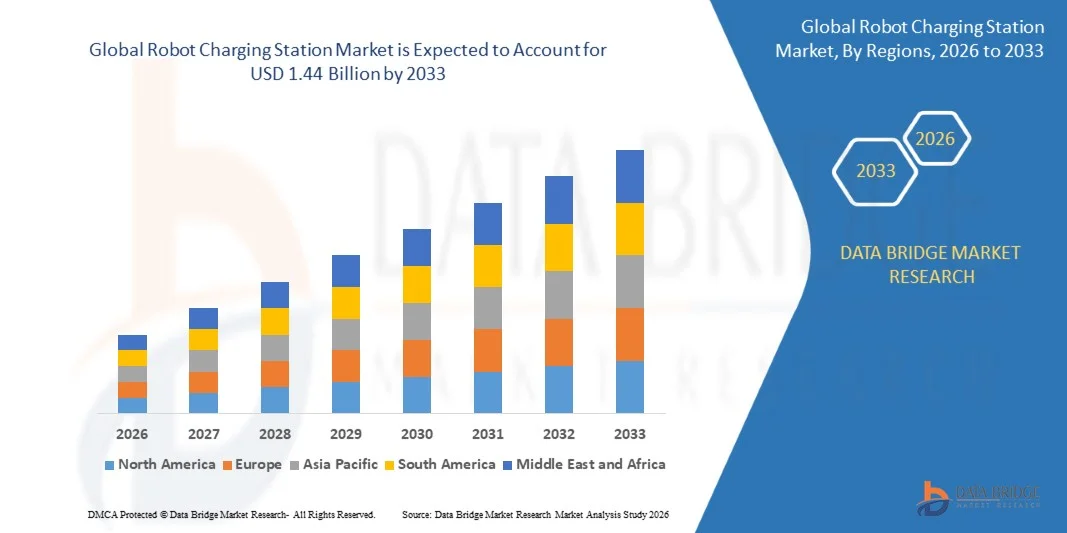
- As per market analysis, the Global Robot Charging Station Market was valued at approximately USD 0.79 billion in 2025 and is projected to reach USD 1.44 billion by 2033, growing at a CAGR of 13.70% from 2026 to 2033.
- The market is witnessing strong growth driven by the increasing adoption of autonomous mobile robots, automated guided vehicles, and service robots, rising demand for uninterrupted robotic operations, growing automation across industries, and the need for efficient and automated battery management. The ability of Robot Charging Stations to enable autonomous recharging, reduce operational downtime, improve robot utilization, and support continuous workflows is further supporting market expansion.
- Increasing demand for warehouse automation, logistics automation, manufacturing robotics, healthcare robots, cleaning robots, delivery robots, and autonomous mobile robots is encouraging organizations to adopt Robot Charging Station s across industries such as manufacturing, warehousing and logistics, healthcare, retail, hospitality, agriculture, and transportation. Advances in wireless charging, automated docking systems, battery management systems, autonomous navigation, smart charging, and IoT-enabled monitoring are further creating opportunities for market growth.
Market Size & Forecast
- Market Value (2025): USD 0.79 billion
- Expected Market Value (2033): USD 1.44 Million
- Forecast CAGR (2026–2033): 13.70%
- Leading Region in 2025: Asia-Pacific
- Fastest Growing Region: Asia-Pacific
What are the Major Takeaways of the Robot Charging Station Market?
- Asia-Pacific dominated the Robot Charging Station , accounting for a 51.0% revenue share in 2025, supported by rapid industrialization, expanding manufacturing and logistics automation, increasing deployment of autonomous mobile robots, and rising investments in warehouse and smart factory technologies. China, Japan, South Korea, and India are contributing significantly to regional adoption through increasing automation and Industry 4.0 initiatives. The region is expected to maintain its leading position during the forecast period.
- Asia-Pacific is also expected to witness the fastest growth, registering a CAGR of 16.2% from 2026 to 2033, supported by increasing deployment of autonomous robots across manufacturing, warehousing, logistics, healthcare, retail, and service applications. Growing demand for automated battery charging, continuous robotic operations, and smart charging infrastructure is further supporting regional market expansion.
- Automatic charging stations dominated the market by charging type, accounting for a 64.0% market share in 2025, supported by increasing demand for autonomous robot operations, reduced manual intervention, improved fleet utilization, and continuous charging capabilities. Automatic charging solutions are increasingly being integrated with autonomous mobile robots, automated guided vehicles, and service robots operating in demanding industrial and commercial environments.
- Autonomous Mobile Robots (AMRs) dominated the market by robot type, accounting for a 42.0% market share in 2025, driven by increasing adoption of flexible robotic systems for material transportation, order fulfillment, inventory movement, and warehouse operations. The growing deployment of AMRs in e-commerce fulfillment centers, manufacturing facilities, and distribution centers is expected to further increase demand for automated charging infrastructure.
- Warehousing and logistics dominated the market by application, accounting for a 36.0% market share in 2025, supported by rapid growth in e-commerce, increasing warehouse automation, labor shortages, and rising demand for continuous material-handling operations. The manufacturing segment is expected to witness strong growth at a CAGR of 14.8% from 2026 to 2033, supported by increasing use of autonomous robots for material handling, assembly, machine tending, and intralogistics applications.
Report Scope and Robot Charging Station Market Segmentation
|
Attributes |
Robot Charging Station Key Market Insights |
|
Segments Covered |
|
|
Countries Covered |
North America
Europe
Asia-Pacific
Middle East and Africa
South America
|
|
Key Market Players |
|
|
Market Opportunities |
|
|
Value Added Data Infosets |
In addition to the market insights such as market value, growth rate, market segments, geographical coverage, market players, and market scenario, the market report curated by the Data Bridge Market Research team includes in-depth expert analysis, import/export analysis, pricing analysis, production consumption analysis, and pestle analysis. |
What is the Key Trend in the Robot Charging Station Market?
- Robot Charging Station manufacturers are increasingly focusing on autonomous and AI-enabled charging technologies, integrating computer vision, advanced sensors, robotic arms, intelligent navigation, and automated docking systems to enable robots to locate charging stations, align precisely, initiate charging, and resume operations with minimal human intervention. This trend is supporting the development of fully autonomous robotic fleets and reducing charging-related downtime.
- The development of faster, wireless, and more flexible charging systems is gaining traction, as manufacturers seek to support continuous operation of autonomous mobile robots (AMRs), delivery robots, robotic vehicles, and other automated systems. Contactless inductive charging, multi-bay charging, and automated docking solutions are increasingly being developed to eliminate manual cable handling, improve charging efficiency, and integrate charging directly into robot workflows.
- For instance, in April 2026, Rocsys launched its M1 multi-bay hands-free EV charging solution, designed for autonomous mobility and robotaxi fleets. The system supports charging across up to 10 charging bays using robotic arms and AI-powered computer vision, while the company subsequently announced a USD 13 million Series A extension to accelerate commercialization and deployment across regions.
- Manufacturers are also expanding robot charging applications beyond conventional industrial automation, with increasing adoption across autonomous delivery, warehousing, logistics, robotic inspection, outdoor security, healthcare, and mobility applications. At the same time, wireless power transfer, smart charging management, cloud-connected monitoring, multi-robot charging, and AI-based autonomous docking are encouraging the transition of charging stations from basic power supply equipment toward intelligent infrastructure capable of supporting continuously operating robotic ecosystem.
What are the Key Drivers of the Robot Charging Station Market?
- Robot Charging Station manufacturers are increasingly focusing on AI-enabled autonomous charging systems, integrating machine vision, advanced sensors, intelligent docking, automated connector positioning, and AI-based control to enable charging stations to identify robots, locate charging ports, establish connections, and manage charging operations with minimal human intervention. The integration of AI and machine learning into docking and charging processes is supporting more accurate and efficient autonomous charging.
- The development of faster, more flexible, and automated charging solutions is gaining traction, as manufacturers seek to support the growing deployment of autonomous mobile robots (AMRs), automated guided vehicles (AGVs), industrial robots, and commercial robots. Wired, wireless, and fast-charging technologies are increasingly being developed to reduce downtime, improve fleet utilization, and enable continuous robotic operations across manufacturing, warehousing, logistics, healthcare, and retail environments.
- For instance, in May 2025, Hyundai Motor Group partnered with Incheon International Airport Corporation to demonstrate AI-based automatic EV charging robots, with the airport serving as a demonstration site for automated charging services. The system is designed to locate the charging port and initiate charging without human intervention, highlighting the increasing integration of robotics, AI, and automated charging infrastructure.
- Manufacturers are also expanding robot charging applications beyond conventional industrial automation, with increasing adoption across warehouses, logistics centers, airports, parking facilities, healthcare environments, retail centers, and autonomous transportation infrastructure. At the same time, wireless charging, fast charging, smart fleet management, predictive battery monitoring, and automated docking are encouraging the transition of charging stations from basic power-replenishment equipment toward intelligent infrastructure capable of supporting continuous and autonomous robot operation.
Which Factors are Challenging the Growth of the Robot Charging Station Market ?
- Robot Charging Station manufacturers are increasingly focusing on advanced automated charging technologies, integrating wireless power transfer, intelligent docking, battery monitoring, automated connection systems, and smart charging controls to enable robots to recharge autonomously with minimal human intervention. However, the increasing technological complexity of these systems can raise development, installation, and maintenance costs.
- The development of faster, higher-capacity, and more flexible charging systems is gaining traction, as manufacturers seek to support the growing requirements of autonomous mobile robots, automated guided vehicles, delivery robots, service robots, and industrial robotic fleets. However, requirements for shorter charging times, higher power output, battery compatibility, thermal management, and reliable docking can create technical challenges for charging station providers.
- For instance, in 2025, WiBotic expanded its wireless charging solutions for autonomous robots, focusing on automated wireless power transfer, fleet charging, and intelligent energy management for commercial and industrial robotic applications. Such developments highlight the growing need for reliable, efficient, and interoperable charging infrastructure as robot fleets become larger and more autonomous.
- Manufacturers are also expanding Robot Charging Station applications beyond conventional industrial automation, with increasing adoption across warehouses, logistics centers, healthcare facilities, retail environments, hospitality, agriculture, and outdoor autonomous operations. At the same time, diverse robot designs, battery configurations, charging requirements, operating environments, and fleet-management platforms can create interoperability and integration challenges, potentially increasing deployment complexity and limiting the standardization of robot charging infrastructure.
How is the Robot Charging Station Segmented?
The market is segmented on the basis of Type, Level of Charging, and Commercial Application.
- By Type
On the basis of type, the Robot Charging Station is segmented into Fixed and Mobile. The Fixed segment held the largest market revenue share of 58.42% in 2025, supported by increasing deployment of charging infrastructure at warehouses, manufacturing facilities, logistics centers, and other locations where robots operate within defined areas. Fixed charging stations provide reliable docking, automated charging, and continuous power availability for robotic fleets.
The Mobile segment is expected to witness the fastest growth during the forecast period, registering a CAGR of 15.24% from 2026 to 2033, driven by increasing demand for flexible charging solutions, autonomous fleet operations, temporary robotic deployments, and charging infrastructure that can be repositioned according to operational requirements.
- By Level of Charging
On the basis of level of charging, the Robot Charging Station is segmented into Level 1, Level 2, and Level 3. The Level 2 segment held the largest market revenue share of 47.36% in 2025, supported by its balance between charging speed, infrastructure requirements, operational efficiency, and suitability for commercial and industrial robotic applications. Increasing adoption of automated robots requiring regular and reliable charging is further supporting segment growth.
The Level 3 segment is expected to witness the fastest growth during the forecast period, registering a CAGR of 16.18% from 2026 to 2033, driven by increasing demand for rapid charging, reduced robot downtime, high-utilization robotic fleets, and continuous operations across logistics, warehousing, manufacturing, and commercial environments.
- By Commercial Application
On the basis of commercial application, the Robot Charging Station is segmented into Parking Facilities, Airports, Retail Centers & Malls, and Others. The Parking Facilities segment held the largest market revenue share of 41.28% in 2025, supported by increasing deployment of automated parking systems, autonomous mobility solutions, and smart infrastructure requiring reliable charging facilities. Growing investments in intelligent parking and automated transportation systems are further supporting demand.
The Airports segment is expected to witness the fastest growth during the forecast period, registering a CAGR of 17.06% from 2026 to 2033, driven by increasing adoption of autonomous cleaning robots, baggage-handling systems, security robots, passenger-assistance robots, and other automated solutions. Rising airport modernization and smart infrastructure investments are expected to create significant opportunities for Robot Charging Station deployment.
Which Region Holds the Largest Share of the Robot Charging Station ?
- Asia-Pacific dominated the Robot Charging Station with the largest revenue share of 51.0% in 2025, supported by rapid industrialization, expansion of manufacturing and logistics hubs, increasing adoption of autonomous mobile robots (AMRs) and automated guided vehicles (AGVs), rising labor costs, workforce shortages, and growing investments in warehouse and factory automation. The region is further supported by increasing deployment of robotic systems across automotive, electronics, semiconductor, e-commerce, manufacturing, and logistics operations, particularly in China, Japan, South Korea, and India.
- Asia-Pacific is expected to witness the fastest growth at a CAGR of 16.2% from 2026 to 2033, driven by expanding warehouse automation, increasing adoption of autonomous robots, development of smart factories, rising demand for continuous robotic operations, and growing investments in automated charging infrastructure. China, Japan, South Korea, and India are contributing to regional growth through investments in industrial robotics, logistics automation, smart manufacturing, and advanced robotic charging technologies.
U.S. Robot Charging Station Market Insight
The U.S. Robot Charging Station is witnessing steady growth, supported by increasing adoption of autonomous mobile robots (AMRs), automated guided vehicles (AGVs), and service robots across warehouses, manufacturing facilities, logistics centers, healthcare institutions, and retail environments. Growing investments in warehouse automation, smart factories, and robotic fleet management are encouraging demand for automated and intelligent charging solutions. The expansion of e-commerce and fulfillment operations is further increasing the need for continuous robot availability and reduced operational downtime. Advancements in wireless charging, automated docking, battery monitoring, and energy management are expected to create additional opportunities across the U.S. market.
Europe Robot Charging Station Market Insight
Europe’s Robot Charging Station is witnessing steady growth, supported by increasing adoption of autonomous mobile robots (AMRs), automated guided vehicles (AGVs), and service robots across manufacturing, warehousing, logistics, automotive, and healthcare applications. Growing investments in Industry 4.0, smart factories, warehouse automation, and energy-efficient robotic infrastructure are strengthening demand for automated and intelligent charging solutions. The region’s focus on reducing operational downtime, improving robotic fleet utilization, and integrating connected charging systems is further supporting market expansion. Germany, the United Kingdom, France, Italy, and the Netherlands are key markets contributing to regional development.
U.K. Robot Charging Station Market Insight
The U.K. Robot Charging Station is witnessing steady growth, supported by increasing adoption of autonomous mobile robots (AMRs), automated guided vehicles (AGVs), and service robots across warehouses, manufacturing facilities, logistics centers, healthcare institutions, retail environments, and airports. Growing investments in warehouse automation, smart manufacturing, and automated material handling are increasing demand for reliable and continuous robot charging solutions. The expansion of e-commerce and fulfillment operations is further supporting market development, while advancements in autonomous docking, wireless charging, battery management, and IoT-enabled monitoring are creating opportunities for intelligent and flexible robotic charging infrastructure.
Germany Robot Charging Station Market Insight
Germany’s Robot Charging Station is supported by the country’s strong industrial automation ecosystem, extensive adoption of autonomous mobile robots (AMRs) and automated guided vehicles (AGVs), and growing investments in smart manufacturing and Industry 4.0 technologies. Increasing automation across automotive, electronics, logistics, warehousing, and manufacturing facilities is driving demand for reliable and automated robotic charging solutions. The presence of established robotics and automation companies, along with increasing emphasis on continuous production, operational efficiency, and reduced robot downtime, further supports market growth. Growing deployment of intelligent charging and fleet-management technologies is expected to create additional opportunities.
Asia-Pacific Robot Charging Station Market Insight
Asia-Pacific dominated the Robot Charging Station with a revenue share of 51.0% in 2025, supported by rapid industrialization, expanding manufacturing and logistics operations, increasing adoption of autonomous mobile robots (AMRs) and automated guided vehicles (AGVs), and growing investments in warehouse automation. China, Japan, South Korea, and India are witnessing increased deployment of robotic systems across automotive, electronics, semiconductor, e-commerce, and manufacturing industries. The region is also expected to register the fastest growth at a CAGR of 16.2% from 2026 to 2033, driven by smart factory development and automated charging infrastructure.
Japan Robot Charging Station Market Insight
Japan’s Robot Charging Station is supported by the country’s advanced robotics ecosystem, high adoption of industrial automation, and strong presence of automotive, electronics, and manufacturing industries. Increasing deployment of autonomous mobile robots (AMRs), automated guided vehicles (AGVs), and service robots is driving demand for reliable and automated charging infrastructure. Labor shortages and an aging workforce are further encouraging businesses to adopt robotic solutions that can operate continuously with minimal human intervention. Growing investments in smart factories, warehouse automation, wireless charging technologies, and intelligent battery management systems are expected to create additional opportunities for Robot Charging Station providers.
China Robot Charging Station Market Insight
China’s Robot Charging Station is experiencing strong growth, supported by rapid industrial automation, large-scale deployment of autonomous mobile robots (AMRs), automated guided vehicles (AGVs), and service robots across manufacturing, warehousing, logistics, and e-commerce operations. The country’s extensive manufacturing base, expanding smart factory infrastructure, and increasing adoption of Industry 4.0 technologies are strengthening demand for automated and intelligent charging solutions. Growing investments in robotics, warehouse automation, and battery management technologies are further supporting market development. The expansion of automated logistics facilities and increasing demand for uninterrupted robotic operations are expected to create additional opportunities for charging station manufacturers.
Which are the Top Companies in Robot Charging Station Market?
The Robot Charging Station industry is primarily led by well-established companies, including:
- ABB Ltd. (Switzerland)
- KUKA AG (Germany)
- FANUC Corporation (Japan)
- Yaskawa Electric Corporation (Japan)
- OMRON Corporation (Japan)
- WiBotic Inc. (U.S.)
- Wiferion GmbH (Germany)
- Rocsys B.V. (Netherlands)
- Clearpath Robotics Inc. (Canada)
- Mobile Industrial Robots A/S (MiR) (Denmark)
- Nidec Corporation (Japan)
- Festo SE & Co. KG (Germany)
- Neobotix GmbH (Germany)
- DF Automation and Robotics Sdn Bhd (Malaysia)
- SMP Robotics Corporation (U.S.)
What are Latest Developments in Robot Charging Station Market?
- In April 2026, Rocsys unveiled the Rocsys M1, a multi-bay, hands-free charging system designed for robotaxi fleets. The system can manage charging across multiple vehicles and is being developed for large-scale autonomous fleet operations, with broader deployment planned from 2027.
- In February 2025, OMRON Corporation partnered with Wiferion to certify Wiferion’s inductive wireless charging technology for OMRON’s LD Series autonomous mobile robots. The collaboration supports faster, contactless charging and improved AMR operating time across industrial applications.
- In February 2025, Rocsys secured an order from the Port of Rotterdam for autonomous charging robots, supporting automated charging operations in port environments. The development demonstrates increasing adoption of robotic charging infrastructure for heavy-duty autonomous vehicles and logistics operations.
- In March 2025, Wiferion partnered with Jordahl USA to introduce protective enclosures for Wiferion wireless charging stations used with AGVs, AMRs, and mobile robotics. The development strengthens the suitability of wireless charging systems for demanding industrial environments.
- In April 2026, Rocsys continued expanding its autonomous charging platform by combining robotic charging hardware, AI-based computer vision, and software to support hands-free fleet operations. Its technology is being positioned for ports, logistics, automotive, and autonomous vehicle applications, highlighting the shift toward fully automated charging infrastructure.

- Interactive Data Analysis Dashboard
- Company Analysis Dashboard for high growth potential opportunities
- Research Analyst Access for customization & queries
- Competitor Analysis with Interactive dashboard
- Latest News, Updates & Trend analysis
- Harness the Power of Benchmark Analysis for Comprehensive Competitor Tracking
Data collection and base year analysis are done using data collection modules with large sample sizes. The stage includes obtaining market information or related data through various sources and strategies. It includes examining and planning all the data acquired from the past in advance. It likewise envelops the examination of information inconsistencies seen across different information sources. The market data is analysed and estimated using market statistical and coherent models. Also, market share analysis and key trend analysis are the major success factors in the market report. To know more, please request an analyst call or drop down your inquiry.
The key research methodology used by DBMR research team is data triangulation which involves data mining, analysis of the impact of data variables on the market and primary (industry expert) validation. Data models include Vendor Positioning Grid, Market Time Line Analysis, Market Overview and Guide, Company Positioning Grid, Patent Analysis, Pricing Analysis, Company Market Share Analysis, Standards of Measurement, Global versus Regional and Vendor Share Analysis. To know more about the research methodology, drop in an inquiry to speak to our industry experts.
Data Bridge Market Research is a leader in advanced formative research. We take pride in servicing our existing and new customers with data and analysis that match and suits their goal. The report can be customized to include price trend analysis of target brands understanding the market for additional countries (ask for the list of countries), clinical trial results data, literature review, refurbished market and product base analysis. Market analysis of target competitors can be analyzed from technology-based analysis to market portfolio strategies. We can add as many competitors that you require data about in the format and data style you are looking for. Our team of analysts can also provide you data in crude raw excel files pivot tables (Fact book) or can assist you in creating presentations from the data sets available in the report.













