


What is the Ready to Drink (RTD) Alcoholic Beverages Market Size and Growth Rate?
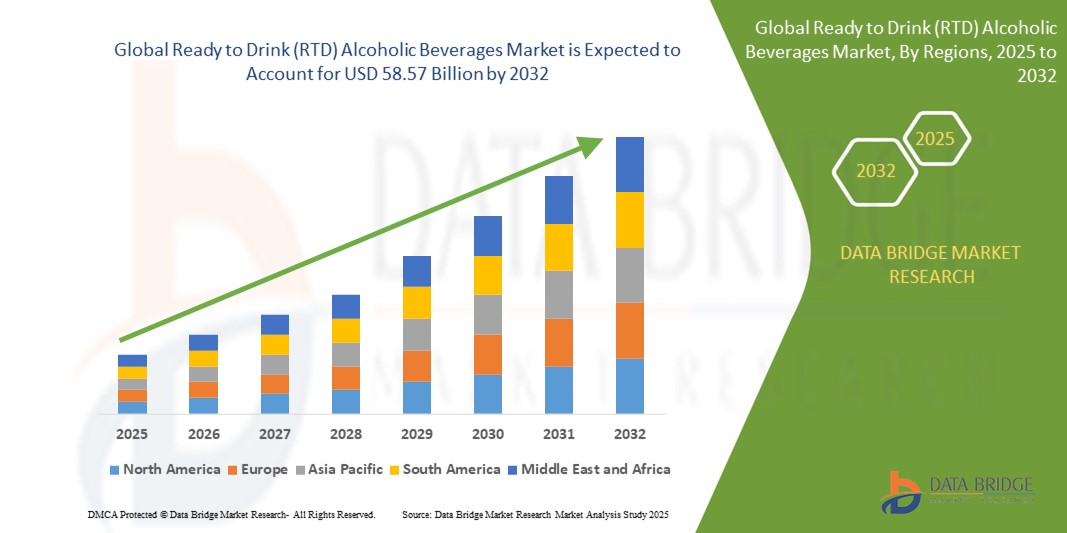
- As per Data Bridge Market Research Analysis the global ready to drink (RTD) alcoholic beverages market was valued at USD 32.84 billion in 2024 and is expected to reach USD 58.57 billion by 2032
- During the forecast period of 2025 to 2032 the market is likely to grow at a CAGR of 7.50 % primarily driven by the increasing consumer demand for convenient and low-alcohol beverage options
- This growth is driven by factors such as the rising popularity of flavoured alcoholic drinks, shifting consumer preferences toward healthier lifestyle choices, and the expansion of distribution channels both online and offline
Market Size and Forecast:
- Global Market Value (2024): USD 32.84 billion
- Expected Market Value (2032): USD 58.57 billion
- Forecast CAGR (2025–2032): 7.50%
What are the Major Takeaways of Ready to Drink (RTD) Alcoholic Beverages Market?
- Ready-to-drink (RTD) alcoholic beverages are pre-mixed drinks that combine alcohol with other ingredients, such as fruit juices, soda, or flavourings, and are ready for immediate consumption without any preparation
- The market is seeing continuous innovation in flavours and ingredients, with brands launching drinks such as vodka-based lemonades and gin with botanicals, as seen with Absolut’s pre-mixed cocktails and Tanqueray’s gin and tonic cans becoming popular in retail stores and at festivals
- Health-driven preferences are shaping new product launches, such as low-calorie hard seltzers and zero-sugar cocktails
- For instances, White Claw and Truly have expanded their lines with lighter versions to meet the demand from fitness-aware consumers
- Packaging plays a major role in consumer appeal, where recyclable cans and resealable bottles are trending, such as the use of slim cans by High Noon and Bacardi to enhance portability and eco-conscious branding
- Premiumization continues across the market, where consumers are drawn to drinks with artisanal spirits and craft-inspired labels, similar to how Cutwater Spirits markets its bar-quality canned cocktails using real tequila and whiskey
- Online sales channels are thriving, especially through platforms such as Drizzly and Minibar Delivery, where consumers can browse a wide range of Ready to Drink options, often discovering limited-edition releases or new flavours not found in-store
Report Scope and Ready to Drink (RTD) Alcoholic Beverages Market Segmentation
|
Attributes |
Ready to Drink (RTD) Alcoholic Beverages Key Market Insights |
|
Segments Covered |
|
|
Countries Covered |
North America
Europe
Asia-Pacific
Middle East and Africa
South America
|
|
Key Market Players |
|
|
Market Opportunities |
|
|
Value Added Data Infosets |
In addition to the insights on market scenarios such as market value, growth rate, segmentation, geographical coverage, and major players, the market reports curated by the Data Bridge Market Research also include in-depth expert analysis, pricing analysis, brand share analysis, consumer survey, demography analysis, supply chain analysis, value chain analysis, raw material/consumables overview, vendor selection criteria, PESTLE Analysis, Porter Analysis, and regulatory framework. |
What are the Ready to Drink (RTD) Alcoholic Beverages Market Trends?
“Rising Demand for Health-Conscious Options”
- Consumers are increasingly choosing light and clean-label drinks, which has led to the popularity of products such as hard seltzers made with natural fruit flavours and no added sugar, such as White Claw and Truly, which have introduced versions with fewer than 100 calories per can to cater to health-conscious drinkers
- Many Ready to Drink brands are reformulating classic cocktails into healthier alternatives
- For instance, Skinnygirl's low-calorie margaritas offer a flavourful yet lighter option for those looking to enjoy a cocktail without the extra calories, while brands such as Cutwater Spirits now offer lower-calorie versions of their canned cocktails, providing a healthier choice
- Beverage makers are introducing drinks with functional ingredients such as vitamin C, antioxidants, and adaptogens to meet wellness trends, such as Pulp Culture’s hard-pressed juices, which include live probiotics for gut health, targeting fitness-focused consumers who are interested in beverages with added benefits
- Organic and gluten-free options are becoming more widely available, with brands such as JuneShine offering kombucha-based alcoholic beverages that combine the health benefits of probiotics with the enjoyment of an alcoholic drink, appealing to health-conscious consumers who want a cleaner, natural option
- Labels and marketing are now highlighting health-related features more prominently, with phrases such as “low sugar,” “zero carbs,” and “natural flavours” becoming common on products such as Spindrift sparkling water, making it easier for consumers to find healthier options both in-store and through online platforms such as Drizzly
Ready to Drink (RTD) Alcoholic Beverages Market Dynamics
Driver
“Increasing consumer demand for convenience”
- Busy lifestyles are pushing consumers towards RTD beverages, with products such as White Claw and Truly’s hard seltzers becoming popular at beach outings and outdoor events
- For instances, White Claw’s growth surged during summer gatherings, making it a go-to drink at barbecues and pool parties across the U.S.
- Millennials and young professionals are increasingly opting for on-the-go drinks such as Cutwater Spirits’ canned margaritas, often spotted at events such as Coachella and tailgates, where the convenience of a pre-mixed drink is essential
- For instances, At Coachella, Cutwater’s pre-mixed canned cocktails became a fan favorite due to their portability and refreshing taste
- The trend toward smaller home-based social events has led to a rise in demand for products such as High Noon’s canned vodka cocktails, which have gained popularity on online platforms such as Drizly. These drinks are now a popular choice for at-home gatherings, especially during the pandemic when socializing shifted to smaller, private settings
- RTD beverages are designed for convenience, with products such as Jack Daniel’s ready-to-drink whiskey cocktails being especially favored at music festivals such as Lollapalooza. At these events, Jack Daniel’s RTDs offer festival-goers a hassle-free way to enjoy whiskey cocktails without needing a bartender or mixers
- Eco-conscious consumers are driving the demand for sustainable options, with Bon & Viv’s recyclable cans gaining popularity among environmentally-minded shoppers at grocery stores and on platforms such as Amazon. Their emphasis on eco-friendly packaging appeals to consumers who seek to reduce their environmental footprint while enjoying their favorite beverages
Opportunity
“Functional RTD Beverages”
- Modern consumers, especially Millennials and Gen Z, are seeking RTD beverages that support wellness goals such as stress relief, energy boosts, or mood enhancement rather than just traditional intoxication
- For instance, Kin Euphorics, co-founded by Bella Hadid, blends adaptogens and nootropics to promote calm and focus
- Ingredient innovation aligned with health trends: Brands are incorporating adaptogens (such as, ashwagandha), nootropics (such as, L-theanine), and botanicals (such as, chamomile, ginger) into their formulas to appeal to a more mindful drinking culture
- For instance, Recess Mood is a sparkling RTD brand that blends magnesium and botanicals for stress relief, blurring the line between wellness and alcohol
- Shifting positioning from recreational to lifestyle-enhancing: Functional RTDs are marketed for specific moods or use cases such as “post-work wind down” or “social energy,” offering an experience tailored to modern lifestyles
- For instance, Hiyo sells its beverages as "feel-good social tonics" meant to elevate mood without alcohol
- Social drinking without compromise: These beverages cater to occasions where people want to enjoy the ritual of drinking without negative side effects such as hangovers, the popularity of low- and no-alcohol RTDs such as De Soi, created by Katy Perry, reflects this shift
- A clear path for brand differentiation and loyalty: In an increasingly saturated RTD space, functionality offers unique value, allowing brands to stand out while building deeper emotional connections with consumers who prioritize both health and indulgence
Restraint/Challenge
“Limited Regulatory Landscape”
- The regulatory landscape poses a significant challenge for the Ready to Drink alcoholic beverages market, with different regions imposing varying rules on production, labeling, and distribution
- For instance, in countries such as Australia, high taxes on alcohol can increase the cost of products such as hard seltzers, impacting their affordability and market penetration
- Some countries have restrictions on alcohol content in ready-to-drink beverages, which can limit product formulations and affect overall marketability
- For instance, in the European Union, there are strict regulations on alcohol percentages in canned cocktails, which forces brands to modify their recipes to meet specific local standards
- Stringent marketing and labelling guidelines require clear disclosures on ingredients, alcohol content, and health warnings. In the U.S., the Alcohol and Tobacco Tax and Trade Bureau (TTB) enforces these regulations, increasing the operational complexity and cost for brands such as White Claw, which must ensure full transparency in their product labelling
- The demand from health-conscious consumers forces brands to ensure higher standards for ingredients and quality control
- For instance, brands such as Bon & Viv focus on offering gluten-free and low-sugar options, but this comes with increased costs and more stringent production processes to meet market expectations
- Cultural preferences for traditional alcoholic beverages, such as beer and wine, also limit the growth of the Ready to Drink market in some regions. In countries such as Germany and Italy, where beer and wine dominate the alcohol market, the acceptance of RTD drinks remains slow, hindering the growth potential of brands trying to enter these established markets
Ready to Drink (RTD) Alcoholic Beverages Market Scope
The market is segmented on the basis of product, packaging type, type, end user, nature, and distribution channel
|
Segmentation |
Sub-Segmentation |
|
By Product |
|
|
By Packaging Type |
|
|
By Type |
|
|
By End User |
|
|
By Nature |
|
|
By Distribution Channel |
|
Ready to Drink (RTD) Alcoholic Beverages Market Regional Analysis
“Europe is the Dominant Region in the Ready to Drink (RTD) Alcoholic Beverages Market”
- Europe dominates the Ready-to-Drink alcoholic beverages market, supported by its deep-rooted social drinking culture and consistently high alcohol consumption rates
- A strong tradition of socializing, especially in countries such as the UK, Germany, and Spain, drives the popularity of convenient, ready-to-serve alcoholic drinks among European consumers
- The preference for minimal preparation and ease of use has led to a surge in RTD demand, with consumers incorporating these beverages into both casual home settings and public gatherings
- European brands continue to innovate with unique flavour’s, premium ingredients, and stylish packaging to meet diverse consumer preferences and enhance the overall drinking experience
- The blend of cultural habits and evolving convenience-driven trends keeps Europe at the forefront of the global RTD alcoholic beverages market, encouraging steady demand and product
“Asia-Pacific is Projected to Register the Highest Growth Rate”
- Asia Pacific is fastest-growing region in the Ready-to-Drink (RTD) alcoholic beverages market due to its large and diverse population
- The growing demand for convenience, especially among millennials and young professionals, is one of the key drivers for the region's RTD market expansion
- Consumers in countries such as China and Japan are increasingly opting for ready-to-drink cocktails, hard seltzers, and flavored alcoholic beverages as a quick and convenient alternative to traditional drinks
- The trend of smaller, home-based social gatherings, accelerated by recent global events, has further boosted the demand for RTD products as they offer easy-to-consume, pre-mixed options
- Manufacturers are responding by diversifying their product offerings, tailoring them to local tastes, and creating innovative flavours to match the evolving preferences in Asia Pacific, driving rapid market growth
Which are the Top Companies in Ready to Drink (RTD) Alcoholic Beverages Market?
The market competitive landscape provides details by competitor. Details included are company overview, company financials, revenue generated, market potential, investment in research and development, new market initiatives, global presence, production sites and facilities, production capacities, company strengths and weaknesses, product launch, product width and breadth, application dominance. The above data points provided are only related to the companies' focus related to market.
The Major Market Leaders Operating in the Market Are:
- Davide Campari-Milano N.V. (Netherlands)
- Diageo (U.K.)
- Halewood Sales (U.K.)
- ASAHI GROUP HOLDINGS, LTD. (Japan)
- Accolade Wines (Australia)
- Bacardi & Company Limited (Bermuda)
- Mike's Hard Lemonade Co. (U.S.)
- Castel Group (France)
- SUNTORY HOLDINGS LIMITED. (Japan)
- Anheuser-Busch Companies LLC (U.S.)
- Brown Forman (U.S.)
- United Brands LLC (U.S.)
- Pernod Ricard (France)
- Miller Brewing Co. (U.S.)
What are the Latest Developments in Global Ready to Drink (RTD) Alcoholic Beverages Market?
- In September 2024, The Coca-Cola Company and Bacardi Limited announced a strategic partnership to launch a ready-to-drink (RTD) cocktail combining BACARDÍ rum and Coca-Cola. This collaboration marks Coca-Cola's continued expansion into the alcoholic beverage sector, aiming to offer consumers a convenient, high-quality pre-mixed cocktail. The initial launch is planned for select European markets and Mexico in 2025, with a benchmark alcohol by volume (ABV) of 5%, varying by market. This move is expected to enhance Coca-Cola's portfolio, tapping into the growing demand for RTD beverages and reinforcing Bacardi's presence in the global spirit’s market
- In September 2024, Diageo and PepsiCo announced a strategic partnership to launch a ready-to-drink (RTD) cocktail combining Captain Morgan Original Spiced Gold rum with Pepsi Max. This collaboration marks PepsiCo's entry into the alcoholic beverage market in Great Britain. The 5% ABV product is available in 330ml and 250ml cans at major U.K. retailers, including Tesco, Sainsbury's, Morrisons, and Asda, with a recommended retail price of GBP 2.59 (USD 3.46) for the 330ml format. This launch is expected to expand the RTD category by offering a premium, convenient option that aligns with evolving consumer preferences for quality and convenience in alcoholic beverages

- Interactive Data Analysis Dashboard
- Company Analysis Dashboard for high growth potential opportunities
- Research Analyst Access for customization & queries
- Competitor Analysis with Interactive dashboard
- Latest News, Updates & Trend analysis
- Harness the Power of Benchmark Analysis for Comprehensive Competitor Tracking
Table of Content
1 INTRODUCTION
1.1 OBJECTIVES OF THE STUDY
1.2 MARKET DEFINITION
1.3 OVERVIEW OF GLOBAL READY TO DRINK (RTD) ALCOHOLIC BEVERAGES MARKET
1.4 CURRENCY AND PRICING
1.5 LIMITATION
1.6 MARKETS COVERED
2 MARKET SEGMENTATION
2.1 KEY TAKEAWAYS
2.2 ARRIVING AT THE GLOBAL READY TO DRINK (RTD) ALCOHOLIC BEVERAGES MARKETSIZE
2.2.1 VENDOR POSITIONING GRID
2.2.2 TECHNOLOGY LIFE LINE CURVE
2.2.3 MARKET GUIDE
2.2.4 COMPANY POSITIONING GRID
2.2.5 COMAPANY MARKET SHARE ANALYSIS
2.2.6 MULTIVARIATE MODELLING
2.2.7 DEMAND AND SUPPLY-SIDE VARIABLES
2.2.8 TOP TO BOTTOM ANALYSIS
2.2.9 STANDARDS OF MEASUREMENT
2.2.10 VENDOR SHARE ANALYSIS
2.2.11 DATA POINTS FROM KEY PRIMARY INTERVIEWS
2.2.12 DATA POINTS FROM KEY SECONDARY DATABASES
2.3 GLOBAL READY TO DRINK (RTD) ALCOHOLIC BEVERAGES MARKET: RESEARCH SNAPSHOT
2.4 ASSUMPTIONS
3 MARKET OVERVIEW
3.1 DRIVERS
3.2 RESTRAINTS
3.3 OPPORTUNITIES
3.4 CHALLENGES
4 EXECUTIVE SUMMARY
5 PREMIUM INSIGHTS
5.1 SUPPLY CHAIN ANALYSIS
5.2 PRIVATE LABEL VS BRAND ANALYSIS
5.3 PROMOTIONAL ACTIVITIES
5.4 NEW PRODUCT LAUNCH STRATEGY
5.4.1 NUMBER OF NEW PRODUCT LAUNCH
5.4.1.1. LINE EXTENSTION
5.4.1.2. NEW PACKAGING
5.4.1.3. RE-LAUNCHED
5.4.1.4. NEW FORMULATION
5.4.2 DIFFERNTIAL PRODUCT OFFERING
5.4.3 MEETING CONSUMER REQUIREMENT
5.4.4 PACKAGE DESIGNING
5.4.5 PRICING ANALYSIS
5.5 FACTORS INFLUENCING PURCHASING DECISION OF CUSTOMERS
5.6 MARKET GROWTH STRATEGIES ADOPTED BY KEY MARKET PLAYERS
5.7 NEW PRODUCT LAUNCHES
6 IMPACT OF ECONOMIC SLOW DOWN ON MARKET
6.1 IMPACT ON PRICE
6.2 IMPACT ON SUPPLY CHAIN
6.3 IMPACT ON SHIPMENT
6.4 IMPACT ON COMPANY’S STRATEGIC DECISIONS
7 REGULATORY FRAMEWORK AND GUIDELINES
8 PRICING ANALYSIS
9 PRODUCTION CAPACITY OF KEY MANUFACTURERES
10 BRAND OUTLOOK
10.1 COMPARATIVE BRAND ANALYSIS
10.2 PRODUCT VS BRAND OVERVIEW
11 TAXATION AND DUTY LEVIES
12 GLOBAL READY TO DRINK (RTD) ALCOHOLIC BEVERAGES MARKET, BY TYPE, 2022-2031, (USD MILLION)
12.1 OVERVIEW
12.2 BEER
12.2.1 BEER, BY TYPE
12.2.1.1. ALE BEER
12.2.1.1.1. ALE, BY TYPE
12.2.1.1.1.1 BLOND ALE
12.2.1.1.1.2 BROWN ALE
12.2.1.1.1.3 PALE ALE
12.2.1.1.1.4 SOUR ALE
12.2.1.2. LAGER BEER
12.2.1.3. STOUT BEER
12.2.1.4. PORTER BEER
12.2.1.5. WHEAT BEER
12.2.1.6. PILSNER
12.2.1.7. OTHERS
12.3 WINE
12.3.1 WINE, BY TYPE
12.3.1.1. RED WINE
12.3.1.1.1. RED WINE, BY TYPE
12.3.1.1.1.1 FULL-BODIED RED WINES
12.3.1.1.1.2 MEDIUM-BODIED RED WINES
12.3.1.1.1.3 LIGHT-BODIED RED WINES
12.3.1.2. WHITE WINE
12.3.1.3. ROSE WINE
12.3.2 WINE, BY CATEGORY
12.3.2.1. STILL WINE
12.3.2.2. SPARKLING WINE
12.4 WHISKEY
12.4.1.1. WHISKEY, BY TYPE
12.4.1.1.1. RYE MALT WHISKEY
12.4.1.1.2. CORN WHISKEY
12.4.1.1.3. BOURBON WHISKEY
12.4.1.1.4. TENNESSEE WHISKEY
12.4.1.1.5. IRISH WHISKEY
12.4.1.1.6. RYE WHISKEY
12.4.1.1.7. CANADIAN WHISKY
12.4.1.1.8. SCOTCH WHISKY
12.4.1.1.9. JAPANESE WHISKY
12.4.1.1.10. WHITE WHISKEY
12.4.1.1.11. WHEAT WHISKEY
12.4.1.1.12. MALT WHISKEY
12.4.1.1.13. BLENDED WHISKEY
12.4.1.1.14. OTHERS
12.4.1.2. WHISKEY, BY DISTILLATION PROCESS
12.4.1.2.1. SINGLE DISTILLED
12.4.1.2.2. DOUBLE DISTILLED
12.4.1.2.3. TRIPLE DISTILLED
12.5 RUM
12.5.1 RUM, BY TYPE
12.5.1.1. WHITE RUM
12.5.1.2. LIGHT RUM
12.5.1.3. GOLD RUM
12.5.1.4. DARK RUM
12.5.1.5. OVER-PROOF RUM
12.5.1.6. SPICED RUM
12.5.1.7. CACHACA
12.5.1.8. FLAVORED RUM
12.5.1.9. OTHERS (IF ANY)
12.6 VODKA
12.7 TEQUILA
12.7.1 TEQUILA, BY TYPE
12.7.1.1. BLANCO
12.7.1.2. REPOSADO
12.7.1.3. ANEJO
12.7.1.4. EXTRA-ANEJO
12.7.1.5. OTHERS (IF ANY)
12.8 GIN
12.8.1 GIN, BY STYLE
12.8.1.1. LONDON DRY GIN
12.8.1.2. PLYMOUTH GIN
12.8.1.3. OLD TOM GIN
12.8.1.4. GENEVER
12.8.1.5. NEW AMERICAN
12.9 BRANDY
12.9.1 BRANDY, BY TYPE
12.9.1.1. COGNAC
12.9.1.2. ARMAGNAC
12.9.1.3. SPANISH BRANDY
12.9.1.4. AMERICAN BRANDY
12.9.1.5. GRAPPA
12.9.1.6. EAU-DE-VIE
12.9.1.7. FLAVORED BRANDY
12.9.1.8. OTHERS (IF ANY)
12.1 RTD COCKTAILS
12.10.1 RTD COCKTAILS, BY PRODUCT
12.10.1.1. MALT BASED RTD COCKTAILS
12.10.1.2. SPIRIT BASED RTD COCKTAILS
12.10.1.3. WINE BASED RTD COCKTAILS
12.10.2 RTD COCKTAILS, BY ALCOHOL BY VOLUME % (ABV %)
12.10.2.1. 3% ABV
12.10.2.2. 5% ABV
12.10.2.3. 6% BV
12.10.2.4. 7% ABV
12.10.2.5. 8% ABV
12.10.2.6. OTHERS
12.11 OTHERS (IF ANY)
13 GLOBAL READY TO DRINK (RTD) ALCOHOLIC BEVERAGES MARKET, BY FLAVOR, 2022-2031, (USD MILLION)
13.1 OVERVIEW
13.2 REGULAR / PLAIN
13.3 FLAVORED
13.3.1 FLAVORED, BY TYPE
13.3.1.1. HONEY
13.3.1.2. MAPLE
13.3.1.3. CARAMEL
13.3.1.4. PINA COLADA
13.3.1.5. CHOICOLATE
13.3.1.6. VANILLA
13.3.1.7. FRUIT
13.3.1.7.1. GGREEN APPLE
13.3.1.7.2. FFIG
13.3.1.7.3. LYCHEE
13.3.1.7.4. MINT
13.3.1.7.5. PEACH
13.3.1.7.6. PPEAR
13.3.1.7.7. LLEMON
13.3.1.7.8. PECAN
13.3.1.7.9. MANGO
13.3.1.7.10. BLACK CHERRY
13.3.1.7.11. RASPBERRY
13.3.1.7.12. STRAWBERRY
13.3.1.7.13. BLUEBERRY
13.3.1.7.14. CRANBERRY
13.3.1.7.15. ORANGE
13.3.1.7.16. MELON
13.3.1.7.17. OTHERS
13.3.1.8. SPICES
13.3.1.8.1. CINNAMON
13.3.1.8.2. GINGER
13.3.1.8.3. PEPPER
13.3.1.8.4. CLOVE
13.3.1.8.5. NUTMEG
13.3.1.8.6. OTHERS
13.3.1.9. NUTS
13.3.1.9.1. ALMOND
13.3.1.9.2. WALNUT
13.3.1.9.3. HAZELNUT
13.3.1.9.4. MACADAMIA NUTS
13.3.1.9.5. OTHERS
13.3.1.10. OTHERS
14 GLOBAL READY TO DRINK (RTD) ALCOHOLIC BEVERAGES MARKET, BY ALCOHOLIC CONTENT, 2022-2031, (USD MILLION)
14.1 OVERVIEW
14.2 LOW
14.3 MEDIUM
14.4 HIGH
15 GLOBAL READY TO DRINK (RTD) ALCOHOLIC BEVERAGES MARKET, BY CATEGORY, 2022-2031, (USD MILLION)
15.1 OVERVIEW
15.2 ORGANIC
15.2.1 ORGANIC, BY RTD ALCOHOLIC BEVERAGE TYPE
15.2.1.1. BEER
15.2.1.2. WINE
15.2.1.3. WHISKEY
15.2.1.4. RUM
15.2.1.5. VODKA
15.2.1.6. TEQUILA
15.2.1.7. GIN
15.2.1.8. BRANDY
15.2.1.9. RTD COCKTAILS
15.2.1.10. OTHERS )IF ANY)
15.3 CONVENTIONAL
15.3.1 CONVENTIONAL, BY RTD ALCOHOLIC BEVERAGE TYPE
15.3.1.1. BEER
15.3.1.2. WINE
15.3.1.3. WHISKEY
15.3.1.4. RUM
15.3.1.5. VODKA
15.3.1.6. TEQUILA
15.3.1.7. GIN
15.3.1.8. BRANDY
15.3.1.9. RTD COCKTAILS
15.3.1.10. OTHERS )IF ANY)
16 GLOBAL READY TO DRINK (RTD) ALCOHOLIC BEVERAGES MARKET, BY PRICE CATEGORY, 2022-2031, (USD MILLION)
16.1 OVERVIEW
16.2 ECONOMY
16.2.1 ECONOMY, BY RTD ALCOHOLIC BEVERAGE TYPE
16.2.1.1. BEER
16.2.1.2. WINE
16.2.1.3. WHISKEY
16.2.1.4. RUM
16.2.1.5. VODKA
16.2.1.6. TEQUILA
16.2.1.7. GIN
16.2.1.8. BRANDY
16.2.1.9. RTD COCKTAILS
16.2.1.10. OTHERS )IF ANY)
16.3 STANDARD
16.3.1 STANDARD, BY RTD ALCOHOLIC BEVERAGE TYPE
16.3.1.1. BEER
16.3.1.2. WINE
16.3.1.3. WHISKEY
16.3.1.4. RUM
16.3.1.5. VODKA
16.3.1.6. TEQUILA
16.3.1.7. GIN
16.3.1.8. BRANDY
16.3.1.9. RTD COCKTAILS
16.3.1.10. OTHERS )IF ANY)
16.4 PREMIUM
16.4.1 PREMIUM, BY RTD ALCOHOLIC BEVERAGE TYPE
16.4.1.1. BEER
16.4.1.2. WINE
16.4.1.3. WHISKEY
16.4.1.4. RUM
16.4.1.5. VODKA
16.4.1.6. TEQUILA
16.4.1.7. GIN
16.4.1.8. BRANDY
16.4.1.9. RTD COCKTAILS
16.4.1.10. OTHERS )IF ANY)
17 GLOBAL READY TO DRINK (RTD) ALCOHOLIC BEVERAGES MARKET, BY BRAND CATEGORY, 2022-2031, (USD MILLION)
17.1 OVERVIEW
17.2 BRANDED
17.3 PRIVATE LABEL
18 GLOBAL READY TO DRINK (RTD) ALCOHOLIC BEVERAGES MARKET, BY AGE GROUP, 2022-2031, (USD MILLION)
18.1 OVERVIEW
18.2 18-24 YEARS
18.3 25-44 YEARS
18.4 45-64 YEARS
18.5 65+ YEARS
19 GLOBAL READY TO DRINK (RTD) ALCOHOLIC BEVERAGES MARKET, BY PACKAGING TYPE, 2022-2031, (USD MILLION)
19.1 OVERVIEW
19.2 BOTTLES
19.2.1 PLASTIC
19.2.2 GLASS
19.3 CANS
19.4 OTHERS
20 GLOBAL READY TO DRINK (RTD) ALCOHOLIC BEVERAGES MARKET, BY PACKAGING SIZE, 2022-2031, (USD MILLION)
20.1 OVERVIEW
20.2 LESS THAN 250 ML
20.3 251-500 ML
20.4 501-750 ML
20.5 751-1000 ML
20.6 MORE THAN 1000 ML
21 GLOBAL READY TO DRINK (RTD) ALCOHOLIC BEVERAGES MARKET, BY END USE, 2022-2031, (USD MILLION)
21.1 OVERVIEW
21.2 HOUSEHOLD / RETAIL
21.2.1 HOUSEHOLD / RETAIL, BY RTD ALCOHOLIC BEVERAGE TYPE
21.2.1.1. BEER
21.2.1.2. WINE
21.2.1.3. WHISKEY
21.2.1.4. RUM
21.2.1.5. VODKA
21.2.1.6. TEQUILA
21.2.1.7. GIN
21.2.1.8. BRANDY
21.2.1.9. RTD COCKTAILS
21.2.1.10. OTHERS )IF ANY)
21.3 COMMERCIAL
21.3.1 COMMERCIAL, BY CATEGORY
21.3.1.1. HOTELS
21.3.1.2. RESTAURANTS
21.3.1.3. BARS / CLUBS
21.3.1.4. CAFÉ
21.3.1.5. PARTIES / BANQUETS
21.3.1.6. OTHERS
21.3.2 COMMERCIAL, BY RTD ALCOHOLIC BEVERAGE TYPE
21.3.2.1. BEER
21.3.2.2. WINE
21.3.2.3. WHISKEY
21.3.2.4. RUM
21.3.2.5. VODKA
21.3.2.6. TEQUILA
21.3.2.7. GIN
21.3.2.8. BRANDY
21.3.2.9. RTD COCKTAILS
21.3.2.10. OTHERS )IF ANY)
22 GLOBAL READY TO DRINK (RTD) ALCOHOLIC BEVERAGES MARKET, BY DISTRIBUTION CHANNEL, 2022-2031, (USD MILLION)
22.1 OVERVIEW
22.2 STORE-BASED
22.2.1 SUPERMARKETS & HYPERMARKETS
22.2.2 GROCERY STORES
22.2.3 CONVENIENCE STORES
22.2.4 SPECIALTY STORES
22.2.5 BARS / RESTAURANTS / CAFES / CLUBS
22.2.6 LIQUIR STORES
22.2.7 OTHERS
22.3 NON-STORE-BASED
22.3.1 ONLINE
22.3.1.1. E-COMMERCE WEBSITES
22.3.1.2. COMPANY OWNED WEBSITES
22.3.2 VENDING
23 GLOBAL READY TO DRINK (RTD) ALCOHOLIC BEVERAGES MARKET, BY GEOGRAPHY, 2022-2031 (USD MILLION)
OVERVIEW (ALL SEGMENTATION PROVIDED ABOVE IS REPRESENTED IN THIS CHAPTER BY COUNTRY)
23.1 NORTH AMERICA
23.1.1 U.S.
23.1.2 CANADA
23.1.3 MEXICO
23.2 EUROPE
23.2.1 GERMANY
23.2.2 U.K.
23.2.3 ITALY
23.2.4 FRANCE
23.2.5 SPAIN
23.2.6 SWITZERLAND
23.2.7 NETHERLANDS
23.2.8 BELGIUM
23.2.9 RUSSIA
23.2.10 TURKEY
23.2.11 REST OF EUROPE
23.3 ASIA-PACIFIC
23.3.1 JAPAN
23.3.2 CHINA
23.3.3 SOUTH KOREA
23.3.4 INDIA
23.3.5 AUSTRALIA
23.3.6 SINGAPORE
23.3.7 THAILAND
23.3.8 INDONESIA
23.3.9 MALAYSIA
23.3.10 PHILIPPINES
23.3.11 REST OF ASIA-PACIFIC
23.4 SOUTH AMERICA
23.4.1 BRAZIL
23.4.2 ARGENTINA
23.4.3 REST OF SOUTH AMERICA
23.5 MIDDLE EAST AND AFRICA
23.5.1 SOUTH AFRICA
23.5.2 UAE
23.5.3 SAUDI ARABIA
23.5.4 KUWAIT
23.5.5 REST OF MIDDLE EAST AND AFRICA
24 GLOBAL READY TO DRINK (RTD) ALCOHOLIC BEVERAGES MARKET, COMPANY LANDSCAPE
24.1 COMPANY SHARE ANALYSIS: GLOBAL
24.2 COMPANY SHARE ANALYSIS: NORTH AMERICA
24.3 COMPANY SHARE ANALYSIS: EUROPE
24.4 COMPANY SHARE ANALYSIS: ASIA-PACIFIC
24.5 MERGERS & ACQUISITIONS
24.6 NEW PRODUCT DEVELOPMENT & APPROVALS
24.7 EXPANSIONS & PARTNERSHIP
24.8 REGULATORY CHANGES
25 GLOBAL READY TO DRINK (RTD) ALCOHOLIC BEVERAGES MARKET, SWOT & DBMR ANALYSIS
26 GLOBAL READY TO DRINK (RTD) ALCOHOLIC BEVERAGES MARKET, COMPANY PROFILE
26.1 ASAHI GROUP HOLDINGS LTD
26.1.1 COMPANY OVERVIEW
26.1.2 REVENUE ANALYSIS
26.1.3 PRODUCT PORTFOLIO
26.1.4 GEOGRAPHIC PRESENCE
26.1.5 RECENT DEVELOPMENTS
26.2 ANHEUSER-BUSCH INBEV SA/NV
26.2.1 COMPANY OVERVIEW
26.2.2 REVENUE ANALYSIS
26.2.3 PRODUCT PORTFOLIO
26.2.4 GEOGRAPHIC PRESENCE
26.2.5 RECENT DEVELOPMENTS
26.3 BACARDI LTD
26.3.1 COMPANY OVERVIEW
26.3.2 REVENUE ANALYSIS
26.3.3 PRODUCT PORTFOLIO
26.3.4 GEOGRAPHIC PRESENCE
26.3.5 RECENT DEVELOPMENTS
26.4 BROWN-FORMAN CORPORATION
26.4.1 COMPANY OVERVIEW
26.4.2 REVENUE ANALYSIS
26.4.3 PRODUCT PORTFOLIO
26.4.4 GEOGRAPHIC PRESENCE
26.4.5 RECENT DEVELOPMENTS
26.5 CARLSBERG A/S
26.5.1 COMPANY OVERVIEW
26.5.2 REVENUE ANALYSIS
26.5.3 PRODUCT PORTFOLIO
26.5.4 GEOGRAPHIC PRESENCE
26.5.5 RECENT DEVELOPMENTS
26.6 DIAGEO PLC
26.6.1 COMPANY OVERVIEW
26.6.2 REVENUE ANALYSIS
26.6.3 PRODUCT PORTFOLIO
26.6.4 GEOGRAPHIC PRESENCE
26.6.5 RECENT DEVELOPMENTS
26.7 SUNTORY HOLDINGS LTD.
26.7.1 COMPANY OVERVIEW
26.7.2 REVENUE ANALYSIS
26.7.3 PRODUCT PORTFOLIO
26.7.4 GEOGRAPHIC PRESENCE
26.7.5 RECENT DEVELOPMENTS
26.8 PERNOD RICARD
26.8.1 COMPANY OVERVIEW
26.8.2 REVENUE ANALYSIS
26.8.3 PRODUCT PORTFOLIO
26.8.4 GEOGRAPHIC PRESENCE
26.8.5 RECENT DEVELOPMENTS
26.9 HEINEKEN HOLDING
26.9.1 COMPANY OVERVIEW
26.9.2 REVENUE ANALYSIS
26.9.3 PRODUCT PORTFOLIO
26.9.4 GEOGRAPHIC PRESENCE
26.9.5 RECENT DEVELOPMENTS
26.1 WILLIAM GRANT & SONS
26.10.1 COMPANY OVERVIEW
26.10.2 REVENUE ANALYSIS
26.10.3 PRODUCT PORTFOLIO
26.10.4 GEOGRAPHIC PRESENCE
26.10.5 RECENT DEVELOPMENTS
26.11 SAPPORO BREWERIES LTD
26.11.1 COMPANY OVERVIEW
26.11.2 REVENUE ANALYSIS
26.11.3 PRODUCT PORTFOLIO
26.11.4 GEOGRAPHIC PRESENCE
26.11.5 RECENT DEVELOPMENTS
26.12 SABECO
26.12.1 COMPANY OVERVIEW
26.12.2 REVENUE ANALYSIS
26.12.3 PRODUCT PORTFOLIO
26.12.4 GEOGRAPHIC PRESENCE
26.12.5 RECENT DEVELOPMENTS
26.13 VIVINO
26.13.1 COMPANY OVERVIEW
26.13.2 REVENUE ANALYSIS
26.13.3 PRODUCT PORTFOLIO
26.13.4 GEOGRAPHIC PRESENCE
26.13.5 RECENT DEVELOPMENTS
26.14 CARLYLE GROUP INC (ACQUIRED ACCOLADE WINES)
26.14.1 COMPANY OVERVIEW
26.14.2 REVENUE ANALYSIS
26.14.3 PRODUCT PORTFOLIO
26.14.4 GEOGRAPHIC PRESENCE
26.14.5 RECENT DEVELOPMENTS
26.15 BUNDABERG BREWED DRINKS
26.15.1 COMPANY OVERVIEW
26.15.2 REVENUE ANALYSIS
26.15.3 PRODUCT PORTFOLIO
26.15.4 GEOGRAPHIC PRESENCE
26.15.5 RECENT DEVELOPMENTS
26.16 HALEWOOD INTERNATIONAL
26.16.1 COMPANY OVERVIEW
26.16.2 REVENUE ANALYSIS
26.16.3 PRODUCT PORTFOLIO
26.16.4 GEOGRAPHIC PRESENCE
26.16.5 RECENT DEVELOPMENTS
26.17 MOLSON COORS
26.17.1 COMPANY OVERVIEW
26.17.2 REVENUE ANALYSIS
26.17.3 PRODUCT PORTFOLIO
26.17.4 GEOGRAPHIC PRESENCE
26.17.5 RECENT DEVELOPMENTS
26.18 MARK ANTHONY BREWING (MIKE'S HARD)
26.18.1 COMPANY OVERVIEW
26.18.2 REVENUE ANALYSIS
26.18.3 PRODUCT PORTFOLIO
26.18.4 GEOGRAPHIC PRESENCE
26.18.5 RECENT DEVELOPMENTS
26.19 LA MARTINIQUAISE
26.19.1 COMPANY OVERVIEW
26.19.2 REVENUE ANALYSIS
26.19.3 PRODUCT PORTFOLIO
26.19.4 GEOGRAPHIC PRESENCE
26.19.5 RECENT DEVELOPMENTS
26.2 MARIE BRIZARD WINE & SPIRITS (MBWS)
26.20.1 COMPANY OVERVIEW
26.20.2 REVENUE ANALYSIS
26.20.3 PRODUCT PORTFOLIO
26.20.4 GEOGRAPHIC PRESENCE
26.20.5 RECENT DEVELOPMENTS
NOTE: THE COMPANIES PROFILED IS NOT EXHAUSTIVE LIST AND IS AS PER OUR PREVIOUS CLIENT REQUIREMENT. WE PROFILE MORE THAN 100 COMPANIES IN OUR STUDY AND HENCE THE LIST OF COMPANIES CAN BE MODIFIED OR REPLACED ON REQUEST
27 RELATED REPORTS
28 CONCLUSION
29 QUESTIONNAIRE
30 ABOUT DATA BRIDGE MARKET RESEARCH

Global Rtd Alcoholic Beverages Market, Supply Chain Analysis and Ecosystem Framework
To support market growth and help clients navigate the impact of geopolitical shifts, DBMR has integrated in-depth supply chain analysis into its Global Rtd Alcoholic Beverages Market research reports. This addition empowers clients to respond effectively to global changes affecting their industries. The supply chain analysis section includes detailed insights such as Global Rtd Alcoholic Beverages Market consumption and production by country, price trend analysis, the impact of tariffs and geopolitical developments, and import and export trends by country and HSN code. It also highlights major suppliers with data on production capacity and company profiles, as well as key importers and exporters. In addition to research, DBMR offers specialized supply chain consulting services backed by over a decade of experience, providing solutions like supplier discovery, supplier risk assessment, price trend analysis, impact evaluation of inflation and trade route changes, and comprehensive market trend analysis.
Data collection and base year analysis are done using data collection modules with large sample sizes. The stage includes obtaining market information or related data through various sources and strategies. It includes examining and planning all the data acquired from the past in advance. It likewise envelops the examination of information inconsistencies seen across different information sources. The market data is analysed and estimated using market statistical and coherent models. Also, market share analysis and key trend analysis are the major success factors in the market report. To know more, please request an analyst call or drop down your inquiry.
The key research methodology used by DBMR research team is data triangulation which involves data mining, analysis of the impact of data variables on the market and primary (industry expert) validation. Data models include Vendor Positioning Grid, Market Time Line Analysis, Market Overview and Guide, Company Positioning Grid, Patent Analysis, Pricing Analysis, Company Market Share Analysis, Standards of Measurement, Global versus Regional and Vendor Share Analysis. To know more about the research methodology, drop in an inquiry to speak to our industry experts.
Data Bridge Market Research is a leader in advanced formative research. We take pride in servicing our existing and new customers with data and analysis that match and suits their goal. The report can be customized to include price trend analysis of target brands understanding the market for additional countries (ask for the list of countries), clinical trial results data, literature review, refurbished market and product base analysis. Market analysis of target competitors can be analyzed from technology-based analysis to market portfolio strategies. We can add as many competitors that you require data about in the format and data style you are looking for. Our team of analysts can also provide you data in crude raw excel files pivot tables (Fact book) or can assist you in creating presentations from the data sets available in the report.













