What is the Seed Treatment Biofertilizers Market Size and Growth Rate?
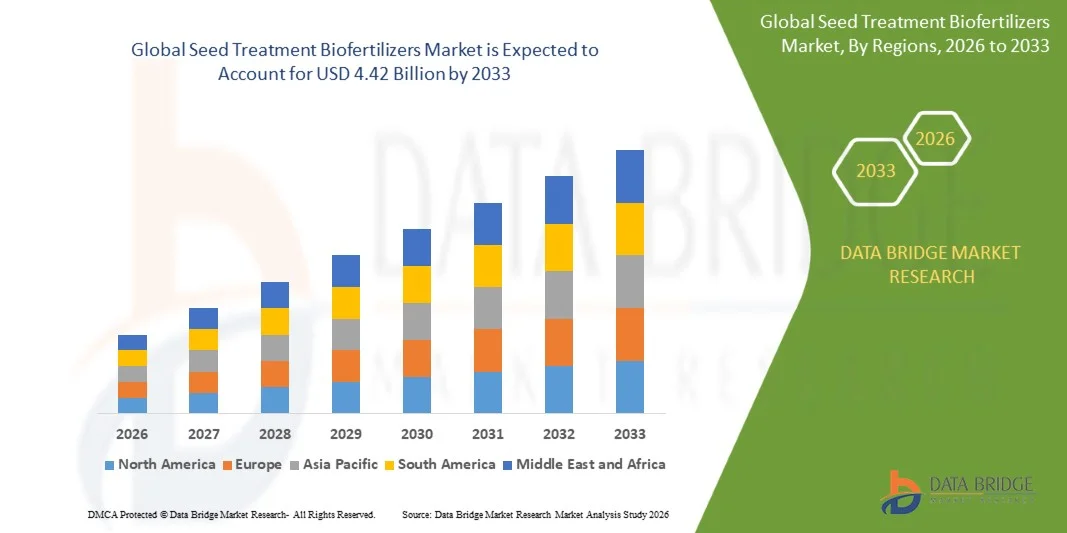
- As per Data Bridge Market Research analysis, the Seed Treatment Biofertilizers Market is estimated at USD 1.85 billion in 2025 and is projected to reach USD 4.42 billion by 2033, growing at a CAGR of 11.50% from 2026 to 2033.
- The market is experiencing strong growth driven by rising global adoption of sustainable agricultural practices, growing government support for reducing chemical fertilizer dependency, and increasing farmer awareness of the yield and soil health benefits offered by microbial seed treatments.
- Growing regulatory and consumer pressure to reduce synthetic fertilizer use, combined with rising investment in microbial strain research and formulation stability, is compelling leading agricultural input companies to expand their seed treatment biofertilizer portfolios. Continued expansion of government subsidy programs supporting biological inputs across emerging markets is expected to further accelerate category adoption.
Market Size & Forecast
- Global Market Value (2025): USD 1.85 Billion
- Expected Market Value (2033): USD 4.42 Billion
- Forecast CAGR (2026–2033): 11.50%
- Leading Region in 2025: North America
- Fastest Growing Region: Asia-Pacific
What are the Major Takeaways of the Seed Treatment Biofertilizers Market?
- North America dominated the Seed Treatment Biofertilizers Market with the share of 38.20% revenue share in 2025, supported by strong adoption of regenerative agriculture practices and government-backed nutrient-use-efficiency programs.
- Asia-Pacific is expected to be the fastest-growing region with a CAGR of 3.01% from 2026 to 2033, fueled by expanding organic farming initiatives, rising government support for sustainable agriculture, and growing awareness of biofertilizer benefits across India and China.
- The nitrogen-fixing biofertilizers segment led the product type category with a 74.30% share in 2025, driven by its critical role in reducing dependency on synthetic nitrogen fertilizers.
- The phosphate-solubilizing biofertilizers segment is the fastest-growing product type, reflecting rising demand for formulations that improve phosphorus availability in nutrient-deficient soils.
- The bacterial segment dominated the microorganism type category with a 63.80% revenue share in 2025, reflecting the widespread commercial availability of proven bacterial strains.
- The cereals & grains segment led the crop type category with a 39.80% share in 2025, driven by the large global cultivation area devoted to staple cereal crops.
- The oilseeds & pulses segment is the fastest-growing crop type with a CAGR of 12.0%, reflecting rising adoption of biofertilizers in leguminous crops that benefit significantly from microbial nutrient enhancement.
Report Scope and Seed Treatment Biofertilizers Market Segmentation
|
Attributes |
Seed Treatment Biofertilizers Key Market Insights |
|
Segments Covered |
|
|
Countries Covered |
North America
Europe
Asia-Pacific
Middle East and Africa
South America
|
|
Key Market Players |
|
|
Market Opportunities |
|
|
Value Added Data Infosets |
In addition to the insights on market scenarios such as market value, growth rate, segmentation, geographical coverage, and major players, the market reports curated by the Data Bridge Market Research also include import export analysis, production capacity overview, production consumption analysis, price trend analysis, climate change scenario, supply chain analysis, value chain analysis, raw material/consumables overview, vendor selection criteria, PESTLE Analysis, Porter Analysis, and regulatory framework. |
What is the Key Trend in the Seed Treatment Biofertilizers Market?
- Leading agricultural input companies continue to form strategic alliances to expand access to advanced microbial strain technology across key agricultural markets.
- In September 2025, ICL entered into a long-term alliance with BioPrime to deploy BioPrime's BioNexus microbial strain platform in India, focusing on enhancing nutrient use efficiency for phosphorus and zinc in soil, aiming to make next-generation biofertilizers more accessible to Indian farmers.
- Manufacturers continue to secure significant financing to accelerate global rollout and R&D expansion of nitrogen-fixing seed treatment technology.
- In April 2024, BioConsortia secured USD 15 million in financing to accelerate the global rollout of its "Always-N" nitrogen-fixing seed treatment biofertilizer, with the funds also supporting expansion of its research and development capabilities and manufacturing footprint.
- Major agrochemical companies continue to partner with specialized biofertilizer innovators to expand distribution of seed treatment biofertilizer products.
- In August 2024, Pivot Bio and Corteva Agriscience joined forces to increase distribution of Pivot Bio's PROVEN 40 seed treatment biofertilizer, a product demonstrating a 20% reduction in nitrogen runoff backed by USDA experiments, accelerating regenerative agriculture adoption in California and the Midwest.
As leading companies continue to pursue strategic alliances, expand financing for microbial R&D, and partner with major agrochemical distributors, the Seed Treatment Biofertilizers Market is expected to sustain strong growth across both developed and emerging agricultural markets.
What are the Key Drivers of the Seed Treatment Biofertilizers Market?
- Growing government support for sustainable agriculture and nutrient-use-efficiency programs continues to drive adoption of seed treatment biofertilizers as an alternative to synthetic fertilizer inputs.
- In March 2025, the USDA expanded its Climate-Smart Commodities program, providing financial support to farmers using nitrogen-fixing microorganisms, helping companies such as Pivot Bio expand the use of microbial biofertilizers on corn and soybean farms across the U.S.
- Rising farmer awareness of the yield and soil health benefits of microbial seed treatments continues to expand commercial adoption across major cereal and oilseed production regions.
- In January 2025, Supercrop Safe Limited carried out a full-range launch of biofertilizer products, including its Super Gold WP+ formulation, across several Indian states including Haryana, Gujarat, Punjab, Rajasthan, and Kerala, aimed at reducing farmer dependency on chemical fertilizers such as DAP and urea.
- Growing agricultural industry interest in circular, waste-based biofertilizer production continues to expand the range of sustainable input options available to farmers.
- In May 2024, Fresh Del Monte partnered to produce biofertilizers using fruit residues, reflecting the broader industry trend toward circular agricultural input production models.
With sustainable agriculture policy support continuing to expand and farmer awareness of microbial seed treatment benefits continuing to grow, the Seed Treatment Biofertilizers Market is expected to remain a high-growth category within the broader biological agricultural input landscape.
Which Factors are Challenging the Growth of the Seed Treatment Biofertilizers Market?
- Variable field performance of microbial biofertilizers across diverse soil types and climatic conditions continues to create adoption hesitancy among some commercial growers accustomed to consistent synthetic fertilizer results.
- Limited cold-chain and storage infrastructure in certain emerging agricultural markets continues to constrain distribution of temperature-sensitive liquid biofertilizer formulations.
- The seed treatment biofertilizers market remains a moderately fragmented category, with a large number of regional and national manufacturers, particularly across India, competing alongside major multinational agrochemical companies.
- For Instance: In March 2024, Research published in Annals of Agricultural Research evaluated biofertilizer-treated sorghum seeds under ambient storage and found that packaging material influenced seedling performance after three months. Seeds stored in aluminum foil pouches performed better than those stored in cloth bags, demonstrating how storage conditions and packaging can affect the viability and effectiveness of microbial seed-treatment solutions.
- Continued reliance on synthetic fertilizers among many commercial growers, owing to their established performance track record and lower upfront application complexity, continues to constrain faster category penetration despite growing biofertilizer adoption.
- For instance: In September 2024, A study published in the South African Journal of Botany evaluated microbial seed coatings in two chickpea varieties and reported that treatment effects varied with crop variety and storage period. The researchers specifically noted that additional field-performance testing was required to validate the benefits, highlighting the challenge of translating controlled experimental results into consistent commercial field outcomes.
- The combination of variable field performance across diverse growing conditions, limited cold-chain infrastructure in certain emerging markets, and continued competition from established synthetic fertilizer products continues to create headwinds for the seed treatment biofertilizers market, even as strong government and consumer support sustains long-term category growth.
How is the Seed Treatment Biofertilizers Market Segmented?
The Seed Treatment Biofertilizers Market is segmented on the basis of product type, microorganism type, formulation, crop type, application method, mode of sale, and end user.
- By Product Type
On the basis of product type, the Seed Treatment Biofertilizers Market is segmented into nitrogen-fixing biofertilizers, phosphate-solubilizing biofertilizers, potassium-mobilizing biofertilizers, and others. The nitrogen-fixing biofertilizers segment dominated the market with a 74.30% share in 2025, driven by their critical role in enhancing soil fertility and crop productivity by converting atmospheric nitrogen into plant-usable forms, reducing dependency on synthetic nitrogen fertilizers.
The phosphate-solubilizing biofertilizers segment is projected to register the fastest growth CAGR of 12.02% from 2026 to 2033, driven by rising demand for formulations that improve phosphorus availability in nutrient-deficient soils, complementing nitrogen-fixing product adoption.
- By Microorganism Type
On the basis of microorganism type, the Seed Treatment Biofertilizers Market is segmented into bacterial, fungal, and algal. The bacterial segment dominated the market with a 63.80% share in 2025, reflecting the widespread commercial availability and proven field performance of bacterial strains such as Rhizobium, Azotobacter, and Azospirillum in seed treatment applications.
The fungal segment is expected to witness the fastest CAGR of 13.01% from 2026 to 2033, driven by growing adoption of mycorrhizal and other fungal-based formulations that enhance root development and nutrient uptake efficiency.
- By Formulation
On the basis of formulation, the Seed Treatment Biofertilizers Market is segmented into liquid, powder/solid, and carrier-based. The solid/powder biofertilizers segment dominated the market with a 57.20% share in 2025, reflecting its established use, longer shelf stability, and ease of storage and transport relative to liquid formulations.
The liquid segment is projected to witness the fastest CAGR of 12.59% from 2026 to 2033, driven by growing farmer preference for formulations offering easier application, higher microbial concentration, and improved seed coating uniformity.
- By Crop Type
On the basis of crop type, the Seed Treatment Biofertilizers Market is segmented into cereals & grains, oilseeds & pulses, fruits & vegetables, and others. The cereals & grains segment dominated the market with a 39.80% share in 2025, driven by the large global cultivation area devoted to staple cereal crops such as wheat, rice, and maize, which represent the primary application base for nitrogen-fixing seed treatments.
The oilseeds & pulses segment is expected to witness the fastest CAGR of 12.68% from 2026 to 2033, driven by rising adoption of nitrogen-fixing and phosphate-solubilizing biofertilizers in leguminous crops that benefit significantly from microbial nutrient enhancement.
- By Application Method
On the basis of application method, the Seed Treatment Biofertilizers Market is segmented into seed coating, seed dressing, and seed pelleting. The seed coating segment dominated the market with the largest share in 2025, reflecting its widespread use in delivering a uniform, controlled microbial layer directly onto the seed surface prior to planting.
The seed pelleting segment is projected to witness the fastest CAGR of 11.99% from 2026 to 2033, driven by growing adoption among precision agriculture operations seeking improved seed handling and planting accuracy alongside microbial inoculation.
- By Mode of Sale
On the basis of mode of sale, the Seed Treatment Biofertilizers Market is segmented into direct/company-owned, distributors & retailers, and online. The distributors & retailers segment dominated the market with the largest share in 2025, reflecting the important role of regional agricultural input dealers in reaching smallholder and commercial farmers across diverse geographies.
The online segment is expected to witness the fastest CAGR of 13.20% from 2026 to 2033, driven by growing digital agricultural input procurement adoption, particularly among commercial growers in developed markets.
- By End User
On the basis of end user, the Seed Treatment Biofertilizers Market is segmented into commercial growers, smallholder farmers, and research & seed companies. The commercial growers segment dominated the market with the largest share in 2025, reflecting large-scale adoption of seed treatment biofertilizers across major cereal and oilseed production regions in North America and South America.
The smallholder farmers segment is projected to witness the fastest CAGR of 13.01% from 2026 to 2033, driven by expanding government subsidy programs and rising affordability of seed treatment biofertilizers across emerging agricultural markets.
Which Region Holds the Largest Share of the Seed Treatment Biofertilizers Market?
- North America dominated the Seed Treatment Biofertilizers Market and accounted for the largest revenue share of 38.29% in 2025, supported by strong adoption of regenerative agriculture practices, extensive corn and soybean cultivation area, and government-backed nutrient-use-efficiency programs such as the USDA's Climate-Smart Commodities initiative.
- The region also benefits from strong presence of leading biofertilizer innovators, including Pivot Bio and BioConsortia, alongside growing strategic partnerships with major agrochemical distributors. Continued expansion of government subsidy programs is expected to further reinforce North America's leadership position in the global market.
U.S. Seed Treatment Biofertilizers Market Insight
The U.S. seed treatment biofertilizers market remains supported by increasing adoption of regenerative and sustainable agriculture practices, growing emphasis on nutrient-use efficiency, and government-backed initiatives promoting climate-smart farming. Programs such as the USDA’s Partnerships for Climate-Smart Commodities have increased attention toward agricultural practices that improve soil health, reduce environmental impacts, and enhance input efficiency. In addition, the presence of established agricultural input companies and specialized biological-input developers is strengthening commercialization. Strategic collaborations, including the August 2024 partnership between Pivot Bio and Corteva Agriscience, are further supporting the integration and distribution of microbial solutions through established agricultural channels, contributing to broader farmer awareness and adoption.
India Seed Treatment Biofertilizers Market Insight
The India seed treatment biofertilizers market continues to benefit from government initiatives supporting sustainable agriculture, soil health improvement, and reduced dependence on chemical inputs. Programs such as the Soil Health Card Scheme have increased awareness regarding balanced nutrient management and the importance of improving soil quality. India also has a large and expanding base of domestic manufacturers developing microbial and biological agricultural inputs for different crops and cultivation conditions. Product expansion, including Supercrop Safe Limited’s January 2025 full-range biofertilizer rollout, is increasing the availability of biological solutions, while international collaborations such as ICL’s September 2025 alliance with BioPrime are supporting technological development and commercialization. These developments are contributing to wider awareness and adoption of biofertilizer-based agricultural solutions across the country.
China Seed Treatment Biofertilizers Market Insight
The China seed treatment biofertilizers market continues to expand, supported by increasing government emphasis on sustainable agricultural production, soil fertility improvement, and more efficient utilization of agricultural inputs. The country’s large agricultural sector and increasing focus on reducing excessive chemical fertilizer use are creating opportunities for microbial and biological alternatives. In parallel, domestic manufacturing capabilities for microbial fertilizers, inoculants, and other biological agricultural inputs are expanding, allowing producers to develop products suited to local crops and growing conditions. Rising awareness among agricultural producers regarding soil health and integrated nutrient management is further supporting the adoption of seed-applied biological products, particularly as agricultural producers seek solutions that improve nutrient availability and crop establishment.
Brazil Seed Treatment Biofertilizers Market Insight
The Brazil seed treatment biofertilizers market benefits from the country’s extensive soybean, corn, and other cereal cultivation base, along with the established use of microbial inoculants in commercial agriculture. Biological nitrogen fixation, particularly in soybean cultivation, has created a strong foundation for the adoption of microbial agricultural inputs, while growing interest in nutrient-use efficiency and sustainable crop production is supporting further product development. The country also has an expanding biological-input ecosystem involving domestic and international companies, including Rizobacter Argentina, which provides microbial solutions for major agricultural crops. In addition, Brazil’s large-scale agricultural production, strong export-oriented farming sector, and increasing interest in biological alternatives to conventional agricultural inputs are supporting the commercialization and broader adoption of seed treatment biofertilizer solutions.
Which are the Top Companies in the Seed Treatment Biofertilizers Market?
The global seed treatment biofertilizers industry is primarily led by well-established agricultural input companies, including:
- Novonesis (Novozymes A/S) (Denmark)
- Corteva Agriscience (U.S.)
- Bayer AG (Germany)
- BASF SE (Germany)
- Syngenta Group (Switzerland)
- UPL Limited (India)
- Pivot Bio, Inc. (U.S.)
- BioConsortia, Inc. (U.S.)
- Rizobacter Argentina S.A. (Argentina)
- ICL Group Ltd. (Israel)
- Lallemand Inc. (Canada)
- Symborg S.L. (Spain)
- Agrinos AS (Norway)
- Marrone Bio Innovations (Bioceres Crop Solutions) (Argentina)
- National Fertilizers Limited (India)
- Madras Fertilizers Limited (India)
- Gujarat State Fertilizers & Chemicals Ltd. (India)
- Camson Bio Technologies Limited (India)
- T. Stanes and Company Limited (India)
- Nutramax Laboratories Inc. (U.S.)
What are the Latest Developments in the Seed Treatment Biofertilizers Market?
- In September 2025, ICL entered into a long-term alliance with BioPrime to deploy BioPrime's BioNexus microbial strain platform in India, focusing on enhancing nutrient use efficiency for phosphorus and zinc in soil.
- In March 2025, the USDA expanded its Climate-Smart Commodities program, providing financial support to farmers using nitrogen-fixing microorganisms, supporting continued adoption of microbial seed treatment biofertilizers in the U.S.
- In January 2025, Supercrop Safe Limited carried out a full-range launch of biofertilizer products, including its Super Gold WP+ formulation, across several Indian states.
- In August 2024, Pivot Bio and Corteva Agriscience joined forces to increase distribution of Pivot Bio's PROVEN 40 seed treatment biofertilizer, demonstrating a 20% reduction in nitrogen runoff backed by USDA experiments.
- In April 2024, BioConsortia secured USD 15 million in financing to accelerate the global rollout of its "Always-N" nitrogen-fixing seed treatment biofertilizer and expand its research and manufacturing capabilities.

- Interactive Data Analysis Dashboard
- Company Analysis Dashboard for high growth potential opportunities
- Research Analyst Access for customization & queries
- Competitor Analysis with Interactive dashboard
- Latest News, Updates & Trend analysis
- Harness the Power of Benchmark Analysis for Comprehensive Competitor Tracking
Data collection and base year analysis are done using data collection modules with large sample sizes. The stage includes obtaining market information or related data through various sources and strategies. It includes examining and planning all the data acquired from the past in advance. It likewise envelops the examination of information inconsistencies seen across different information sources. The market data is analysed and estimated using market statistical and coherent models. Also, market share analysis and key trend analysis are the major success factors in the market report. To know more, please request an analyst call or drop down your inquiry.
The key research methodology used by DBMR research team is data triangulation which involves data mining, analysis of the impact of data variables on the market and primary (industry expert) validation. Data models include Vendor Positioning Grid, Market Time Line Analysis, Market Overview and Guide, Company Positioning Grid, Patent Analysis, Pricing Analysis, Company Market Share Analysis, Standards of Measurement, Global versus Regional and Vendor Share Analysis. To know more about the research methodology, drop in an inquiry to speak to our industry experts.
Data Bridge Market Research is a leader in advanced formative research. We take pride in servicing our existing and new customers with data and analysis that match and suits their goal. The report can be customized to include price trend analysis of target brands understanding the market for additional countries (ask for the list of countries), clinical trial results data, literature review, refurbished market and product base analysis. Market analysis of target competitors can be analyzed from technology-based analysis to market portfolio strategies. We can add as many competitors that you require data about in the format and data style you are looking for. Our team of analysts can also provide you data in crude raw excel files pivot tables (Fact book) or can assist you in creating presentations from the data sets available in the report.