


What is the Self-Contained Breathing Apparatus Market Size and Growth Rate?
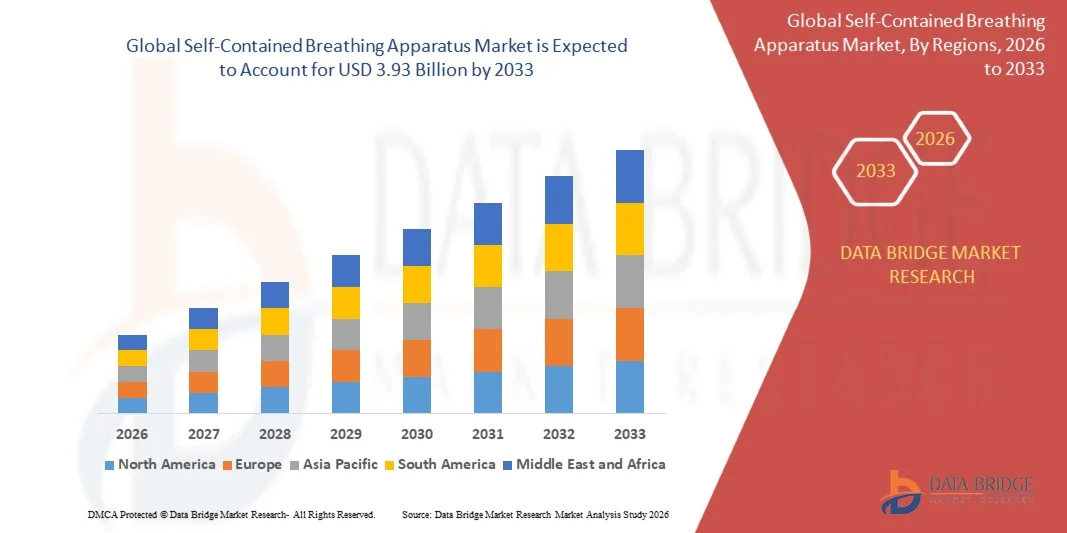
- As per Data Bridge Market Research analysis, the self-contained breathing apparatus market was valued at USD 2.37 billion in 2025 and is projected to reach USD 3.93 billion by 2033, growing at a CAGR of 6.50% from 2026 to 2033.
- The market is experiencing steady growth driven by tightening occupational safety regulations, rising frequency of industrial accidents and fire incidents, and increasing government investment in equipping fire services and emergency response teams with reliable respiratory protection.
- Continued innovation in lightweight composite cylinder technology, extended-duration breathing systems, and smart, telemetry-enabled SCBA units is improving responder safety and situational awareness, while expanding industrial applications across oil & gas, chemical processing, and mining are further widening the market's addressable base.
Market Size & Forecast
- Global Market Value (2025): USD 2.37 Billion
- Expected Market Value (2033): USD 3.93 Billion
- Forecast CAGR (2026–2033): 6.50%
- Leading Region in 2025: North America
- Fastest Growing Region: Asia-Pacific
What are the Major Takeaways of the Self-Contained Breathing Apparatus Market?
- North America dominated the global self-contained breathing apparatus market with the largest revenue share of 38.60% in 2025, supported by stringent occupational safety regulations, well-funded fire services, and the presence of leading SCBA manufacturers.
- Asia-Pacific is expected to be the fastest-growing region at a CAGR of 8.40% from 2026 to 2033, fueled by rapid industrialization, expanding fire service infrastructure, and tightening workplace safety regulations across China and India.
- The open-circuit SCBA segment led the market with a 68.00% share in 2025, driven by its status as the standard choice for global fire services due to operational simplicity and ease of maintenance.
- Closed-circuit SCBA is the fastest-growing type, projected to register a CAGR of 7.80%, reflecting rising demand for extended-duration breathing protection in mining and confined-space rescue applications.
- The fire services segment dominated the application category with a 58.00% revenue share in 2025, supported by consistent government funding and mandatory equipment replacement cycles.
- The composite/carbon fiber cylinders segment accounted for 52.30% of the market share in 2025, driven by their significantly lighter weight compared with traditional steel cylinders.
- The smart/connected SCBA technology segment is the fastest-growing category, with a CAGR of 12.40%, driven by rising adoption of telemetry, GPS tracking, and real-time air consumption monitoring.
Report Scope and Self-Contained Breathing Apparatus Market Segmentation
|
Attributes |
Self-Contained Breathing Apparatus Key Market Insights |
|
Segments Covered |
|
|
Countries Covered |
North America
Europe
Asia-Pacific
Middle East and Africa
South America
|
|
Key Market Players |
|
|
Market Opportunities |
|
|
Value Added Data Infosets |
In addition to the insights on market scenarios such as market value, growth rate, segmentation, geographical coverage, and major players, the market reports curated by the Data Bridge Market Research also include import export analysis, production capacity overview, production consumption analysis, price trend analysis, climate change scenario, supply chain analysis, value chain analysis, raw material/consumables overview, vendor selection criteria, PESTLE Analysis, Porter Analysis, and regulatory framework. |
What is the Key Trend in the Self-Contained Breathing Apparatus Market?
- Manufacturers are increasingly integrating wireless connectivity, GPS tracking, and telemetry-based monitoring into SCBA units to improve situational awareness and coordination among firefighting teams during emergency response operations.
- For instance, in June 2024, Dräger introduced a new SCBA system equipped with advanced communication features, including wireless connectivity and built-in GPS, designed to enhance situational awareness and coordination among firefighting teams during emergency response operations.
- Smart SCBA adoption incorporating telemetry and real-time monitoring systems has continued to expand significantly, reflecting rising demand for connected safety equipment among fire services and industrial safety teams.
- Specialized electronics and defense technology companies have increasingly entered the SCBA segment through partnerships and acquisitions, with multiple patent filings in 2024–2025 targeting AI-assisted air consumption monitoring and predictive maintenance capabilities.
- As fire services and industrial safety programs continue to prioritize responder safety and operational visibility, manufacturers are expected to accelerate investment in smart, connected SCBA platforms, reinforcing digitalization as a core market trend.
What are the Key Drivers of the Self-Contained Breathing Apparatus Market?
- Tightening occupational safety regulations and updated national fire service standards are driving sustained replacement demand for compliant, next-generation SCBA equipment.
- For instance, in April 2025, MSA Safety introduced the G1 SCBA XR Edition at FDIC 2025, featuring upgrades to the breathing air regulator, enhanced soft goods, and a shorter lumbar pad, designed to enhance firefighter comfort, usability, and compliance with the updated NFPA 1970 standard.
- The rising frequency of industrial accidents, fire incidents, and hazardous material exposure events is increasing demand for reliable respiratory protection equipment across both emergency response and industrial settings.
- For instance, in August 2025, 3M Scott introduced the Vision C5 Facepiece with an E-Z Flo C5 Regulator, reflecting continued manufacturer investment in improved breathing performance and responder comfort for high-intensity firefighting operations.
- With global fire incidents continuing to exceed several million annual cases and industrial safety regulations continuing to tighten, sustained investment in SCBA equipment upgrades and replacement cycles is expected to remain a key growth driver for the market.
Which Factors are Challenging the Growth of the Self-Contained Breathing Apparatus Market?
- Advanced SCBA units featuring composite cylinders, smart telemetry, and enhanced regulators involve substantially higher upfront costs compared with standard analog systems, creating budget constraints for smaller fire departments and industrial operators.
- Mandatory periodic hydrostatic testing, cylinder recertification, and component replacement requirements add recurring compliance costs and administrative burden for equipment owners over an SCBA unit's operational lifespan.
- Comprehensive responder training on proper SCBA use, maintenance, and emergency procedures requires significant time and resource investment, particularly for volunteer and smaller municipal fire departments with limited budgets.
- The combination of high upfront equipment costs, recurring recertification and compliance requirements, and the resource-intensive nature of responder training continues to restrain broader SCBA adoption among smaller, budget-constrained fire departments and industrial operators.
How is the Self-Contained Breathing Apparatus Market Segmented?
The self-contained breathing apparatus market is segmented on the basis of type, application, cylinder material, cylinder duration, pressure rating, distribution channel, end user, technology, component, and procurement model.
- By Type
On the basis of type, the global self-contained breathing apparatus market is segmented into open-circuit SCBA and closed-circuit SCBA. The open-circuit SCBA segment dominated the market with a 68.00% share in 2025, as it remains the standard choice for fire services globally due to its straightforward operational principles, ease of maintenance, and widespread familiarity among emergency responders.
The closed-circuit SCBA segment is projected to register the fastest growth at a CAGR of 7.80% from 2026 to 2033, driven by rising demand for extended-duration breathing protection in mining, confined-space rescue, and specialized military and industrial applications.
- By Application
On the basis of application, the global self-contained breathing apparatus market is segmented into fire services, industrial use, underwater diving, medical, and military & law enforcement. The fire services segment dominated the market with a 58.00% share in 2025, reflecting SCBA's role as indispensable safety equipment for firefighting and emergency response teams operating in smoke- and toxic-gas-filled environments.
The industrial use segment is expected to witness the fastest CAGR of 7.90% from 2026 to 2033, driven by tightening occupational safety regulations and expanding respiratory protection requirements across oil & gas, chemical processing, and mining operations.
- By Cylinder Material
On the basis of cylinder material, the global self-contained breathing apparatus market is segmented into composite/carbon fiber cylinders, aluminum cylinders, and steel cylinders. The composite/carbon fiber cylinders segment dominated the market with a 52.30% share in 2025, driven by their significantly lighter weight compared with traditional steel cylinders, reducing responder fatigue during extended operations.
The aluminum cylinders segment is projected to witness the fastest CAGR of 7.50% from 2026 to 2033, supported by growing demand for a cost-effective, corrosion-resistant alternative in industrial and lower-budget procurement settings.
- By Cylinder Duration
On the basis of cylinder duration, the global self-contained breathing apparatus market is segmented into 30-minute duration, 45-minute duration, 60-minute duration, and extended duration (75+ minutes). The 30-minute duration segment dominated the market with a 41.00% share in 2025, reflecting its established use as the standard configuration for structural firefighting operations under most national fire service protocols.
The extended duration (75+ minutes) segment is anticipated to witness the fastest CAGR of 8.60% from 2026 to 2033, driven by rising demand for longer-duration protection in mining, confined-space rescue, and industrial maintenance operations.
- By Pressure Rating
On the basis of pressure rating, the global self-contained breathing apparatus market is segmented into 300 bar, 350 bar, and 400+ bar. The 300 bar segment dominated the market with a 57.00% share in 2025, as it remains the most widely adopted compressed air pressure standard across global fire services and industrial safety programs.
The 400+ bar segment is projected to witness the fastest CAGR of 8.10% from 2026 to 2033, driven by growing demand for higher air storage capacity within compact, lightweight cylinder designs.
- By Distribution Channel
On the basis of distribution channel, the global self-contained breathing apparatus market is segmented into direct sales, distributors, and online. The direct sales segment dominated the market with a 49.50% share in 2025, supported by large-scale government and institutional procurement contracts that typically involve direct manufacturer engagement.
The online segment is expected to witness the fastest CAGR of 9.40% from 2026 to 2033, driven by growing digital procurement adoption for replacement parts, accessories, and smaller commercial orders.
- By End User
On the basis of end user, the global self-contained breathing apparatus market is segmented into firefighting & emergency response departments, oil & gas and chemical processing, mining, manufacturing & industrial, and marine & shipping. The firefighting & emergency response departments segment dominated the market with a 46.80% share in 2025, supported by consistent government funding and mandatory equipment replacement cycles across national and municipal fire services.
The oil & gas and chemical processing segment is anticipated to witness the fastest CAGR of 8.30% from 2026 to 2033, driven by stringent occupational safety regulations and rising investment in respiratory protection across hazardous industrial facilities.
- By Technology
On the basis of technology, the global self-contained breathing apparatus market is segmented into standard/analog SCBA and smart/connected SCBA. The standard/analog SCBA segment dominated the market with a 71.00% share in 2025, reflecting the continued widespread use of conventional, non-connected units across most fire services and industrial safety programs globally.
The smart/connected SCBA segment is expected to witness the fastest CAGR of 12.40% from 2026 to 2033, driven by rising adoption of telemetry, GPS tracking, and real-time air consumption monitoring to improve firefighter safety and situational awareness during emergency response operations.
- By Component
On the basis of component, the global self-contained breathing apparatus market is segmented into face piece/mask, air cylinder, regulator, harness & backplate, and alarm & monitoring systems. The air cylinder segment dominated the market with a 34.60% share in 2025, reflecting its position as the highest-value component within a complete SCBA unit and its recurring replacement and recertification demand.
The alarm & monitoring systems segment is projected to witness the fastest CAGR of 9.80% from 2026 to 2033, driven by growing integration of low-air alarms, PASS devices, and telemetry-based monitoring systems into modern SCBA units.
- By Procurement Model
On the basis of procurement model, the global self-contained breathing apparatus market is segmented into government & institutional procurement and commercial/private sector procurement. The government & institutional procurement segment dominated the market with a 63.40% share in 2025, supported by sustained public sector funding for fire services, defense, and emergency response equipment.
The commercial/private sector procurement segment is expected to witness the fastest CAGR of 7.60% from 2026 to 2033, driven by expanding industrial safety compliance requirements across privately operated oil & gas, chemical, and manufacturing facilities.
Which Region Holds the Largest Share of the Self-Contained Breathing Apparatus Market?
- North America dominated the self-contained breathing apparatus market and accounted for the largest revenue share of 38.60% in 2025, supported by stringent occupational safety regulations, well-funded municipal and national fire services, and the presence of leading SCBA manufacturers.
- The region also benefits from consistent government procurement budgets, active enforcement of updated NFPA standards, and strong industrial demand from the oil & gas and chemical processing sectors, which continues to reinforce North America's leadership position in the global market.
U.S. Self-Contained Breathing Apparatus Market Insight
The U.S. self-contained breathing apparatus market is experiencing steady growth, supported by consistent government funding for fire services and strict enforcement of updated NFPA 1970 safety standards. Leading manufacturers continue to introduce upgraded facepieces, regulators, and smart, telemetry-enabled units to meet evolving firefighter safety and performance requirements. Growing industrial demand from the oil & gas and chemical processing sectors is further contributing to market growth in the U.S.
Germany Self-Contained Breathing Apparatus Market Insight
The Germany self-contained breathing apparatus market is expanding steadily, supported by the country's strong industrial safety culture and the presence of leading global manufacturers. Continued innovation in lightweight composite cylinder technology and connected, telemetry-enabled SCBA systems is supporting demand across both fire services and industrial safety programs. Strong regulatory enforcement of workplace respiratory protection standards is further shaping market growth in Germany.
Asia-Pacific Self-Contained Breathing Apparatus Market Insight
The Asia-Pacific self-contained breathing apparatus market is expected to witness rapid growth, driven by rapid industrialization, expanding fire service infrastructure, and tightening workplace safety regulations across China, India, and Japan. Growing investment in domestic manufacturing capacity, combined with rising awareness of respiratory protection standards, continues to support strong regional market expansion.
Japan Self-Contained Breathing Apparatus Market Insight
The Japan self-contained breathing apparatus market is witnessing consistent growth, supported by the country's well-established fire service infrastructure and strong industrial safety compliance culture. Domestic manufacturers continue to introduce advanced, lightweight SCBA units designed to meet the specific operational needs of both emergency response and industrial applications in Japan.
China Self-Contained Breathing Apparatus Market Insight
The China self-contained breathing apparatus market is growing rapidly, driven by expanding industrial safety regulations and rising investment in fire service and emergency response infrastructure. Growing domestic manufacturing capacity is improving the affordability and availability of SCBA units, while rising demand from the country's oil & gas, chemical, and mining sectors continues to support strong market growth across China.
Which are the Top Companies in Self-Contained Breathing Apparatus Market?
The self-contained breathing apparatus industry is primarily led by well-established companies, including:
- 3M Company (U.S.)
- Honeywell International Inc. (U.S.)
- Drägerwerk AG & Co. KGaA (Germany)
- MSA Safety Incorporated (U.S.)
- Avon Protection Systems, Inc. (U.K.)
- Interspiro AB (Sweden)
- Shigematsu Works Co., Ltd. (Japan)
- Survitec Group Limited (U.K.)
- Rosenbauer International AG (Austria)
- Bristol Uniforms Ltd. (U.K.)
- Delta Plus Group (France)
- Spasciani S.p.A. (Italy)
- Ocenco, Inc. (U.S.)
- North Safety Products (U.S.)
- Bullard (U.S.)
What are Latest Developments in Self-Contained Breathing Apparatus Market?
- In August 2025, 3M Scott introduced the Vision C5 Facepiece featuring an E-Z Flo C5 Regulator, reflecting continued investment in improved breathing performance and responder comfort for high-intensity firefighting operations.
- In April 2025, MSA Safety introduced the G1 SCBA XR Edition at FDIC 2025, featuring upgrades to the breathing air regulator, enhanced soft goods, and a shorter lumbar pad, designed to enhance firefighter comfort, usability, and compliance with the updated NFPA 1970 standard.
- In June 2024, Dräger introduced a new SCBA system equipped with advanced communication features, including wireless connectivity and built-in GPS, designed to enhance situational awareness and coordination among firefighting teams during emergency response operations.
- In May 2024, MSA Safety highlighted the continued advancement of its G1 SCBA platform with integrated thermal imaging, adjustable lumbar support, and connectivity with FireGrid, enabling firefighters and incident commanders to access critical scene and air-management information while improving ergonomics and situational awareness.
- In 2025, MSA Safety expanded the G1 SCBA platform with the G1 SCBA XR Edition, incorporating integrated Bluetooth communications, noise-canceling voice amplification, adjustable sizing and lumbar support, and connectivity with the LUNAR connected device to provide air-status, alarm, and search-status information to incident command. The system is certified to the NFPA 1970:2025 standard.

- Interactive Data Analysis Dashboard
- Company Analysis Dashboard for high growth potential opportunities
- Research Analyst Access for customization & queries
- Competitor Analysis with Interactive dashboard
- Latest News, Updates & Trend analysis
- Harness the Power of Benchmark Analysis for Comprehensive Competitor Tracking
Global Self Contained Breathing Apparatus Market, Supply Chain Analysis and Ecosystem Framework
To support market growth and help clients navigate the impact of geopolitical shifts, DBMR has integrated in-depth supply chain analysis into its Global Self Contained Breathing Apparatus Market research reports. This addition empowers clients to respond effectively to global changes affecting their industries. The supply chain analysis section includes detailed insights such as Global Self Contained Breathing Apparatus Market consumption and production by country, price trend analysis, the impact of tariffs and geopolitical developments, and import and export trends by country and HSN code. It also highlights major suppliers with data on production capacity and company profiles, as well as key importers and exporters. In addition to research, DBMR offers specialized supply chain consulting services backed by over a decade of experience, providing solutions like supplier discovery, supplier risk assessment, price trend analysis, impact evaluation of inflation and trade route changes, and comprehensive market trend analysis.
Data collection and base year analysis are done using data collection modules with large sample sizes. The stage includes obtaining market information or related data through various sources and strategies. It includes examining and planning all the data acquired from the past in advance. It likewise envelops the examination of information inconsistencies seen across different information sources. The market data is analysed and estimated using market statistical and coherent models. Also, market share analysis and key trend analysis are the major success factors in the market report. To know more, please request an analyst call or drop down your inquiry.
The key research methodology used by DBMR research team is data triangulation which involves data mining, analysis of the impact of data variables on the market and primary (industry expert) validation. Data models include Vendor Positioning Grid, Market Time Line Analysis, Market Overview and Guide, Company Positioning Grid, Patent Analysis, Pricing Analysis, Company Market Share Analysis, Standards of Measurement, Global versus Regional and Vendor Share Analysis. To know more about the research methodology, drop in an inquiry to speak to our industry experts.
Data Bridge Market Research is a leader in advanced formative research. We take pride in servicing our existing and new customers with data and analysis that match and suits their goal. The report can be customized to include price trend analysis of target brands understanding the market for additional countries (ask for the list of countries), clinical trial results data, literature review, refurbished market and product base analysis. Market analysis of target competitors can be analyzed from technology-based analysis to market portfolio strategies. We can add as many competitors that you require data about in the format and data style you are looking for. Our team of analysts can also provide you data in crude raw excel files pivot tables (Fact book) or can assist you in creating presentations from the data sets available in the report.













