


Self-Powered Implantable Medical Devices Market Size
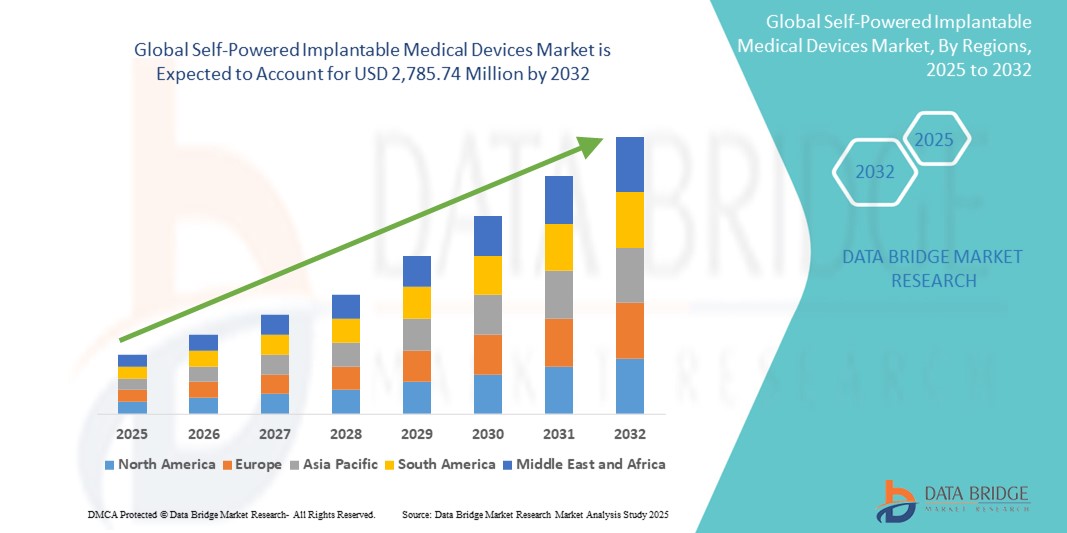
- The global self-powered implantable medical devices market size was valued at USD 317.3 million in 2024 and is expected to reach USD 2,785.74 million by 2032, at a CAGR of 31.20% during the forecast period
- This growth is driven by factors such as rising prevalence of chronic diseases, growing geriatric population, and increasing demand for minimally invasive treatments
Self-Powered Implantable Medical Devices Market Analysis
- Self-powered implantable medical devices are advanced solutions that generate energy within the body, eliminating the need for external power sources or battery replacements. They enable continuous monitoring and therapy for chronic conditions, enhancing patient outcomes and treatment efficiency
- The market is growing rapidly due to the rising burden of chronic diseases, demand for durable and minimally invasive implants, and advancements in energy harvesting technologies. An aging population, improved healthcare infrastructure, and supportive policies are further driving adoption, particularly in cardiology, neurology, and orthopedics
- North America is expected to dominate the self-powered implantable medical devices market with a share of with a share of 43.65%, due to the early adoption of advanced medical technologies, a well-established healthcare infrastructure, and significant investments in R&D for next-generation implantable devices
- Asia-Pacific is expected to be the fastest growing region in the self-powered implantable medical devices market during the forecast period due to increasing healthcare investments, rising awareness of advanced treatment options, and a growing patient population
- Metallic segment is expected to dominate the market with a market share of 49.30% due to its superior mechanical strength, corrosion resistance, and excellent biocompatibility. Metals such as titanium and its alloys are widely used in implants because they can withstand physiological loads and function effectively over extended periods without degrading. Their ability to integrate well with biological tissues also reduces the risk of rejection, making them the preferred choice for critical applications such as orthopedic, dental, and cardiovascular implants
Report Scope and Self-Powered Implantable Medical Devices Market Segmentation
|
Attributes |
Self-Powered Implantable Medical Devices Key Market Insights |
|
Segments Covered |
|
|
Countries Covered |
North America
Europe
Asia-Pacific
Middle East and Africa
South America
|
|
Key Market Players |
|
|
Market Opportunities |
|
|
Value Added Data Infosets |
In addition to the insights on market scenarios such as market value, growth rate, segmentation, geographical coverage, and major players, the market reports curated by the Data Bridge Market Research also include depth expert analysis, patient epidemiology, pipeline analysis, pricing analysis, and regulatory framework. |
Self-Powered Implantable Medical Devices Market Trends
“Growing Demand for Compact and Highly Reliable Devices”
- One prominent trend in the global self-powered implantable medical devices market is the growing demand for compact and highly reliable devices
- This trend is driven by the need for minimally invasive procedures, patient comfort, and longer device lifespan, especially in chronic disease management where long-term implantation is essential
- For instance, researchers at Georgia Institute of Technology have developed nanoscale energy-harvesting implants using piezoelectric nanogenerators, enabling ultra-small devices to power themselves through body movements while maintaining high performance and durability
- The shift toward compact designs is gaining momentum in both developed markets such as U.S. and Europe, and in emerging economies where healthcare systems are rapidly modernizing
- As patients and healthcare providers prioritize less invasive, longer-lasting, and more efficient treatment options, the demand for compact and durable self-powered implants is expected to remain a key trend shaping innovation in the market
Self-Powered Implantable Medical Devices Market Dynamics
Driver
“Increasing Prevalence of Chronic Diseases”
- The rising incidence of chronic diseases is becoming a crucial factor propelling the self-powered implantable medical devices market, as these devices offer sustainable and reliable long-term solutions for managing conditions such as cardiovascular diseases, diabetes, and neurological disorders
- This trend is accelerating globally, with healthcare providers and patients increasingly adopting self-powered implantable devices to reduce dependence on external power sources, thereby enhancing device longevity and patient comfort
- As the prevalence of chronic ailments grows, there is a heightened focus on developing innovative implantable devices capable of harvesting energy from the body, which minimizes the need for battery replacements and invasive procedures
- Key market players are investing in advanced energy-harvesting technologies and miniaturized device designs to improve the efficiency and functionality of self-powered implants, supporting continuous health monitoring and therapeutic interventions
- In addition, the escalating demand for implantable devices that can operate autonomously over extended periods is driving research into novel materials and biocompatible energy sources, thereby reinforcing the market’s growth trajectory
For instance,
- Medtronic and Abbott Laboratories are advancing their implantable cardiac devices with integrated energy-harvesting modules, aiming to extend device lifespan and reduce surgical interventions
- Companies such as Biotronik and Boston Scientific are developing self-powered neurostimulators that utilize biomechanical energy, offering improved therapy for patients with chronic neurological disorders
- With ongoing innovations in self-sustaining energy technologies and the increasing burden of chronic diseases worldwide, the demand for self-powered implantable medical devices is expected to remain a key driver for market expansion
Opportunity
“Integration of Digital Health Technologies”
- The integration of digital health technologies presents a major opportunity for the self-powered implantable medical devices market, enabling enhanced device functionality and continuous patient monitoring without the need for frequent recharging or battery replacement
- Industry leaders are capitalizing on this opportunity by combining energy-harvesting implants with digital health platforms that provide real-time data analytics, remote monitoring, and personalized treatment adjustments
- This opportunity aligns with the broader shift toward connected healthcare, as patients and providers increasingly demand implantable devices that seamlessly integrate with digital ecosystems for improved disease management and proactive care
For instance,
- Philips Healthcare and Boston Scientific are advancing self-powered implantable devices that integrate with cloud-based digital health platforms, enabling continuous remote patient monitoring and data-driven treatment adjustments
- Companies such as iRhythm Technologies are leveraging self-powered implantable sensors combined with AI-enabled analytics to provide real-time cardiac monitoring and early detection of arrhythmias through connected digital health systems
- As the adoption of digital health technologies grows, particularly in chronic disease management and personalized medicine, the self-powered implantable medical devices market stands to benefit significantly from increased demand for autonomous, connected, and efficient medical solutions
Restraint/Challenge
“High Manufacturing Costs”
- High manufacturing costs pose a significant challenge for the self-powered implantable medical devices market, as the complex materials and advanced energy-harvesting technologies required increase production expenses
- Educating manufacturers and healthcare providers on cost-effective production methods and the long-term economic benefits of these devices remains difficult, especially when balancing innovation with affordability and scalability
- This challenge is intensified by the need for rigorous testing, regulatory approvals, and ensuring biocompatibility, which add further financial and time burdens that may delay product launches and market penetration
For instance,
- Companies such as Biotronik are collaborating with contract manufacturers to improve cost efficiency; however, high material costs and complex assembly processes remain significant hurdles
- Without addressing the high production costs and demonstrating clear value propositions, the adoption of self-powered implantable devices may be slowed, limiting the overall growth potential of the market
Self-Powered Implantable Medical Devices Market Scope
The market is segmented on the basis of product, biomaterial, and end use.
|
Segmentation |
Sub-Segmentation |
|
By Product |
|
|
By Biomaterial |
|
|
By End Use |
|
In 2025, the metallic is projected to dominate the market with a largest share in biomaterial segment
The metallic segment is expected to dominate the self-powered implantable medical devices market with the largest share of 49.30% in 2025 due to its superior mechanical strength, corrosion resistance, and excellent biocompatibility. Metals such as titanium and its alloys are widely used in implants because they can withstand physiological loads and function effectively over extended periods without degrading. Their ability to integrate well with biological tissues also reduces the risk of rejection, making them the preferred choice for critical applications such as orthopedic, dental, and cardiovascular implants.
The cardiovascular implants is expected to account for the largest share during the forecast period in product segment
In 2025, the cardiovascular implants segment is expected to dominate the market with the largest market share of 31.0% due to rising prevalence of cardiovascular diseases, increasing geriatric population, and growing demand for advanced cardiac devices such as pacemakers and defibrillators. In addition, technological advancements in self-powered implantable devices that enhance device longevity and reduce the need for battery replacements are further driving adoption in this segment.
Self-Powered Implantable Medical Devices Market Regional Analysis
“North America Holds the Largest Share in the Self-powered implantable medical devices Market”
- North America dominates the Self-Powered Implantable Medical Devices market with a share of 43.65%, driven by the early adoption of advanced medical technologies, a well-established healthcare infrastructure, and significant investments in R&D for next-generation implantable devices
- U.S. holds a significant share due to its high prevalence of chronic conditions such as cardiovascular and neurological disorders, favorable reimbursement policies, and the strong presence of key market players and research institutions
- Regional dominance is further supported by ongoing clinical trials, regulatory support for innovative implantable solutions, and increasing demand for long-lasting, energy-efficient medical implants
- With growing healthcare expenditure, a large aging population, and continuous technological innovation, North America is projected to maintain its lead in the global self-powered implantable medical devices market through 2032
“Asia-Pacific is Projected to Register the Highest CAGR in the Self-powered implantable medical devices Market”
- Asia-Pacific is expected to witness the highest growth rate in the Self-Powered Implantable Medical Devices market, driven by increasing healthcare investments, rising awareness of advanced treatment options, and a growing patient population
- China holds a significant share due to its rapidly expanding healthcare infrastructure, supportive government policies for medical innovation, and a surge in demand for advanced implantable technologies to address chronic diseases
- Regional growth is further driven by increasing medical tourism, expanding access to healthcare services in rural areas, and the growing adoption of minimally invasive procedures
- With accelerating digital health initiatives, rising incidence of lifestyle-related diseases, and growing interest in energy-harvesting biomedical devices, Asia-Pacific is poised to emerge as the fastest-growing region in the global market from 2025 to 2032
Self-Powered Implantable Medical Devices Market Share
The market competitive landscape provides details by competitor. Details included are company overview, company financials, revenue generated, market potential, investment in research and development, new market initiatives, global presence, production sites and facilities, production capacities, company strengths and weaknesses, product launch, product width and breadth, application dominance. The above data points provided are only related to the companies' focus related to market.
The Major Market Leaders Operating in the Market Are:
- Medtronic (U.S.)
- Abbott (U.S.)
- Johnson & Johnson Services, Inc. (U.S.)
- Boston Scientific Corporation (U.S.)
- Smith & Nephew plc (U.K.)
- Stryker (U.S.)
- Cochlear Limited (Australia)
- Integra LifeSciences (U.S.)
- LivaNova PLC (U.K.)
- Biotronik SE and Co. KG (Germany)
Latest Developments in Global Self-Powered Implantable Medical Devices Market
- In June 2024, BioHorizons introduced the Tapered Pro Conical dental implant, featuring a tapered body and thread design that enhances stability. This versatile implant supports both single tooth and full arch restorations, strengthening BioHorizons’ position in the dental implant market by offering clinicians a reliable solution that meets diverse patient needs and expands treatment options
- In June 2024, Royal Philips launched the Duo Venous Stent System, a cutting-edge device designed to treat symptomatic venous outflow obstruction in patients with chronic venous insufficiency. Following its FDA premarket approval, this advanced stent system is set to improve patient outcomes and broaden treatment possibilities, thereby reinforcing Philips’ competitive edge in the vascular intervention device market
- In November 2023, Medtronic received FDA approval for its Symplicity Spyral renal denervation system, aimed at managing hypertension through a minimally invasive radiofrequency procedure that targets overactive kidney nerves. This approval enhances Medtronic’s portfolio in the hypertension treatment market, offering a novel, less invasive therapeutic option and potentially transforming clinical management of resistant high blood pressure

- Interactive Data Analysis Dashboard
- Company Analysis Dashboard for high growth potential opportunities
- Research Analyst Access for customization & queries
- Competitor Analysis with Interactive dashboard
- Latest News, Updates & Trend analysis
- Harness the Power of Benchmark Analysis for Comprehensive Competitor Tracking
Data collection and base year analysis are done using data collection modules with large sample sizes. The stage includes obtaining market information or related data through various sources and strategies. It includes examining and planning all the data acquired from the past in advance. It likewise envelops the examination of information inconsistencies seen across different information sources. The market data is analysed and estimated using market statistical and coherent models. Also, market share analysis and key trend analysis are the major success factors in the market report. To know more, please request an analyst call or drop down your inquiry.
The key research methodology used by DBMR research team is data triangulation which involves data mining, analysis of the impact of data variables on the market and primary (industry expert) validation. Data models include Vendor Positioning Grid, Market Time Line Analysis, Market Overview and Guide, Company Positioning Grid, Patent Analysis, Pricing Analysis, Company Market Share Analysis, Standards of Measurement, Global versus Regional and Vendor Share Analysis. To know more about the research methodology, drop in an inquiry to speak to our industry experts.
Data Bridge Market Research is a leader in advanced formative research. We take pride in servicing our existing and new customers with data and analysis that match and suits their goal. The report can be customized to include price trend analysis of target brands understanding the market for additional countries (ask for the list of countries), clinical trial results data, literature review, refurbished market and product base analysis. Market analysis of target competitors can be analyzed from technology-based analysis to market portfolio strategies. We can add as many competitors that you require data about in the format and data style you are looking for. Our team of analysts can also provide you data in crude raw excel files pivot tables (Fact book) or can assist you in creating presentations from the data sets available in the report.













