


What is the Shape Memory Polymers Market Size and Overview?
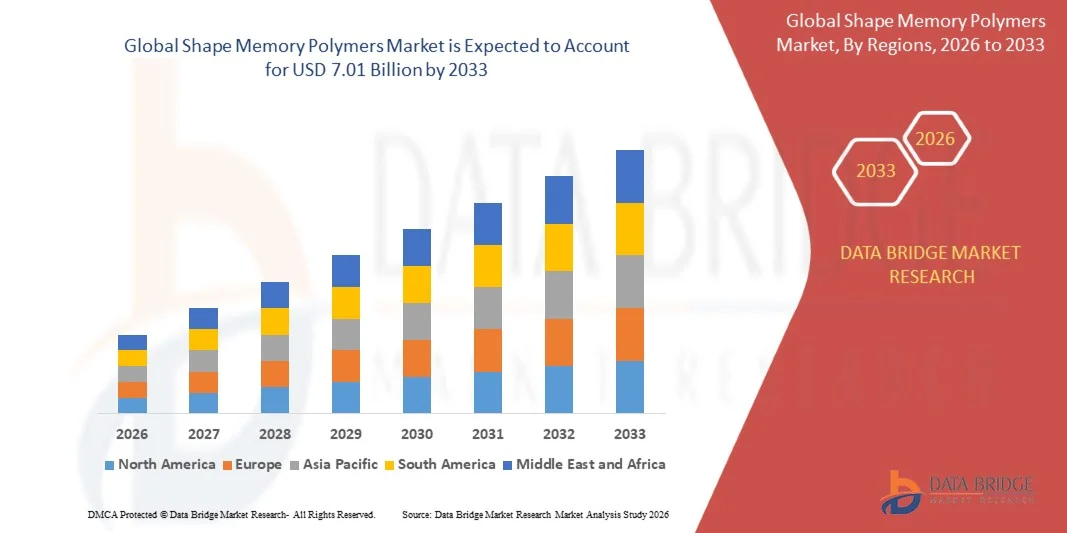
As per Data Bridge Market Research Analysis the Shape Memory Polymers Market was valued at USD 1.42 Billion in 2025 and is projected to reach USD 7.01 Billion by 2033, growing at a CAGR of 22.10% from 2026 to 2033. Shape memory polymers are smart materials capable of recovering from a deformed state to their original shape when exposed to external stimuli such as temperature, light, electrical fields, or chemical triggers. These programmable polymers enable manufacturers to replace complex mechanical assemblies with lightweight, intelligent components across a wide range of industries, including medical devices, aerospace, automotive, consumer electronics, and smart textiles.
The market is experiencing robust growth driven by the increasing adoption of shape memory polymers in biomedical applications, where they are used in self-expanding stents, orthopedic implants, minimally invasive surgical tools, and drug delivery systems. The expanding aerospace and defense sector is also a key contributor, leveraging SMPs for deployable structures, morphing wings, and reconfigurable spacecraft components. Additionally, the integration of SMPs with 4D printing technologies is creating new opportunities in materials engineering, enabling the creation of complex, customizable, and intelligent components.
Market Size & Forecast
- Global Market Value (2025): USD 1.42 Billion
- Expected Market Value (2033): USD 7.01 Billion Forecast CAGR (2026–2033): 22.10%
- Leading Region in 2025: North America
- Fastest Growing Region: Asia-Pacific
Key Market Trends & Insights
- North Americaaccounted for the largest share of the Shape Memory Polymers Market in 2025, representing 91% of global revenue. The U.S. market was estimated at USD 400.6 million in 2025. The region's dominance is supported by strong medical device manufacturing, advanced aerospace programs, active research institutions, and regulatory approvals for SMP-based embolization systems. North America is also projected to register the fastest growth, with a remarkable CAGR of 57.78% through 2031.
- Asia-Pacificis another significant market, with Fortune Business Insights reporting that the region held a 33.09% share of the shape memory polymers market in 2025. Rapid infrastructure build-out in China and India, along with strong manufacturing bases and supportive government policies, are driving demand for SMP applications in self-healing concrete, automotive components, and electronics.
- The Temperature-Activated segment dominated the market in 2025, driven by its simple activation process and compatibility with standard production techniques.
- Composite and nanoparticle-enhanced SMPs are expected to register the highest CAGR, as performance targets move toward higher strength, faster response, and multi-stimuli behavior.
- Biomedical innovation has become a major growth driver for SMP adoption, with regulatory clearances facilitating the transition from laboratory research to clinical applications.
- The shift toward multi-stimuli-responsive SMPs—triggered by heat, light, pH, or electrical signals—is gaining momentum, offering enhanced design flexibility across biomedical, aerospace, and soft robotics applications.
- The integration of 4D printing with SMP technology is expanding capabilities in materials engineering, enabling faster prototyping, reduced waste, and superior customization capabilities.
- Sustainability and material innovation are driving the development of biodegradable and bio-based SMP variants, supported by initiatives such as the European Union's Horizon Europe framework and the U.S. Department of Energy's Advanced Materials Program.
Report Scope and Shape Memory Polymers Market Segmentation
Attributes |
Shape Memory Polymers Key Market Insights |
|
Segments Covered |
|
|
Countries Covered |
North America
Europe
Asia-Pacific
Middle East and Africa
South America
|
|
Key Market Players |
|
|
Market Opportunities |
|
|
Value Added Data Infosets |
In addition to the insights on market scenarios such as market value, growth rate, segmentation, geographical coverage, and major players, the market reports curated by the Data Bridge Market Research also include import export analysis, production capacity overview, production consumption analysis, price trend analysis, climate change scenario, supply chain analysis, value chain analysis, raw material/consumables overview, vendor selection criteria, PESTLE Analysis, Porter Analysis, and regulatory framework. |
What is the Key Trend in the Shape Memory Polymers Market?
Trend: Sustainable and Biodegradable SMP Development
Sustainability and material innovation are increasingly influencing the extension of the SMP market. With worldwide commitments to reduce carbon footprints and favor recyclable polymers, biodegradable and bio-based SMP variants are gaining increased acceptance in green manufacturing. Developments under the European Union's Horizon Europe framework and the U.S. Department of Energy's Advanced Materials Program focus on eco-friendly smart materials. Manufacturers are investing in R&D to produce biodegradable SMP composites that meet environmental regulations while delivering high performance. The next phase of SMP development is highly focused on sustainable and circular material development, with governments and organizations supporting bio-based and recyclable SMP research to reduce polymer waste. This trend is expected to drive innovation in packaging, agricultural tools, and resorbable medical devices.
Shape Memory Polymers Market Dynamics
Key Market Driver: Expanding Biomedical Applications
The global market for shape memory polymers is primarily driven by their increasing adoption in the biomedical sector. SMPs are uniquely suited for minimally invasive surgical devices, such as self-tightening sutures, stents, orthopedic implants, and orthodontic archwires. These materials can be inserted into the body in a compact, temporary shape and then triggered by body heat to expand into their functional, permanent form, reducing surgical complexity and patient recovery time. The aging global population and the corresponding rise in surgical procedures are creating sustained demand for these advanced medical solutions. Regulatory clearances for shape memory polymer devices have facilitated the transition of SMPs from laboratory research to clinical applications, while self-expanding stents and minimally invasive surgical tools are ensuring better patient safety and recovery.
Key Restraint/Challenge: High Material and Processing Costs
A significant challenge facing the shape memory polymers market is the high cost of raw materials and specialized manufacturing processes. The synthesis of high-purity polymer precursors and the precise control required during processing, such as programming the temporary shape, contribute to a final product cost that is often significantly higher than conventional plastics. This cost barrier can limit the use of SMPs to high-value applications where their unique properties provide a critical advantage, making market penetration in cost-sensitive industries difficult. Additional constraints include lower service temperatures and creep compared to metals or high-performance thermosets, limited long-term durability under high load, and slower response without optimized heat or light delivery.
Key Market Opportunity: AI-Driven Material Discovery and 4D Printing
The integration of artificial intelligence with shape memory polymer research presents significant growth opportunities. AI algorithms can analyze vast datasets of material properties, synthesis routes, and performance characteristics, leading to the identification of novel SMP compositions with tailored functionalities. This data-driven approach is expected to significantly reduce development costs and accelerate time-to-market for new SMP applications. Additionally, the combination of 4D printing with SMP technology is expanding capabilities in materials engineering and product design, enabling the production of complex, customizable, and intelligent components. High-tech adaptive implants, self-deploying aerospace components, and intelligent responsive textiles are examples of 4D-printed SMP structures that change shape over time through external stimuli. The development of climate-adaptive building envelope systems and sustainable bio-based formulations also represents emerging opportunities for market expansion. The growing demand for smart textiles, flexible electronics, and soft robotics is further expanding the addressable market for shape memory polymers.
How is the Shape Memory Polymers Market Segmented?
The Shape Memory Polymers market is segmented on the basis of material type, stimulus type, application, and end-user.
- Material Type
On the basis of material type, the Shape Memory Polymers Market is segmented into thermoplastic SMPs, thermoset SMPs, biodegradable SMPs, composite SMPs, and nanoparticle-enhanced SMPs. Thermoplastic SMPs currently generate the highest revenue due to mature extrusion and injection molding routes, easy reprocessing, and support for recycling. These materials run on common extrusion and injection lines, allow welding and thermoforming, and offer significant cost advantages. Thermoset SMPs offer higher shape fixity and thermal stability for aerospace, under-hood, and oil-and-gas applications but have longer cure times and less rework flexibility. Biodegradable SMPs target resorbable medical devices, packaging, and agricultural tools where end-of-life considerations are important, with growth dependent on clinical and regulatory progress. Composite and nanoparticle-enhanced SMPs improve stiffness, thermal conductivity, and recovery speed, enabling thin sections and faster actuation. These engineered classes are expected to record the highest CAGR as multi-stimuli and high-force designs scale. The diversification of material formulations is expanding the application scope of shape memory polymers across multiple end-use industries.
- Stimulus Type
On the basis of stimulus type, the Shape Memory Polymers Market is segmented into temperature-activated, light-activated, electrically-activated, magnetically-activated, and remote activation. Temperature-activated SMPs dominate current shipments because heating can be embedded with resistive traces or sourced from ambient or engine waste heat. These materials respond efficiently to thermal triggers and are widely used in automotive, aerospace, and biomedical applications. Light-Activated SMPs are growing in small, precise actuation zones for micro-devices and optics. Electrically-Activated SMPs use Joule heating or conductive networks for fast, localized response in wearables and electronics. Magnetically-Activated SMPs use magnetic nanoparticles for contactless heating through alternating magnetic fields, useful in closed or sterile systems. Remote Activation applications, such as wireless NIR or magnetic triggers and inductive heating in sealed assemblies, are expected to post the highest CAGR as designers avoid tethered power and improve safety in medical and hazardous environments. The diversification of activation methods is enabling a broader range of applications and improving the versatility of shape memory polymer solutions.
- Application
On the basis of application, the Shape Memory Polymers Market is segmented into biomedical & healthcare, aerospace & defense, automotive, consumer electronics, smart textiles, and others. Biomedical & Healthcare is the largest application segment, driven by the increasing adoption of SMPs in self-expanding stents, orthopedic implants, minimally invasive surgical tools, and drug delivery systems. The aging global population and rising surgical procedures are creating sustained demand for these advanced medical solutions. Aerospace & Defense is a rapidly growing segment, with SMPs being used in deployable structures, morphing wings, reconfigurable spacecraft components, and self-healing materials. The Automotive segment is adopting SMPs for lightweight components that can change shape on demand, as well as self-healing and customizable parts. Consumer electronics applications include self-healing phone cases and temperature-responsive footwear, while Smart Textiles leverage temperature-induced SMPs for garments that can regain their shape. The versatility of shape memory polymers across multiple applications is a key driver of market expansion.
- End-User
On the basis of end-user, the Shape Memory Polymers Market is segmented into medical devices manufacturers, aerospace & defense contractors, automotive OEMs, consumer electronics companies, and research & academic institutes. Medical Devices Manufacturers represent the largest end-user segment, driven by the growing adoption of SMPs in stents, orthopedic implants, surgical tools, and drug delivery systems. Aerospace & Defense Contractors are increasingly utilizing SMPs for deployable structures, morphing wings, and spacecraft components. Automotive OEMs are adopting SMPs for lightweight and self-healing components, contributing to vehicle lightweighting and improved fuel efficiency. Consumer electronics companies are integrating SMPs into self-healing phone cases and temperature-responsive footwear. Research & Academic Institutes represent a significant end-user segment, driving fundamental research and early-stage commercialization of SMP technologies. Strategic collaborations between research institutions and industry players are accelerating the commercialization of novel SMP technologies and expanding market penetration.
Shape Memory Polymers Market Regional Analysis
North America Shape Memory Polymers Market Insight
North America is expected to account for a significant share of the Shape Memory Polymers Market, supported by strong medical device manufacturing, aerospace programs, and active research institutions. The United States is at the forefront of SMP development, with regulatory clearances facilitating the transition from laboratory research to clinical applications. The U.S. Department of Defense and NASA research programs have highlighted the usefulness of SMPs as materials for deployable structures, morphing wings, and reconfigurable components for spacecraft. Major material suppliers including DuPont, Lubrizol, and Huntsman, together with medical device innovators such as Shape Memory Medical, strengthen the regional ecosystem. The region's strong venture capital funding for advanced materials startups and favorable regulatory environment for medical device innovation are further accelerating market growth.
Europe Shape Memory Polymers Market Insight
Europe represents a significant market for shape memory polymers, supported by strong research institutions, advanced manufacturing capabilities, and growing demand from the medical and automotive sectors. Key players such as BASF SE, Covestro AG, Evonik Industries AG, Arkema S.A., and Syensqo are headquartered in Europe, strengthening the region's market position. The region's focus on sustainability and compliance with environmental regulations is driving the development of biodegradable and bio-based SMP formulations. The European Union's Horizon Europe framework is providing substantial funding for eco-friendly smart materials research. The automotive industry's shift toward lightweight and self-healing components is also driving demand for shape memory polymers in the region.
Asia-Pacific Shape Memory Polymers Market Insight
Asia-Pacific is expected to witness the highest growth during the forecast period, fueled by rapid industrialization, increasing healthcare expenditure, and growing adoption of advanced materials in automotive and consumer electronics sectors. China is expected to remain a major growth engine for the Asia-Pacific shape memory polymers market due to expanding healthcare, automotive, and electronics industries. Japan is a key player in SMP development, with companies such as SMP Technologies Inc. and Mitsubishi Chemical Group strengthening the region's market position. The region's expanding manufacturing base, coupled with rising investments in healthcare infrastructure and automotive production, is expected to maintain Asia-Pacific's growth momentum throughout the forecast period.
Latin America Shape Memory Polymers Market Insight
Latin America represents an emerging market for shape memory polymers, with growing demand influenced by increasing investments in healthcare infrastructure and automotive manufacturing. Countries such as Brazil and Mexico are gradually adopting advanced materials to support the growing demand for medical devices and automotive components. The region's expanding healthcare sector and growing awareness of advanced materials are creating opportunities for shape memory polymer applications. However, market growth is currently constrained by limited manufacturing infrastructure, higher technology costs compared to developed regions, and fragmented regulatory frameworks. The development of regional supply chains and partnerships with global SMP technology providers is expected to accelerate market growth.
Middle East & Africa Shape Memory Polymers Market Insight
The Middle East and Africa region represents a nascent market for shape memory polymers, with demand primarily concentrated in the GCC countries and South Africa. Governments across the region are increasing investments in healthcare infrastructure and advanced materials research to diversify their economies and improve healthcare outcomes. The UAE and Saudi Arabia are investing in medical technology and healthcare infrastructure, creating opportunities for shape memory polymer applications in the medical devices sector. South Africa is gradually adopting advanced materials to support the growing demand for medical devices and automotive components. Increasing investments from global medical device manufacturers and material technology providers are improving technology availability across major urban centers. However, relatively low adoption of advanced materials, limited manufacturing infrastructure, and high costs continue to restrain market growth.
Shape Memory Polymers Market Share
The Shape Memory Polymers industry is primarily led by well-established companies, including:
- SMP Technologies Inc. (Japan)
- BASF SE (Germany)
- Covestro AG (Germany)
- DuPont de Nemours, Inc. (U.S.)
- Evonik Industries AG (Germany)
- Arkema S.A. (France)
- Celanese Corporation (U.S.)
- SABIC (Saudi Arabia)
- Syensqo (Belgium)
- Lubrizol Corporation (U.S.)
- Mitsubishi Chemical Group (Japan)
- Huntsman Corporation (U.S.)
- Dow Chemical Company (U.S.)
- Asahi Kasei Corporation (Japan)
- Nanoshel LLC (U.S.)
- Cornerstone Research Group (U.S.)
- Composite Technology Development, Inc. (U.S.)
- MedShape, Inc. (U.S.)
- Shape Memory Medical, Inc. (U.S.)
- DSM N.V. (Netherlands)
Latest Developments in Shape Memory Polymers Market
- In June 2026, Graphy, a South Korean dental technology company, participated in the European Orthodontic Society (EOS) Annual Congress 2026 in Dublin, Ireland, where it showcased its shape-memory aligner (SMA) technology based on its proprietary 3D-printing material, Tera Harz. Shape-memory aligners are clear orthodontic devices designed to gradually return to their original form over time, applying controlled forces to move teeth while reducing the frequency of aligner replacement compared with conventional clear aligners. The company held business meetings with dental professionals from the U.K., Ireland, Eastern Europe, Northern Europe, Japan, China, Canada, and Australia to explore potential clinical applications and distribution partnerships.
- In February 2026, Fraunhofer researchers announced the development of programmable materials that can change their characteristics in a controlled and reversible way with the push of a button, independently adapting to fit new conditions. The materials are being developed by researchers at the Fraunhofer Cluster of Excellence Programmable Materials CPM, which is formed of six core institutes with the aim of designing and producing programmable materials. Applications include comfy chairs and mattresses that prevent bedsores by distributing pressure across a wider area. The change in shape and the stimuli to which the material reacts—mechanical stress, heat, moisture, or electric or magnetic fields—can be determined by the choice of material and its microstructure.
- In February 2026, Porcher Industries launched shape-memory thermoplastic composite (TPC) hybrid textiles with a sustainability focus at JEC World 2026. The multilayered prepreg textiles support in situ consolidation of complex shapes, demonstrating the company's textile expertise and commitment to the TPC ecosystem.
- In November 2025, researchers developed a smart shape-memory sensor for biological pressure monitoring applications as part of the EU-funded SMARTSHAPE project. The project aims to develop a novel temperature-dependent shape memory polymer that enables the sensor to curl up, be introduced into the body through a minimally invasive procedure, and open up when reaching body temperature to take a predefined shape. The sensor is designed for continuous beat-to-beat blood pressure measurements that can be used outside a hospital setting, addressing the unmet clinical need for long-term, continuous blood pressure monitoring.
- In November 2025, researchers published a study on shape-memory polyurethanes for polar wearables with ultrasensitive multi-monitoring capabilities in Nature Communications. The material exhibited exceptional stretchability (>900%) and ionic conductivity (1.34 × 10⁻⁴ S cm⁻¹) with self-healing behavior (85.4% for 1 hour at room temperature) and shape-memory performance with a shape recovery rate of up to 94.8%.
- In September 2025, researchers developed highly stretchable, magnetic-responsive shape memory polymer composites via digital light processing (DLP) 3D printing technology. The proposed method for fabricating magnetic shape-memory polymer composites using DLP 3D printing represents a significant advancement in the field, enabling the production of complex, customizable SMP structures with enhanced functionality.

- Interactive Data Analysis Dashboard
- Company Analysis Dashboard for high growth potential opportunities
- Research Analyst Access for customization & queries
- Competitor Analysis with Interactive dashboard
- Latest News, Updates & Trend analysis
- Harness the Power of Benchmark Analysis for Comprehensive Competitor Tracking
Global Shape Memory Polymers Market, Supply Chain Analysis and Ecosystem Framework
To support market growth and help clients navigate the impact of geopolitical shifts, DBMR has integrated in-depth supply chain analysis into its Global Shape Memory Polymers Market research reports. This addition empowers clients to respond effectively to global changes affecting their industries. The supply chain analysis section includes detailed insights such as Global Shape Memory Polymers Market consumption and production by country, price trend analysis, the impact of tariffs and geopolitical developments, and import and export trends by country and HSN code. It also highlights major suppliers with data on production capacity and company profiles, as well as key importers and exporters. In addition to research, DBMR offers specialized supply chain consulting services backed by over a decade of experience, providing solutions like supplier discovery, supplier risk assessment, price trend analysis, impact evaluation of inflation and trade route changes, and comprehensive market trend analysis.
Data collection and base year analysis are done using data collection modules with large sample sizes. The stage includes obtaining market information or related data through various sources and strategies. It includes examining and planning all the data acquired from the past in advance. It likewise envelops the examination of information inconsistencies seen across different information sources. The market data is analysed and estimated using market statistical and coherent models. Also, market share analysis and key trend analysis are the major success factors in the market report. To know more, please request an analyst call or drop down your inquiry.
The key research methodology used by DBMR research team is data triangulation which involves data mining, analysis of the impact of data variables on the market and primary (industry expert) validation. Data models include Vendor Positioning Grid, Market Time Line Analysis, Market Overview and Guide, Company Positioning Grid, Patent Analysis, Pricing Analysis, Company Market Share Analysis, Standards of Measurement, Global versus Regional and Vendor Share Analysis. To know more about the research methodology, drop in an inquiry to speak to our industry experts.
Data Bridge Market Research is a leader in advanced formative research. We take pride in servicing our existing and new customers with data and analysis that match and suits their goal. The report can be customized to include price trend analysis of target brands understanding the market for additional countries (ask for the list of countries), clinical trial results data, literature review, refurbished market and product base analysis. Market analysis of target competitors can be analyzed from technology-based analysis to market portfolio strategies. We can add as many competitors that you require data about in the format and data style you are looking for. Our team of analysts can also provide you data in crude raw excel files pivot tables (Fact book) or can assist you in creating presentations from the data sets available in the report.













