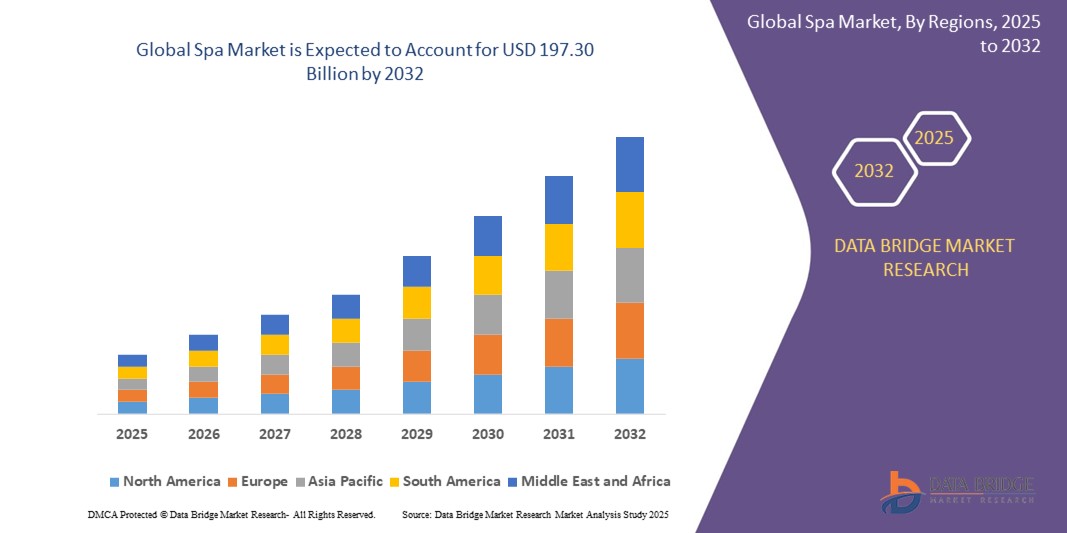
Spa Market Size
- The global spa market was valued at USD 76.35 billion in 2024 and is expected to reach USD 197.30 billion by 2032
- During the forecast period of 2025 to 2032 the market is such as to grow at a CAGR of 12.60%, primarily driven by the increasing consumer inclination toward wellness and self-care
- This growth is driven by factors such as the rising demand for personalized and holistic relaxation experiences
Spa Market Analysis
- The spa market is witnessing strong growth as consumers increasingly prioritize self-care and wellness, leading to higher spending on relaxation and therapeutic services
- The rising popularity of wellness tourism and holistic health experiences has encouraged spas to expand their offerings beyond traditional treatments to include services such as meditation, yoga, and personalized wellness programs
- Technological integration in spa services, such as virtual consultations, automated therapies, and digital booking systems, is enhancing customer convenience and boosting service efficiency
- The demand for natural and organic products within spa treatments is rising, as people become more conscious of skin health and the ingredients used in personal care routines
- Customization and exclusivity are shaping consumer preferences, with spas offering tailored experiences to match individual wellness goals and lifestyle needs
- For instance, many spas are introducing AI-powered skincare analysis to provide personalized facials and treatment plans based on real-time skin condition assessments, making services more targeted and result-driven
- In conclusion, the spa market continues to grow as personalized, tech-driven, and wellness-focused experiences become key to meeting evolving consumer expectations
Report Scope and Spa Market Segmentation
|
Attributes |
Spa Key Market Insights |
|
Segments Covered |
|
|
Countries Covered |
North America
Europe
Asia-Pacific
Middle East and Africa
South America
|
|
Key Market Players |
|
|
Market Opportunities |
|
|
Value Added Data Infosets |
In addition to the insights on market scenarios such as market value, growth rate, segmentation, geographical coverage, and major players, the market reports curated by the Data Bridge Market Research also include in-depth expert analysis, pricing analysis, brand share analysis, consumer survey, demography analysis, supply chain analysis, value chain analysis, raw material/consumables overview, vendor selection criteria, PESTLE Analysis, Porter Analysis, and regulatory framework. |
Spa Market Trends
“Rising Demand for Personalized and Holistic Spa Experiences”
- The rise of wellness tourism is significantly driving the expansion of the spa market, as more travelers seek health-focused vacations that combine relaxation and well-being during their trips
- Spas are now considered an essential part of travel experiences, with tourists actively seeking destinations that offer wellness-oriented services like massage therapies, detox programs, and holistic treatments
- Popular destinations like Bali, Tulum, and other wellness hubs are leading the trend by offering luxurious spa retreats, which incorporate natural therapies such as Ayurveda, aromatherapy, and healing rituals designed to rejuvenate both the body and mind
- According to the United Nations Department of Economic and Social Affairs, by 2050, 68% of the global population will live in urban areas, creating a higher demand for wellness-oriented travel experiences like spas, as urban dwellers look for ways to escape the pressures of city life
- There is a growing trend of integrating holistic and natural therapies into spa offerings, attracting wellness-conscious travelers who are interested in improving their mental, emotional, and physical health through alternative treatments
- Many wellness-focused spas are adopting eco-friendly and sustainable practices, such as using organic products, eco-conscious packaging, and renewable energy sources, catering to environmentally-conscious travelers
- The growing global awareness of the importance of mental health, fitness, and self-care is contributing to the increasing demand for spa services and wellness tourism, creating new opportunities for the spa market to thrive
- In conclusion, spas are evolving to offer tailored wellness programs that cater to individual needs, including stress reduction, detoxification, anti-aging, and weight management, attracting travelers who are looking for personalized health experiences
Spa Market Dynamics
Driver
“Increasing Focus on Wellness and Self-Care”
- The spa market is driven by the growing global emphasis on wellness, mental health, and self-care as consumers seek solutions for stress and lifestyle-related concerns
- Services such as massage therapy, hydrotherapy, and body treatments are increasingly chosen for their therapeutic benefits and long-term wellness outcomes
- The integration of holistic therapies such as aromatherapy, reflexology, and guided meditation is helping spas attract clients seeking emotional and physical balance
- For instance, many urban wellness centers now offer personalized spa experiences that combine body treatments with mindfulness sessions for a complete recharge
- Younger and working-age consumers, along with support from corporate wellness programs and health professionals, are fueling steady growth in spa visits
- In conclusion, the modern lifestyle is pushing more people toward wellness-focused routines and spa services are becoming a trusted part of their self-care journey
Opportunity
“Technological Advancements in Spa Services”
- Technology is creating new opportunities for the spa market by enhancing personalization, efficiency, and customer interaction through digital tools and smart equipment
- Spas are adopting artificial intelligence, virtual consultations, and real-time skin analysis to offer treatments tailored to individual skin and wellness needs
- Booking systems, mobile apps, and digital memberships are making services more convenient while helping businesses manage client relationships and improve loyalty
- Smart devices such as infrared saunas, LED therapy machines, and automated massage systems are being used to elevate the customer experience and reduce manual workload
- For instance, some modern spas now use AI-powered skin diagnostics to recommend custom facials based on live data, helping clients see more effective results
- In conclusion, integrating smart technology into spa services is opening new ways to attract clients, deliver results, and stay competitive in a fast-evolving wellness industry
Restraint/Challenge
“High Cost of Setting Up and Maintaining Spa Facilities”
- One of the main challenges in the spa market is the high initial and ongoing costs of setting up and maintaining spa facilities, including quality interiors, specialized equipment, and skilled staff
- The cost of maintaining hygiene standards and providing a professional, relaxing environment adds to the financial burden, particularly in urban locations where rent is high
- Small and medium spa businesses often face difficulty in managing these expenses, especially when the demand for expensive equipment and up-to-date technology continues to rise
- For instance, spas that incorporate advanced treatments such as AI-powered skin diagnostics or infrared therapy must invest in continuous equipment upgrades, which can be costly with no immediate return on investment
- Economic factors such as slowdowns, consumer spending fluctuations, and seasonal demand also affect profitability, presenting challenges for both new and existing spa businesses
- In conclusion, high setup and operational costs are significant barriers in the spa market, requiring careful planning, cost management, and strategic approaches to remain competitive and sustainable
Spa Market Scope
The market is segmented on the basis of server type, facility type, and end user.
|
Segmentation |
Sub-Segmentation |
|
By Server Type |
|
|
By Facility Type |
|
|
By End User |
|
Spa Market Regional Analysis
“North America is the Dominant Region in the Spa Market”
- North America, particularly the United States, leads the global spa market in both revenue and service diversity
- The region has a strong market presence, driven by an established consumer base and high demand for wellness services
- The U.S. market is characterized by a broad demographic of spa-goers, including millennials and men, who are increasingly seeking personalized wellness experiences
- The day/club/salon spa segment is the largest, offering a wide range of services such as massage, skincare, and relaxation therapies
- The growth in North America is fueled by the increasing focus on self-care, mental wellness, and luxury wellness services
- In conclusion, the region benefits from a high demand for spa experiences across various demographics, including millennials and men, who are increasingly prioritizing mental and physical well-being
“Asia-Pacific is Projected to Register the Highest Growth Rate”
- The Asia-Pacific spa market is experiencing rapid growth, driven by economic development and an expanding middle class
- Countries such as India, China, Japan, and Thailand are seeing a significant rise in demand for spa services, particularly in urban centers
- The hotel/resort spa segment is growing rapidly, with luxury wellness tourism becoming a key attraction in the region
- The growing popularity of holistic wellness practices, including traditional therapies and modern treatments, is contributing to the market’s expansion
- The increasing disposable income and rising awareness of mental and physical health are driving the demand for spa services in this region
- In conclusion, Asia-Pacific is witnessing remarkable growth, fueled by rapid economic development and an expanding middle class
Spa Market Share
The market competitive landscape provides details by competitor. Details included are company overview, company financials, revenue generated, market potential, investment in research and development, new market initiatives, global presence, production sites and facilities, production capacities, company strengths and weaknesses, product launch, product width and breadth, application dominance. The above data points provided are only related to the companies' focus related to market.
The Major Market Leaders Operating in the Market Are:
- Planet Beach Franchising Corporation (U.S.)
- Hot Springs Resort & Spa (U.S.)
- Four Seasons Hotel Limited (Canada)
- ME SPE Franchising, LLC. (U.S.)
- Lanserhof (Austria)
- Jade Mountain (U.S.)
- Rancho La Puerta Inc. (U.S.)
- Mandarin Oriental Hotel Group Limited (China)
- MGM Resorts International (U.S.)
- Crown Resorts Limited (Australia)
- Caesars Entertainment (U.S.)
- Las Vegas Sands Corporation (U.S.)
- Melco International Development Limited (China)
- Genting Berhad (Malaysia)
- Wynn Resorts Holdings, LLC (U.S.)
- Galaxy Entertainment Group Limited (China)
- Omni Hotels & Resorts (U.S.)
Latest Developments in Global Spa Market
- In April 2025, L'Oréal Professionnel introduced its Hair Spa range, offering professional in-salon treatments designed to address various hair and scalp concerns. The collection includes products such as the Deep Nourishing Creambath, Repairing Creambath, Smoothing Creambath, and Hydrating Concentrate, each formulated with ingredients such as water lily and purified water to nourish, repair, and hydrate the hair and scalp. These treatments aim to provide a relaxing spa experience while delivering targeted hair care benefits
- In November 2024, Woodhouse Spas introduced a new range of treatments that combine advanced skincare technology with luxurious relaxation. Highlighting the offerings is the Glacial Gloss facial, which uses cryotherapy to reduce redness, melasma, and inflammation-related aging, anti aging service, promoting a radiant complexion. These innovative services aim to rejuvenate both skin and spirit, providing accessible, personalized skincare solutions at select locations
- In November 2024, the company expanded its footprint by converting 30 LaVida Massage locations across seven states, including Arkansas, Georgia, and Michigan. This move marked Hand & Stone's entry into Arkansas with its Bentonville location and increased its total spa count from 39 to 40. The conversion strategy included comprehensive training and support for new franchisees and staff, ensuring a seamless transition into the Hand & Stone brand
- In November 2024, Çırağan Palace Kempinski Istanbul unveiled its redesigned spa and wellness center, managed by Sanitas Spa & Wellness. The renovated spa featured a VIP Turkish bath, massage rooms, a fitness center, an indoor pool, and more. Signature treatments included the "Sultan’s Bath" and "Sanitas Signature Massage," alongside offerings such as the Thai Blend Massage for muscle pain and Shiroibhyanga for detoxification and body harmony

- Interactive Data Analysis Dashboard
- Company Analysis Dashboard for high growth potential opportunities
- Research Analyst Access for customization & queries
- Competitor Analysis with Interactive dashboard
- Latest News, Updates & Trend analysis
- Harness the Power of Benchmark Analysis for Comprehensive Competitor Tracking
Data collection and base year analysis are done using data collection modules with large sample sizes. The stage includes obtaining market information or related data through various sources and strategies. It includes examining and planning all the data acquired from the past in advance. It likewise envelops the examination of information inconsistencies seen across different information sources. The market data is analysed and estimated using market statistical and coherent models. Also, market share analysis and key trend analysis are the major success factors in the market report. To know more, please request an analyst call or drop down your inquiry.
The key research methodology used by DBMR research team is data triangulation which involves data mining, analysis of the impact of data variables on the market and primary (industry expert) validation. Data models include Vendor Positioning Grid, Market Time Line Analysis, Market Overview and Guide, Company Positioning Grid, Patent Analysis, Pricing Analysis, Company Market Share Analysis, Standards of Measurement, Global versus Regional and Vendor Share Analysis. To know more about the research methodology, drop in an inquiry to speak to our industry experts.
Data Bridge Market Research is a leader in advanced formative research. We take pride in servicing our existing and new customers with data and analysis that match and suits their goal. The report can be customized to include price trend analysis of target brands understanding the market for additional countries (ask for the list of countries), clinical trial results data, literature review, refurbished market and product base analysis. Market analysis of target competitors can be analyzed from technology-based analysis to market portfolio strategies. We can add as many competitors that you require data about in the format and data style you are looking for. Our team of analysts can also provide you data in crude raw excel files pivot tables (Fact book) or can assist you in creating presentations from the data sets available in the report.