


What is the Substation Automation Market Size and Growth Rate?
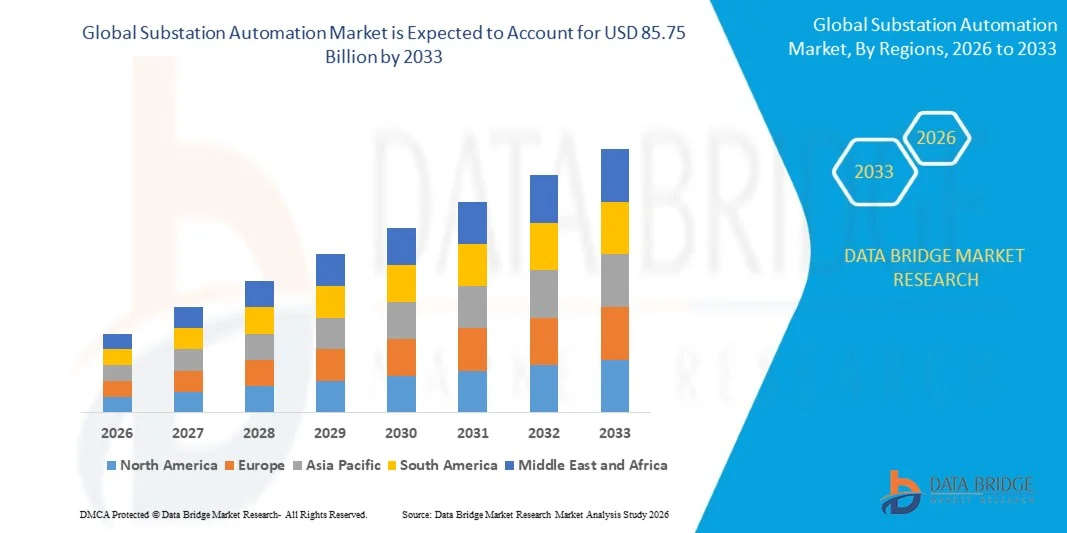
- As per Data Bridge Market Research analysis, the substation automation market was valued at USD 53.00 billion in 2025 and is projected to reach USD 85.75 billion by 2033, growing at a CAGR of 6.20% from 2026 to 2033.
- The market is experiencing consistent growth driven by increasing demand for reliable and efficient electricity transmission and distribution, rapid grid modernization, and expanding adoption of smart grid technologies and automated substation systems.
- The aging of electrical infrastructure globally, combined with rising renewable energy integration and growing demand for real-time grid monitoring and control, is compelling utilities and power operators to adopt advanced substation automation technologies. Intelligent electronic devices (IEDs), SCADA systems, communication networks, and digital protection solutions are increasingly replacing conventional systems, offering improved grid reliability, operational efficiency, remote monitoring, and faster fault detection.
Market Size & Forecast
- Global Market Value (2025): USD 53.00 Billion
- Expected Market Value (2033): USD 85.75 Billion
- Forecast CAGR (2026–2033): 6.20%
- Leading Region in 2025: North America
- Fastest Growing Region: Asia Pacific
What are the Major Takeaways of the Substation Automation Market?
- North America dominated the substation automation market with the largest revenue share of 34.12% in 2025, supported by significant investments in grid modernization, aging infrastructure replacement, smart grid technologies, and the integration of renewable energy sources
- Asia-Pacific is expected to be the fastest-growing region at a CAGR of 7.2% from 2026 to 2033, fueled by rapid industrialization and urbanization, rising electricity demand, grid modernization initiatives, and increasing investments in smart grid and renewable energy infrastructure.
- The hardware segment led the market with a 44.0% share in 2025, driven by the essential role of intelligent electronic devices, protection relays, merging units, and process-bus equipment in automated substations
- Software is the fastest-growing offering type, projected to register a CAGR of 10.8%, reflecting the surge in digitalization of electricity grids and growing demand for intelligent monitoring and analytics.
- The transmission substations segment dominated the type category with a 54.0% revenue share in 2025, led by the high value of automation systems deployed across high-voltage transmission infrastructure.
- Retrofit installations accounted for 54.3% of the market share in 2025, preferred by the large installed base of conventional substations requiring modernization.
- The optical fiber communication segment is the fastest-growing communication category, with a CAGR of 9.1%, driven by growing requirements for high-speed, secure, and interference-resistant communication within digital substations
Report Scope and Substation Automation Market Segmentation
|
Attributes |
Substation Automation Key Market Insights |
|
Segments Covered |
|
|
Countries Covered |
North America
Europe
Asia-Pacific
Middle East and Africa
South America
|
|
Key Market Players |
|
|
Market Opportunities |
|
|
Value Added Data Infosets |
In addition to the insights on market scenarios such as market value, growth rate, segmentation, geographical coverage, and major players, the market reports curated by the Data Bridge Market Research also include in-depth expert analysis, geographically represented company-wise production and capacity, network layouts of distributors and partners, detailed and updated price trend analysis and deficit analysis of supply chain and demand. |
What is the Key Trend in the Substation Automation Market?
- Utilities are increasingly adopting digital substations based on IEC 61850 to replace conventional hardwired protection and control systems, enabling faster communication, reduced wiring, greater interoperability, and more flexible grid operations.
- For instance, in August 2025, Gujarat Energy Transmission Corporation Limited (GETCO) reported implementation of a fully digital 220/66 kV Sevaliya substation using IEC 61850-9-2 process-bus technology, demonstrating the transition from conventional station automation toward fully digital substations.
- The adoption of IEC 61850 process-bus technology enables utilities to replace extensive copper wiring with digital communication, improving substation flexibility, operational efficiency, equipment integration, and maintenance capabilities.
- Utilities are also increasingly exploring virtualized protection, automation, and control systems, allowing multiple applications to run on shared computing infrastructure while reducing hardware requirements and simplifying system upgrades.
- For instance, in May 2025, Nokia reported that utilities were progressing toward virtualized substations, with modernization efforts increasingly focused on digitalizing primary-equipment data through IEC 61850 and virtualizing protection, automation, and control systems.
- As utilities continue modernizing aging electrical infrastructure and integrating distributed energy resources, IEC 61850, process-bus architectures, and virtualized automation platforms are expected to become increasingly important components of next-generation digital substations.
What are the Key Drivers of the Substation Automation Market?
- The rapid integration of renewable energy, distributed energy resources, and bidirectional power flows has significantly increased demand for substation automation systems capable of providing real-time monitoring, protection, control, and grid visibility.
- For instance, in May 2026, Hitachi Energy and Türkiye’s TEİAŞ launched Türkiye’s first digital substation pilot, designed to modernize the grid, improve reliability and safety, and support the integration of increasing amounts of intermittent renewable energy.
- Utilities, transmission operators, and industrial power users are integrating intelligent electronic devices, SCADA systems, sensors, and communication networks to improve grid reliability, reduce outages, accelerate fault detection, and support remote asset management.
- For instance, in October 2025, Siemens Energy announced the modernization of Germany’s Daxlanden high-voltage substation, with the project aimed at strengthening grid reliability and preparing the infrastructure for Germany’s renewable-energy transition and rising electricity demand.
- With power networks becoming increasingly digital, decentralized, and data-intensive, substation automation will remain essential for improving operational visibility, integrating renewable generation, strengthening grid reliability, and enabling predictive maintenance across modern electricity infrastructure.
Which Factors are Challenging the Growth of the Substation Automation Market?
- Advanced substation automation systems require significant investment in intelligent electronic devices, communication infrastructure, cybersecurity systems, engineering, integration, and specialized commissioning, increasing project costs for utilities.
- For instance, in May 2025, an Indian Express investigation reported that 273 POWERGRID substations required next-generation firewalls, with the estimated installation cost reaching approximately USD 1.25 million, highlighting the additional cybersecurity expenditure required to protect increasingly digitalized substations.
- These costs can limit adoption among smaller utilities and operators with constrained capital budgets, while complex integration between equipment from different manufacturers can create interoperability and engineering challenges.
- For instance, in May 2026, Reuters reported that U.S. substation transformer demand had increased 116% between 2019 and 2025, while transformer prices had risen 80% over five years and high-capacity units faced lead times of up to four years, increasing the cost and delaying grid modernization projects.
- The combination of cybersecurity requirements, legacy-system integration, specialized workforce needs, and lengthy commissioning processes continues to increase the complexity and total cost of substation automation deployment, particularly for aging substations undergoing digital transformation.
How is the Substation Automation Market Segmented?
The substation automation market is segmented on the basis of offering, type, installation type, end-user industry, component, and communication.
- By Offering
On the basis of offering, the substation automation market is segmented into hardware, software, and services. The hardware segment dominated the market with a 44.0% share in 2025, driven by the essential role of intelligent electronic devices, protection relays, merging units, and process-bus equipment in automated substations. Hardware provides the physical foundation for real-time monitoring, protection, control, and data acquisition across transmission and distribution networks. Utilities continue to invest in protection and control equipment as they modernize aging grid infrastructure and integrate renewable energy sources. Increasing deployment of digital relays and IEC 61850-compatible equipment is further supporting hardware demand. The segment also benefits from replacement of conventional electromechanical equipment with digital protection and control systems.
The software segment is projected to register the fastest growth at a CAGR of 10.8% from 2026 to 2033, driven by accelerating digitalization of electricity grids and growing demand for intelligent monitoring and analytics. Software platforms increasingly integrate SCADA, asset-health monitoring, fault analytics, and distribution management capabilities. Utilities are adopting these platforms to improve real-time visibility and optimize increasingly complex grid operations. The integration of renewable generation and distributed energy resources is further increasing demand for advanced software-based control capabilities. Cloud-enabled and interoperable platforms are also allowing utilities to manage large volumes of operational data more efficiently
- By Type
On the basis of type, the substation automation market is segmented into transmission substations and distribution substations. The transmission substations segment dominated the market with 54.0% share in 2025, supported by the high value of automation systems deployed across high-voltage transmission infrastructure. Transmission substations require sophisticated protection, control, monitoring, and communication systems to maintain stability across large electricity networks. Increasing investments in long-distance transmission corridors and renewable power evacuation infrastructure are strengthening demand for automated transmission substations. Advanced automation enables utilities to monitor grid conditions, detect faults rapidly, and coordinate protection across interconnected networks. The increasing use of wide-area monitoring and synchronized measurement technologies is also supporting segment growth.
The distribution substations segment is projected to register the fastest growth at a CAGR of 8.7% from 2026 to 2033, driven by increasing investment in distribution-grid modernization and the integration of distributed energy resources. Distribution networks are experiencing greater complexity because of rooftop solar, battery storage, electric vehicles, and bidirectional electricity flows. Automation enables utilities to detect and isolate faults, regulate voltage, and restore power more rapidly across local networks. Increasing deployment of feeder automation and advanced distribution management systems is further supporting demand. Utilities are also using automation to improve reliability and reduce outage duration across aging distribution infrastructure.
- By Installation Type
On the basis of installation type, the substation automation market is segmented into new installations and retrofit installations. The retrofit installations segment dominated the market with 54.3% share in 2025, owing to the large installed base of conventional substations requiring modernization. Utilities are upgrading existing protection, control, communication, and monitoring equipment rather than completely replacing operational substations. Retrofit projects allow operators to introduce digital automation capabilities while extending the useful life of existing electrical infrastructure. Aging substations increasingly require replacement of obsolete equipment, improved cybersecurity, and compatibility with modern communication protocols. The ability to conduct upgrades during scheduled outages also helps utilities minimize service disruptions.
The new installations segment is projected to register the fastest growth at a CAGR of 9.6% from 2026 to 2033, driven by expansion of transmission and distribution infrastructure and construction of new renewable-energy-connected substations. Greenfield projects allow utilities to incorporate digital protection, IEC 61850 communication, fiber-optic networks, and cybersecurity architecture from the initial design stage. New substations can therefore be optimized for automation without the interoperability constraints associated with legacy equipment. Growing electricity demand and expansion of renewable generation are creating additional requirements for new grid infrastructure. Data centers, industrial facilities, and transportation electrification projects are also increasing demand for digitally enabled substations.
- By End-user Industry
On the basis of end-user industry, the global substation automation market is segmented into utilities, steel, oil and gas, mining, and transportation. The utilities segment dominated the market with 72.4% share in 2025, supported by extensive deployment of automation across electricity generation, transmission, and distribution networks. Utility operators are increasingly adopting automation to improve grid reliability, monitor assets remotely, and reduce the impact of power outages. Aging electrical infrastructure and growing electricity demand are encouraging utilities to accelerate modernization programs. Renewable energy integration is also increasing the need for real-time monitoring and automated control across electricity networks. Utilities are investing in IEDs, SCADA, communication networks, and digital protection systems to improve operational efficiency.
The transportation segment is projected to register the fastest growth at a CAGR of 10.1% from 2026 to 2033, driven by increasing electrification of railway and transportation infrastructure. Rail traction substations require sophisticated automation for voltage regulation, fault isolation, regenerative-braking management, and coordination with train-control systems. Growing investments in high-speed rail, metro systems, and electrified railway networks are increasing demand for reliable power-management infrastructure. Automation enables transportation operators to monitor electrical assets remotely and respond rapidly to faults. Increasing emphasis on uninterrupted and energy-efficient railway operations is further supporting adoption.
- By Component
On the basis of component, the substation automation market is segmented into intelligent electronic devices, communication networks, and supervisory control and data acquisition. The intelligent electronic devices segment dominated the market with 45.3% share in 2025, owing to their central role in protection, monitoring, measurement, and control functions within automated substations. IEDs collect real-time electrical information and execute automated protection and control commands. Their ability to integrate multiple functions into a single intelligent device reduces the need for separate conventional equipment. Increasing adoption of digital relays, bay controllers, merging units, and process-bus technologies is supporting IED demand. Utilities also rely on IEDs to improve fault detection and enable remote operational control.
The supervisory control and data acquisition segment is projected to register the fastest growth at a CAGR of 9.5% from 2026 to 2033, driven by increasing demand for centralized real-time monitoring and remote control of substations. SCADA systems allow utilities to collect operational data, visualize grid conditions, identify abnormal events, and execute control commands remotely. Growing grid complexity is increasing the need for centralized visibility across geographically distributed substations. Integration with advanced analytics and cloud-native platforms is further expanding SCADA functionality beyond conventional monitoring. Utilities are also using SCADA systems to support predictive maintenance and improve response to equipment failures.
- By Communication
On the basis of communication, the substation automation market is segmented into ethernet, power line communication, copper wire communication, and optical fiber communication. The ethernet segment dominated the market with 68.9% share in 2025, supported by its ability to provide high-speed and standardized communication across modern substation automation architectures. Ethernet enables efficient data exchange between IEDs, SCADA systems, protection equipment, and control platforms. Its compatibility with modern digital-substation protocols makes it increasingly important for IEC 61850-based architectures. Utilities also benefit from Ethernet's scalability and ability to support large volumes of real-time operational data. Growing deployment of digital substations is further encouraging migration toward Ethernet-based communication networks.
The optical fiber communication segment is projected to register the fastest growth at a CAGR of 9.1% from 2026 to 2033, driven by growing requirements for high-speed, secure, and interference-resistant communication within digital substations. Fiber-optic networks provide high bandwidth and low latency, making them suitable for protection and control applications requiring rapid data transmission. Their immunity to electromagnetic interference is particularly valuable in high-voltage substation environments. Increasing deployment of IEC 61850 process-bus architectures is further supporting the use of optical fiber communication. Utilities are also adopting fiber networks to improve communication reliability and support increasingly data-intensive grid operations.
Which Region Holds the Largest Share of the Substation Automation Market?
- North America dominated the substation automation market with the largest revenue share of 34.12% in 2025, supported by significant investments in grid modernization, aging infrastructure replacement, smart grid technologies, and the integration of renewable energy sources
- The region also benefits from strong government support for grid modernization, increasing renewable energy integration, stringent reliability requirements, and growing adoption of IEC 61850-compliant digital substations. Increasing investments in cybersecurity, predictive maintenance, and automated monitoring across utility networks continue to strengthen North America’s leadership position in the global market.
U.S. Substation Automation Market Insight
The U.S. substation automation market is witnessing strong growth due to rising investments in grid modernization, aging infrastructure replacement, and advanced digital control technologies. The country’s expanding electricity demand from data centers, manufacturing, and electrification, along with increasing renewable energy integration, is driving demand for automated substations and intelligent grid technologies. In addition, growing emphasis on grid resilience, cybersecurity, remote monitoring, and predictive maintenance is accelerating the deployment of SCADA, IEDs, and digital communication systems across utility networks. The U.S. Department of Energy continues to support modernization initiatives focused on improving grid reliability, security, and integration of distributed generation.
Asia-Pacific Substation Automation Market Insight
The Asia-Pacific substation automation market is expected to witness rapid growth, driven by expanding electricity infrastructure, urbanization, industrialization, and increasing investments in smart grid development across countries such as China, India, and Japan. Growing electricity demand, renewable energy integration, and expansion of transmission and distribution networks are supporting regional market expansion. In addition, increasing deployment of digital substations, intelligent electronic devices, advanced SCADA systems, and IEC 61850-based communication technologies is accelerating automation adoption across utilities and industrial facilities. The region’s large-scale investments in new power infrastructure and modernization of existing substations are further strengthening demand for advanced automation solutions.
Japan Substation Automation Market Insight
The Japan substation automation market is witnessing consistent growth due to rising investments in grid resilience, advanced power infrastructure, and digital technologies. Utilities are increasingly adopting intelligent monitoring, protection, and control systems to improve the reliability of the country’s electricity network and manage increasingly complex power flows. Moreover, growing integration of renewable energy and distributed generation is increasing the need for real-time monitoring and automated grid management. Increasing adoption of digital substation technologies, predictive maintenance, and advanced communication systems is further contributing to market growth in Japan.
China Substation Automation Market Insight
The China substation automation market is growing rapidly, driven by expanding electricity demand, large-scale transmission infrastructure development, and increasing investments in smart grid technologies. The country’s rapid renewable energy expansion is creating greater requirements for automated monitoring, protection, and control across transmission and distribution networks. Growing deployment of digital substations, intelligent electronic devices, and advanced communication systems is significantly boosting market demand. In addition, increasing investments in ultra-high-voltage transmission infrastructure and grid digitalization are positioning China as one of the major markets for substation automation globally.
U.K. Substation Automation Market Insight
The U.K. substation automation market is experiencing steady growth, supported by rising investments in transmission infrastructure, renewable energy integration, and modernization of existing substations. National Grid is expanding and upgrading substations to accommodate increasing electricity demand from data centers, battery storage, and clean-energy projects. Furthermore, growing adoption of digital control centers, automated monitoring, and advanced grid-management technologies is improving network visibility and operational efficiency. Increasing focus on the energy transition and grid resilience is further accelerating deployment of advanced substation technologies across the U.K.
Germany Substation Automation Market Insight
The Germany substation automation market is expanding steadily due to the country’s accelerating energy transition, increasing renewable energy integration, and growing electricity demand. Utilities and grid operators are increasingly modernizing high-voltage substations to strengthen grid reliability and accommodate changing power flows associated with renewable generation. Continuous advancements in digital monitoring, automated protection, and intelligent control systems are further supporting market development. In addition, modernization of major substations and increasing investment in transmission infrastructure are strengthening demand for advanced automation technologies across Germany.
Which are the Top Companies in Substation Automation Market?
The substation automation industry is primarily led by well-established companies, including:
- ABB (Switzerland)
- Eaton (Ireland)
- Schweitzer Engineering Laboratories, Inc. (U.S.)
- Emerson Electric Co. (U.S.)
- Honeywell International Inc. (U.S.)
- Siemens AG (Germany)
- Mitsubishi Electric Corporation (Japan)
- Toshiba Energy Systems & Solutions Corporation (Japan)
- Arteche (Spain)
- Schneider Electric SE (France)
- S&C Electric Company (U.S.)
- NovaTech, LLC (U.S.)
- Larsen & Toubro Limited (India)
- Hitachi Energy Ltd (Switzerland)
- Phoenix Contact GmbH & Co. KG (Germany)
- NR Electric Co., Ltd. (China)
- NARI Technology Co., Ltd. (China)
- GE Vernova (U.S.)
- Beckwith Electric Co., Inc. (U.S.)
- Cisco Systems, Inc. (U.S.)
What are Latest Developments in Substation Automation Market?
- In March 2024, Hitachi Energy launched the new SAM600 version 3.0, a process interface unit designed to accelerate the adoption of digital substations. The one-box SAM600 consolidates multiple functions and can operate as a merging unit, switchgear control unit, or a combination of both. The solution uses IEC 61850 process-bus technology to digitally transfer current and voltage information, helping utilities reduce wiring, improve substation safety and reliability, simplify system layouts, and support advanced automation and communication applications.
- In January 2023, ABB launched the world’s first virtualized protection and control solution based on its Smart Substation Control and Protection SSC600 software. The solution virtualizes substation protection and control functions, enabling utilities to move functionality from dedicated hardware into software and helping simplify substation architectures. The development supports greater flexibility, scalability, and digitalization of power substations while reinforcing the transition toward software-based substation automation.
- In September 2022, Siemens and Shell signed a Memorandum of Understanding to collaborate on low-carbon and highly efficient energy solutions, with Siemens’ Electrification and Automation business serving as the power distribution and substation automation supplier for Shell’s Holland Hydrogen 1 project. Siemens was involved in the planning, construction, and execution of the project’s power distribution system and was also scheduled to provide servicing. The collaboration demonstrated the increasing integration of digitalized power distribution and substation automation technologies into large-scale renewable-energy and green-hydrogen infrastructure.
- In September 2021, GE Vernova commissioned Africa’s first fully digital high-voltage substation in Thiès, Senegal, for Senelec’s transmission and distribution grid expansion program. The project introduced GE’s digital substation technology with advanced functionalities aimed at improving grid reliability and supporting the integration of renewable energy. The digital architecture also reduced the substation footprint by up to 50% and enabled faster deployment, demonstrating the growing adoption of digital automation and monitoring technologies in high-voltage substations.
- In February 2021, Schneider Electric announced its 2021 Master-level EcoXpert partners for Critical Power and Substation Automation, recognizing 46 companies across 23 countries for their expertise in deploying Schneider Electric’s digital power management and substation automation solutions. The partners were selected for leveraging IoT-enabled technologies, EcoStruxure architecture, and digital solutions for the management and control of electrical power systems.

- Interactive Data Analysis Dashboard
- Company Analysis Dashboard for high growth potential opportunities
- Research Analyst Access for customization & queries
- Competitor Analysis with Interactive dashboard
- Latest News, Updates & Trend analysis
- Harness the Power of Benchmark Analysis for Comprehensive Competitor Tracking
Global Substation Automation Market, Supply Chain Analysis and Ecosystem Framework
To support market growth and help clients navigate the impact of geopolitical shifts, DBMR has integrated in-depth supply chain analysis into its Global Substation Automation Market research reports. This addition empowers clients to respond effectively to global changes affecting their industries. The supply chain analysis section includes detailed insights such as Global Substation Automation Market consumption and production by country, price trend analysis, the impact of tariffs and geopolitical developments, and import and export trends by country and HSN code. It also highlights major suppliers with data on production capacity and company profiles, as well as key importers and exporters. In addition to research, DBMR offers specialized supply chain consulting services backed by over a decade of experience, providing solutions like supplier discovery, supplier risk assessment, price trend analysis, impact evaluation of inflation and trade route changes, and comprehensive market trend analysis.
Data collection and base year analysis are done using data collection modules with large sample sizes. The stage includes obtaining market information or related data through various sources and strategies. It includes examining and planning all the data acquired from the past in advance. It likewise envelops the examination of information inconsistencies seen across different information sources. The market data is analysed and estimated using market statistical and coherent models. Also, market share analysis and key trend analysis are the major success factors in the market report. To know more, please request an analyst call or drop down your inquiry.
The key research methodology used by DBMR research team is data triangulation which involves data mining, analysis of the impact of data variables on the market and primary (industry expert) validation. Data models include Vendor Positioning Grid, Market Time Line Analysis, Market Overview and Guide, Company Positioning Grid, Patent Analysis, Pricing Analysis, Company Market Share Analysis, Standards of Measurement, Global versus Regional and Vendor Share Analysis. To know more about the research methodology, drop in an inquiry to speak to our industry experts.
Data Bridge Market Research is a leader in advanced formative research. We take pride in servicing our existing and new customers with data and analysis that match and suits their goal. The report can be customized to include price trend analysis of target brands understanding the market for additional countries (ask for the list of countries), clinical trial results data, literature review, refurbished market and product base analysis. Market analysis of target competitors can be analyzed from technology-based analysis to market portfolio strategies. We can add as many competitors that you require data about in the format and data style you are looking for. Our team of analysts can also provide you data in crude raw excel files pivot tables (Fact book) or can assist you in creating presentations from the data sets available in the report.













