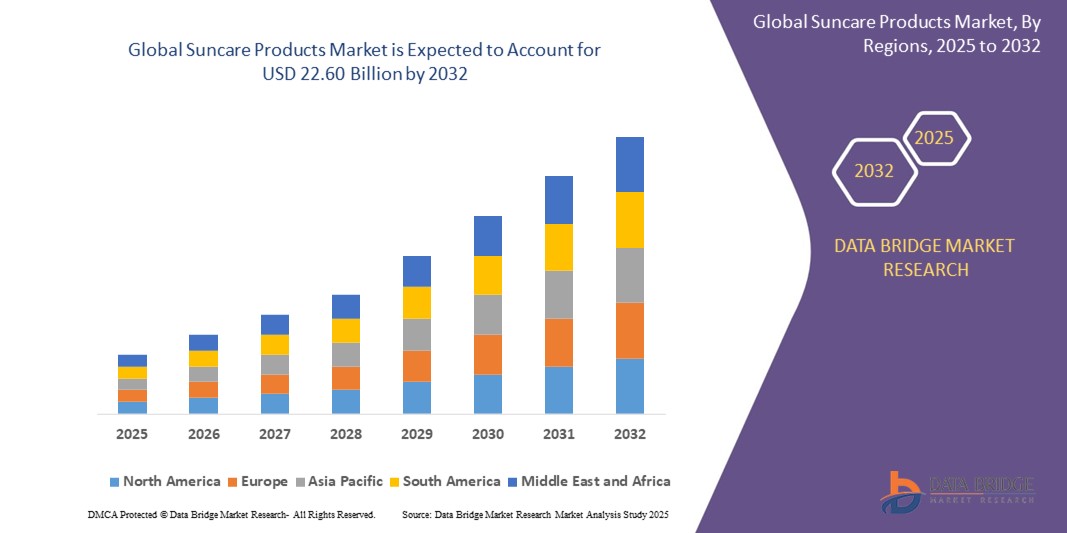
Suncare Products Market Size
- The global Suncare Products market size was valued at USD 14.56 billion in 2024 and is expected to reach USD 22.60 billion by 2032, at a CAGR of 5.65% during the forecast period
- The market growth is largely fueled by the Increasing awareness among consumers about the harmful effects of ultraviolet (UV) radiation, such as skin cancer and premature aging, is significantly driving demand for suncare products
- Furthermore, increased R&D investments and technological innovations, such as sensor bearings the growing popularity of outdoor recreation, sports, and travel is boosting the use of sunscreens, especially water- and sweat-resistant formulations. These converging factors are accelerating the adoption of Suncare Products solutions, thereby significantly boosting the industry's growth
Suncare Products Market Analysis
- Suncare products, delivering broad-spectrum UV protection plus added skincare benefits (anti-ageing, hydration, tinted coverage), have become everyday “must-haves” across beauty, sports and dermatology routines thanks to their proven efficacy, convenience and alignment with clean-beauty and wellness trends. The segment now blends mineral filters, reef-safe chemistry, anti-pollution actives and lightweight textures to meet rising consumer expectations.
- Escalating demand is driven by four converging forces — heightened awareness of UV-induced skin damage, social-media-led skincare education, tightening SPF-labelling & reef-safety regulations, and AI-powered e-commerce that personalises shade/SPF selection.
- Asia-Pacific is on track to command the largest regional revenue share 37.56% by 2025, overtaking Europe as recovery in tourism, high UV indices and K-beauty-inspired daily SPF habits accelerate growth.
- Asia-Pacific is also the fastest-growing region with 6.21% CAGR 2024-32 due to rapid urbanisation, rising disposable incomes and strong local manufacturing in China, Japan, South Korea and India. Governments’ public-health campaigns and stringent ingredient bans (e.g., oxybenzone, octinoxate) further support adoption of high-SPF, reef-compliant products.
- The Sun-protection segment will continue to dominate the product mix, holding 46.89% of global revenue in 2025, as consumers favour lightweight fluid formats for face and body.
Report Scope and Suncare Products Market Segmentation
|
Attributes |
Suncare Products Key Market Insights |
|
Segments Covered |
|
|
Countries Covered |
North America
Europe
Asia-Pacific
Middle East and Africa
South America
|
|
Key Market Players |
|
|
Market Opportunities |
|
|
Value Added Data Infosets |
In addition to the insights on market scenarios such as market value, growth rate, segmentation, geographical coverage, and major players, the market reports curated by the Data Bridge Market Research also include in-depth expert analysis, pricing analysis, brand share analysis, consumer survey, demography analysis, supply chain analysis, value chain analysis, raw material/consumables overview, vendor selection criteria, PESTLE Analysis, Porter Analysis, and regulatory framework. |
Suncare Products Market Trends
“Clean Beauty and Reef-Safe Innovation in Suncare”
- A significant and accelerating trend in the global Suncare Products market is the transition toward clean, eco-friendly, and reef-safe formulations, driven by environmentally conscious consumers and evolving global regulations aimed at protecting marine ecosystems. This innovation is reshaping product development, ingredient sourcing, and brand positioning across the suncare industry.
- For instance, leading companies such as Neutrogena, La Roche-Posay, and Supergoop! are reformulating sunscreens to exclude oxybenzone, octinoxate, and other reef-harming chemicals. Instead, they are incorporating non-nano zinc oxide, titanium dioxide, and biodegradable ingredients to meet consumer demand and regulatory compliance.
- Clean suncare products are increasingly featuring certified organic ingredients, vegan/cruelty-free labels, and recyclable or compostable packaging. These features resonate strongly with Gen Z and Millennial consumers, who prioritize transparency, sustainability, and ethical sourcing in their purchasing decisions.
- Additionally, reef-safe certifications and environmental impact labeling are gaining traction as marketing tools, enabling brands to differentiate in crowded marketplaces. Consumers are using digital apps and e-commerce filters to identify reef-safe and clean SPF options tailored to their values and skin types.
- This trend is also driving R&D investments in novel UV filters and delivery systems, such as encapsulated actives, microspheres for longer wear, and lightweight water-gel textures, to enhance safety and user experience without compromising efficacy.
- The demand for clean and reef-safe sunscreens is rapidly growing across coastal regions, tourist destinations, and environmentally regulated markets. Brands embracing green chemistry and sustainability-driven innovation are gaining market share and solidifying consumer loyalty in the evolving global suncare landscape.
Suncare Products Market Dynamics
Driver
“Rising Demand Driven by Skin Health Awareness and Daily Sun Protection”
- The growing awareness of the harmful effects of UV radiation—including skin cancer, photoaging, hyperpigmentation, and sunburn—is a significant driver for the rising demand for Suncare Products. Consumers are increasingly incorporating sunscreens into their daily skincare routines, beyond just seasonal or beach use.
- For instance, in March 2024, La Roche-Posay launched its “Everyday SPF” campaign across North America and Europe, educating consumers about 365-day sun protection and offering dermatologist-recommended formulations for all skin types. Such initiatives by leading brands are expected to fuel the expansion of the Suncare Products market globally.
- As dermatologists, beauty influencers, and health organizations advocate for year-round sunscreen use—especially for urban populations exposed to both UV rays and environmental pollutants—suncare products are becoming essential for both cosmetic and medical skincare applications.
- Furthermore, innovations in lightweight, non-greasy, tinted, and multifunctional sunscreen formats are eliminating traditional barriers to usage, making it easier for men and women to adopt SPF products into their morning skincare or makeup routines.
- The increasing prevalence of skin conditions linked to UV exposure, growing consumer interest in preventive skincare, and the availability of broad-spectrum SPF formulations tailored for sensitive, acne-prone, or melanin-rich skin types are accelerating suncare adoption across all demographics and geographies.
Restraint/Challenge
“High Product Costs and Limited Awareness in Price-Sensitive Markets”
- The relatively high cost of premium suncare products—especially those with broad-spectrum protection, reef-safe ingredients, and dermatologist-grade formulations—poses a significant barrier to widespread adoption in price-sensitive and emerging markets where basic skincare takes precedence over preventive solutions.
- For instance, mineral-based sunscreens from leading brands like Supergoop!, ISDIN, and EltaMD often retail at 2–4 times the price of conventional chemical sunscreens, limiting affordability for middle- and lower-income consumers in markets such as India, Indonesia, and parts of Africa.
- Limited awareness of UV-related health risks—such as skin cancer, sun-induced aging, and pigmentation disorders—further hampers demand. In many developing regions, sunscreen is still perceived as a luxury or cosmetic product rather than a daily health necessity.
- Cultural and behavioral factors, including low SPF usage among men, limited education on correct application/reapplication, and preference for natural remedies, contribute to low market penetration despite high UV indices in these regions.
- Overcoming these restraints will require consumer education campaigns, lower-cost product lines, and local partnerships to improve accessibility and awareness. Additionally, promoting multi-use products (e.g., SPF moisturizers, BB creams with sun protection) may help bridge the affordability and awareness gaps.
Suncare Products Market Scope
The market is segmented on the basis of type, form, and distribution channel.
- By Type
On the basis of type, the Suncare Products market is segmented into Sun Protection, After Sun, and Self-Tanning. Sun Protection products dominate the market, accounting for the largest revenue share of approximately 46.89% in 2025, driven by increasing consumer awareness of UV-induced skin damage, rising skin cancer rates, and the growing trend of daily SPF usage in skincare routines.
After Sun products, holding around 14.8%, are gaining popularity for their soothing and hydrating properties, especially in high-tourism and tropical regions.
- By form
On the basis of form, the market is segmented into Cream, Gel, Lotion, Powder, Liquid, Wipes, Spray, and Coloured. Creams and Lotions lead the category, together accounting for over 60% of total market share in 2025 due to their familiarity, ease of application, and availability across mass-market and premium price points.
Sprays hold a significant and growing share of approximately 18.5%, driven by demand for lightweight, fast-absorbing formulations that offer convenience and mess-free reapplication.
- By Distribution Channel
On the basis of distribution channel, the market is segmented into Online Stores, Departmental Stores, Direct Sales, Discount Stores, Drug Stores, Salons, Specialty Stores, and Other Channels. Online Stores are emerging as the fastest-growing channel, projected to hold 24.7% of global revenue in 2025, due to rising e-commerce penetration, digital skincare consultations, and social media marketing.
Drug Stores and Specialty Stores collectively contribute about 38.3%, driven by consumer preference for dermatologist-recommended products and access to trusted skincare advisors.
Suncare Products Market Regional Analysis
- Asia-Pacific dominates the Suncare Products market, holding the largest revenue share of approximately 45.5% in 2024.
- This dominance is driven by high UV exposure, growing skin health awareness, increasing disposable incomes, and rising adoption of daily skincare routines across urban centers.
- Countries like China, Japan, South Korea, and India are witnessing rapid expansion of both mass-market and premium suncare brands, supported by booming e-commerce platforms and dermatological education.
China Suncare Products Market Insight
China accounted for the largest market revenue share in Asia-Pacific in 2025, attributed to its expanding middle class, cosmetic consciousness among younger consumers, and high rate of urbanization. The rising preference for multifunctional and tinted SPF products, along with a surge in local skincare startups, is propelling domestic growth.
Japan Suncare Products Market Insight
Japan’s market is gaining momentum due to its cultural emphasis on skincare, aging population, and demand for lightweight, non-comedogenic SPF solutions. The popularity of hybrid skincare-cosmetic products, including SPF-infused foundations and BB creams, is also boosting the market.
North America Suncare Products Market Insight
North America holds the second-largest share, accounting for approximately 38.11% of the global Suncare Products market in 2024. Market growth is fueled by strong awareness of skin cancer prevention, active outdoor lifestyles, and the availability of dermatologist-recommended brands. Innovations in reef-safe formulations, sports sunscreens, and clean-label products are further strengthening consumer loyalty across the U.S. and Canada.
U.S. Suncare Products Market Insight
The U.S. contributes a significant portion of North America’s share, driven by rising adoption of daily SPF skincare, growth of DTC (Direct-to-Consumer) suncare brands, and ongoing shifts toward natural and sustainable ingredients. Strategic collaborations with dermatologists and influencers are shaping purchase decisions.
Europe Suncare Products Market Insight
Europe accounts for a substantial portion of the market, supported by strict regulatory frameworks on sun protection labeling and product safety. The market is characterized by strong demand for broad-spectrum, fragrance-free, and dermatologist-developed products, especially in sun-sensitive populations. Seasonal variations, growing interest in safe tanning alternatives, and eco-conscious consumer behavior are key trends across the region.
U.K. Suncare Products Market Insight
The U.K. market is expanding due to rising skin cancer awareness campaigns, increased use of SPF makeup hybrids, and popularity of cruelty-free and vegan suncare products. Growth is further supported by retail partnerships and beauty-tech integrations in e-commerce.
Germany Suncare Products Market Insight
Germany’s market growth is driven by scientifically backed skincare preferences, rising demand for mineral-based sunscreens, and strong performance in pharmacy-led distribution channels. Sustainability initiatives and plastic-free packaging are gaining traction among health-conscious consumers.
Suncare Products Market Share
The Suncare Products industry is primarily led by well-established companies, including:
- Shiseido Co., Ltd. (Japan)
- Kao Corporation (Japan)
- Bayer AG (Germany)
- Edgewell Personal Care (U.S.)
- Beiersdorf (Germany)
- The Mentholatum Company (U.S.)
- Procter & Gamble (U.S.)
- Estée Lauder Inc (U.S.)
- THE AVON COMPANY (U.K.)
- L’Oréal (France)
- Jahwa (China)
- Johnson & Johnson Services, Inc. (U.S.)
- CHANDO (China)
- Amorepacific (South Korea)
- LG Household & Health Care Ltd. (South Korea)
- Unilever (U.K./Netherlands)
- Blistex Inc. (U.S.)
- Clarins (France)
- Coty Inc. (U.S.)
- Walgreens Boots Alliance, Inc. (U.S.)
Latest Developments in Global Suncare Products Market
- In May 2025 , La Roche-Posay: During Miami’s Racing Fan Fest the brand launched “Anthelios UV Pro Sport Sunscreen” and distributed thousands of samples while offering free dermatologist screenings, highlighting its push into high-performance, sport-focused sun protection
- In February 2025, Supergoop!: Supergoop! introduced “Glowscreen Soft-Radiance Drops Mineral SPF 40,” a two-shade, serum-texture mineral sunscreen that delivers a soft glow while protecting sensitive skin, reinforcing the brand’s hybrid skin-care/make-up positioning
- In January 2025, Shiseido’s Anessa brand unveiled the “Anessa Perfect UV Brush On Powder,” a portable mineral-filter UV-protection powder that lets users top-up SPF over make-up. The limited-edition product will debut in Japanese drug-stores on 21 February 2025, enlarging Anessa’s touch-up suncare formats
- In June 2024, Edgewell (Banana Boat): Edgewell rolled out the “Banana Boat 360 Coverage Sunscreen Mist,” the first refill-ready, reusable trigger-spray system in mass suncare. Refill bottles use 25 % PCR plastic, cutting virgin plastic and aligning with Edgewell’s Sustainable Care 2030 targets
- In June 2023, Beiersdorf (Nivea Sun): Beiersdorf relaunched its Nivea Sun Protect & Moisture line with bottles and pumps containing 50 % recycled plastic and reef-friendly formulas free of oxybenzone and octinoxate, supporting the company’s pledge to halve virgin-plastic use by 2025

- Interactive Data Analysis Dashboard
- Company Analysis Dashboard for high growth potential opportunities
- Research Analyst Access for customization & queries
- Competitor Analysis with Interactive dashboard
- Latest News, Updates & Trend analysis
- Harness the Power of Benchmark Analysis for Comprehensive Competitor Tracking
Data collection and base year analysis are done using data collection modules with large sample sizes. The stage includes obtaining market information or related data through various sources and strategies. It includes examining and planning all the data acquired from the past in advance. It likewise envelops the examination of information inconsistencies seen across different information sources. The market data is analysed and estimated using market statistical and coherent models. Also, market share analysis and key trend analysis are the major success factors in the market report. To know more, please request an analyst call or drop down your inquiry.
The key research methodology used by DBMR research team is data triangulation which involves data mining, analysis of the impact of data variables on the market and primary (industry expert) validation. Data models include Vendor Positioning Grid, Market Time Line Analysis, Market Overview and Guide, Company Positioning Grid, Patent Analysis, Pricing Analysis, Company Market Share Analysis, Standards of Measurement, Global versus Regional and Vendor Share Analysis. To know more about the research methodology, drop in an inquiry to speak to our industry experts.
Data Bridge Market Research is a leader in advanced formative research. We take pride in servicing our existing and new customers with data and analysis that match and suits their goal. The report can be customized to include price trend analysis of target brands understanding the market for additional countries (ask for the list of countries), clinical trial results data, literature review, refurbished market and product base analysis. Market analysis of target competitors can be analyzed from technology-based analysis to market portfolio strategies. We can add as many competitors that you require data about in the format and data style you are looking for. Our team of analysts can also provide you data in crude raw excel files pivot tables (Fact book) or can assist you in creating presentations from the data sets available in the report.