What is the Sweet Dark Chocolate Market Size and Growth Rate?
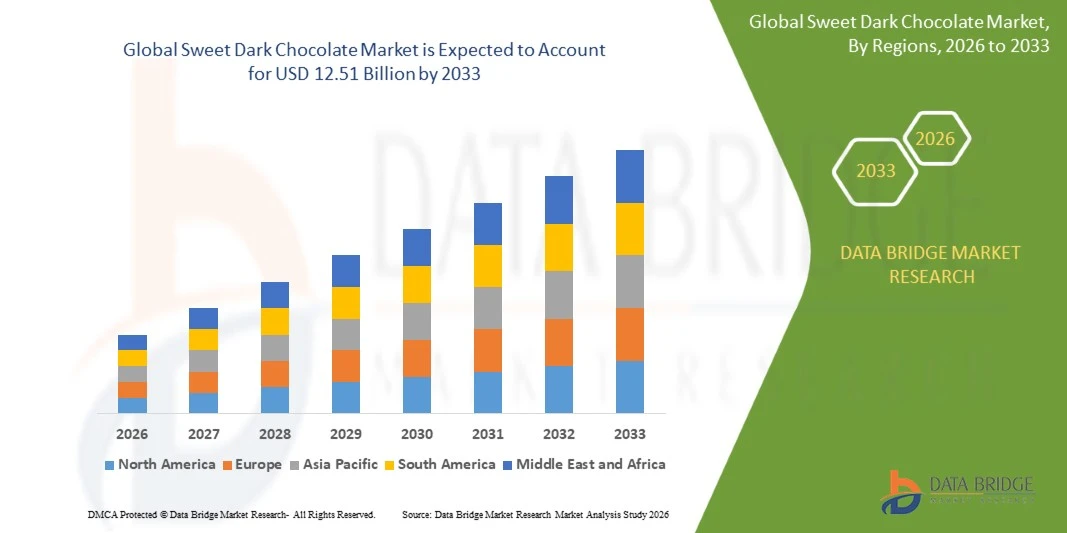
- As per Data Bridge Market Research analysis, the sweet dark chocolate market was valued at USD 8.80 billion in 2025 and is projected to reach USD 12.51 billion by 2033, growing at a CAGR of 4.50% from 2026 to 2033.
- The market is experiencing consistent growth driven by rising demand for premium chocolate products, increasing consumer preference for high-cocoa-content varieties, and expanding applications across confectionery, bakery, and food and beverage industries.
- The growing awareness of cocoa's antioxidant properties, combined with rising demand for premium and lower-sugar confectionery, is encouraging manufacturers to introduce innovative dark chocolate formulations. Organic ingredients, distinctive flavors, sustainable cocoa sourcing, and expanding online retail channels are further supporting consumer demand across developed and emerging market
Market Size & Forecast
- Global Market Value (2025): USD 8.80 Billion
- Expected Market Value (2033): USD 12.51 Billion
- Forecast CAGR (2026–2033): 4.50%
- Leading Region in 2025: North America
- Fastest Growing Region: Asia Pacific
What are the Major Takeaways of the Sweet Dark Chocolate Market?
- North America dominated the sweet dark chocolate market with the largest revenue share of 30.0% in 2025, supported by strong demand for premium and organic chocolate products, high consumer spending, and well-established retail networks.
- Asia-Pacific is expected to be the fastest-growing region at a CAGR of 5.26% from 2026 to 2033, fueled by rising disposable incomes, premium confectionery demand, and expanding chocolate consumption across China, India, and Japan.
- The 70% cocoa dark chocolate segment led the market with a 30% share in 2025, driven by its balance of cocoa intensity, sweetness, and consumer acceptability.
- 90% cocoa dark chocolate are the fastest-growing type, projected to register a CAGR of 7.8%, reflecting the surge in consumers increasingly explore high-cocoa-content products and intense chocolate flavors
- The dark chocolate bars segment dominated the product type category with a 54% revenue share in 2025, led by widespread consumer familiarity, convenience, and availability across supermarkets, specialty chocolate stores, and online platforms.
- Food accounted for 70% of the market share in 2025, preferred by the widespread use of sweet dark chocolate in confectionery, bakery products, desserts, and packaged snacks
- The beverages segment is the fastest-growing application category, with a CAGR of 6.5%, driven by consumers increasingly seek premium drinking chocolate, chocolate-based beverages, and café-style indulgence
Report Scope and Sweet Dark Chocolate Market Segmentation
|
Attributes |
Sweet Dark Chocolate Key Market Insights |
|
Segments Covered |
|
|
Countries Covered |
North America
Europe
Asia-Pacific
Middle East and Africa
South America
|
|
Key Market Players |
|
|
Market Opportunities |
|
|
Value Added Data Infosets |
In addition to the insights on market scenarios such as market value, growth rate, segmentation, geographical coverage, and major players, the market reports curated by the Data Bridge Market Research also include in-depth expert analysis, pricing analysis, brand share analysis, consumer survey, demography analysis, supply chain analysis, value chain analysis, raw material/consumables overview, vendor selection criteria, PESTLE Analysis, Porter Analysis, and regulatory framework. |
What is the Key Trend in the Sweet Dark Chocolate Market?
- Premiumization is a key trend in the sweet dark chocolate market, as consumers increasingly prefer high-cocoa-content products, single-origin cocoa, artisanal production, and distinctive flavor profiles that offer a richer chocolate experience.
- For instance, in May 2025, The Economic Times reported on India's growing craft chocolate industry, highlighting the use of locally sourced cacao, single-origin cocoa beans, and distinctive flavor profiles by Indian chocolate brands to attract consumers seeking premium chocolate experiences.
- Manufacturers are expanding premium product portfolios through innovative recipes, ethical sourcing, and transparent ingredient information to differentiate products and attract quality-conscious consumers.
- Demand for reduced-sugar, organic, and clean-label chocolate is also influencing product development, as consumers seek indulgent confectionery that aligns with their ingredient preferences.
- Growing interest in experiential confectionery is encouraging manufacturers to introduce dark chocolate infused with fruits, nuts, spices, sea salt, and exotic ingredients to provide differentiated taste experiences.
- For instance, in January 2024, Justin’s (Hormel Foods) announced the launch of USDA-certified organic dark chocolate peanut and dark chocolate peanut butter candy pieces made with Rainforest Alliance Certified cocoa, reflecting growing product innovation around organic ingredients and responsible cocoa sourcing
- Sustainable packaging and traceable cocoa sourcing are gaining importance as chocolate brands respond to consumer expectations for responsible production, transparent supply chains, and environmentally conscious packaging.
What are the Key Drivers of the Sweet Dark Chocolate Market?
- The rising consumer interest in premium confectionery and higher cocoa-content products is supporting demand for sweet dark chocolate across established and emerging markets.
- For instance, in August 2025, Food Infotech reported that Indian chocolate manufacturers were increasingly investing in premium and health-conscious product lines, with brands expanding dark chocolate offerings and exploring local cocoa sourcing to meet evolving consumer preferences.
- Increasing awareness of cocoa's naturally occurring flavanols and antioxidant compounds is encouraging interest in dark chocolate, although health benefits depend on the product's composition and consumption levels.
- Product innovation, expanding specialty retail, and online distribution are helping manufacturers reach consumers seeking distinctive flavors, premium gifting options, and convenient access to specialty chocolate products.
- Rising disposable incomes and urbanization in emerging economies are expanding the consumer base for premium chocolate, particularly among younger consumers who are increasingly exploring international confectionery brands.
- For instance, in November 2023, The Economic Times reported that India's dark chocolate segment was gaining traction as consumers increasingly sought products associated with health and wellness. Amul highlighted its range of dark chocolates containing 55%, 75%, 90%, and 99% cocoa, reflecting growing demand for higher-cocoa-content products.
- Growing demand for premium gifting and seasonal confectionery is encouraging manufacturers to develop sophisticated dark chocolate assortments, limited-edition collections, and customized packaging for celebrations and special occasions.
What Factors are Challenging the Growth of the Sweet Dark Chocolate Market?
- High cocoa bean prices and fluctuations in raw material availability create significant cost pressures for sweet dark chocolate manufacturers, affecting production expenses and pricing strategies.
- For instance, in February 2024, Reuters reported that global cocoa prices had approximately doubled over the preceding year, reaching record levels because of declining supplies. Hershey and Cadbury maker Mondelez planned further price increases, while consumers were reducing purchases amid inflationary pressures, highlighting the impact of rising raw material costs on chocolate demand.
- These rising costs can lead to higher retail prices, reduced purchase frequency, and lower sales volumes, particularly among price-sensitive consumers and in emerging markets.
- Manufacturers also face challenges from climate-related crop disruptions, dependence on major cocoa-producing countries, and the need to maintain product quality while managing ingredient costs.
- Increasing regulatory requirements concerning cocoa traceability, deforestation, and responsible sourcing can raise compliance costs for manufacturers and exporters operating across international markets.
- For instance, in July 2025, Reuters reported that The Hershey Company planned average double-digit price increases across its confectionery portfolio because of exceptionally high cocoa costs and supply disruptions in Ghana and Ivory Coast. These cost pressures demonstrate the challenges chocolate manufacturers face in maintaining affordability and profitability.
- The relatively bitter taste of high-cocoa-content chocolate may limit mass-market acceptance among consumers who prefer sweeter milk chocolate, requiring manufacturers to balance cocoa intensity, sweetness, and affordability.
How is the Sweet Dark Chocolate Market Segmented?
The sweet dark chocolate market is segmented on the basis of type, product type, application, and distribution channel.
- By Type
On the basis of type, the sweet dark chocolate market is segmented into 70% cocoa dark chocolate, 75% cocoa dark chocolate, 80% cocoa dark chocolate, and 90% cocoa dark chocolate. The 70% cocoa dark chocolate segment is expected to dominate the market with an estimated 30% share in 2025, supported by its balance of cocoa intensity, sweetness, and consumer acceptability. It appeals to consumers seeking a richer chocolate experience without the pronounced bitterness of products with extremely high cocoa content. Manufacturers widely use this cocoa concentration in premium chocolate bars, gifting products, and specialty confectionery. Its versatility supports product development with nuts, fruits, caramel, and other flavor inclusions. Growing interest in premium chocolate and cocoa-rich formulations further supports demand.
The 90% cocoa dark chocolate segment is projected to register the fastest growth at an estimated CAGR of 7.8% from 2026 to 2033, as consumers increasingly explore high-cocoa-content products and intense chocolate flavors. These products appeal particularly to consumers who prefer less-sweet confectionery and distinctive cocoa characteristics. Growing interest in premium and specialty chocolate is encouraging manufacturers to expand high-cocoa product offerings. The segment also benefits from consumer interest in ingredient transparency and products with relatively low added sugar, although formulations vary by brand. Specialty retailers and e-commerce platforms provide convenient access to niche, high-cocoa chocolate products. Product innovation in cocoa origin, texture, and flavor profiles may further support adoption.
- By Product Type
On the basis of product type, the sweet dark chocolate market is segmented into dark chocolate bars, dark chocolate chips, dark chocolate baking chocolate, dark chocolate couverture, dark chocolate truffles, and dark chocolate-coated products. The dark chocolate bars segment is expected to dominate the market with an estimated 54% share in 2025, supported by widespread consumer familiarity, convenience, and availability across supermarkets, specialty chocolate stores, and online platforms. Chocolate bars are popular for everyday snacking, personal consumption, and gifting. Manufacturers offer multiple cocoa concentrations, flavor combinations, and premium formulations to appeal to different consumer preferences. Single-origin cocoa, organic ingredients, and artisanal production further enhance the appeal of premium bars.
The dark chocolate chips segment is projected to register the fastest growth at an estimated CAGR of 7.7% from 2026 to 2033, driven by rising demand for baking ingredients and versatile chocolate formats. Dark chocolate chips are widely used in cookies, brownies, cakes, muffins, and other baked products. Their convenient size and consistent formulation make them suitable for both household baking and commercial food production. Growing interest in home baking and gourmet desserts is encouraging consumers to purchase specialized chocolate ingredients. Foodservice operators and bakeries also use dark chocolate chips in desserts, toppings, and confectionery applications. Manufacturers are expanding product options through higher cocoa content, premium ingredients, and specialized baking formulations.
- By Application
On the basis of application, the sweet dark chocolate market is segmented into beverages, food, personal care and cosmetics, and others. The food segment is expected to dominate the market with an estimated 70% share in 2025, supported by the widespread use of sweet dark chocolate in confectionery, bakery products, desserts, and packaged snacks. Chocolate bars, truffles, coated nuts, cakes, biscuits, and brownies represent important consumption formats. Manufacturers of packaged foods use dark chocolate to develop premium product lines and differentiated flavor profiles. Growing demand for artisanal confectionery and premium desserts further supports this application. Dark chocolate is also used as an ingredient in ice cream, dairy desserts, fillings, and decorative coatings
The beverages segment is projected to witness strong growth at an estimated CAGR of 6.5% from 2026 to 2033, as consumers increasingly seek premium drinking chocolate, chocolate-based beverages, and café-style indulgence. Dark chocolate is used in hot chocolate preparations, specialty drinks, milkshakes, and blended beverage formulations. Cafés and restaurants are introducing premium chocolate beverages to diversify their menus and attract consumers seeking distinctive flavors. Demand for richer cocoa profiles is encouraging the development of beverages using dark chocolate rather than conventional sweet chocolate formulations. Ready-to-drink product innovation and premium beverage offerings may further support market expansion. Seasonal demand for hot chocolate also creates opportunities for retailers and foodservice operators.
- By Distribution Channel
On the basis of distribution channel, the sweet dark chocolate market is segmented into online sales and offline sales. The offline sales segment is expected to dominate the market with an estimated 75% share in 2025, supported by the extensive presence of supermarkets, hypermarkets, convenience stores, specialty chocolate retailers, and department stores. Physical retail allows consumers to compare brands, cocoa percentages, prices, and packaging before purchasing. Chocolate is also frequently purchased as an impulse snack or a gift during festivals and special occasions. Retailers offer product displays, promotional pricing, and seasonal assortments that encourage purchases. Specialty chocolate shops provide access to premium, artisanal, and single-origin products
The online sales segment is projected to register the fastest growth at an estimated CAGR of 8.5% from 2026 to 2033, driven by the expansion of e-commerce platforms, digital grocery services, and direct-to-consumer chocolate brands. Online channels provide access to specialty products that may not be available in local retail stores. Consumers can compare cocoa concentrations, ingredients, brands, and prices before placing orders. Subscription services, customized gift boxes, and curated chocolate assortments are further improving the online shopping experience. Quick-commerce platforms are also making chocolate purchases more convenient for urban consumers. Digital marketing and personalized product recommendations help brands reach niche audiences interested in premium and high-cocoa-content chocolate.
Which Region Holds the Largest Share of the Sweet Dark Chocolate Market?
- North America dominated the sweet dark chocolate market with the largest revenue share of 30.0% in 2025, supported by strong demand for premium and organic chocolate products, high consumer spending, and well-established retail networks
- The region also benefits from growing consumer interest in organic and high-cocoa-content chocolate, innovative flavor offerings, and extensive retail and e-commerce distribution networks. Rising demand for premium gifting products and reduced-sugar chocolate varieties further supports regional sales, while established brands and strong purchasing power reinforce North America's position in the global dark chocolate market
U.S. Sweet Dark Chocolate Market Insight
The U.S. sweet dark chocolate market is witnessing steady growth due to rising demand for premium confectionery products, increasing consumer interest in high-cocoa-content chocolate, and expanding availability of specialty chocolate brands. The country’s established food processing industry, strong retail infrastructure, and growing preference for innovative flavors are driving demand across household and commercial applications. In addition, increasing interest in organic ingredients, reduced-sugar formulations, and premium chocolate gifting is encouraging manufacturers to expand their product portfolios.
Asia-Pacific Sweet Dark Chocolate Market Insight
The Asia-Pacific sweet dark chocolate market is expected to witness rapid growth, driven by rising disposable incomes, expanding urban populations, and increasing demand for premium confectionery across China, India, and Japan. Growing exposure to international chocolate brands, expanding modern retail infrastructure, and increasing adoption of online shopping are supporting regional market expansion. In addition, the growing popularity of specialty chocolate products, innovative flavors, and premium gifting options is encouraging manufacturers to strengthen their presence across emerging Asian markets.
Japan Sweet Dark Chocolate Market Insight
The Japan sweet dark chocolate market is witnessing consistent growth due to rising demand for premium confectionery, innovative chocolate flavors, and high-quality cocoa-based products. Consumers increasingly value refined packaging, seasonal product launches, and distinctive flavor combinations, encouraging manufacturers to introduce differentiated dark chocolate offerings. Moreover, the country’s established confectionery industry, strong specialty retail network, and growing availability of premium imported and locally produced chocolate are further supporting market development.
China Sweet Dark Chocolate Market Insight
The China sweet dark chocolate market is growing rapidly, driven by rising disposable incomes, expanding urban consumer populations, and increasing interest in premium chocolate products. Growing exposure to international confectionery brands, expanding e-commerce platforms, and rising demand for high-quality gifting products are significantly boosting market demand. In addition, the expansion of specialty chocolate retailers, innovative product launches, and growing interest in distinctive cocoa flavors are supporting China’s development as an important growth market for premium dark chocolate.
U.K. Sweet Dark Chocolate Market Insight
The U.K. sweet dark chocolate market is experiencing steady growth, supported by strong demand for premium confectionery, artisanal chocolate, and products featuring distinctive cocoa concentrations. Increasing consumer interest in organic ingredients, ethical cocoa sourcing, and reduced-sugar alternatives is encouraging manufacturers to diversify their product portfolios. Furthermore, the widespread availability of dark chocolate through supermarkets, specialty retailers, and online platforms, combined with demand for premium gifting and seasonal confectionery, is contributing to market development.
Germany Sweet Dark Chocolate Market Insight
The Germany sweet dark chocolate market is expanding steadily due to established confectionery manufacturing capabilities, strong consumer demand for high-quality chocolate, and increasing interest in premium cocoa-based products. Chocolate manufacturers and specialty retailers are expanding their offerings through innovative flavors, organic ingredients, and responsibly sourced cocoa. Continuous product development, established retail distribution networks, and growing consumer interest in sustainable packaging and premium confectionery are further supporting market growth in Germany.
Which are the Top Companies in Sweet Dark Chocolate Market?
The sweet dark chocolate industry is primarily led by well-established companies, including:
- Ghirardelli Chocolate Company (U.S.)
- Tony’s Chocolonely B.V. (Netherlands)
- Alter Eco Foods (U.S.)
- HU Master Holdings, Inc. (U.S.)
- Taza Chocolate (U.S.)
- Endangered Species Chocolate, LLC (U.S.)
- Valrhona SAS (France)
- The Hershey Company (U.S.)
- Mondelez International, Inc. (U.S.)
- Mars, Incorporated (U.S.)
- Ferrero International S.A. (Luxembourg)
- Hotel Chocolat Group Limited (U.K.)
- Ritter Sport (Germany)
- Chocolaterie Guylian N.V. (Belgium)
- Barry Callebaut AG (Switzerland)
- Meiji Holdings Co., Ltd. (Japan)
- Lotte Wellfood Co., Ltd. (South Korea)
- The Barry Callebaut Group (Switzerland)
- Chocolat Madagascar (Madagascar)
What are Latest Developments in Sweet Dark Chocolate Market?
- In May 2025, Birmingham Chocolate acquired Macalat®, an organic, sugar-free sweet dark chocolate brand, expanding its portfolio with products designed for consumers seeking alternatives to conventional sweetened chocolate. Macalat’s range includes chocolate bars and resealable treats featuring ingredients such as puffed quinoa, raspberry, mango, and dates. The acquisition strengthened Birmingham Chocolate’s presence in the emerging segment of organic, sugar-free sweet dark chocolate.
- In January 2024, Nestlé UK and Ireland launched KitKat 70% Dark, introducing a limited-edition variant combining the brand’s crispy wafer with dark chocolate. Initially available exclusively at Sainsbury’s stores across the U.K., the product used cocoa mass sourced from families participating in Nestlé’s Cocoa Income Accelerator Programme. The launch highlighted the company’s focus on premium dark chocolate offerings and responsible cocoa sourcing.
- In April 2023, The Macalat Company launched its organic, sugar-free sweet dark chocolate brand, introducing a plant-based chocolate bar formulated without sugar or sugar substitutes. The product was developed to deliver a smooth, sweet chocolate experience using alternative ingredients, addressing demand for confectionery options with simpler ingredient profiles. The launch also marked the introduction of a dedicated sweet dark chocolate product category for the company.
- In April 2022, The Whole Truth Foods launched its dark chocolate range sweetened exclusively with dates, offering products without added sugar or artificial sweeteners. The company used locally sourced, single-origin cocoa from Idukki, Kerala, alongside dates, and established its own bean-to-bar chocolate factory in Mumbai to manage production. The development reflected growing interest in clean-label chocolate and alternative sweetening ingredients in India
- In March 2021, Nestlé began the wider rollout of Incoa, a 70% dark chocolate bar made exclusively from the cocoa fruit, under its Les Recettes de L’Atelier brand. The product used cocoa pulp to provide sweetness without adding refined sugar and was introduced in retail markets in France and the Netherlands, with further European markets planned. The launch demonstrated an alternative approach to chocolate formulation that uses more parts of the cocoa fruit while reducing reliance on conventional sweeteners.
- Interactive Data Analysis Dashboard
- Company Analysis Dashboard for high growth potential opportunities
- Research Analyst Access for customization & queries
- Competitor Analysis with Interactive dashboard
- Latest News, Updates & Trend analysis
- Harness the Power of Benchmark Analysis for Comprehensive Competitor Tracking
Global Sweet Dark Chocolate Market, Supply Chain Analysis and Ecosystem Framework
To support market growth and help clients navigate the impact of geopolitical shifts, DBMR has integrated in-depth supply chain analysis into its Global Sweet Dark Chocolate Market research reports. This addition empowers clients to respond effectively to global changes affecting their industries. The supply chain analysis section includes detailed insights such as Global Sweet Dark Chocolate Market consumption and production by country, price trend analysis, the impact of tariffs and geopolitical developments, and import and export trends by country and HSN code. It also highlights major suppliers with data on production capacity and company profiles, as well as key importers and exporters. In addition to research, DBMR offers specialized supply chain consulting services backed by over a decade of experience, providing solutions like supplier discovery, supplier risk assessment, price trend analysis, impact evaluation of inflation and trade route changes, and comprehensive market trend analysis.
Data collection and base year analysis are done using data collection modules with large sample sizes. The stage includes obtaining market information or related data through various sources and strategies. It includes examining and planning all the data acquired from the past in advance. It likewise envelops the examination of information inconsistencies seen across different information sources. The market data is analysed and estimated using market statistical and coherent models. Also, market share analysis and key trend analysis are the major success factors in the market report. To know more, please request an analyst call or drop down your inquiry.
The key research methodology used by DBMR research team is data triangulation which involves data mining, analysis of the impact of data variables on the market and primary (industry expert) validation. Data models include Vendor Positioning Grid, Market Time Line Analysis, Market Overview and Guide, Company Positioning Grid, Patent Analysis, Pricing Analysis, Company Market Share Analysis, Standards of Measurement, Global versus Regional and Vendor Share Analysis. To know more about the research methodology, drop in an inquiry to speak to our industry experts.
Data Bridge Market Research is a leader in advanced formative research. We take pride in servicing our existing and new customers with data and analysis that match and suits their goal. The report can be customized to include price trend analysis of target brands understanding the market for additional countries (ask for the list of countries), clinical trial results data, literature review, refurbished market and product base analysis. Market analysis of target competitors can be analyzed from technology-based analysis to market portfolio strategies. We can add as many competitors that you require data about in the format and data style you are looking for. Our team of analysts can also provide you data in crude raw excel files pivot tables (Fact book) or can assist you in creating presentations from the data sets available in the report.