


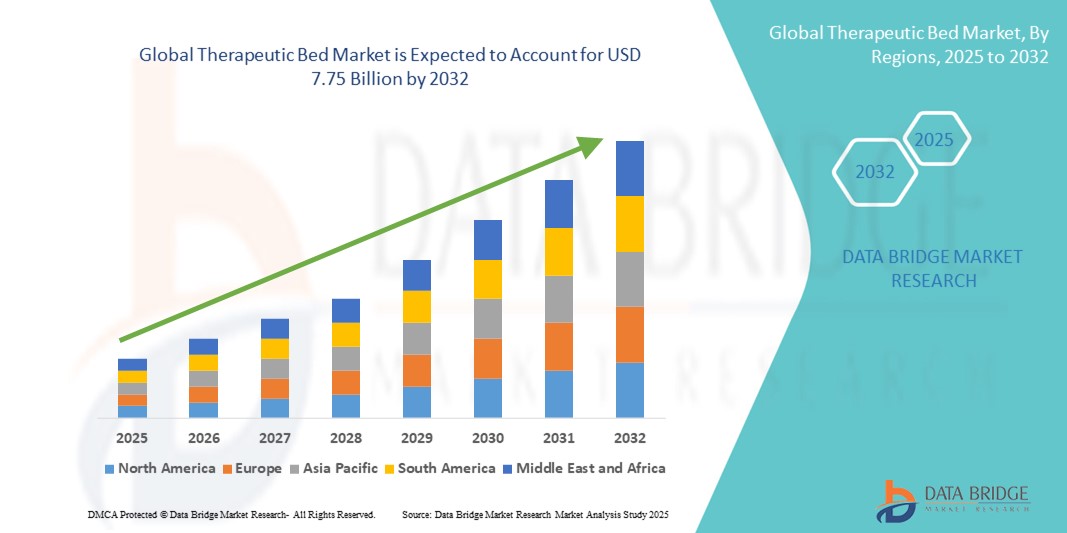
Therapeutic Bed Market Size
- The global therapeutic bed market size was valued at USD 4.97 billion in 2024 and is expected to reach USD 7.75 billion by 2032, at a CAGR of 5.70% during the forecast period
- The market growth is largely fueled by the rising prevalence of chronic conditions, aging population, and increasing demand for advanced patient care technologies in both hospital and homecare settings
- Furthermore, growing awareness around pressure ulcer prevention, improved comfort, and the integration of smart technologies in therapeutic beds is positioning them as essential equipment in modern healthcare infrastructure. These converging factors are accelerating adoption across healthcare facilities, thereby significantly boosting the industry's growth
Therapeutic Bed Market Analysis
- Therapeutic beds, designed to enhance patient comfort, reduce pressure ulcers, and support medical recovery, are increasingly essential components of hospital and homecare environments due to their role in improving patient outcomes and facilitating advanced care protocols
- The escalating demand for therapeutic beds is primarily fueled by the rising geriatric population, increasing prevalence of chronic and mobility-related conditions, and growing emphasis on quality patient care across healthcare systems
- North America dominated the therapeutic bed market with the largest revenue share of 39.3% in 2024, driven by advanced healthcare infrastructure, high per capita health expenditure, and strong demand from hospitals and long-term care facilities in the U.S. and Canada
- Asia-Pacific is expected to be the fastest growing region in the therapeutic bed market during the forecast period due to expanding healthcare access, increasing healthcare investments, and a rising elderly population, particularly in China and India
- Clinical beds segment dominated the therapeutic bed market with a market share of 62.7% in 2024, owing to their extensive use in hospitals and rehabilitation centers for a variety of patient care needs, including surgical recovery and chronic disease management
Report Scope and Therapeutic Bed Market Segmentation
|
Attributes |
Therapeutic Bed Key Market Insights |
|
Segments Covered |
|
|
Countries Covered |
North America
Europe
Asia-Pacific
Middle East and Africa
South America
|
|
Key Market Players |
|
|
Market Opportunities |
|
|
Value Added Data Infosets |
In addition to the insights on market scenarios such as market value, growth rate, segmentation, geographical coverage, and major players, the market reports curated by the Data Bridge Market Research also include in-depth expert analysis, pricing analysis, brand share analysis, consumer survey, demography analysis, supply chain analysis, value chain analysis, raw material/consumables overview, vendor selection criteria, PESTLE Analysis, Porter Analysis, and regulatory framework. |
Therapeutic Bed Market Trends
“Technological Advancements in Pressure Redistribution and Patient Monitoring”
- A significant and accelerating trend in the global therapeutic bed market is the integration of advanced technologies aimed at improving pressure redistribution and incorporating real-time patient monitoring systems. These innovations are revolutionizing patient care by enhancing comfort, reducing the risk of pressure ulcers, and enabling proactive clinical interventions
- For instance, Hillrom’s Centrella Smart+ Bed features advanced microclimate management and digital connectivity to EHR systems, allowing real-time data sharing for patient condition tracking. Similarly, Stryker’s ProCuity bed series offers advanced fall prevention features and wireless connectivity to streamline care team communication
- Therapeutic beds now incorporate features such as alternating pressure systems, low-air-loss therapy, and sensor-based monitoring that track patient movement, weight distribution, and even heart and respiratory rates. For instance, Arjo’s Citadel Patient Care System provides integrated weight and positioning sensors to support individualized therapy protocols
- The adoption of IoT-enabled therapeutic beds allows for centralized control and improved workflow efficiency in hospitals and long-term care facilities, offering insights into patient mobility trends and automating alerts for repositioning or assistance
- This trend towards smart, sensor-integrated, and data-driven therapeutic beds is reshaping patient care environments, aligning with broader digital transformation goals in healthcare. As a result, companies such as LINET and Invacare are developing AI-enabled therapeutic beds equipped with remote diagnostics and auto-adjusting comfort settings to promote both clinical efficacy and patient satisfaction
- The demand for therapeutic beds that support intelligent monitoring and adaptive care is growing rapidly across acute care, long-term care, and home healthcare settings, driven by the rising aging population, increasing chronic disease burden, and the need to reduce hospital-acquired conditions such as bedsores
Therapeutic Bed Market Dynamics
Driver
“Rising Chronic Illnesses and Aging Population Fueling Demand”
- The increasing global prevalence of chronic illnesses, such as cardiovascular diseases, diabetes, and musculoskeletal disorders, combined with a rapidly aging population, is a major driver for the growing demand for therapeutic beds in hospitals, long-term care centers, and home settings
- For instance, according to the WHO, the global population aged 60 years and older is expected to double by 2050. This demographic shift is contributing to higher hospitalization rates and longer patient stays, necessitating specialized beds that support recovery and minimize complications such as pressure injuries
- Therapeutic beds with features such as adjustable height, pressure redistribution surfaces, and enhanced mobility support are crucial for patients requiring extended care or at risk of developing pressure ulcers and other complications. These features are vital in improving patient outcomes and reducing care burdens on healthcare staff
- In addition, increasing government initiatives and healthcare expenditure aimed at upgrading hospital infrastructure are boosting the therapeutic bed market. Several healthcare systems are mandating the use of pressure-relieving surfaces in high-dependency units, further fueling demand
- The expansion of home healthcare services and the preference for home-based recovery are also contributing to market growth, as patients and caregivers increasingly opt for motorized, user-friendly therapeutic beds designed for home use
Restraint/Challenge
“High Cost and Limited Access in Emerging Economies”
- The high cost of advanced therapeutic beds, particularly those integrated with smart technologies, remains a significant challenge, especially in cost-sensitive markets and underfunded healthcare systems
- For instance, specialized ICU or pressure-relieving beds can be several times more expensive than standard hospital beds, making them less accessible for many facilities in developing regions
- In addition, the limited reimbursement coverage for therapeutic beds in several countries can deter healthcare providers and patients from adopting these solutions
- Maintenance requirements, such as regular servicing of air systems or electronic components, add to the overall cost of ownership, posing a challenge for smaller hospitals or long-term care facilities with budget constraints
- Overcoming this barrier will require collaborative efforts by manufacturers, governments, and insurance providers to make therapeutic beds more affordable and widely available through cost-effective models, rental programs, and improved funding mechanisms
Therapeutic Bed Market Scope
The market is segmented on the basis of product, type, application, and end user.
- By Product
On the basis of product, the therapeutic bed market is segmented into clinical beds, household beds, and accessories. The clinical beds segment dominated the market with the largest market revenue share of 62.7% in 2024, owing to their extensive usage in hospitals, rehabilitation centers, and long-term care facilities. Clinical beds are equipped with advanced features such as motorized positioning, pressure-relief surfaces, and safety enhancements, making them essential for managing both acute and chronic care patients.
The household beds segment is expected to witness the fastest growth rate from 2025 to 2032, driven by the increasing trend of home healthcare, especially for elderly and chronically ill patients. Rising preference for in-home recovery and the availability of affordable, easy-to-use adjustable beds contribute to this segment’s growth.
- By Type
On the basis of type, the therapeutic bed market is segmented into regular tubes, reinforced/armoured tubes, coated tubes, laser resistant tubes, double lumen tubes, and others. The reinforced/armoured tubes segment held the largest market revenue share in 2024, driven by their durability and enhanced support features, especially for bariatric and long-term care patients. These tubes are widely used in critical care environments where structural integrity and patient safety are crucial.
The coated tubes segment is expected to grow rapidly over the forecast period due to their antimicrobial properties, making them suitable for infection-prone environments and surgical settings. Their increasing adoption in hospital ICUs and isolation wards is contributing to segment expansion.
- By Application
On the basis of application, the therapeutic bed market is segmented into acute care beds, critical care beds, and long-term beds. The acute care beds segment dominated the market with the largest revenue share in 2024, attributed to their use in managing short-term, high-intensity treatment across emergency, medical, and post-operative care units. These beds support mobility, electronic adjustments, and emergency functions critical to acute care delivery.
The long-term beds segment is anticipated to grow at the highest CAGR from 2025 to 2032, owing to the increasing aging population, rising cases of chronic illnesses, and the expansion of nursing homes and assisted living facilities globally.
- By End User
On the basis of end user, the therapeutic bed market is segmented into hospitals and clinics, reproductive care centers, and others. The hospitals and clinics segment held the largest market revenue share in 2024, driven by high hospitalization rates, increasing surgical procedures, and rising investments in hospital infrastructure worldwide. The need for specialized and multifunctional therapeutic beds in ICUs and general wards is a key factor behind this dominance.
The reproductive care centers segment is expected to expand steadily during forecast period, supported by the growing demand for maternity and neonatal care beds that offer comfort, flexibility, and specialized configurations.
Therapeutic Bed Market Regional Analysis
- North America dominated the therapeutic bed market with the largest revenue share of 39.3% in 2024, driven by advanced healthcare infrastructure, high per capita health expenditure, and strong demand from hospitals and long-term care facilities in the U.S. and Canada
- Healthcare providers in the region prioritize therapeutic beds for their ability to enhance patient comfort, prevent pressure ulcers, and support critical care with features such as adjustability, pressure redistribution, and integrated monitoring systems
- This strong demand is further supported by high healthcare expenditure, favorable reimbursement policies, and a well-established hospital network, positioning therapeutic beds as an essential component in both acute and long-term care settings across the region
U.S. Therapeutic Bed Market Insight
The U.S. therapeutic bed market captured the largest revenue share of 79% in 2024 within North America, driven by advanced healthcare infrastructure, high hospitalization rates, and rising demand for pressure-relieving and patient-friendly bed systems. The surge in chronic conditions, coupled with an aging population, is fueling the need for beds equipped with smart features such as adjustability, fall prevention, and remote monitoring. Moreover, favorable reimbursement policies and increased investments in hospital upgrades are strengthening the adoption of therapeutic beds across acute care, long-term care, and home settings.
Europe Therapeutic Bed Market Insight
The Europe therapeutic bed market is projected to expand at a substantial CAGR throughout the forecast period, primarily driven by rising healthcare expenditure, aging demographics, and strict patient care standards. The growing focus on reducing hospital-acquired conditions such as pressure ulcers is leading to the adoption of advanced therapeutic beds. The region’s emphasis on quality care, especially in Germany, France, and the U.K., is fostering demand for beds with pressure redistribution and smart monitoring technologies across hospitals, nursing homes, and rehabilitation centers.
U.K. Therapeutic Bed Market Insight
The U.K. therapeutic bed market is anticipated to grow at a noteworthy CAGR during the forecast period, supported by a growing elderly population and increasing investments in healthcare infrastructure. The country’s National Health Service (NHS) initiatives to improve long-term and palliative care have driven demand for high-specification therapeutic beds. In addition, rising awareness about pressure ulcer prevention and patient mobility support is encouraging the adoption of therapeutic beds across public hospitals, specialty clinics, and home care settings.
Germany Therapeutic Bed Market Insight
The Germany therapeutic bed market is expected to expand at a considerable CAGR during the forecast period, fueled by the country’s well-established healthcare system and focus on high-quality, technologically advanced patient care. Germany's aging population and strong presence of domestic bed manufacturers contribute to market growth. Increased investments in digital hospital initiatives and emphasis on improving in-patient recovery outcomes are boosting demand for therapeutic beds integrated with monitoring sensors, mobility assistance, and pressure relief systems.
Asia-Pacific Therapeutic Bed Market Insight
The Asia-Pacific therapeutic bed market is poised to grow at the fastest CAGR of 22% during the forecast period of 2025 to 2032, driven by rising healthcare infrastructure development, growing elderly population, and increasing public and private healthcare spending across countries such as China, India, and Japan. Technological advancements, local manufacturing, and government health reforms are expanding the accessibility of therapeutic beds. The growing trend of home healthcare and expansion of long-term care facilities are further accelerating market demand across the region.
Japan Therapeutic Bed Market Insight
The Japan therapeutic bed market is gaining momentum due to the country’s aging population, advanced medical technology, and emphasis on preventive healthcare. Therapeutic beds with features such as adjustable height, pressure management, and integrated sensors are increasingly being adopted in hospitals and elderly care centers. Government support for eldercare infrastructure and the integration of therapeutic beds in smart hospitals are also contributing to the steady market expansion in Japan.
India Therapeutic Bed Market Insight
The India therapeutic bed market accounted for the largest market revenue share in Asia-Pacific in 2024, attributed to the country's expanding healthcare infrastructure, increased government health initiatives, and rising demand for affordable therapeutic care. Growing chronic disease incidence and elderly population are driving the adoption of therapeutic beds in both public hospitals and private nursing homes. Local manufacturing, combined with the expansion of home healthcare and digital health services, is further boosting market growth in India.
Therapeutic Bed Market Share
The therapeutic bed industry is primarily led by well-established companies, including:
- Stryker (U.S.)
- Hill-Rom Holdings, Inc. (U.S.)
- Invacare Corporation (U.S.)
- Arjo AB (Sweden)
- LINET Group SE (Czech Republic)
- Paramount Bed Co., Ltd. (Japan)
- Medline Industries, LP (U.S.)
- Joerns Healthcare LLC (U.S.)
- Drive DeVilbiss Healthcare (U.S.)
- Savaria Corporation (Canada)
- GF Health Products, Inc. (U.S.)
- Stiegelmeyer GmbH & Co. KG (Germany)
- Antano Group S.r.l. (Italy)
- Apex Medical Corp. (Taiwan)
- Besco Medical Co., Ltd. (China)
- Amico Corporation (Canada)
- Midmark Corporation (U.S.)
- NOA Medical Industries, Inc. (U.S.)
- Technologie Medicale (France)
- Wissner-Bosserhoff GmbH (Germany)
What are the Recent Developments in Global Therapeutic Bed Market?
- In May 2023, Hillrom (a Baxter International Inc. company) announced the expansion of its smart bed offerings with the introduction of an advanced therapeutic bed model equipped with integrated patient monitoring and mobility-assist features. Designed for high-acuity environments, the new model aims to improve patient safety, accelerate recovery, and reduce caregiver workload, reinforcing Hillrom’s leadership in smart therapeutic solutions tailored to evolving hospital demands
- In April 2023, Arjo AB, a global medical technology company, launched the Evenda therapeutic bed platform, engineered to meet the needs of long-term and elderly care facilities. This product integrates pressure injury prevention technology and ergonomic design to enhance patient comfort and caregiver efficiency. The launch emphasizes Arjo’s focus on high-quality, clinically supported innovations for aging populations in institutional and home care settings
- In March 2023, LINET Group SE, a leading European manufacturer of hospital beds, introduced its Sentida SC bed series aimed at promoting early mobilization and fall prevention. These beds feature a multi-zoned lying surface, digital safety alerts, and intuitive controls to support both patients and healthcare staff. The launch aligns with LINET’s strategic focus on improving outcomes in rehabilitation and long-term care through intelligent design and digital integration
- In February 2023, Invacare Corporation unveiled its next-generation Softform Premier Active 2 RX therapeutic support surface in North America, combining static foam and dynamic air technologies. Developed for use in both acute and long-term care settings, the support system is designed to deliver optimal pressure redistribution and adapt to individual patient needs. This development reflects Invacare’s commitment to addressing pressure injury prevention with flexible, clinically tested solutions
- In January 2023, Stryker Corporation introduced its enhanced ProCuity therapeutic bed series globally, integrating wireless connectivity and advanced fall prevention features. The series supports continuous patient monitoring and facilitates integration with hospital information systems, contributing to better clinical workflows and safety outcomes. This launch showcases Stryker’s innovation-driven approach in redefining patient care through data-enabled, high-performance therapeutic beds

- Interactive Data Analysis Dashboard
- Company Analysis Dashboard for high growth potential opportunities
- Research Analyst Access for customization & queries
- Competitor Analysis with Interactive dashboard
- Latest News, Updates & Trend analysis
- Harness the Power of Benchmark Analysis for Comprehensive Competitor Tracking
Data collection and base year analysis are done using data collection modules with large sample sizes. The stage includes obtaining market information or related data through various sources and strategies. It includes examining and planning all the data acquired from the past in advance. It likewise envelops the examination of information inconsistencies seen across different information sources. The market data is analysed and estimated using market statistical and coherent models. Also, market share analysis and key trend analysis are the major success factors in the market report. To know more, please request an analyst call or drop down your inquiry.
The key research methodology used by DBMR research team is data triangulation which involves data mining, analysis of the impact of data variables on the market and primary (industry expert) validation. Data models include Vendor Positioning Grid, Market Time Line Analysis, Market Overview and Guide, Company Positioning Grid, Patent Analysis, Pricing Analysis, Company Market Share Analysis, Standards of Measurement, Global versus Regional and Vendor Share Analysis. To know more about the research methodology, drop in an inquiry to speak to our industry experts.
Data Bridge Market Research is a leader in advanced formative research. We take pride in servicing our existing and new customers with data and analysis that match and suits their goal. The report can be customized to include price trend analysis of target brands understanding the market for additional countries (ask for the list of countries), clinical trial results data, literature review, refurbished market and product base analysis. Market analysis of target competitors can be analyzed from technology-based analysis to market portfolio strategies. We can add as many competitors that you require data about in the format and data style you are looking for. Our team of analysts can also provide you data in crude raw excel files pivot tables (Fact book) or can assist you in creating presentations from the data sets available in the report.













