


What is the Tissue Regeneration Market Size and Overview?
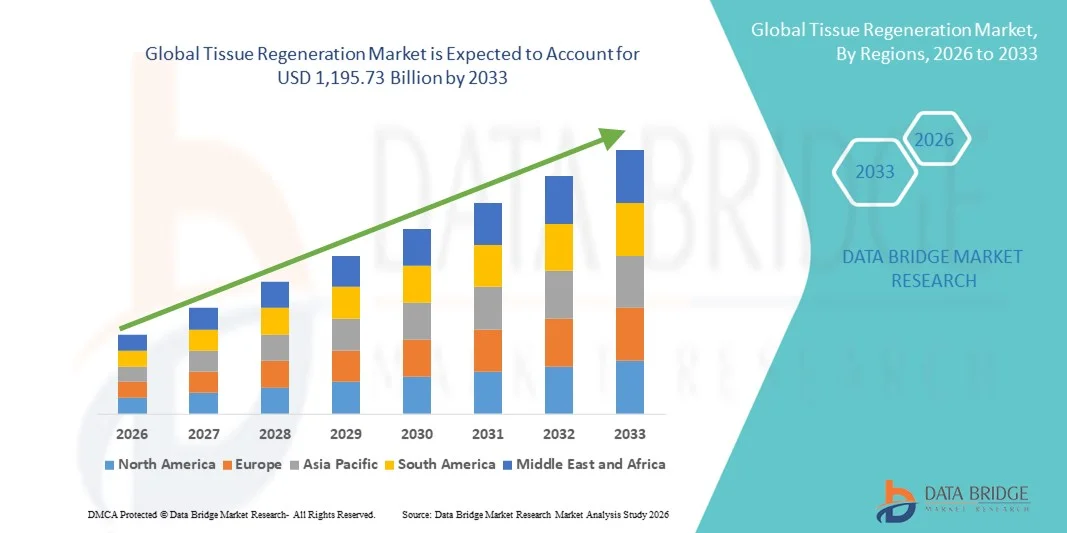
- As per Data Bridge Market Research Analysis the global tissue regeneration market size was valued at USD 195.05 billion in 2025 and is expected to reach USD 1,195.73 billion by 2033, at a CAGR of 25.44% during the forecast period
- The market growth is largely fueled by the increasing prevalence of chronic diseases, surgical procedures, and traumatic injuries, driving demand for advanced regenerative therapies and biomaterials
- Furthermore, rising investments in research and development, coupled with technological advancements in stem cell therapy, scaffolds, and growth factors, are establishing tissue regeneration as a pivotal solution in modern healthcare. These converging factors are accelerating the adoption of tissue regeneration therapies, thereby significantly boosting the industry's growth
Market Size & Forecast
- Global Market Value (2025): USD 195.05 billion in 2025
- Expected Market Value (2033): USD 1,195.73 billion by 2033
- Forecast CAGR (2026–2033): 25.44%
Tissue Regeneration Market Analysis
- Tissue regeneration, encompassing advanced therapies such as stem cell therapy, biomaterials, and scaffolds, is increasingly vital for addressing chronic diseases, traumatic injuries, and surgical repair across both orthopedic and soft tissue applications due to its potential to restore damaged tissues and improve patient outcomes
- The escalating demand for tissue regeneration solutions is primarily fueled by the rising prevalence of chronic conditions, increasing surgical procedures, and growing investments in R&D for regenerative medicine technologies
- North America dominated the tissue regeneration market with the largest revenue share of 38.7% in 2025, characterized by advanced healthcare infrastructure, high adoption of regenerative therapies, and a strong presence of key market players, with the U.S. experiencing substantial growth in stem cell-based and scaffold-based therapies, driven by innovations from both established biotech companies and startups focusing on tissue engineering and cellular therapeutics
- Asia-Pacific is expected to be the fastest-growing region in the tissue regeneration market during the forecast period due to increasing healthcare expenditure, growing awareness of regenerative treatments, and rising prevalence of orthopedic and chronic conditions
- Stem cell therapy segment dominated the tissue regeneration market with a market share of 41.5% in 2025, driven by its proven efficacy in tissue repair and expanding clinical applications across multiple therapeutic areas
Report Scope and Tissue Regeneration Market Segmentation
|
Attributes |
Tissue Regeneration Key Market Insights |
|
Segments Covered |
|
|
Countries Covered |
North America
Europe
Asia-Pacific
Middle East and Africa
South America
|
|
Key Market Players |
|
|
Market Opportunities |
|
|
Value Added Data Infosets |
In addition to the insights on market scenarios such as market value, growth rate, segmentation, geographical coverage, and major players, the market reports curated by the Data Bridge Market Research also include in-depth expert analysis, patient epidemiology, pipeline analysis, pricing analysis, and regulatory framework |
What is the Key Trend in the Tissue Regeneration Market?
Increasing Adoption of 3D Bioprinting and Scaffold-Based Therapies
- A significant and accelerating trend in the global tissue regeneration market is the integration of 3D bioprinting technology with advanced scaffold-based materials, enabling precise fabrication of tissue constructs for regenerative applications
- For instance, bioprinted cardiac patches are being developed to restore damaged heart tissue with patient-specific geometries, improving surgical outcomes and reducing recovery time
- Scaffold-based therapies combined with growth factors allow for enhanced cell proliferation, vascularization, and tissue maturation, supporting the creation of functional tissues that closely mimic native structures
- The integration of bioprinting and scaffolds facilitates customization for individual patient needs, allowing personalized implants for orthopedic, dermatological, and organ regeneration applications
- Growing collaborations between biotech companies, academic institutions, and hospitals are accelerating innovation and commercial deployment of advanced tissue regeneration solutions
- Increasing use of AI and machine learning to optimize tissue engineering processes, predict patient outcomes, and improve the efficiency of regenerative treatments
- This trend towards more precise, personalized, and functional tissue constructs is fundamentally reshaping clinical expectations for regenerative medicine. Consequently, companies such as CELLINK are developing advanced bioprinting platforms with multi-material capabilities and high-resolution tissue fabrication
- The demand for tissue regeneration solutions leveraging 3D bioprinting and scaffold-based therapies is growing rapidly across both hospital and research settings, as clinicians and scientists prioritize precision and efficacy in regenerative treatments
Tissue Regeneration Market Dynamics
Driver
Rising Prevalence of Chronic Diseases and Surgical Procedures
- The increasing incidence of chronic conditions, traumatic injuries, and surgical interventions is a significant driver for the heightened demand for tissue regeneration solutions
- For instance, advanced stem cell therapies are being applied to treat osteoarthritis and cartilage damage, offering improved recovery and long-term functionality for patients
- As patient populations grow and life expectancy increases, there is a greater need for regenerative therapies to repair damaged tissues and organs, reducing the reliance on conventional treatments
- Furthermore, government initiatives and funding for regenerative medicine research are encouraging the development and clinical adoption of novel tissue regeneration technologies
- The effectiveness of regenerative therapies in reducing recovery time, enhancing tissue functionality, and improving overall patient outcomes is propelling adoption across hospitals, research centers, and specialized clinics
- The trend towards integrating tissue regeneration into mainstream healthcare is supported by technological advancements and increasing awareness among physicians and patients about the benefits of regenerative solutions
- Rising partnerships between pharmaceutical and biotech companies to develop combination therapies that integrate tissue regeneration with immunotherapy and gene therapy
- Expanding adoption of regenerative solutions in veterinary medicine and aesthetic procedures is opening new revenue streams and application areas for the market
Restraint/Challenge
High Cost of Therapy and Regulatory Hurdles
- The high cost of advanced tissue regeneration therapies, including stem cell and scaffold-based treatments, poses a significant challenge to broader market adoption
- For instance, autologous stem cell treatments for orthopedic applications can be prohibitively expensive for many patients, limiting accessibility in developing regions
- Regulatory approvals for regenerative therapies are complex and vary across countries, often requiring extensive clinical trials and long review timelines, which can delay product launches
- In addition, concerns about the long-term safety, efficacy, and potential immune responses of regenerative products can create hesitation among clinicians and patients
- Limited standardization in manufacturing processes for regenerative products can affect consistency and quality, posing challenges for large-scale commercialization
- Ethical concerns around stem cell sourcing and manipulation can impact public perception and adoption of tissue regeneration therapies
- While research and technological advancements are gradually reducing costs, the perceived premium for regenerative therapies compared to conventional treatments continues to restrict market penetration
- Overcoming these challenges through cost reduction strategies, streamlined regulatory pathways, and clinical validation will be crucial for sustained growth in the tissue regeneration market
Tissue Regeneration Market Scope
The market is segmented on the basis of technology, raw material, application, and end-user.
- By Technology
On the basis of technology, the tissue regeneration market is segmented into cell therapy, stem cell therapy, stem cell sources, tissue vascularization, cell culturing, and others. The stem cell therapy segment dominated the market with the largest revenue share of 41.5% in 2025, driven by its proven efficacy in repairing damaged tissues and organs across multiple therapeutic areas. Stem cell therapy is widely used in orthopedic, cardiovascular, and neurological applications due to its ability to differentiate into multiple cell types and promote tissue regeneration. Hospitals and research centers prioritize stem cell-based solutions for their high success rates and potential for personalized medicine. Clinical trials and regulatory approvals in major markets such as the U.S. and Europe further strengthen its dominance. In addition, technological advancements in stem cell harvesting and culturing techniques have enhanced safety and reduced immunogenic risks.
The cell therapy segment is expected to witness the fastest CAGR from 2026 to 2033, fueled by increasing adoption in emerging markets and advancements in autologous and allogeneic therapies. Cell therapy applications are expanding beyond traditional areas into dermatology, ophthalmology, and chronic wound care. Rising investments by biotechnology firms and growing awareness among physicians and patients about regenerative benefits are propelling growth. The integration of cell therapies with tissue scaffolds and growth factors enhances their efficacy, attracting both hospitals and contract research organizations. Furthermore, favorable government initiatives and funding for regenerative medicine are accelerating commercialization.
- By Raw Material
On the basis of raw material, the tissue regeneration market is segmented into synthetic, genetically modified, and biological. The biological segment dominated the market with the largest revenue share in 2025, driven by the use of natural biomaterials such as collagen, fibrin, and extracellular matrices in tissue engineering. Biological materials are preferred due to their high biocompatibility, reduced immune response, and ability to promote natural tissue healing. These materials are widely applied in orthopedic grafts, cardiovascular patches, and wound healing products. Hospitals and research centers prioritize biological scaffolds for their proven clinical performance and long-term safety. Regulatory approvals for biological grafts and matrices in major regions further support market dominance. Continuous innovation in processing and sterilization techniques also enhances their adoption.
The synthetic segment is expected to register the fastest growth rate during the forecast period, owing to advances in biodegradable polymers, hydrogels, and 3D-printed scaffolds. Synthetic materials allow customization of mechanical properties, degradation rates, and drug-release profiles. They are increasingly integrated with stem cells and growth factors to create highly functional tissue constructs. Cost-effectiveness, scalability, and ease of manufacturing make synthetic materials attractive for large-scale applications. Growing adoption in tissue vascularization and organ-on-chip models further accelerates growth. Regulatory pathways for synthetic biomaterials are also becoming more streamlined, supporting faster commercialization.
- By Application
On the basis of application, the tissue regeneration market is segmented into cardiovascular, oncology, dermatology, orthopedic, neurology, ophthalmology, and others. The orthopedic segment dominated the market with the largest revenue share in 2025, driven by the high prevalence of musculoskeletal disorders, fractures, and joint injuries. Orthopedic applications extensively utilize stem cells, scaffold-based grafts, and platelet-rich plasma to enhance bone and cartilage regeneration. Hospitals and surgical centers widely adopt these therapies due to proven clinical outcomes and reduced recovery time. The aging population and increasing sports-related injuries are contributing to sustained demand. Technological advancements in 3D-printed bone scaffolds and minimally invasive surgical techniques further reinforce market dominance. Insurance coverage and government support for orthopedic regenerative therapies also encourage adoption.
The dermatology segment is expected to witness the fastest CAGR from 2026 to 2033, fueled by growing demand for advanced wound care, burn repair, and cosmetic skin treatments. Stem cell therapies, bioengineered skin grafts, and platelet-rich plasma are increasingly used to accelerate healing and improve aesthetic outcomes. Rising awareness of regenerative dermatology among clinics, hospitals, and cosmetic centers is propelling growth. The increasing prevalence of chronic wounds in diabetic and elderly populations creates significant market opportunities. Collaborations between biotech companies and dermatology clinics are enhancing product penetration. Moreover, adoption in emerging markets with rising healthcare infrastructure further drives growth.
- By End-User
On the basis of end-user, the tissue regeneration market is segmented into hospital & diagnostic centres, pharmaceutical & biotechnology companies, contract research organizations (CROs), and others. The hospitals & diagnostic centres segment dominated the market with the largest revenue share in 2025, due to high patient demand for regenerative therapies, access to advanced surgical procedures, and strong adoption of stem cell-based treatments. Hospitals invest in infrastructure for stem cell therapy, tissue scaffolds, and bioengineered grafts to provide comprehensive treatment solutions. Orthopedic, cardiovascular, and neurology departments are the primary drivers of hospital adoption. Clinical validation, regulatory approvals, and insurance coverage for regenerative procedures strengthen market dominance. In addition, hospital partnerships with biotechnology firms for clinical trials ensure continuous innovation.
The pharmaceutical & biotechnology companies segment is expected to witness the fastest CAGR from 2026 to 2033, driven by R&D investments, product development, and commercialization of novel regenerative solutions. Biotech companies focus on cell therapy, bioengineered tissues, and scaffold-based products for multiple therapeutic applications. Strong government funding, venture capital investments, and collaborations with hospitals and CROs accelerate growth. Pharmaceutical players are increasingly integrating regenerative approaches into drug development pipelines. The segment benefits from intellectual property protections and licensing agreements, which support rapid expansion in global markets. Emerging biotech hubs in Asia-Pacific and Europe further fuel growth.
Which Region Holds the Largest Share of the Tissue Regeneration Market?
- North America dominated the tissue regeneration market with the largest revenue share of 38.7% in 2025, characterized by advanced healthcare infrastructure, high adoption of regenerative therapies, and a strong presence of key market players
- Healthcare providers and research institutions in the region highly value the efficacy, personalized treatment potential, and clinical advantages offered by stem cell therapy, scaffold-based solutions, and growth factor applications
- his widespread adoption is further supported by advanced healthcare infrastructure, high R&D investments, and a strong presence of key industry players, establishing tissue regeneration as a preferred solution for both therapeutic and clinical research applications
U.S. Tissue Regeneration Market Insight
The U.S. tissue regeneration market captured the largest revenue share of 42% in 2025 within North America, fueled by the growing prevalence of chronic diseases, orthopedic disorders, and surgical interventions. Healthcare providers are increasingly prioritizing advanced regenerative therapies such as stem cell treatments, scaffold-based solutions, and growth factor applications. The growing adoption of personalized regenerative medicine, combined with robust demand for minimally invasive procedures and integration with hospital systems, further propels the tissue regeneration industry. Moreover, strong R&D investments and the presence of key biotech and pharmaceutical companies are significantly contributing to the market's expansion.
Europe Tissue Regeneration Market Insight
The Europe tissue regeneration market is projected to expand at a substantial CAGR throughout the forecast period, primarily driven by increasing government support for regenerative medicine and the rising prevalence of degenerative diseases. The growth in healthcare infrastructure, coupled with the demand for advanced therapeutic solutions, is fostering the adoption of tissue regeneration technologies. European healthcare providers are also drawn to the improved patient outcomes, reduced recovery times, and clinical efficiency these therapies offer. The region is experiencing significant growth across hospitals, research centers, and specialized clinics, with regenerative solutions being incorporated into both treatment and clinical research applications.
U.K. Tissue Regeneration Market Insight
The U.K. tissue regeneration market is anticipated to grow at a noteworthy CAGR during the forecast period, driven by the rising focus on personalized medicine and advanced regenerative therapies. In addition, increasing incidences of orthopedic injuries, chronic wounds, and degenerative conditions are encouraging healthcare providers to adopt stem cell and scaffold-based solutions. The UK’s advanced healthcare system, alongside strong clinical research initiatives and robust biopharma infrastructure, is expected to continue to stimulate market growth.
Germany Tissue Regeneration Market Insight
The Germany tissue regeneration market is expected to expand at a considerable CAGR during the forecast period, fueled by growing awareness of regenerative medicine and rising demand for technologically advanced therapeutic solutions. Germany’s well-developed healthcare infrastructure, combined with a strong focus on research and innovation, promotes the adoption of tissue regeneration therapies, particularly in hospitals and specialized clinics. Integration of regenerative solutions with advanced surgical and rehabilitation procedures is also becoming increasingly prevalent, aligning with local standards for clinical efficacy and patient safety.
Asia-Pacific Tissue Regeneration Market Insight
The Asia-Pacific tissue regeneration market is poised to grow at the fastest CAGR of 26% during the forecast period of 2026 to 2033, driven by increasing healthcare expenditure, rising prevalence of chronic diseases, and growing investments in advanced medical technologies in countries such as China, Japan, and India. The region's expanding focus on innovative healthcare solutions and government initiatives promoting regenerative medicine are driving adoption. Furthermore, as APAC emerges as a hub for manufacturing and research in regenerative therapies, the affordability and accessibility of these solutions are expanding to a wider patient base.
Japan Tissue Regeneration Market Insight
The Japan tissue regeneration market is gaining momentum due to the country’s high focus on advanced healthcare technologies, aging population, and rising demand for personalized regenerative treatments. The Japanese market emphasizes improving patient outcomes and quality of life, with the adoption of stem cell therapy and scaffold-based solutions growing in hospitals and research facilities. Integration of regenerative therapies with advanced surgical procedures and digital healthcare platforms is fueling growth. Moreover, Japan’s healthcare initiatives to support elderly care are likely to spur demand for tissue regeneration solutions in both residential and clinical settings.
India Tissue Regeneration Market Insight
The India tissue regeneration market accounted for the largest market revenue share in Asia Pacific in 2025, attributed to the country's expanding healthcare infrastructure, rising awareness of regenerative therapies, and increasing prevalence of chronic and orthopedic conditions. India is becoming a key market for stem cell treatments, scaffold-based therapies, and growth factor applications in hospitals, clinics, and research centers. Government initiatives promoting regenerative medicine, alongside affordable solutions from domestic and international manufacturers, are key factors propelling the market in India.
Which are the Top Companies in Tissue Regeneration Market?
The Tissue Regeneration industry is primarily led by well-established companies, including:
- Organogenesis Holdings Inc. (U.S.)
- Medtronic (Ireland)
- Integra LifeSciences Corporation (U.S.)
- Stryker (U.S.)
- Zimmer Biomet (U.S.)
- MiMedx (U.S.)
- Osiris Therapeutics, Inc. (U.S.)
- Tissue Regenix Group plc (U.K.)
- AlloSource (U.S.)
- BioTissue (U.S.)
- VIVEX Biologics (U.S.)
- Alliqua BioMedical, Inc. (U.S.)
- MISONIX, Inc. (U.S.)
- Arthrex, Inc. (U.S.)
- B. Braun SE (Germany)
- BD (U.S.)
- CONMED Corporation (U.S.)
- Globus Medical, Inc. (U.S.)
- Lattice Biologics Ltd. (France)
- Smith & Nephew (U.K.)
What are the Recent Developments in Global Tissue Regeneration Market?
- In December 2025, the U.S. Food and Drug Administration approved Axogen’s Avance Nerve Graft, a processed human tissue‑based product for peripheral nerve repair, offering a new regenerative option that avoids the need for a second surgical site and supports nerve recovery with potential broad adoption
- In August 2025, scientists from the CSIR‑Centre for Cellular and Molecular Biology (CCMB) in Hyderabad discovered a “Programmed Cell Revival” mechanism where cells recovered from near‑death and promoted tissue repair and regeneration across species, opening new avenues for regenerative biology
- In December 2024, the FDA approved Ryoncil, the first mesenchymal stem cell (MSC) therapy for pediatric steroid‑refractory acute graft‑versus‑host disease (SR‑aGVHD), marking a key regulatory milestone for stem‑cell‑based therapeutic applications in life‑threatening conditions
- In September 2024, researchers at the Novo Nordisk Foundation Center for Stem Cell Medicine (reNEW) created blood stem cells in the lab that closely resemble those in the human body, providing a significant advancement toward disease modeling and personalized regenerative therapies for blood and immune system disorders. The breakthrough was highlighted in the centre’s annual activities and research updates
- In July 2024, Humacyte, Inc. received FDA’s Regenerative Medicine Advanced Therapy (RMAT) designation for its investigational acellular tissue engineered vessel (ATEV) to treat advanced peripheral artery disease (PAD), indicating regulatory support and accelerated development for regenerative vascular solutions

- Interactive Data Analysis Dashboard
- Company Analysis Dashboard for high growth potential opportunities
- Research Analyst Access for customization & queries
- Competitor Analysis with Interactive dashboard
- Latest News, Updates & Trend analysis
- Harness the Power of Benchmark Analysis for Comprehensive Competitor Tracking
Data collection and base year analysis are done using data collection modules with large sample sizes. The stage includes obtaining market information or related data through various sources and strategies. It includes examining and planning all the data acquired from the past in advance. It likewise envelops the examination of information inconsistencies seen across different information sources. The market data is analysed and estimated using market statistical and coherent models. Also, market share analysis and key trend analysis are the major success factors in the market report. To know more, please request an analyst call or drop down your inquiry.
The key research methodology used by DBMR research team is data triangulation which involves data mining, analysis of the impact of data variables on the market and primary (industry expert) validation. Data models include Vendor Positioning Grid, Market Time Line Analysis, Market Overview and Guide, Company Positioning Grid, Patent Analysis, Pricing Analysis, Company Market Share Analysis, Standards of Measurement, Global versus Regional and Vendor Share Analysis. To know more about the research methodology, drop in an inquiry to speak to our industry experts.
Data Bridge Market Research is a leader in advanced formative research. We take pride in servicing our existing and new customers with data and analysis that match and suits their goal. The report can be customized to include price trend analysis of target brands understanding the market for additional countries (ask for the list of countries), clinical trial results data, literature review, refurbished market and product base analysis. Market analysis of target competitors can be analyzed from technology-based analysis to market portfolio strategies. We can add as many competitors that you require data about in the format and data style you are looking for. Our team of analysts can also provide you data in crude raw excel files pivot tables (Fact book) or can assist you in creating presentations from the data sets available in the report.













