


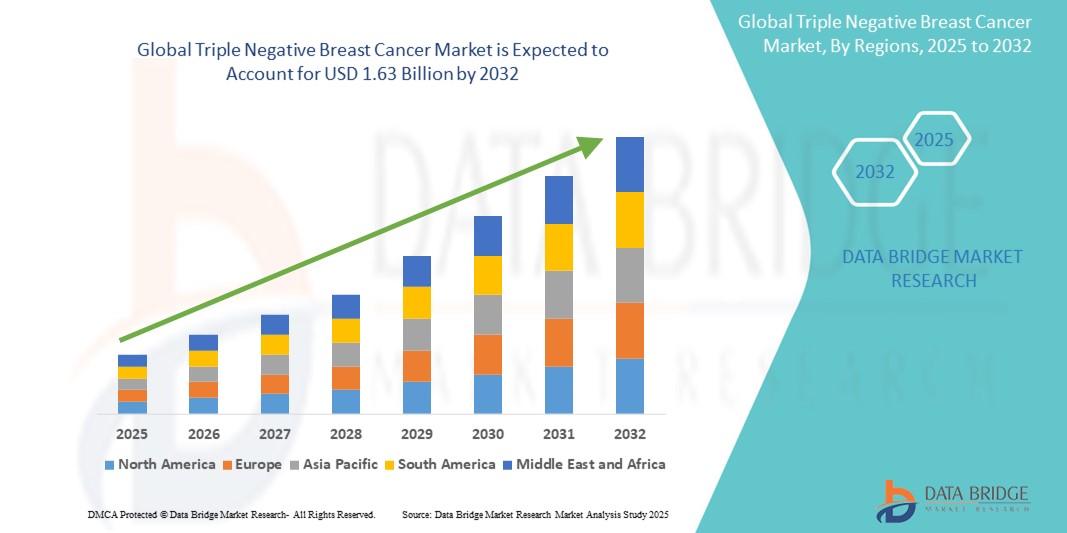
Triple Negative Breast Cancer Market Size
- The global triple negative breast cancer market was valued at USD 1.06 billion in 2024 and is expected to reach USD 1.63 billion by 2032
- During the forecast period of 2025 to 2032 the market is likely to grow at a CAGR of 5.50%, primarily driven by the rising incidence rates, increasing R&D investments, and growing adoption of targeted therapies.
- This growth is driven by factors such as the rising prevalence of triple negative breast cancer, advancements in diagnostic technologies, and increasing availability of innovative treatment options.
Triple Negative Breast Cancer Market Analysis
- Triple negative breast cancer (TNBC) is a highly aggressive subtype of breast cancer that lacks estrogen, progesterone, and HER2 receptors, making it challenging to treat with traditional hormone or targeted therapies. It often requires a combination of chemotherapy, immunotherapy, and experimental treatments
- The market for TNBC treatments is significantly driven by increasing disease prevalence, growing awareness, and ongoing advancements in oncology research. The urgent need for more effective treatment options continues to propel investments in clinical trials and drug development
- North America remains a leading region in the TNBC market, supported by strong healthcare infrastructure, higher diagnosis rates, and robust R&D pipelines from major pharmaceutical companies
- For instance, the U.S. has seen a consistent rise in TNBC-focused clinical trials, with key players developing novel immunotherapies and antibody-drug conjugates. The region also benefits from supportive regulatory pathways and fast-track drug approvals
- Globally, treatments for triple negative breast cancer are considered among the top priorities in breast cancer research, given the subtype’s aggressive nature and limited treatment options, making innovation in this segment crucial for improving patient outcomes
Report Scope and Triple Negative Breast Cancer Market Segmentation
|
Attributes |
Triple Negative Breast Cancer Key Market Insights |
|
Segments Covered |
|
|
Countries Covered |
North America
Europe
Asia-Pacific
Middle East and Africa
South America
|
|
Key Market Players |
|
|
Market Opportunities |
|
|
Value Added Data Infosets |
In addition to the insights on market scenarios such as market value, growth rate, segmentation, geographical coverage, and major players, the market reports curated by the Data Bridge Market Research also include import export analysis, production capacity overview, production consumption analysis, price trend analysis, climate change scenario, supply chain analysis, value chain analysis, raw material/consumables overview, vendor selection criteria, PESTLE Analysis, Porter Analysis, and regulatory framework. |
Triple Negative Breast Cancer Market Trends
“Rising Focus on Immunotherapy and Targeted Drug Development”
- One prominent trend in the global triple negative breast cancer (TNBC) market is the increasing focus on immunotherapy and the development of targeted drug therapies
- Unlike other breast cancer types, TNBC does not respond to hormonal or HER2-targeted treatments, which has led to a surge in research aimed at novel approaches such as immune checkpoint inhibitors and antibody-drug conjugates
- For instance, immune checkpoint inhibitors such as PD-1/PD-L1 blockers have shown promising results in improving progression-free survival in TNBC patients, especially when combined with chemotherapy
- Targeted therapies are also being tailored to genetic mutations such as BRCA1/2, opening up new treatment avenues for a subset of TNBC patients through PARP inhibitors and similar agent
- This trend is transforming the treatment landscape for TNBC, offering hope for more effective and personalized treatment options, and significantly driving innovation and growth in the global market
Triple Negative Breast Cancer Market Dynamics
Driver
“Increasing Prevalence and Unmet Medical Needs in Aggressive Breast Cancer Subtype”
- The increasing prevalence of triple negative breast cancer (TNBC), a highly aggressive and difficult-to-treat subtype, is a significant driver of the global TNBC market. TNBC accounts for approximately 10–15% of all breast cancers and is more common in younger women and certain ethnic populations
- Unlike other forms of breast cancer, TNBC lacks the expression of estrogen, progesterone, and HER2 receptors, limiting the effectiveness of standard hormone or HER2-targeted therapies. This creates a substantial unmet need for more effective treatment options
- The aggressive nature of TNBC often leads to higher recurrence rates and shorter overall survival, prompting increased efforts in research, early diagnosis, and development of novel therapies such as immunotherapy, PARP inhibitors, and antibody-drug conjugates
- The Ongoing advancements in genomic profiling and biomarker identification are enabling more precise and personalized treatment approaches, further accelerating market growth
- As awareness increases and diagnostic tools improve, more cases of TNBC are being identified at earlier stages, resulting in a rising number of patients requiring specialized care and innovative treatment solutions
For instance,
- In October 2022, the American Cancer Society reported that TNBC has a higher incidence in African American women and tends to be diagnosed at more advanced stages, leading to poorer prognosis—emphasizing the urgent need for tailored therapies and interventions
- In February 2023, a report by the National Cancer Institute highlighted that the rate of clinical trials targeting TNBC has significantly increased, focusing on immunotherapies and combination regimens to improve patient survival and quality of life
- Consequently, the growing prevalence of TNBC, combined with its aggressive nature and limited treatment options, continues to drive global demand for innovative and effective therapeutic approaches in the TNBC market
Opportunity
“Harnessing Precision Medicine and AI for Targeted TNBC Therapies”
- The integration of artificial intelligence (AI) and precision medicine presents a major opportunity in the treatment of triple negative breast cancer (TNBC), enabling the development of personalized therapies and improving clinical decision-making
- AI-powered platforms can analyze large datasets, including genomic profiles, tumor biomarkers, and patient histories, to identify optimal treatment pathways and predict patient response to therapies. This capability is especially crucial in TNBC, where conventional treatment options are limited
- In addition, precision medicine approaches can tailor therapies based on specific genetic mutations, such as BRCA1/2 or PIK3CA, allowing for more targeted drug development and enhanced treatment efficacy
For instance,
- In March 2024, a study published in Nature Medicine highlighted the role of AI in predicting TNBC recurrence by analyzing histopathological and genomic data, helping oncologists personalize follow-up care and improve survival outcomes
- In July 2023, a report by the National Institutes of Health (NIH) emphasized how AI-assisted drug discovery is accelerating the identification of novel compounds for TNBC, reducing the time and cost involved in bringing new therapies to clinical trials
- The integration of AI and precision medicine not only boosts treatment effectiveness but also facilitates early diagnosis, real-time monitoring, and risk assessment, ultimately improving patient outcomes and creating a significant growth opportunity in the global TNBC market
Restraint/Challenge
“High Cost of Advanced Therapies Limiting Accessibility and Adoption”
- The high cost associated with advanced triple negative breast cancer (TNBC) treatments, such as immunotherapies, targeted therapies, and personalized medicine, poses a significant challenge to market growth, particularly in low- and middle-income countries
- Therapies such as immune checkpoint inhibitors and antibody-drug conjugates often come with substantial price tags, which can strain healthcare budgets and limit patient access, especially where insurance coverage is inadequate or out-of-pocket expenses are high
- This financial burden can lead to delays in treatment, reduced adherence to prescribed regimens, or reliance on less effective standard chemotherapy options
For instance,
- In September 2023, an article published in The Lancet Oncology reported that the annual cost of TNBC immunotherapy regimens can exceed USD 100,000 per patient, making it inaccessible for many patients in resource-limited settings, even when clinical benefits are evident
- In April 2024, the World Health Organization (WHO) emphasized that the affordability of novel cancer drugs remains a major global concern, with TNBC therapies among the most expensive due to their complexity and limited competition
- Consequently, the high cost of TNBC treatments contributes to disparities in care, limits widespread adoption of breakthrough therapies, and poses a barrier to equitable healthcare delivery—ultimately restricting the market’s growth potential in economically constrained regions.
Triple Negative Breast Cancer Market Scope
The market is segmented on the basis of treatment type, route of administration, end users, and distribution channel.
|
Segmentation |
Sub-Segmentation |
|
By Treatment Type |
|
|
By Route of Administration |
|
|
By End User |
|
|
By Distribution Channel
|
|
Triple Negative Breast Cancer Market Regional Analysis
“North America is the Dominant Region in the Triple Negative Breast Cancer Market”
- North America leads the global triple negative breast cancer (TNBC) market, fueled by a strong healthcare infrastructure, high awareness levels, and extensive research and development activities
- U.S. holds the largest market share due to the high incidence of TNBC, growing number of clinical trials, and early adoption of advanced therapies such as immunotherapies and targeted treatment
- The supportive regulatory frameworks, such as the FDA’s fast-track designations and orphan drug status for TNBC treatments, further drive innovation and accelerate the availability of new drugs in the region
- In addition, the presence of major pharmaceutical companies and robust funding from both public and private sectors strengthen the market landscape across North America
“Asia-Pacific is Projected to Register the Highest Growth Rate”
- Asia-Pacific is expected to experience the highest growth rate in the TNBC market, driven by increasing cancer awareness, rising healthcare investments, and improved access to diagnostic and therapeutic facilities
- Countries such as China, India, and Japan are emerging as key markets due to their large patient populations and growing burden of breast cancer, including aggressive subtypes such as TNBC
- Japan is at the forefront in the region, with advanced healthcare infrastructure and a strong focus on precision medicine and early cancer detection, boosting demand for innovative TNBC treatments
- In China and India, expanding cancer screening programs, increasing availability of oncology drugs, and rising government initiatives to improve cancer care accessibility are propelling the market forward
- The growing participation of Asia-Pacific countries in global clinical trials and the presence of regional biotech startups focusing on oncology further contribute to the rapid development of the TNBC market in the region
Triple Negative Breast Cancer Market Share
The market competitive landscape provides details by competitor. Details included are company overview, company financials, revenue generated, market potential, investment in research and development, new market initiatives, global presence, production sites and facilities, production capacities, company strengths and weaknesses, product launch, product width and breadth, application dominance. The above data points provided are only related to the companies' focus related to market.
The Major Market Leaders Operating in the Market Are:
- Johnson & Johnson Services, Inc. (U.S.)
- Cipla (U.S.)
- Abbott (U.S.)
- AbbVie Inc. (U.S.)
- Merck KGaA (Germany)
- Sun Pharmaceutical Industries Ltd. (India)
- Aurobindo Pharma Limited (India)
- Lupin (India)
- Hikma Pharmaceuticals PLC (U.K.)
- Amneal Pharmaceuticals LLC (U.S.)
- Pfizer Inc. (U.S.)
- Mylan N.V. (U.S.)
- Novartis AG (Switzerland)
- Bristol-Myers Squibb Company (U.S.)
- GSK plc. (U.K.)
- Bayer AG (Germany)
- AstraZeneca (U.K.)
- Boehringer Ingelheim International GmbH (Germany)
- Lilly (U.S.)
- Imugene Limited (Australia)
Latest Developments in Global Triple Negative Breast Cancer Market
- In January 2025, the U.S. Food and Drug Administration (FDA) approved Datopotamab Deruxtecan (Datroway), a Trop-2-directed antibody-drug conjugate developed by AstraZeneca and Daiichi Sankyo, for patients with unresectable or metastatic, hormone receptor-positive, HER2-negative breast cancer. This therapy offers a targeted approach, delivering cytotoxic agents directly to cancer cells, thereby minimizing damage to healthy tissues
- In January 2025, Eli Lilly announced a definitive agreement to acquire Scorpion Therapeutics' PI3Kα inhibitor program, including the investigational drug STX-478, for up to $2.5 billion. This strategic acquisition aims to enhance Lilly's oncology pipeline, particularly in addressing challenging cancers such as triple-negative breast cancer (TNBC).
- In February 2024, researchers from the University of Adelaide reported that their novel compound, CDDD11-8, effectively inhibited the growth of TNBC tumors in preclinical models without toxic side effects. This orally administered therapy targets the CDK9 protein, which is involved in cancer cell proliferation, and holds promise for future clinical development
- In September 2024, Merck presented data from the Phase 3 KEYNOTE-522 trial demonstrating that Keytruda (pembrolizumab), when combined with chemotherapy before surgery (neoadjuvant) and continued as a single agent after surgery (adjuvant), reduced the risk of death by 34% compared to neoadjuvant chemotherapy alone in patients with high-risk early-stage triple-negative breast cancer (TNBC).
- In December 2024, Lantern Pharma announced that its investigational drug LP-184 received Fast Track designation from the FDA for the treatment of TNBC. LP-184 is a small molecule drug designed to selectively damage DNA in cancer cells with specific biomarkers or mutations, offering a potential targeted therapy for drug-resistant TNBC

- Interactive Data Analysis Dashboard
- Company Analysis Dashboard for high growth potential opportunities
- Research Analyst Access for customization & queries
- Competitor Analysis with Interactive dashboard
- Latest News, Updates & Trend analysis
- Harness the Power of Benchmark Analysis for Comprehensive Competitor Tracking
Data collection and base year analysis are done using data collection modules with large sample sizes. The stage includes obtaining market information or related data through various sources and strategies. It includes examining and planning all the data acquired from the past in advance. It likewise envelops the examination of information inconsistencies seen across different information sources. The market data is analysed and estimated using market statistical and coherent models. Also, market share analysis and key trend analysis are the major success factors in the market report. To know more, please request an analyst call or drop down your inquiry.
The key research methodology used by DBMR research team is data triangulation which involves data mining, analysis of the impact of data variables on the market and primary (industry expert) validation. Data models include Vendor Positioning Grid, Market Time Line Analysis, Market Overview and Guide, Company Positioning Grid, Patent Analysis, Pricing Analysis, Company Market Share Analysis, Standards of Measurement, Global versus Regional and Vendor Share Analysis. To know more about the research methodology, drop in an inquiry to speak to our industry experts.
Data Bridge Market Research is a leader in advanced formative research. We take pride in servicing our existing and new customers with data and analysis that match and suits their goal. The report can be customized to include price trend analysis of target brands understanding the market for additional countries (ask for the list of countries), clinical trial results data, literature review, refurbished market and product base analysis. Market analysis of target competitors can be analyzed from technology-based analysis to market portfolio strategies. We can add as many competitors that you require data about in the format and data style you are looking for. Our team of analysts can also provide you data in crude raw excel files pivot tables (Fact book) or can assist you in creating presentations from the data sets available in the report.













