


What is the Upcycled Food Products Market Size and Growth Rate?
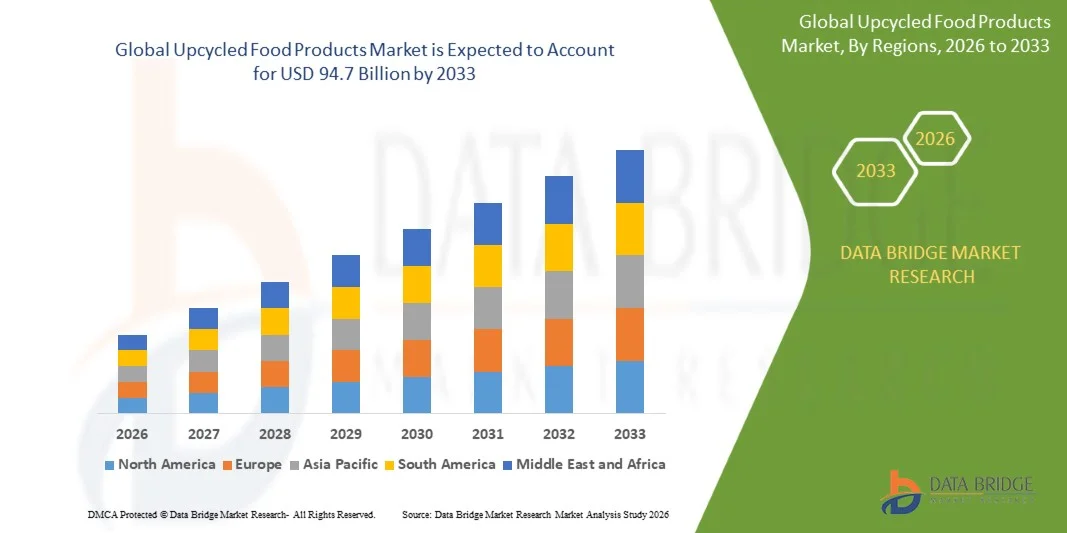
As per Data Bridge Market Research Analysis the upcycled food products market was valued at USD 60.8 billion in 2025 and is projected to reach USD 94.7 billion by 2033, growing at a CAGR of 5.7% from 2026 to 2033. The market is experiencing strong growth as consumers increasingly prioritize sustainable consumption, environmentally responsible food choices, and products that contribute to reducing food waste. Rising awareness of the environmental impact of food loss, coupled with growing demand for clean-label, plant-based, and nutrient-rich food products, has accelerated the adoption of upcycled food products among environmentally conscious consumers. In addition, food manufacturers are continuously expanding their product portfolios by incorporating upcycled ingredients into snacks, bakery products, beverages, condiments, and functional foods to meet evolving consumer preferences while supporting circular economy initiatives.
The rapid expansion of modern retail networks and e-commerce platforms, along with increasing availability of upcycled food products through supermarkets, specialty stores, and online channels, has significantly improved market accessibility. Furthermore, continuous innovation in ingredient recovery technologies, food waste valorization processes, and sustainable product development, combined with growing investments in circular food systems and corporate sustainability initiatives, is expected to support long-term market growth across both developed and emerging economies.
Market Size & Forecast
- Global Market Value (2025): USD 60.8 Billion
- Expected Market Value (2033): USD 94.7 Billion
- Forecast CAGR (2026–2033): 5.7%
- Leading Region in 2025: North America
- Fastest Growing Region: Asia-Pacific
Key Market Trends & Insights
- North America dominated the global upcycled food products market with the largest 56.2% revenue share in 2025 and continues to maintain its leadership, supported by high consumer awareness of food waste reduction, strong demand for sustainable food products, an established ecosystem of certified upcycled brands, and strategic partnerships between retailers and food manufacturers.
- Asia-Pacific is projected to be the fastest-growing regional market, expanding at a CAGR of 6.5% during the forecast period. Rapid urbanization, growing middle-class population, increasing sustainability awareness, supportive government initiatives to reduce food waste, and rising demand for environmentally responsible food products are driving market growth across China, India, Japan, and South Korea.
- Fruit & vegetable waste accounted for the largest source segment, capturing approximately 42.1% of the market in 2026, owing to its abundant availability, high nutritional value, and extensive utilization in bakery products, snacks, confectionery, and functional food ingredients.
- Food processing waste is expected to register the fastest growth over the forecast period, supported by increasing commercialization of spent grains, whey, coffee grounds, fruit pomace, vegetable peels, and other food processing by-products for developing value-added food ingredients and finished consumer products.
- Supermarkets & hypermarkets remained the leading distribution channel, accounting for nearly 49.3% of market revenue in 2026, benefiting from broad product availability, strong retail visibility, competitive pricing, and increasing shelf space dedicated to sustainable and eco-friendly food products.
- Online sales channels are projected to witness the fastest growth as consumers increasingly purchase sustainable food products through e-commerce platforms, while manufacturers continue expanding direct-to-consumer (DTC) strategies, digital marketing initiatives, and subscription-based delivery models.
Report Scope and Upcycled Food Products Market Segmentation
|
Attributes |
Upcycled Food Products Market Key Segments |
|
Segments Covered |
|
|
Countries Covered |
North America
Europe
Asia-Pacific
Middle East and Africa
South America
|
|
Key Market Players |
|
|
Market Opportunities |
|
|
Value Added Data Infosets |
In addition to the insights on market scenarios such as market value, growth rate, segmentation, geographical coverage, and major players, the market reports curated by the Data Bridge Market Research also include in-depth expert analysis, pricing analysis, brand share analysis, consumer survey, demography analysis, supply chain analysis, value chain analysis, raw material/consumables overview, vendor selection criteria, PESTLE Analysis, Porter Analysis, and regulatory framework. |
What is the Key Trend in the Upcycled Food Products Market?
Trend: Rising Adoption of Sustainable and Circular Food Solutions
The upcycled food products market is experiencing significant growth as consumers increasingly prioritize sustainability, environmental responsibility, and food waste reduction in their purchasing decisions. Growing awareness of the environmental impact of food loss has encouraged manufacturers to transform surplus agricultural produce and food processing by-products into nutritious, value-added products such as snacks, bakery items, beverages, and functional ingredients. This trend is further supported by the expansion of the circular economy, where companies are maximizing resource utilization while minimizing waste throughout the food value chain.
Food manufacturers are also investing in advanced ingredient recovery, fermentation, and processing technologies to improve the nutritional value, functionality, and commercial viability of upcycled ingredients. At the same time, retailers are expanding shelf space for certified sustainable products, while e-commerce platforms and direct-to-consumer channels are increasing the accessibility of upcycled foods. Industry collaborations and certification programs, particularly those introduced by the Upcycled Food Association, are strengthening consumer confidence and accelerating the commercialization of upcycled food products across global markets. In June 2024, Foodvalley launched the UPcycled4Food initiative to accelerate the adoption of upcycled food products and ingredients by promoting collaboration among food manufacturers, retailers, and foodservice providers. Additionally, in April 2022, Del Monte Foods expanded its portfolio of Upcycled Certified™ products with the launch of Gut Love and Boost Me Fruit Infusions, reinforcing the company's commitment to reducing food waste through product innovation.
Upcycled Food Products Market Dynamics
Key Market Driver: Increasing Focus on Food Waste Reduction and Circular Economy Initiatives
The growing emphasis on reducing food waste and promoting circular economy practices is the primary driver of the global upcycled food products market. According to the Food and Agriculture Organization (FAO), nearly one-third of all food produced globally is either lost or wasted each year, creating significant environmental, economic, and social challenges. Governments, food manufacturers, retailers, and non-profit organizations are increasingly implementing initiatives to recover edible surplus food and convert food processing by-products into high-value food products. In response, manufacturers are developing innovative products using ingredients such as fruit pomace, spent grains, coffee grounds, and vegetable by-products, enabling resource optimization while meeting consumer demand for sustainable and nutritious food options. The growing adoption of upcycled food certification programs and corporate sustainability commitments is further accelerating market growth. In March 2025, Upcycled Foods, Inc. expanded its ingredient portfolio by launching its first line of upcycled whole raisins for the commercial market, enabling food manufacturers to incorporate sustainable, antioxidant-rich ingredients into bakery, confectionery, and snack applications. Additionally, in March 2025, Upcycled Foods, Inc. collaborated with Misfits Market to introduce Odds & Ends Upcycled Certified breads, incorporating ReGrained SuperGrain+ ingredients to promote circular food production and reduce food waste.
Key Restraint/Challenge: Limited Consumer Awareness and Supply Chain Challenges
Despite increasing market momentum, limited consumer awareness regarding the nutritional benefits and safety of upcycled food products remains a key restraint. Many consumers still associate food by-products with inferior quality, creating adoption barriers, particularly in developing markets. In addition, inconsistent availability of raw materials, seasonal fluctuations in agricultural waste generation, and the need for specialized processing and storage infrastructure increase production complexity and costs. The absence of standardized regulations and labeling requirements across several countries also poses challenges for manufacturers seeking to expand internationally. In March 2025, Misfits Market and Upcycled Foods, Inc. emphasized that bringing their first private-label upcycled breads to market required extensive collaboration across ingredient sourcing, formulation, and commercialization, highlighting the complexity of scaling upcycled food supply chains. Similarly, Kerry Group partnered with Upcycled Foods, Inc. to commercialize an upcycled protein crisp made from spent brewing grains, demonstrating that developing scalable upcycled ingredients requires specialized processing technologies and long-term manufacturing partnerships.
Key Market Opportunity: Expansion of Functional Ingredients and Sustainable Food Innovation
Growing demand for clean-label, plant-based, and functional foods presents significant opportunities for upcycled food manufacturers. Companies are increasingly investing in advanced food processing technologies to recover proteins, dietary fibre, antioxidants, and bioactive compounds from agricultural and food processing by-products. These value-added ingredients are being incorporated into bakery products, snacks, beverages, dairy alternatives, and nutritional supplements, expanding commercial applications. Furthermore, increasing investments by food companies, strategic collaborations, and the expansion of retail and e-commerce channels are expected to create new growth opportunities, particularly across emerging economies where food waste reduction has become a national sustainability priority. In May 2025, Blue Stripes expanded its whole-cacao product portfolio by utilizing the entire cacao fruit—including the pulp and husk—to develop functional snacks and chocolate products, demonstrating the commercial potential of upcycled ingredients in value-added food applications. Additionally, in March 2025, Misfits Market introduced its Odds & Ends Upcycled Certified™ bread line, developed with ReGrained SuperGrain+, highlighting the growing retail adoption of functional upcycled ingredients and sustainable product innovation.
How is the Upcycled Food Products Market Segmented?
The upcycled food products market is segmented on the basis of source, product type, distribution channel, end user.
- By Source
On the basis of source, the market is segmented into fruit & vegetable waste, food processing waste, dairy by-products, bakery & confectionery waste, beverage industry by-products, meat & seafood by-products, and others. The fruit & vegetable waste segment dominated the global upcycled food products market, accounting for 42.1% of the market share in 2026. The segment's leadership is primarily attributed to the abundant availability of surplus fruits, vegetable peels, pomace, pulp, and imperfect produce generated throughout the food supply chain. These by-products are increasingly utilized to manufacture bakery products, snacks, beverages, functional ingredients, and dietary fibre-rich foods, helping manufacturers reduce food waste while improving resource efficiency.
The food processing waste segment is projected to register the fastest CAGR. The segment includes by-products such as spent grains from breweries, coffee grounds, whey, cocoa husks, fruit pomace, vegetable peels, and other processing residues.
- By Product Type
Based on product type, the market is segmented into bakery & confectionery products, snacks, beverages, ingredients & powders, dairy & dairy alternatives, condiments & sauces, and others. The bakery & confectionery segment accounted for the largest market share of 24.8% in 2025. The segment's dominance is attributed to high consumer acceptance, convenience, impulse purchasing behaviour, and the growing availability of sustainable snack options made from upcycled fruits, vegetables, spent grains, and other food by-products. Manufacturers continue to introduce innovative snack bars, chips, chocolates, dried fruit snacks, and confectionery products that combine sustainability with clean-label and functional ingredients, further strengthening market demand.
The snacks segment is projected to register one of the fastest growth rates, expanding at a CAGR of 5.5% . Growth is driven by the increasing incorporation of upcycled flours, fruit pomace, brewer's spent grains, and fibre-rich ingredients into bread, cookies, breakfast cereals, crackers, and other baked products. Rising consumer preference for nutritious, sustainable, and high-fiber bakery products is encouraging manufacturers to expand their upcycled product portfolios.
- By Distribution Channel
Based on distribution channel, the upcycled food products market is segmented into supermarkets & hypermarkets, convenience stores, specialty stores, online retail, foodservice, and others. The supermarkets & hypermarkets segment accounted for the largest market share of approximately 49.3% in 2026. The segment's dominance is attributed to the wide availability of upcycled food products, strong consumer trust, competitive pricing, and expanding shelf space for sustainable and environmentally responsible food products. These retail formats also provide greater product visibility and promotional opportunities, encouraging consumers to purchase certified upcycled food products.
The online retail segment is projected to register the fastest growth during the forecast period. Increasing digitalization, growing consumer preference for convenient shopping, and the expansion of direct-to-consumer (DTC) business models are driving online sales. Digital platforms enable manufacturers to educate consumers about sustainability, promote upcycled food certifications, and offer subscription-based purchasing options, helping both established companies and emerging brands expand their customer base. Meanwhile, specialty stores and foodservice channels continue to witness steady growth as demand for premium, organic, and sustainable food products increases globally.
- By End User
Based on end user, the upcycled food products market is segmented into direct-to-consumer, food service & hospitality, ingredient manufacturers (B2B), institutional & government, pet care industry, and beauty & personal care. The direct-to-consumer segment accounted for the largest market share of approximately 37.9% in 2025 and is projected to expand at a CAGR of 5.1% through 2033.
The direct-to-consumer segment continues to dominate the market as consumers become increasingly aware of food waste reduction, sustainable consumption, and clean-label products. Food manufacturers are strengthening their direct sales channels through company websites, online marketplaces, and subscription services while leveraging sustainability messaging and transparent sourcing practices to build brand loyalty. The growing availability of certified upcycled food products across retail and digital platforms is further supporting segment growth.
The ingredient manufacturers (B2B) segment is expected to register the fastest CAGR of approximately 6.3%. Growth is driven by increasing adoption of upcycled ingredients such as dietary fibers, plant proteins, fruit pomace, spent grains, and natural extracts by food and beverage manufacturers seeking cost-effective, functional, and sustainable raw materials. Long-term supply agreements, advances in ingredient recovery technologies, and increasing incorporation of upcycled ingredients into mainstream food production are expected to further accelerate segment expansion.
Which Region Holds the Largest Share of the Upcycled Food Products Market?
The North America upcycled food products market was valued at USD 23.27 billion in 2025, accounting for 56.2% of the global market, and is projected to reach USD 24.88 billion in 2026. The region dominates the market due to its advanced food innovation ecosystem, strong sustainability initiatives, and well-established food processing industry. Increasing consumer awareness regarding food waste reduction and willingness to pay premium prices for sustainable products continue to drive demand. The presence of leading upcycled food manufacturers, supportive certification programs, and investments in circular economy practices further strengthen market growth.
U.S. Upcycled Food Products Market Insight
The U.S. upcycled food products market is projected to reach USD 21.54 billion in 2026, maintaining its position as the largest contributor to the North American market. Market growth is driven by increasing consumer awareness of food waste reduction, strong demand for sustainable and clean-label food products, and widespread adoption of circular economy practices across the food industry. The country benefits from the presence of leading upcycled food manufacturers, advanced food processing technologies, and strong retail partnerships with major chains such as Kroger and Walmart, which continue to expand the availability of certified upcycled products. Rising investments in product innovation, favourable sustainability initiatives, and growing consumer willingness to pay premium prices for environmentally responsible food products are expected to support the continued expansion of the U.S. market.
Europe Upcycled Food Products Market Insight
The Europe upcycled food products market was valued at USD 9.40 billion in 2025, accounting for 22.55% of the global market, and is projected to reach USD 10.02 billion in 2026. The region remains one of the key markets for upcycled food products, driven by stringent food waste reduction regulations, circular economy initiatives, and growing consumer preference for sustainable and ethically sourced food products.
Rising demand for organic and fair-trade certified foods, coupled with increasing adoption of healthy snacking habits, continues to support market growth. Furthermore, the expansion of food startups, increasing investments in sustainable food innovation, and supportive government policies are accelerating the commercialization of upcycled food products across the region.
U.K Upcycled Food Products Market Insight
The U.K. upcycled food products market is projected to reach USD 2.21 billion by 2026, supported by increasing consumer awareness of food waste reduction and growing demand for sustainable, ethically sourced food products. Rising adoption of circular economy practices, favourable government initiatives to minimize food waste, and strong demand for organic and clean-label products are driving market growth. The country is also witnessing increased participation from food startups and established manufacturers developing innovative upcycled snacks, bakery products, beverages, and functional ingredients.
Asia Pacific Upcycled Food Products Market Insight
The Asia Pacific upcycled food products market was valued at USD 7.48 billion in 2025, accounting for 17.9% of the global market, and is projected to reach USD 8.08 billion in 2026, expanding at a CAGR of 6.5%. The region is the fastest-growing market, driven by rapid urbanization, increasing awareness of food waste and climate change, and supportive government initiatives promoting food security and circular economy practices. Rising demand for plant-based and functional food products, particularly in China, India, Japan, and South Korea, along with retail modernization and a growing middle-class population, is accelerating the adoption of upcycled food products. Furthermore, advancements in upcycling technologies and the expansion of regional and international upcycled food brands are expected to support sustained market growth.
China Upcycled Food Products Market Insight
The China upcycled food products market is projected to reach USD 4.67 billion by 2026, making it the largest market within the Asia Pacific region. Market growth is driven by increasing government focus on food waste reduction, rising investments in sustainable food production, and growing consumer demand for environmentally responsible and functional food products. Rapid expansion of the food processing industry, continuous advancements in upcycling technologies, and increasing adoption of circular economy initiatives are encouraging manufacturers to commercialize value-added products derived from food by-products. In addition, expanding retail infrastructure, rising health consciousness, and increasing demand for clean-label products are expected to further strengthen China's position in the regional upcycled food products market.
Upcycled Food Products Market Share
The upcycled food products market is primarily led by well-established companies, including:
- Upcycled Foods, Inc. (U.S.)
- Matriark Foods, Inc. (U.S.)
- Renewal Mill, Inc. (U.S.)
- Oisix Inc. (Japan)
- The Upcycled Grain Project Limited (New Zealand)
- Rubies in the Rubble Ltd. (U.K.)
- Barnana (U.S.)
- RIND Snacks(U.S.)
- Blue Stripes (U.S.)
- Evergrain, LLC. (U.S.)
- Outcast Foods USA (Canada)
- The Spare Food Co. (South Korea)
- Toast. (U.K.)
- NetZero.(France)
- Kern Tec GmbH (Austria)
- Renewal Processing Ltd. (Canada)
- Circular Food Solutions (Netherlands)
What are Latest Developments in Upcycled Food Products Market?
- In April 2022, Del Monte Foods, Inc. announced that two of its products, Del Monte Gut Love and Boost Me Fruit Infusions, to be Upcycled Certified by the Upcycled Food Association.
- In June 2024, Foodvalley, one of the leading agro-food centers in Europe, launched the UPCycled4Food initiative to make upcycled food products and ingredients the 'new normal.'
- In March 2025, Upcycled Foods, Inc. (UP, Inc.) and Misfits Market launched the retailer's first upcycled bread types for its Odds & Ends private label. The company launched two Upcycled Certified breads featuring ReGrained SuperGrain+ and a mixture of sourdough from bakery ingredient leader Puratos.
- In March 2025, Upcycled Foods, Inc. (UP, Inc.) announced the introduction of upcycled whole raisins from wine-grape varieties of California vineyards. The new product is a functional ingredient that improves texture and enhances flavor.

- Interactive Data Analysis Dashboard
- Company Analysis Dashboard for high growth potential opportunities
- Research Analyst Access for customization & queries
- Competitor Analysis with Interactive dashboard
- Latest News, Updates & Trend analysis
- Harness the Power of Benchmark Analysis for Comprehensive Competitor Tracking
Global Upcycled Food Products Market, Supply Chain Analysis and Ecosystem Framework
To support market growth and help clients navigate the impact of geopolitical shifts, DBMR has integrated in-depth supply chain analysis into its Global Upcycled Food Products Market research reports. This addition empowers clients to respond effectively to global changes affecting their industries. The supply chain analysis section includes detailed insights such as Global Upcycled Food Products Market consumption and production by country, price trend analysis, the impact of tariffs and geopolitical developments, and import and export trends by country and HSN code. It also highlights major suppliers with data on production capacity and company profiles, as well as key importers and exporters. In addition to research, DBMR offers specialized supply chain consulting services backed by over a decade of experience, providing solutions like supplier discovery, supplier risk assessment, price trend analysis, impact evaluation of inflation and trade route changes, and comprehensive market trend analysis.
Data collection and base year analysis are done using data collection modules with large sample sizes. The stage includes obtaining market information or related data through various sources and strategies. It includes examining and planning all the data acquired from the past in advance. It likewise envelops the examination of information inconsistencies seen across different information sources. The market data is analysed and estimated using market statistical and coherent models. Also, market share analysis and key trend analysis are the major success factors in the market report. To know more, please request an analyst call or drop down your inquiry.
The key research methodology used by DBMR research team is data triangulation which involves data mining, analysis of the impact of data variables on the market and primary (industry expert) validation. Data models include Vendor Positioning Grid, Market Time Line Analysis, Market Overview and Guide, Company Positioning Grid, Patent Analysis, Pricing Analysis, Company Market Share Analysis, Standards of Measurement, Global versus Regional and Vendor Share Analysis. To know more about the research methodology, drop in an inquiry to speak to our industry experts.
Data Bridge Market Research is a leader in advanced formative research. We take pride in servicing our existing and new customers with data and analysis that match and suits their goal. The report can be customized to include price trend analysis of target brands understanding the market for additional countries (ask for the list of countries), clinical trial results data, literature review, refurbished market and product base analysis. Market analysis of target competitors can be analyzed from technology-based analysis to market portfolio strategies. We can add as many competitors that you require data about in the format and data style you are looking for. Our team of analysts can also provide you data in crude raw excel files pivot tables (Fact book) or can assist you in creating presentations from the data sets available in the report.













