


Market Analysis and Insights of Vermouth Market
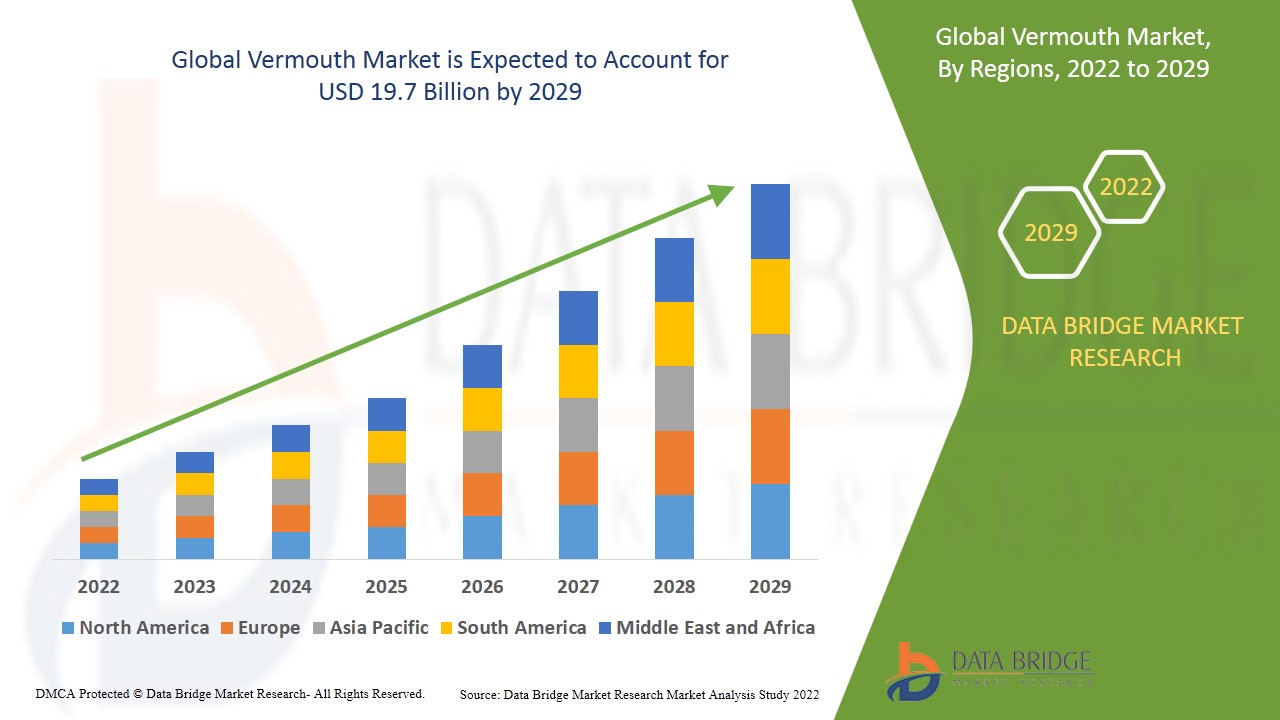
The vermouth market is expected to gain market growth in the forecast period of 2022 to 2029. Data Bridge Market Research analyses that the vermouth market will rise up to USD 19.7 billion 2029 and is projected to exhibit a CAGR of 5.8% for the forecast period of 2022-2029.
Vermouth is basically a dry or sweet aperitif wine that comprises less alcohol content as compared to traditional drinks and it is aromatized with herbs and sometimes used in blended drinks. It is generally a fortified wine which is flavored with a range of botanicals (flowers, seeds, spices, roots, barks and herbs) and often colorful. They are widely used in various end use industries such as horeca, beverage industry and food industry.
The factors such as growing disposable income and increasing popularity for premium products are the major factors fostering the growth of the vermouth market. Additionally, the burgeoning demand for new flavors of fortified wines are other important factors acting as vermouth market growth determinants. Moreover, the most well-established players in this space are focusing on launching new premium products which are estimated to accelerate the overall growth of the market. However, the availability of substitutes is supposed to hamper the market’s growth.
The constant developments in flavours by various well-established manufacturers along with the product premiumization will further generate various profitable opportunities for the vermouth market. However, the high taxes might also pose as a major challenge for the market growth rate.
This vermouth market report provides details of new recent developments, trade regulations, import export analysis, production analysis, value chain optimization, market share, impact of domestic and localized market players, analyses opportunities in terms of emerging revenue pockets, changes in market regulations, strategic market growth analysis, market size, category market growths, application niches and dominance, product approvals, product launches, geographic expansions, technological innovations in the market. To gain more info on vermouth market contact Data Bridge Market Research for an Analyst Brief, our team will help you take an informed market decision to achieve market growth.
Global Vermouth Market Scope and Market Size
The vermouth market is segmented on the basis of product, distribution channel, packaging and end- users. The growth among segments helps you analyze niche pockets of growth and strategies to approach the market and determine your core application areas and the difference in your target markets.
- On the basis of product, the vermouth market is segmented into sweet and blanc and dry.
- Based on distribution channel, the vermouth market is segmented into on-trade and off-trade.
- On the basis of end- users, the vermouth market is segmented into horeca, beverage industry and food industry.
Vermouth Market Country Level Analysis
The vermouth market is segmented on the basis of product, distribution channel, packaging and end- users.
The countries covered in the vermouth market report are U.S., Canada, Mexico in North America, Germany, Sweden, Poland, Denmark, Italy, U.K., France, Spain, Netherlands, Belgium, Switzerland, Turkey, Russia, Rest of Europe in Europe, Japan, China, India, South Korea, New Zealand, Vietnam, Australia, Singapore, Malaysia, Thailand, Indonesia, Philippines, Rest of Asia-Pacific (APAC) in Asia-Pacific (APAC), Brazil, Argentina, Rest of South America as a part of South America, UAE, Saudi Arabia, Oman, Qatar, Kuwait, South Africa, Rest of Middle East and Africa(MEA) as a part of Middle East and Africa(MEA).
Asia-Pacific region dominates the vermouth market and will continue to flourish its trend of dominance during the forecast period owing to the lifestyle changes of the consumers, social media impact, and rising trend of entertainments in lounges and clubs accelerating alcoholic drink sales within the region. North America, on the other hand is expected to show lucrative growth due to the increased popularity of premium products coupled with rising consumption of new flavors of fortified wines in the region.
The country section of the vermouth market report also provides individual market impacting factors and changes in regulation in the market domestically that impacts the current and future trends of the market. Data points such as consumption volumes, production sites and volumes, import export analysis, price trend analysis, cost of raw materials, down-stream and upstream value chain analysis are some of the major pointers used to forecast the market scenario for individual countries. Also, presence and availability of global brands and their challenges faced due to large or scarce competition from local and domestic brands, impact of domestic tariffs and trade routes are considered while providing forecast analysis of the country data.
Competitive Landscape and Vermouth Market Share Analysis
The vermouth market competitive landscape provides details by competitor. Details included are company overview, company financials, revenue generated, market potential, investment in research and development, new market initiatives, global presence, production sites and facilities, production capacities, company strengths and weaknesses, product launch, product width and breadth, application dominance. The above data points provided are only related to the companies’ focus related to vermouth market.
Some of the major players operating in the vermouth market report are Bacardi, Regal Rogue, quandaryvineyards, Davide Campari-Milano N.V., Hotaling & Co., brancadistillerie, Martinez Lacuesta, AtsbyVermouth, Belsazar, Cinzano, Contratto, Gancia, ImbueNatural, Martini, laquintinyevermouthroyal, Lo-Fi Aperitifs, Lustau, Maidenii, Mancino Vermouth, Noilly Prat, THE RANSOM COMPANY, Riserva Carlo Alberto, Distillerie Des Alpes, Sutton Cellars and Uncouth Vermouth among others.

- Interactive Data Analysis Dashboard
- Company Analysis Dashboard for high growth potential opportunities
- Research Analyst Access for customization & queries
- Competitor Analysis with Interactive dashboard
- Latest News, Updates & Trend analysis
- Harness the Power of Benchmark Analysis for Comprehensive Competitor Tracking
Table of Content
1 INTRODUCTION
1.1 OBJECTIVES OF THE STUDY
1.2 MARKET DEFINITION
1.3 OVERVIEW OF GLOBAL VERMOUTH MARKET
1.4 CURRENCY AND PRICING
1.5 LIMITATION
1.6 MARKETS COVERED
2 MARKET SEGMENTATION
2.1 KEY TAKEAWAYS
2.2 ARRIVING AT THE GLOBAL VERMOUTH MARKET SIZE
2.2.1 VENDOR POSITIONING GRID
2.2.2 TECHNOLOGY LIFE LINE CURVE
2.2.3 MARKET GUIDE
2.2.4 COMPANY POSITIONING GRID
2.2.5 COMAPANY MARKET SHARE ANALYSIS
2.2.6 MULTIVARIATE MODELLING
2.2.7 DEMAND AND SUPPLY-SIDE VARIABLES
2.2.8 TOP TO BOTTOM ANALYSIS
2.2.9 STANDARDS OF MEASUREMENT
2.2.10 VENDOR SHARE ANALYSIS
2.2.11 DATA POINTS FROM KEY PRIMARY INTERVIEWS
2.2.12 DATA POINTS FROM KEY SECONDARY DATABASES
2.3 GLOBAL VERMOUTH MARKET: RESEARCH SNAPSHOT
2.4 ASSUMPTIONS
3 MARKET OVERVIEW
3.1 DRIVERS
3.2 RESTRAINTS
3.3 OPPORTUNITIES
3.4 CHALLENGES
4 EXECUTIVE SUMMARY
5 PREMIUM INSIGHTS
5.1 IMPORT-EXPORT ANALYSIS
5.2 INDUTRY TRENDS AND FUTURE PERSPECTIVE
5.3 REGULATORY FRAMEWORK AND GUIDELINES
5.3.1 ADVERTISING & PROMOTIONS
5.4 TAXATION AND DUTY LEVIES
5.5 COMPARATIVE ANALYSIS OF TYPES OF WINE
5.6 DEMOGRAPHIC PREFERENCES
5.7 PRICING ANALYSIS
5.8 BRAND COMPETITIVE ANALYSIS
6 IMPACT OF ECONOMIC SLOW DOWN ON MARKET
6.1 IMPACT ON PRICE
6.2 IMPACT ON SUPPLY CHAIN
6.3 IMPACT ON SHIPMENT
6.4 IMPACT ON COMPANY’S STRATEGIC DECISIONS
7 REGULATORY FRAMEWORK AND GUIDELINES
8 PRICING INDEX (PRICE AT B2B END & PRICES AT FOB)
9 PRODUCTION CAPACITY OF KEY MANUFACTURERES
10 BRAND OUTLOOK
10.1 COMPARATIVE BRAND ANALYSIS
10.2 PRODUCT VS BRAND OVERVIEW
11 GLOBAL VERMOUTH MARKET, BY TYPE OF VERMOUTH
11.1 OVERVIEW
11.2 BLANC VERMOUTH
11.3 DRY VERMOUTH
11.4 SWEET VERMOUTH
11.5 ROSE VERMOUTH
12 GLOBAL VERMOUTH MARKET, BY PRODUCT TYPE
12.1 OVERVIEW
12.2 ALCOHOLIC VERMOUTH
12.3 NON-ALCOHOLIC VERMOUTH
12.3.1 NON-ALCOHOLIC WINE, BY ALCOHOL BY VOLUME (ABV) %
12.3.1.1. LESS THAN 0.05% ABV
12.3.1.2. 0.05% ABV
12.3.1.3. 0.5% ABV
12.3.1.4. MORE THAN 0.5% ABV
13 GLOBAL VERMOUTH MARKET, BY FLAVOR
13.1 OVERVIEW
13.2 ORIGINAL
13.3 FLAVORED
13.3.1 FRUITS
13.3.1.1. GREEN APPLE
13.3.1.2. FIG
13.3.1.3. LEMON
13.3.1.4. CHERRY
13.3.1.5. PEACH
13.3.1.6. ORANGE
13.3.1.7. MELON
13.3.1.8. PINEAPPLE
13.3.1.9. MANGO
13.3.1.10. POMEGRANATE
13.3.1.11. OTHERS
13.3.2 BERRY
13.3.2.1. RASBERRY
13.3.2.2. STRAWBERRY
13.3.2.3. BLUEBERRY
13.3.2.4. CRANBERRES
13.3.2.5. CRANBERRIES
13.3.2.6. OTHERS
13.3.3 SPICES
13.3.3.1. CINNAMON
13.3.3.2. GINGER
13.3.3.3. PEPPER
13.3.3.4. CLOVES
13.3.3.5. NUTMEGS
13.3.3.6. OTHERS
13.3.4 FLORAL
13.3.4.1. HIBISCUS
13.3.4.2. ROSE
13.3.4.3. OTHERS
13.3.5 HERBAL
13.3.5.1. TRUFFLE
13.3.5.2. SMOKED TOBACCO
13.3.5.3. OTHERS
13.3.6 HONEY
13.3.7 MAPLE
13.3.8 CARAMEL
13.3.9 CHOCOLATES
13.3.10 VANILLA
14 GLOBAL VERMOUTH MARKET, BY AGEING
14.1 OVERVIEW
14.2 AGED VERMOUTH
14.2.1 AGED VERMOUTH, BY AGEING YEARS
14.2.1.1. 18-24 YEARS
14.2.1.2. 25-44 YEARS
14.2.1.3. 45-64 YEARS
14.2.1.4. 65+ YEARS
14.3 UNAGED VERMOUTH
15 GLOBAL VERMOUTH MARKET, BY AGEING BARREL TYPE
15.1 OVERVIEW
15.2 OAK
15.3 MAPLE
15.4 CEDAR
15.5 HICKORY
15.6 OTHERS
16 GLOBAL VERMOUTH MARKET, BY PRODUCT CATEGORY
16.1 OVERVIEW
16.2 REGULAR VERMOUTH
16.3 PREMIUM VERMOUTH
17 GLOBAL VERMOUTH MARKET, BY NATURE
17.1 OVERVIEW
17.2 CONVENIONAL
17.3 ORGANIC
18 GLOBAL VERMOUTH MARKET, BY DISTRIBUTION CHANNEL
18.1 OVERVIEW
18.2 STORE BASED RETAILERS
18.2.1 CONVENIENCE STORES
18.2.2 LIQUOR STORES
18.2.3 SUPERMARKETS/HYPERMARKETS
18.2.4 SPECIALTY STORES
18.2.5 GROCERY STORES
18.2.6 WHOLESALERS
18.2.7 OTHERS
18.3 ONLINE RETAILERS
19 GLOBAL VERMOUTH MARKET, COMPANY LANDSCAPE
19.1 COMPANY SHARE ANALYSIS: GLOBAL
19.2 COMPANY SHARE ANALYSIS: NORTH AMERICA
19.3 COMPANY SHARE ANALYSIS: EUROPE
19.4 COMPANY SHARE ANALYSIS: ASIA-PACIFIC
19.5 MERGERS & ACQUISITIONS
19.6 NEW PRODUCT DEVELOPMENT & APPROVALS
19.7 EXPANSIONS & PARTNERSHIP
19.8 REGULATORY CHANGES
20 GLOBAL VERMOUTH MARKET, BY GEOGRAPHY
20.1 OVERVIEW (ALL SEGMENTATION PROVIDED ABOVE IS REPRESNTED IN THIS CHAPTER BY COUNTRY)
20.2 NORTH AMERICA
20.2.1 U.S.
20.2.2 CANADA
20.2.3 MEXICO
20.3 EUROPE
20.3.1 GERMANY
20.3.2 U.K.
20.3.3 ITALY
20.3.4 FRANCE
20.3.5 SPAIN
20.3.6 SWITZERLAND
20.3.7 NETHERLANDS
20.3.8 BELGIUM
20.3.9 RUSSIA
20.3.10 DENMARK
20.3.11 SWEDEN
20.3.12 POLAND
20.3.13 TURKEY
20.3.14 REST OF EUROPE
20.4 ASIA-PACIFIC
20.4.1 JAPAN
20.4.2 CHINA
20.4.3 SOUTH KOREA
20.4.4 INDIA
20.4.5 AUSTRALIA
20.4.6 SINGAPORE
20.4.7 THAILAND
20.4.8 INDONESIA
20.4.9 MALAYSIA
20.4.10 PHILIPPINES
20.4.11 NEW ZEALAND
20.4.12 VIETNAM
20.4.13 REST OF ASIA-PACIFIC
20.5 SOUTH AMERICA
20.5.1 BRAZIL
20.5.2 ARGENTINA
20.5.3 REST OF SOUTH AMERICA
20.6 MIDDLE EAST AND AFRICA
20.6.1 SOUTH AFRICA
20.6.2 ETHIOPIA
20.6.3 UAE
20.6.4 REST OF MIDDLE EAST AND AFRICA
21 GLOBAL VERMOUTH MARKET, SWOT & DBMR ANALYSIS
22 GLOBAL VERMOUTH MARKET, COMPANY PROFILE
22.1 EANDJ GALLO WINERY
22.1.1 COMPANY OVERVIEW
22.1.2 REVENUE ANALYSIS
22.1.3 GEOGRAPHICAL PRESENCE
22.1.4 PRODUCT PORTFOLIO
22.1.5 RECENT DEVELOPMENTS
22.2 CONSTELLATION BRANDS
22.2.1 COMPANY OVERVIEW
22.2.2 REVENUE ANALYSIS
22.2.3 GEOGRAPHICAL PRESENCE
22.2.4 PRODUCT PORTFOLIO
22.2.5 RECENT DEVELOPMENTS
22.3 CASTEL FRERES
22.3.1 COMPANY OVERVIEW
22.3.2 REVENUE ANALYSIS
22.3.3 GEOGRAPHICAL PRESENCE
22.3.4 PRODUCT PORTFOLIO
22.3.5 RECENT DEVELOPMENTS
22.4 THE WINE GROUP
22.4.1 COMPANY OVERVIEW
22.4.2 REVENUE ANALYSIS
22.4.3 GEOGRAPHICAL PRESENCE
22.4.4 PRODUCT PORTFOLIO
22.4.5 RECENT DEVELOPMENTS
22.4.6 RECENT DEVELOPMENTS
22.5 ACCOLADE WINES
22.5.1 COMPANY OVERVIEW
22.5.2 REVENUE ANALYSIS
22.5.3 GEOGRAPHICAL PRESENCE
22.5.4 PRODUCT PORTFOLIO
22.5.5 RECENT DEVELOPMENTS
22.6 CONCHA Y TORO
22.6.1 COMPANY OVERVIEW
22.6.2 REVENUE ANALYSIS
22.6.3 GEOGRAPHICAL PRESENCE
22.6.4 PRODUCT PORTFOLIO
22.6.5 RECENT DEVELOPMENTS
22.7 TREASURY WINE ESTATES
22.7.1 COMPANY OVERVIEW
22.7.2 REVENUE ANALYSIS
22.7.3 GEOGRAPHICAL PRESENCE
22.7.4 PRODUCT PORTFOLIO
22.7.5 RECENT DEVELOPMENTS
22.8 BRANCOTT ESTATE
22.8.1 COMPANY OVERVIEW
22.8.2 REVENUE ANALYSIS
22.8.3 GEOGRAPHICAL PRESENCE
22.8.4 PRODUCT PORTFOLIO
22.8.5 RECENT DEVELOPMENTS
22.9 PERNOD-RICARD
22.9.1 COMPANY OVERVIEW
22.9.2 REVENUE ANALYSIS
22.9.3 GEOGRAPHICAL PRESENCE
22.9.4 PRODUCT PORTFOLIO
22.9.5 RECENT DEVELOPMENTS
22.1 CASELLA WINES
22.10.1 COMPANY OVERVIEW
22.10.2 REVENUE ANALYSIS
22.10.3 GEOGRAPHICAL PRESENCE
22.10.4 PRODUCT PORTFOLIO
22.10.5 RECENT DEVELOPMENTS
22.11 CHEVAL BLANC
22.11.1 COMPANY OVERVIEW
22.11.2 REVENUE ANALYSIS
22.11.3 GEOGRAPHICAL PRESENCE
22.11.4 PRODUCT PORTFOLIO
22.11.5 RECENT DEVELOPMENTS
22.12 TORRES
22.12.1 COMPANY OVERVIEW
22.12.2 REVENUE ANALYSIS
22.12.3 GEOGRAPHICAL PRESENCE
22.12.4 PRODUCT PORTFOLIO
22.12.5 RECENT DEVELOPMENTS
22.13 WOLF BLASS
22.13.1 COMPANY OVERVIEW
22.13.2 REVENUE ANALYSIS
22.13.3 GEOGRAPHICAL PRESENCE
22.13.4 PRODUCT PORTFOLIO
22.13.5 RECENT DEVELOPMENTS
22.14 FETZER
22.14.1 COMPANY OVERVIEW
22.14.2 REVENUE ANALYSIS
22.14.3 GEOGRAPHICAL PRESENCE
22.14.4 PRODUCT PORTFOLIO
22.14.5 RECENT DEVELOPMENTS
22.15 GRUPO PEÑAFLOR
22.15.1 COMPANY OVERVIEW
22.15.2 REVENUE ANALYSIS
22.15.3 GEOGRAPHICAL PRESENCE
22.15.4 PRODUCT PORTFOLIO
22.15.5 RECENT DEVELOPMENTS
22.16 BLOSSOM HILLS
22.16.1 COMPANY OVERVIEW
22.16.2 REVENUE ANALYSIS
22.16.3 GEOGRAPHICAL PRESENCE
22.16.4 PRODUCT PORTFOLIO
22.16.5 RECENT DEVELOPMENTS
22.17 VINS GRANDS CRUS
22.17.1 COMPANY OVERVIEW
22.17.2 REVENUE ANALYSIS
22.17.3 GEOGRAPHICAL PRESENCE
22.17.4 PRODUCT PORTFOLIO
22.17.5 RECENT DEVELOPMENTS
22.18 CHAPEL HOUSE VINEYARD
22.18.1 COMPANY OVERVIEW
22.18.2 REVENUE ANALYSIS
22.18.3 GEOGRAPHICAL PRESENCE
22.18.4 PRODUCT PORTFOLIO
22.18.5 RECENT DEVELOPMENTS
22.19 SULA WINEYARDS
22.19.1 COMPANY OVERVIEW
22.19.2 REVENUE ANALYSIS
22.19.3 GEOGRAPHICAL PRESENCE
22.19.4 PRODUCT PORTFOLIO
22.19.5 RECENT DEVELOPMENTS
22.2 VINA CONCHA Y TORO
22.20.1 COMPANY OVERVIEW
22.20.2 REVENUE ANALYSIS
22.20.3 GEOGRAPHICAL PRESENCE
22.20.4 PRODUCT PORTFOLIO
22.20.5 RECENT DEVELOPMENTS
22.21 ROCKFORD
22.21.1 COMPANY OVERVIEW
22.21.2 REVENUE ANALYSIS
22.21.3 GEOGRAPHICAL PRESENCE
22.21.4 PRODUCT PORTFOLIO
22.21.5 RECENT DEVELOPMENTS
22.22 PENFOLDS
22.22.1 COMPANY OVERVIEW
22.22.2 REVENUE ANALYSIS
22.22.3 GEOGRAPHICAL PRESENCE
22.22.4 PRODUCT PORTFOLIO
22.22.5 RECENT DEVELOPMENTS
22.23 MOUNT MARY
22.23.1 COMPANY OVERVIEW
22.23.2 REVENUE ANALYSIS
22.23.3 GEOGRAPHICAL PRESENCE
22.23.4 PRODUCT PORTFOLIO
22.23.5 RECENT DEVELOPMENTS
22.24 MOSS WOOD
22.24.1 COMPANY OVERVIEW
22.24.2 REVENUE ANALYSIS
22.24.3 GEOGRAPHICAL PRESENCE
22.24.4 PRODUCT PORTFOLIO
22.24.5 RECENT DEVELOPMENTS
22.25 LEEUWIN ESTATE
22.25.1 COMPANY OVERVIEW
22.25.2 REVENUE ANALYSIS
22.25.3 GEOGRAPHICAL PRESENCE
22.25.4 PRODUCT PORTFOLIO
22.25.5 RECENT DEVELOPMENTS
22.26 HENSCHKE
22.26.1 COMPANY OVERVIEW
22.26.2 REVENUE ANALYSIS
22.26.3 GEOGRAPHICAL PRESENCE
22.26.4 PRODUCT PORTFOLIO
22.26.5 RECENT DEVELOPMENTS
22.27 GIACONDA
22.27.1 COMPANY OVERVIEW
22.27.2 REVENUE ANALYSIS
22.27.3 GEOGRAPHICAL PRESENCE
22.27.4 PRODUCT PORTFOLIO
22.27.5 RECENT DEVELOPMENTS
22.28 CULLEN
22.28.1 COMPANY OVERVIEW
22.28.2 REVENUE ANALYSIS
22.28.3 GEOGRAPHICAL PRESENCE
22.28.4 PRODUCT PORTFOLIO
22.28.5 RECENT DEVELOPMENTS
22.29 BASS PHILLIP
22.29.1 COMPANY OVERVIEW
22.29.2 REVENUE ANALYSIS
22.29.3 GEOGRAPHICAL PRESENCE
22.29.4 PRODUCT PORTFOLIO
22.29.5 RECENT DEVELOPMENTS
22.3 CHANGYU PIONEER WINE COMPANY
22.30.1 COMPANY OVERVIEW
22.30.2 REVENUE ANALYSIS
22.30.3 GEOGRAPHICAL PRESENCE
22.30.4 PRODUCT PORTFOLIO
22.30.5 RECENT DEVELOPMENTS
*NOTE: THE COMPANIES PROFILED IS NOT EXHAUSTIVE LIST AND IS AS PER OUR PREVIOUS CLIENT REQUIREMENT. WE PROFILE MORE THAN 100 COMPANIES IN OUR STUDY AND HENCE THE LIST OF COMPANIES CAN BE MODIFIED OR REPLACED ON REQUEST
23 RELATED REPORTS
24 CONCLUSION
25 QUESTIONNAIRE
26 ABOUT DATA BRIDGE MARKET RESEARCH

Global Vermouth Market, Supply Chain Analysis and Ecosystem Framework
To support market growth and help clients navigate the impact of geopolitical shifts, DBMR has integrated in-depth supply chain analysis into its Global Vermouth Market research reports. This addition empowers clients to respond effectively to global changes affecting their industries. The supply chain analysis section includes detailed insights such as Global Vermouth Market consumption and production by country, price trend analysis, the impact of tariffs and geopolitical developments, and import and export trends by country and HSN code. It also highlights major suppliers with data on production capacity and company profiles, as well as key importers and exporters. In addition to research, DBMR offers specialized supply chain consulting services backed by over a decade of experience, providing solutions like supplier discovery, supplier risk assessment, price trend analysis, impact evaluation of inflation and trade route changes, and comprehensive market trend analysis.
Data collection and base year analysis are done using data collection modules with large sample sizes. The stage includes obtaining market information or related data through various sources and strategies. It includes examining and planning all the data acquired from the past in advance. It likewise envelops the examination of information inconsistencies seen across different information sources. The market data is analysed and estimated using market statistical and coherent models. Also, market share analysis and key trend analysis are the major success factors in the market report. To know more, please request an analyst call or drop down your inquiry.
The key research methodology used by DBMR research team is data triangulation which involves data mining, analysis of the impact of data variables on the market and primary (industry expert) validation. Data models include Vendor Positioning Grid, Market Time Line Analysis, Market Overview and Guide, Company Positioning Grid, Patent Analysis, Pricing Analysis, Company Market Share Analysis, Standards of Measurement, Global versus Regional and Vendor Share Analysis. To know more about the research methodology, drop in an inquiry to speak to our industry experts.
Data Bridge Market Research is a leader in advanced formative research. We take pride in servicing our existing and new customers with data and analysis that match and suits their goal. The report can be customized to include price trend analysis of target brands understanding the market for additional countries (ask for the list of countries), clinical trial results data, literature review, refurbished market and product base analysis. Market analysis of target competitors can be analyzed from technology-based analysis to market portfolio strategies. We can add as many competitors that you require data about in the format and data style you are looking for. Our team of analysts can also provide you data in crude raw excel files pivot tables (Fact book) or can assist you in creating presentations from the data sets available in the report.













