


Veterinary Hormones Market Size
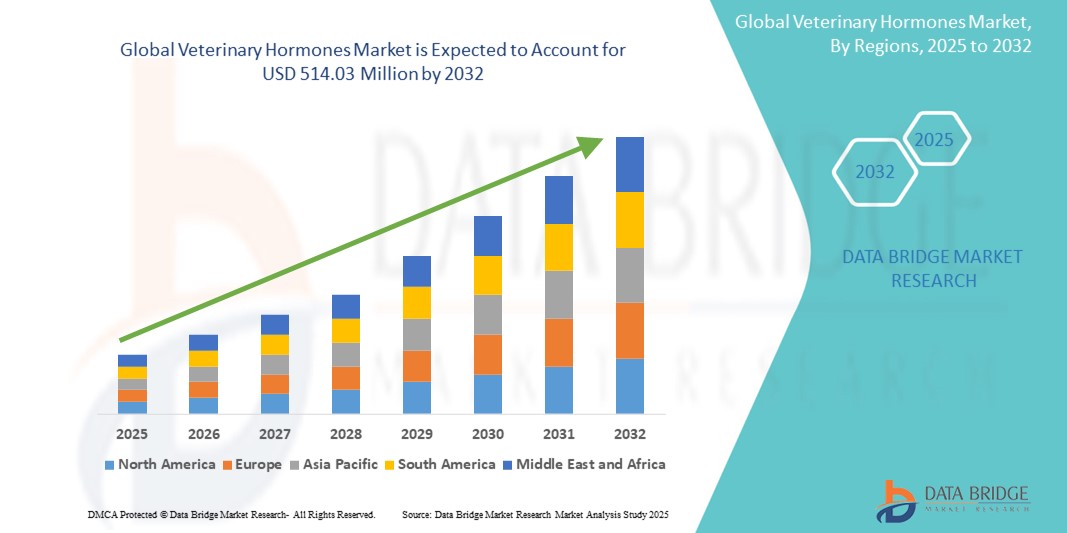
- The global veterinary hormones market size was valued at USD 383.48 million in 2024 and is expected to reach USD 514.03 million by 2032, at a CAGR of 3.73% during the forecast period
- The market growth is largely fueled by the increasing demand for animal protein, growing livestock production, and rising prevalence of animal reproductive and metabolic disorders, driving widespread adoption of veterinary hormonal therapies across the globe
- Furthermore, advancements in veterinary endocrinology, supportive government initiatives, and increasing investments in animal healthcare infrastructure are establishing veterinary hormones as a critical component in animal health management. These converging factors are accelerating the adoption of veterinary hormone solutions, thereby significantly boosting the industry's growth
Veterinary Hormones Market Analysis
- Veterinary hormones, used to regulate growth, reproduction, and metabolic functions in animals, are increasingly vital in modern livestock and animal healthcare systems due to their role in enhancing productivity, improving reproductive efficiency, and supporting overall animal health across various species including cattle, poultry, and swine
- The escalating demand for veterinary hormones is primarily fueled by rising global meat and dairy consumption, increasing livestock population, and growing awareness among farmers about animal health and fertility management
- North America dominated the veterinary hormones market with the largest revenue share of 39.9% in 2024, characterized by advanced veterinary healthcare infrastructure, high animal health expenditure, and the strong presence of key pharmaceutical players, with the U.S. experiencing substantial adoption of hormonal therapies for reproductive and growth regulation in both livestock and companion animals
- Asia-Pacific is expected to be the fastest growing region in the veterinary hormones market during the forecast period due to expanding livestock production, increasing government support for animal health programs, and rising demand for protein-rich diets
- The steroid hormone segment dominated the veterinary hormones market with a market share of 64.5% in 2024, driven by its effectiveness in promoting rapid weight gain and improving feed efficiency, particularly in cattle and swine industries
Report Scope and Veterinary Hormones Market Segmentation
|
Attributes |
Veterinary Hormones Key Market Insights |
|
Segments Covered |
|
|
Countries Covered |
North America
Europe
Asia-Pacific
Middle East and Africa
South America
|
|
Key Market Players |
|
|
Market Opportunities |
|
|
Value Added Data Infosets |
In addition to the insights on market scenarios such as market value, growth rate, segmentation, geographical coverage, and major players, the market reports curated by the Data Bridge Market Research also include in-depth expert analysis, pricing analysis, brand share analysis, consumer survey, demography analysis, supply chain analysis, value chain analysis, raw material/consumables overview, vendor selection criteria, PESTLE Analysis, Porter Analysis, and regulatory framework. |
Veterinary Hormones Market Trends
“Technological Advancements in Hormonal Delivery and Precision Livestock Management”
- A significant and accelerating trend in the global veterinary hormones market is the integration of advanced delivery technologies and precision livestock farming (PLF) tools to improve hormone administration accuracy, animal welfare, and productivity outcomes. Innovations such as hormone-releasing implants, long-acting injectables, and biosensor-assisted administration are enhancing efficiency and reducing manual interventions
- For instance, companies are introducing controlled-release hormonal implants for cattle and swine that reduce dosing frequency and ensure consistent hormone levels over time. These systems help minimize stress on animals and labor costs for producers
- The adoption of biosensors and real-time monitoring systems allows veterinarians and farmers to track reproductive cycles and metabolic health parameters with high accuracy, ensuring timely hormone administration. Technologies such as wearable sensors and automated livestock tracking enable hormone treatments to be better timed and personalized
- This trend toward more intelligent, precise, and welfare-focused hormone usage is reshaping the veterinary healthcare approach, particularly in large-scale commercial operations. Companies such as Zoetis and Merck Animal Health are investing in smart delivery platforms integrated with reproductive management software and livestock data analytics tools
- The growing availability of such innovations is fostering higher compliance and improved results in hormone-driven breeding and growth protocols, especially in dairy and meat production. The result is rising adoption of advanced hormonal solutions across both developed and developing markets
- The demand for efficient, precision-based, and low-stress hormone delivery systems is expanding rapidly, as the livestock industry increasingly focuses on optimizing yields, improving reproductive efficiency, and reducing antimicrobial usage
Veterinary Hormones Market Dynamics
Driver
“Rising Global Demand for Animal Protein and Livestock Productivity”
- The escalating demand for animal-derived food products—such as meat, milk, and eggs—driven by growing global populations and rising incomes, is a major driver of the veterinary hormones market
- For instance, FAO data projects continued growth in per capita meat consumption in emerging economies. This trend is prompting livestock producers to adopt hormone therapies that boost weight gain, reproductive success, and overall productivity
- Veterinary hormones are widely used in reproduction management, such as estrus synchronization and artificial insemination, particularly in cattle and swine. The need for improved calving intervals, better fertility rates, and efficient herd management is fueling the demand for such interventions
- Furthermore, governments and agricultural bodies in countries such as India, China, and Brazil are supporting hormone-based programs for improving dairy output and livestock genetics. This widespread support, coupled with increasing commercial livestock farming, is significantly contributing to market expansion
- Hormonal solutions offer producers the ability to improve feed conversion ratios, ensure seasonal breeding, and meet growing protein demands—making them integral tools in modern animal agriculture. As demand for food security and sustainable animal production rises, so too will the demand for veterinary hormones
Restraint/Challenge
“Stringent Regulatory Oversight and Consumer Concerns Over Hormone Use”
- One of the major challenges facing the veterinary hormones market is growing regulatory scrutiny and consumer skepticism regarding the safety and ethical use of hormones in animal production. Concerns about hormone residues in meat and dairy products, animal welfare, and antibiotic resistance are prompting stricter regulations across regions
- For instance, the European Union has long banned the use of certain growth-promoting hormones in livestock, and similar sentiment is emerging in other markets, pressuring manufacturers and producers to comply with evolving standards
- This regulatory landscape can delay product approvals, limit market entry for new formulations, and increase compliance costs for manufacturers. In addition, public perception around "hormone-free" or "organic" labels is influencing consumer choices, particularly in developed markets
- Addressing these concerns through transparent communication, residue-free hormone innovations, and investment in alternative reproductive technologies is essential for market sustainability. Furthermore, the high cost of advanced hormonal therapies may restrict adoption in price-sensitive regions unless subsidized or supported by government initiatives
- Balancing productivity demands with regulatory compliance and shifting consumer expectations will remain a key challenge for veterinary hormone suppliers in the coming years
Veterinary Hormones Market Scope
The market is segmented on the basis of animal type, product type, application, and distribution channel.
- By Animal Type
On the basis of animal type, the veterinary hormones market is segmented into poultry, livestock, porcine, equine, aquaculture, and other animals. The livestock segment dominated the market with the largest revenue share in 2024, primarily due to the widespread use of hormonal treatments in cattle and sheep for improving growth rates and enhancing reproductive efficiency. Hormones such as progesterone, estrogen, and prostaglandins are routinely administered to boost milk production and optimize breeding cycles in dairy and beef herds.
The aquaculture segment is anticipated to witness the fastest growth rate from 2025 to 2032, driven by the rising global demand for fish protein and the increasing adoption of hormonal treatments to enhance growth and control sex differentiation in farmed species. Technological advancements and growing investments in sustainable fish farming practices are further contributing to this growth.
- By Product Type
On the basis of product type, the veterinary hormones market is segmented into steroid hormones, peptide hormones, amines, anabolic agents, hormone replacements, stress hormones, beta-adrenergic receptor agonists, prostaglandins, and exogenous hormones. The steroid hormones segment held the largest market revenue share of 64.5% in 2024, due to their extensive application in enhancing weight gain, improving feed efficiency, and managing reproduction, particularly in cattle and swine. Their effectiveness and ease of administration make them the preferred choice for many commercial livestock operations.
The peptide hormones segment is expected to witness the fastest CAGR from 2025 to 2032, fueled by rising demand for precise and targeted hormonal therapies in reproductive management and disease control. Advancements in biopharmaceutical formulations and growing awareness among veterinarians about safety and efficacy are driving adoption.
- By Application
On the basis of application, the veterinary hormones market is segmented into growth promoters, performance enhancers, reproductive management, disease prevention, diagnostic & research use, and other applications. The growth promoters segment dominated the market in 2024, driven by increasing meat consumption and the need for efficient animal weight gain and feed utilization. Growth hormones are widely used in commercial animal farming to enhance production yield.
The reproductive management segment is projected to grow at the fastest rate from 2025 to 2032, supported by the growing adoption of artificial insemination, estrus synchronization, and embryo transfer techniques across the livestock industry. Hormonal solutions play a key role in optimizing fertility cycles and herd productivity.
- By Distribution Channel
On the basis of distribution channel, the veterinary hormones market is segmented into veterinary clinics, retail pharmacies, wholesale distributors, and online stores. The veterinary clinics segment accounted for the largest market share in 2024, as most hormone-based treatments require professional diagnosis and administration by licensed veterinarians. These clinics serve as the primary point of access for hormone therapies in both livestock and companion animals.
The online stores segment is expected to witness the highest growth from 2025 to 2032, fueled by the increasing digitalization of veterinary supply chains, growing availability of non-prescription hormone products, and expanding e-commerce penetration in rural and urban areas asuch as.
Veterinary Hormones Market Regional Analysis
- North America dominated the veterinary hormones market with the largest revenue share of 39.9% in 2024, characterized by advanced veterinary healthcare infrastructure, high animal health expenditure, and the strong presence of key pharmaceutical players, with the U.S. experiencing substantial adoption of hormonal therapies for reproductive and growth regulation in both livestock and companion animals
- Producers in the region prioritize productivity-enhancing solutions such as estrus synchronization and growth-promoting hormones to meet the growing demand for meat and dairy products, particularly in the U.S. and Canada
- This widespread adoption is further supported by strong veterinary infrastructure, significant R&D investments by key pharmaceutical companies, and favorable government initiatives promoting animal health, positioning North America as the leading market for veterinary hormone solutions
U.S. Veterinary Hormones Market Insight
The U.S. veterinary hormones market captured the largest revenue share of 83% in 2024 within North America, fueled by the country’s advanced animal healthcare infrastructure and extensive commercial livestock operations. High meat and dairy consumption, coupled with widespread use of hormone therapies for reproductive management and growth promotion, supports market dominance. Moreover, strong R&D activity by key players and supportive regulatory frameworks further boost adoption. The presence of major pharmaceutical firms and ongoing innovation in hormonal formulations contribute significantly to sustained market expansion.
Europe Veterinary Hormones Market Insight
The Europe veterinary hormones market is projected to grow at a substantial CAGR throughout the forecast period, driven by stringent animal welfare regulations and the rising focus on livestock productivity. Growing concerns over reproductive health in animals, increasing dairy output, and expanding use of hormone-assisted breeding technologies are encouraging adoption. Hormone applications in cattle and swine farming—especially in countries such as France, Spain, and Italy—are prominent, while rising demand for hormone-free certifications and sustainable practices influences product innovation and regulatory alignment across the region
U.K. Veterinary Hormones Market Insight
The U.K. veterinary hormones market is anticipated to grow at a noteworthy CAGR during the forecast period, supported by advanced veterinary services and an increased focus on reproductive health in companion and farm animals. Growing demand for animal-derived products and national support for herd fertility programs are encouraging the controlled use of hormone therapies. In addition, innovation in hormone delivery systems and a rising emphasis on animal welfare and organic certification create a balanced approach between productivity and ethical concerns.
Germany Veterinary Hormones Market Insight
The Germany veterinary hormones market is expected to expand at a considerable CAGR during the forecast period, fueled by a strong veterinary infrastructure, stringent quality standards, and high demand for sustainable animal production practices. The country’s emphasis on advanced veterinary diagnostics and precision hormone delivery technologies supports market growth. Germany also shows growing interest in hormone alternatives, prompting pharmaceutical companies to focus on safe, residue-free hormonal solutions aligned with both consumer and regulatory expectations.
Asia-Pacific Veterinary Hormones Market Insight
The Asia-Pacific veterinary hormones market is poised to grow at the fastest CAGR during the forecast period of 2025 to 2032, driven by increasing livestock production, rising protein consumption, and government-backed animal health initiatives across countries such as China, India, and Indonesia. Expanding demand for milk, meat, and eggs is prompting farmers to adopt hormone-based reproductive and growth solutions. In addition, the region benefits from cost-effective manufacturing and a growing number of domestic veterinary pharmaceutical companies.
Japan Veterinary Hormones Market Insight
The Japan veterinary hormones market is gaining momentum due to the country's emphasis on animal health, innovation, and food quality. With a well-established veterinary regulatory framework and rising demand for premium dairy and meat products, the country is witnessing greater adoption of precision hormonal therapies. Japan's technological leadership supports integration of hormone use with digital livestock monitoring tools, enabling more accurate and ethical reproductive management.
India Veterinary Hormones Market Insight
The India veterinary hormones market accounted for the largest market revenue share in Asia Pacific in 2024, attributed to its large livestock population, growing demand for dairy and meat products, and rising awareness of reproductive health. Government initiatives such as the National Animal Disease Control Programme and expanding veterinary infrastructure are promoting the use of hormonal therapies to boost productivity. Domestic pharmaceutical companies are offering cost-effective solutions tailored to rural and commercial farming needs, driving strong market growth across the country.
Veterinary Hormones Market Share
The veterinary hormones industry is primarily led by well-established companies, including:
- Zoetis Inc. (U.S.)
- Boehringer Ingelheim International GmbH (Germany)
- Elanco (U.S.)
- Ceva (France)
- Virbac (France)
- Phibro Animal Health Corportion (U.S.)
- Vetoquinol S.A. (France)
- Bimeda Holdings PLC (Ireland)
- IDEXX Laboratories, Inc. (U.S.)
- Neogen Corporation (U.S.)
- Ourofino Saúde Animal Participações S.A. (Brazil)
- Biogénesis Bagó S.A. (Argentina)
- Indian Immunologicals Ltd. (India)
- Hester Biosciences Limited (India)
- Kyoritsu Seiyaku Corporation (Japan)
- HIPRA, S.A. (Spain)
- Dechra Pharmaceuticals Limited (U.K.)
- PetIQ, LLC. (U.S.)
What are the Recent Developments in Global Veterinary Hormones Market?
- In March 2024, Zoetis Inc., a global leader in animal health, introduced SyncSure, a next-generation hormone-based fertility synchronization solution for dairy cattle in North America and Europe. Designed to improve conception rates and streamline breeding cycles, SyncSure combines proven hormonal protocols with data-driven monitoring tools, highlighting Zoetis’ continued investment in enhancing reproductive efficiency and livestock productivity through science-based innovations
- In February 2024, Boehringer Ingelheim expanded its veterinary hormone production facility in Germany to meet rising global demand for animal reproductive and metabolic therapies. The expansion includes state-of-the-art manufacturing capabilities for peptide-based hormones and aligns with the company’s strategic objective to increase its footprint in the livestock fertility market, particularly in Asia-Pacific and Latin America
- In January 2024, Ceva Santé Animale launched ReproOne, a comprehensive hormonal fertility management program in India, targeting small and medium-scale dairy farmers. The initiative aims to boost milk production through improved calving rates and educate rural veterinarians on proper hormone usage. This development underscores Ceva’s focus on tailored solutions for emerging markets and its commitment to sustainable animal health practices
- In November 2023, Elanco Animal Health collaborated with a leading agri-tech startup to integrate hormone therapy protocols with precision livestock farming tools in Brazil. The pilot program leverages real-time biosensor data to optimize hormone administration in beef cattle, aiming to reduce hormone waste and improve outcomes. This marks a shift toward digital-hormonal convergence in the veterinary space, enhancing productivity while promoting responsible usage
- In October 2023, Virbac introduced a new formulation of long-acting progesterone implants for swine breeding programs across Southeast Asia. The product offers extended hormonal coverage with fewer applications, reducing stress on animals and labor for farmers. This advancement reflects Virbac’s commitment to developing efficient, welfare-oriented hormone therapies tailored to regional production needs

- Interactive Data Analysis Dashboard
- Company Analysis Dashboard for high growth potential opportunities
- Research Analyst Access for customization & queries
- Competitor Analysis with Interactive dashboard
- Latest News, Updates & Trend analysis
- Harness the Power of Benchmark Analysis for Comprehensive Competitor Tracking
Data collection and base year analysis are done using data collection modules with large sample sizes. The stage includes obtaining market information or related data through various sources and strategies. It includes examining and planning all the data acquired from the past in advance. It likewise envelops the examination of information inconsistencies seen across different information sources. The market data is analysed and estimated using market statistical and coherent models. Also, market share analysis and key trend analysis are the major success factors in the market report. To know more, please request an analyst call or drop down your inquiry.
The key research methodology used by DBMR research team is data triangulation which involves data mining, analysis of the impact of data variables on the market and primary (industry expert) validation. Data models include Vendor Positioning Grid, Market Time Line Analysis, Market Overview and Guide, Company Positioning Grid, Patent Analysis, Pricing Analysis, Company Market Share Analysis, Standards of Measurement, Global versus Regional and Vendor Share Analysis. To know more about the research methodology, drop in an inquiry to speak to our industry experts.
Data Bridge Market Research is a leader in advanced formative research. We take pride in servicing our existing and new customers with data and analysis that match and suits their goal. The report can be customized to include price trend analysis of target brands understanding the market for additional countries (ask for the list of countries), clinical trial results data, literature review, refurbished market and product base analysis. Market analysis of target competitors can be analyzed from technology-based analysis to market portfolio strategies. We can add as many competitors that you require data about in the format and data style you are looking for. Our team of analysts can also provide you data in crude raw excel files pivot tables (Fact book) or can assist you in creating presentations from the data sets available in the report.












