


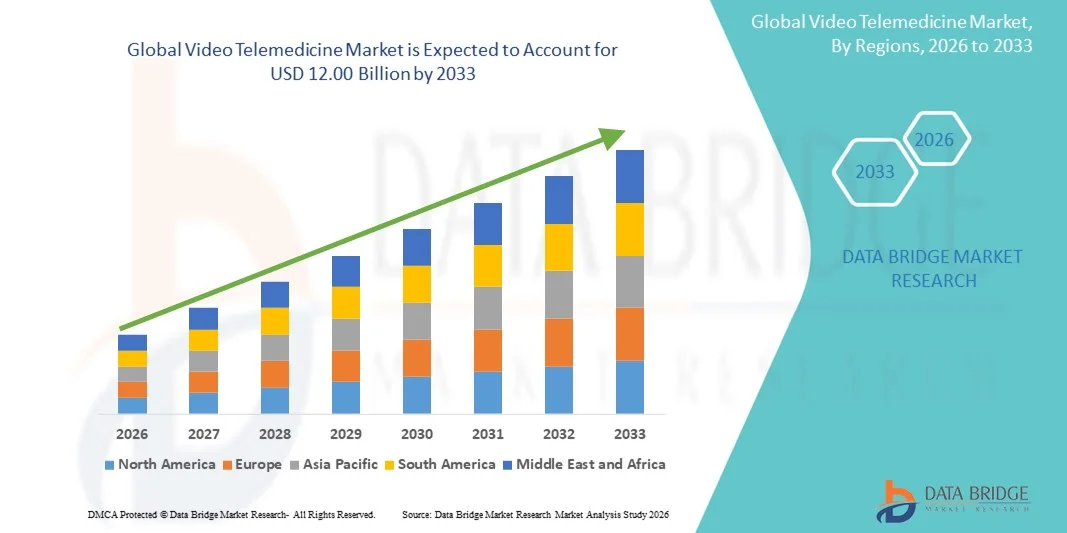
Video Telemedicine Market Size
- The global video telemedicine market size was valued at USD 4.78 billion in 2025 and is expected to reach USD 12.00 billion by 2033, at a CAGR of 12.20% during the forecast period
- The market expansion is primarily driven by the rising deployment of remote care technologies, increasing digital transformation across healthcare systems, and growing acceptance of virtual consultations among both patients and providers
- In addition, the demand for efficient, accessible, and integrated digital healthcare solutions is positioning video telemedicine as a critical component of modern care delivery. These converging dynamics are accelerating the adoption of video-based clinical interactions, significantly strengthening the industry's growth trajectory
Video Telemedicine Market Analysis
- Video telemedicine, enabling real-time virtual consultations between patients and healthcare providers, is becoming an essential component of modern digital healthcare ecosystems due to its ability to enhance accessibility, reduce patient wait times, and support seamless remote clinical interactions across multiple medical specialties
- The accelerating demand for video telemedicine solutions is primarily driven by the global shift toward digital health models, increasing need for remote care delivery, rising prevalence of chronic diseases, and strong patient preference for convenient, on-demand virtual consultations
- North America dominated the video telemedicine market with the largest revenue share of 42.5% in 2025, supported by advanced healthcare IT infrastructure, high broadband penetration, favorable reimbursement policies for virtual care, and strong adoption by hospitals, clinics, and insurers, with the U.S. witnessing substantial expansion across virtual primary care, behavioral health, and chronic disease management
- Asia-Pacific is expected to be the fastest-growing region during the forecast period, driven by rapid digitalization of healthcare systems, government-backed telehealth initiatives, increasing smartphone and internet penetration, and rising demand for accessible care in underserved and rural areas
- The software segment dominated the video telemedicine market with a share of 61.8% in 2025, fueled by the increasing need for secure, interoperable, and cloud-based video communication platforms that support HD consultations, EHR integration, AI-assisted diagnostics, and scalable virtual care delivery models across hospitals, clinics, and home-based care settings
Report Scope and Video Telemedicine Market Segmentation
|
Attributes |
Video Telemedicine Key Market Insights |
|
Segments Covered |
|
|
Countries Covered |
North America
Europe
Asia-Pacific
Middle East and Africa
South America
|
|
Key Market Players |
|
|
Market Opportunities |
|
|
Value Added Data Infosets |
In addition to the insights on market scenarios such as market value, growth rate, segmentation, geographical coverage, and major players, the market reports curated by the Data Bridge Market Research also include in-depth expert analysis, patient epidemiology, pipeline analysis, pricing analysis, and regulatory framework |
Video Telemedicine Market Trends
AI-Enabled and Remote Patient Monitoring Integration
- A significant and accelerating trend in the global video telemedicine market is the integration of artificial intelligence (AI) and remote patient monitoring tools into virtual care platforms, enhancing diagnostic accuracy and enabling continuous patient care
- For instance, Amwell’s telehealth platform incorporates AI-powered symptom checkers alongside video consultations, allowing clinicians to prioritize care and deliver more personalized recommendations. Similarly, Teladoc Health leverages AI analytics to monitor patient vitals and flag potential health risks during remote sessions
- AI integration allows platforms to analyze patient data, track chronic conditions, and provide predictive insights, improving outcomes and reducing hospital readmissions. For instance, some platforms use AI to detect early signs of deterioration in cardiac or diabetic patients and alert clinicians automatically
- The seamless integration of video telemedicine with wearable devices and health apps enables healthcare providers to collect real-time data during consultations, facilitating more informed decision-making and proactive interventions
- This trend towards intelligent, data-driven, and connected telemedicine solutions is reshaping patient expectations for virtual care. Consequently, companies such as MDLIVE are developing AI-enabled telehealth tools with features such as predictive analytics, automated triage, and integration with electronic health records
- The demand for telemedicine platforms offering AI-driven insights and real-time monitoring is growing rapidly across hospitals, clinics, and home care services, as patients increasingly prioritize convenience, continuity of care, and personalized treatment
Video Telemedicine Market Dynamics
Driver
Rising Demand Due to Healthcare Accessibility and Digital Transformation
- The increasing need for accessible healthcare services, coupled with accelerated digital transformation in healthcare systems, is a significant driver for the growing adoption of video telemedicine
- For instance, in March 2025, Teladoc Health expanded its chronic care virtual programs in rural U.S. areas, aiming to reduce healthcare access gaps and support remote patient management. Such initiatives by leading providers are expected to drive market growth during the forecast period
- As patients seek convenient care from home and healthcare systems strive to reduce overcrowding, video telemedicine offers advanced capabilities such as real-time consultations, remote monitoring, and follow-up management, providing a compelling alternative to in-person visits
- Furthermore, government initiatives promoting telehealth reimbursement and healthcare digitization are supporting the integration of video consultations into mainstream healthcare delivery, enabling hospitals and clinics to scale virtual care efficiently
- The convenience of on-demand consultations, reduced travel time, and continuous care management are key factors propelling adoption among patients, providers, and payers asuch as. The trend towards integrated digital health ecosystems and patient-centered care further strengthens the market
Restraint/Challenge
Data Security Concerns and Regulatory Complexity
- Concerns surrounding cybersecurity vulnerabilities in telemedicine platforms pose a significant challenge to broader market penetration. As video consultations rely on internet connectivity and digital data, they are susceptible to hacking, data breaches, and unauthorized access, raising concerns among patients and providers
- For instance, reports of ransomware attacks targeting healthcare providers have made some patients hesitant to adopt virtual consultations, especially for sensitive medical information
- Addressing these security concerns through end-to-end encryption, secure authentication protocols, and compliance with HIPAA and other regional regulations is crucial for building trust. Companies such as Amwell and MDLIVE emphasize robust security measures and compliance features to reassure users. In addition, the relatively high implementation costs for hospitals and smaller clinics, particularly for platforms with integrated AI and monitoring features, can limit adoption
- While platform pricing is gradually becoming more competitive, the perceived premium for advanced telemedicine capabilities can hinder uptake, especially in developing regions or smaller healthcare facilities that lack digital infrastructure
- Overcoming these challenges through enhanced cybersecurity, regulatory guidance, and affordable, scalable telemedicine solutions will be vital for sustained market growth
Video Telemedicine Market Scope
The market is segmented on the basis of communication technology, application, deployment, component, and end users.
- By Communication Technology
On the basis of communication technology, the market is segmented into 3G, 4G, satellite communication, ADSL, and broadband ISDN. The 4G segment dominated the market with the largest revenue share of 47.8% in 2025, driven by its widespread availability, high-speed mobile internet, low latency, and reliable video streaming quality. Healthcare providers often prioritize 4G-enabled telemedicine solutions for real-time consultations, remote monitoring, and integration with wearable devices and mobile health applications. 4G platforms support seamless connection between doctors and patients across urban and semi-urban regions, improving access to specialized care. The market also sees strong demand for 4G due to its compatibility with cloud-based platforms and AI-enabled telehealth solutions. Patients and clinicians benefit from reduced consultation delays and uninterrupted data transmission during video calls. The robust infrastructure supporting 4G connectivity makes it the preferred choice for hospitals and large clinics aiming for scalable telemedicine deployments.
The Broadband ISDN segment is expected to witness the fastest CAGR from 2026 to 2033, fueled by adoption in hospitals and specialty clinics requiring secure, high-definition video quality and stable connections. Broadband ISDN is particularly preferred for enterprise-level telemedicine setups due to its ability to handle multiple simultaneous video streams. Healthcare providers leverage ISDN connectivity for multi-specialty consultations, tele-radiology, and remote diagnostics, ensuring minimal latency and enhanced patient experience. The segment growth is supported by increasing investments in healthcare IT infrastructure and digital transformation initiatives. Broadband ISDN enables seamless integration with hospital information systems and electronic health records (EHRs). The growing demand for high-quality video consultations in remote and rural areas further accelerates the adoption of this communication technology.
- By Application
On the basis of application, the market is segmented into cardiology, dermatology, neurology and psychiatry, orthopaedics, oncology, radiology, pathology, gynaecology, and dentistry. The Cardiology segment held the largest revenue share of 28.4% in 2025, driven by the increasing need for continuous monitoring of heart patients, virtual follow-ups, and remote diagnostics. Hospitals prioritize cardiology telemedicine solutions for real-time ECG tracking, vitals monitoring, and early detection of abnormalities. Cardiology teleconsultations reduce hospital visits while maintaining high-quality patient care. The segment benefits from rising prevalence of cardiovascular diseases and growing patient awareness about remote health monitoring. Healthcare providers increasingly rely on AI-enabled analytics to interpret cardiac data during virtual consultations. The large revenue share reflects widespread adoption by hospitals, clinics, and specialty care centers focusing on cardiovascular care.
The Dermatology segment is expected to witness the fastest CAGR from 2026 to 2033, fueled by the visual nature of dermatological assessments which can be effectively conducted via high-quality video consultations. Dermatology telemedicine enables patients to receive timely diagnosis and treatment without the need to travel to clinics. Platforms offer integration with mobile apps and imaging tools for accurate assessment of skin conditions. The segment growth is supported by rising awareness of teledermatology services and the convenience of remote follow-ups. Clinics and hospitals can expand patient reach and reduce appointment backlogs. Patients benefit from faster consultations, reduced wait times, and access to specialists who may not be locally available.
- By Deployment
On the basis of deployment, the market is segmented into cloud-based video conferencing and on-premise video conferencing. The Cloud-Based segment dominated with a revenue share of 62.5% in 2025, due to scalability, remote accessibility, and integration with EHRs and AI-based diagnostic tools. Cloud platforms enable hospitals and clinics to manage large volumes of virtual consultations without heavy IT infrastructure. The segment is preferred for its cost-effectiveness, rapid deployment, and ability to connect multiple care providers and patients simultaneously. Cloud solutions facilitate remote care delivery across geographies, enhancing patient engagement and care continuity. Healthcare providers benefit from real-time updates, seamless data sharing, and simplified telemedicine workflow management. The dominance of this segment reflects growing adoption in hospitals, specialty clinics, and home care services globally.
The On-Premise segment is expected to witness the fastest CAGR from 2026 to 2033, preferred by hospitals and clinics requiring secure, internally managed telemedicine systems. On-premise solutions provide greater control over patient data, ensuring compliance with regional healthcare regulations. The segment growth is driven by large healthcare facilities and specialty centers prioritizing cybersecurity and data privacy. On-premise deployments support integration with existing hospital IT infrastructure and specialized medical equipment. They also enable multi-department consultations without dependence on external cloud services. The growing awareness of data protection and regulatory compliance accelerates adoption of on-premise telemedicine solutions.
- By Component
On the basis of component, the market is segmented into hardware and software. The Software segment dominated with a market share of 61.8% in 2025, driven by telemedicine platforms, AI-powered patient monitoring, and scheduling/management software for virtual consultations. Software enables healthcare providers to manage appointments, clinical data, and remote diagnostics efficiently. Hospitals and clinics leverage software for workflow automation, analytics, and integration with EHRs. The segment is widely adopted due to the growing demand for mobile apps and cloud-based telehealth solutions. Patients benefit from easy access to virtual consultations and real-time health tracking. The dominance of this segment reflects its critical role in delivering efficient, secure, and scalable telemedicine services.
The Hardware segment is expected to witness the fastest CAGR from 2026 to 2033, fueled by rising demand for high-definition cameras, microphones, wearable devices, and telehealth monitoring equipment. Hardware improves consultation quality, supports remote diagnostics, and enables continuous patient monitoring. Hospitals and home care providers increasingly deploy advanced devices to enhance telemedicine effectiveness. Integration with AI and cloud platforms allows real-time data transmission and analysis. The segment growth is supported by increased adoption of telemedicine in developing regions and rural areas. Hardware advancements contribute to a better patient experience and more accurate virtual consultations.
- By End Users
On the basis of end users, the market is segmented into hospitals, clinics, home care services, and others. The Hospitals segment held the largest revenue share of 45.7% in 2025, driven by telemedicine adoption for outpatient consultations, chronic disease management, and follow-up care. Hospitals leverage virtual care to optimize physician time, reduce congestion, and expand patient reach. The segment growth is supported by integration with EHRs and AI-based analytics for remote patient management. Hospitals often invest in scalable telemedicine solutions to cover multiple specialties. The large revenue share reflects widespread adoption in developed regions with advanced healthcare infrastructure. Telemedicine improves care continuity, patient satisfaction, and hospital operational efficiency.
The Home Care Services segment is expected to witness the fastest CAGR from 2026 to 2033, fueled by remote patient monitoring, aging population needs, and integration of wearable devices. Home care providers can deliver continuous care to patients without hospital visits, enhancing quality of life. The segment growth is driven by increasing demand for telehealth-enabled chronic disease management and preventive care at home. Integration with mobile apps allows seamless communication between caregivers, clinicians, and patients. Governments and healthcare organizations are promoting home-based care through reimbursement initiatives and telehealth policies. The segment benefits from technological adoption in remote and rural areas, enabling scalable delivery of healthcare services.
Video Telemedicine Market Regional Analysis
- North America dominated the video telemedicine market with the largest revenue share of 42.5% in 2025, supported by advanced healthcare IT infrastructure, high broadband penetration, favorable reimbursement policies for virtual care, and strong adoption by hospitals, clinics, and insurers
- Patients and healthcare providers in the region highly value the convenience, reduced travel time, and real-time monitoring enabled by video telemedicine platforms, along with seamless integration with electronic health records (EHRs) and AI-enabled diagnostic tools
- This widespread adoption is further supported by a technologically inclined population, high smartphone penetration, and the growing need for accessible healthcare solutions, establishing video telemedicine as a preferred mode of care delivery across hospitals, clinics, and home care services
U.S. Video Telemedicine Market Insight
The U.S. video telemedicine market captured the largest revenue share of 78% in 2025 within North America, driven by the widespread adoption of digital health solutions and strong healthcare IT infrastructure. Patients and providers are increasingly prioritizing virtual consultations, remote monitoring, and continuity of care through connected devices. The growing preference for AI-enabled platforms, cloud-based systems, and mobile app integration further propels the market. In addition, favorable government reimbursement policies for telehealth services and the integration of telemedicine with electronic health records (EHRs) are significantly contributing to market expansion. High smartphone penetration and a tech-savvy population enhance the accessibility and adoption of video telemedicine services.
Europe Video Telemedicine Market Insight
The Europe video telemedicine market is projected to expand at a substantial CAGR throughout the forecast period, primarily driven by increasing digital health initiatives and government support for telehealth adoption. The rising prevalence of chronic diseases, combined with urbanization and growing patient awareness, is fostering the adoption of virtual care solutions. European healthcare providers are embracing telemedicine to improve access to specialists and reduce patient travel time. The convenience, cost-effectiveness, and integration of telemedicine platforms with existing hospital systems are accelerating growth. The market is witnessing significant adoption across hospitals, clinics, and home care services.
U.K. Video Telemedicine Market Insight
The U.K. video telemedicine market is anticipated to grow at a noteworthy CAGR during the forecast period, driven by the rising trend of digital healthcare and patient demand for convenient access to healthcare professionals. Concerns regarding long hospital wait times and accessibility are encouraging adoption of virtual consultations. Integration with wearable devices, EHRs, and mobile apps further supports market growth. The U.K.’s robust healthcare infrastructure, widespread internet access, and high patient awareness are expected to continue stimulating telemedicine adoption. Increasing telehealth investments by both public and private healthcare providers reinforce market expansion.
Germany Video Telemedicine Market Insight
The Germany video telemedicine market is expected to expand at a considerable CAGR during the forecast period, fueled by government initiatives promoting digital health, increasing awareness of telehealth benefits, and strong IT infrastructure. Germany’s emphasis on secure, privacy-focused solutions aligns with patient expectations, particularly in hospitals and specialty clinics. The adoption of virtual consultations is also driven by chronic disease management and the need for remote specialist care. Integration with hospital information systems and AI-enabled monitoring tools enhances the effectiveness of video telemedicine services. The country’s focus on innovation, healthcare digitization, and patient-centered care is supporting robust market growth.
Asia-Pacific Video Telemedicine Market Insight
The Asia-Pacific video telemedicine market is poised to grow at the fastest CAGR of 25% during the forecast period of 2026 to 2033, driven by increasing digitalization of healthcare, rising internet penetration, and expanding telehealth infrastructure in countries such as China, Japan, and India. Growing awareness about virtual care, coupled with government support and healthcare modernization initiatives, is accelerating adoption. Telemedicine is increasingly utilized for outpatient care, chronic disease management, and remote monitoring. The region’s large population and growing middle class, along with improved affordability of telehealth solutions, are driving market expansion. Rapid technological advancements and integration with mobile apps further enhance accessibility for patients and providers.
Japan Video Telemedicine Market Insight
The Japan video telemedicine market is gaining momentum due to the country’s high-tech healthcare ecosystem, increasing demand for convenient care, and government support for digital health solutions. The adoption of telemedicine is fueled by the growing number of smart hospitals, aging population, and need for remote monitoring of chronic conditions. Integration with wearable devices, AI analytics, and hospital information systems is supporting growth. Patients and healthcare providers value the ability to conduct virtual consultations, reducing hospital visits while maintaining care quality. Japan’s focus on innovation and technologically advanced healthcare solutions continues to drive telemedicine adoption.
India Video Telemedicine Market Insight
The India video telemedicine market accounted for the largest revenue share in Asia-Pacific in 2025, driven by the country’s rapidly expanding healthcare infrastructure, rising internet and smartphone penetration, and growing demand for accessible healthcare in rural and urban areas. Telemedicine adoption is increasing in hospitals, clinics, and home care services, supported by government initiatives promoting digital health and teleconsultation services. Affordability of telehealth platforms, combined with rising awareness among patients and providers, is accelerating market growth. Integration with mobile apps, wearable devices, and AI-enabled monitoring tools further enhances the accessibility and effectiveness of virtual care solutions.
Video Telemedicine Market Share
The Video Telemedicine industry is primarily led by well-established companies, including:
- American Well (U.S.)
- Teladoc Health, Inc. (U.S.)
- GlobalMed Holdings, LLC (U.S.)
- MD Live (U.S.)
- Doctor on Demand, Inc. (U.S.)
- Babylon Holdings Ltd. (U.K.)
- Doxy.me Inc (U.S.)
- VSee (U.S.)
- MeMD (U.S.)
- Medweb (U.S.)
- HealthTap (U.S.)
- Cisco Systems, Inc. (U.S.)
- Koninklijke Philips (Netherlands)
- GE Healthcare (U.S.)
- Siemens Healthineers AG (Germany)
- SOC Telemed (U.S.)
- Ping An Good Doctor (China)
- Practo Technologies Pvt. Ltd. (India)
- Honeywell International Inc. (U.S.)
What are the Recent Developments in Global Video Telemedicine Market?
- In March 2025, Samaritan Health Services partnered with KeyCare to offer 24×7 national virtual urgent‑care services via an Epic‑based telemedicine platform, enabling patients to access on-demand video consultations through the MyChart portal
- In March 2025, Microsoft Research launched live trials of a 3‑D telemedicine system (using its Holoportation™ technology) in a mobile van setup in Ghana, allowing multiple remote specialists to jointly review 3‑D patient images for pre‑ or post‑surgical consultations a major step forward in bringing specialist care to remote areas
- In November 2023, a proof‑of‑concept demonstration of 3‑D Telemedicine (via an international multi-disciplinary team clinic) showed that real‑time 3‑D telemedicine can work effectively suggesting potential for overseas surgical collaborations and remote specialist consultations, particularly for low‑ to middle‑income countries
- In July 2023, Samaritan Health Services rolled out a new telemedicine platform Epic Video Client to replace older systems, enabling secure video visits, streamlined clinical paperwork, and easy access for patients and clinicians via MyChart or email notifications
- In November 2021, a study from University of Mississippi Medical Center (UMMC) demonstrated success of remote patient monitoring (RPM) for hypertension via telehealth patients used home‑based devices to transmit blood pressure data, enabling clinicians to monitor, adjust treatment and improve outcomes in rural and underserved populations.

- Interactive Data Analysis Dashboard
- Company Analysis Dashboard for high growth potential opportunities
- Research Analyst Access for customization & queries
- Competitor Analysis with Interactive dashboard
- Latest News, Updates & Trend analysis
- Harness the Power of Benchmark Analysis for Comprehensive Competitor Tracking
Data collection and base year analysis are done using data collection modules with large sample sizes. The stage includes obtaining market information or related data through various sources and strategies. It includes examining and planning all the data acquired from the past in advance. It likewise envelops the examination of information inconsistencies seen across different information sources. The market data is analysed and estimated using market statistical and coherent models. Also, market share analysis and key trend analysis are the major success factors in the market report. To know more, please request an analyst call or drop down your inquiry.
The key research methodology used by DBMR research team is data triangulation which involves data mining, analysis of the impact of data variables on the market and primary (industry expert) validation. Data models include Vendor Positioning Grid, Market Time Line Analysis, Market Overview and Guide, Company Positioning Grid, Patent Analysis, Pricing Analysis, Company Market Share Analysis, Standards of Measurement, Global versus Regional and Vendor Share Analysis. To know more about the research methodology, drop in an inquiry to speak to our industry experts.
Data Bridge Market Research is a leader in advanced formative research. We take pride in servicing our existing and new customers with data and analysis that match and suits their goal. The report can be customized to include price trend analysis of target brands understanding the market for additional countries (ask for the list of countries), clinical trial results data, literature review, refurbished market and product base analysis. Market analysis of target competitors can be analyzed from technology-based analysis to market portfolio strategies. We can add as many competitors that you require data about in the format and data style you are looking for. Our team of analysts can also provide you data in crude raw excel files pivot tables (Fact book) or can assist you in creating presentations from the data sets available in the report.













