


Virtual ICU (vICU) Services Market Size
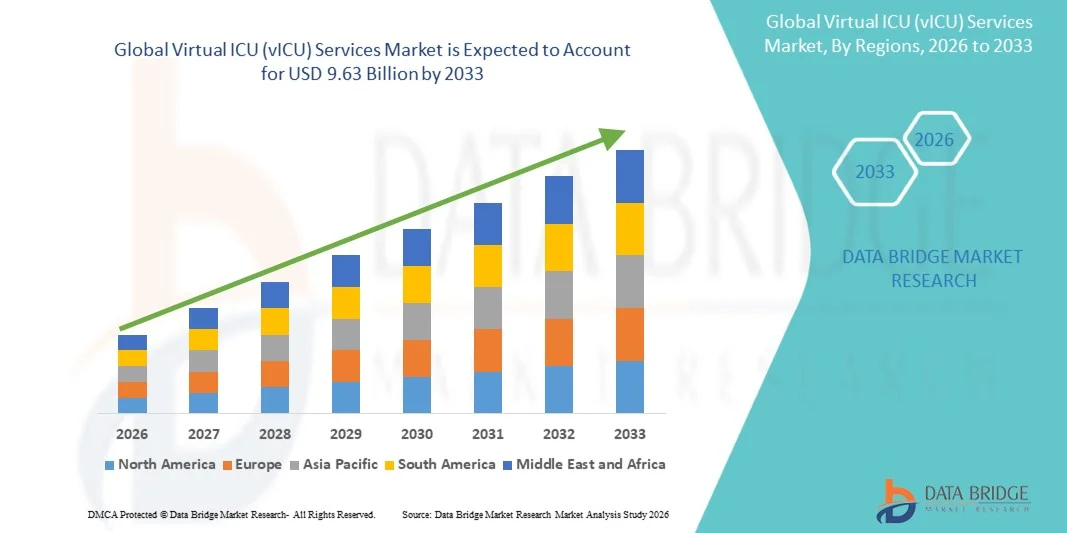
- The global virtual ICU (vICU) services market size was valued at USD 2.96 billion in 2025and is expected to reach USD 9.63 billion by 2033, at a CAGR of 15.90% during the forecast period
- The market growth is primarily driven by the increasing demand for remote critical care monitoring, rising ICU admissions, and the growing shortage of intensivists and skilled healthcare professionals across hospitals and healthcare systems worldwide
- Furthermore, the expanding adoption of telehealth technologies, integration of artificial intelligence and predictive analytics in critical care, and rising focus on improving patient outcomes while reducing healthcare costs are positioning virtual ICU services as an essential component of modern critical care delivery. These combined factors are significantly accelerating the adoption of vICU solutions, thereby driving the market’s growth trajectory over the forecast period
Virtual ICU (vICU) Services Market Analysis
- Virtual ICU (vICU) services, enabling remote monitoring and management of critically ill patients through centralized command centers, advanced analytics, and telecommunication technologies, are increasingly becoming essential components of modern healthcare systems due to their ability to improve patient outcomes, optimize intensivist coverage, and enhance continuous critical care delivery across healthcare facilities
- The rising demand for virtual ICU (vICU) services is primarily driven by the increasing prevalence of chronic and critical illnesses, growing ICU admissions, shortages of skilled critical care professionals, and the expanding adoption of telehealth and digital healthcare technologies across hospitals and healthcare networks worldwide
- North America dominated the virtual ICU (vICU) services market with the largest revenue share of 41.3% in 2025, supported by advanced healthcare infrastructure, widespread implementation of tele-ICU platforms, favorable reimbursement policies, and strong investments in artificial intelligence and cloud-based monitoring technologies, with the U.S. witnessing significant adoption of centralized virtual critical care programs across multi-hospital systems
- Asia-Pacific is expected to be the fastest-growing region in the virtual ICU (vICU) services market during the forecast period due to increasing healthcare digitalization, rising investments in smart hospital infrastructure, growing adoption of cloud-based healthcare solutions, and expanding demand for remote patient monitoring services across emerging economies
- The tele-ICU platforms segment dominated the virtual ICU (vICU) services market with a market share of 38.6% in 2025, driven by the growing need for centralized ICU management, real-time patient monitoring capabilities, enhanced clinician collaboration, and increasing integration of artificial intelligence and predictive analytics into critical care workflows
Report Scope and Virtual ICU (vICU) Services Market Segmentation
|
Attributes |
Virtual ICU (vICU) Services Key Market Insights |
|
Segments Covered |
|
|
Countries Covered |
North America · U.S. · Canada · Mexico Europe · Germany · France · U.K. · Netherlands · Switzerland · Belgium · Russia · Italy · Spain · Turkey · Rest of Europe Asia-Pacific · China · Japan · India · South Korea · Singapore · Malaysia · Australia · Thailand · Indonesia · Philippines · Rest of Asia-Pacific Middle East and Africa · Saudi Arabia · U.A.E. · South Africa · Egypt · Israel · Rest of Middle East and Africa South America · Brazil · Argentina · Rest of South America |
|
Key Market Players |
|
|
Market Opportunities |
· The increasing integration of artificial intelligence and predictive analytics into virtual ICU (vICU) services · The expanding adoption of cloud-based tele-ICU platforms in rural and underserved healthcare facilities |
|
Value Added Data Infosets |
In addition to the insights on market scenarios such as market value, growth rate, segmentation, geographical coverage, and major players, the market reports curated by the Data Bridge Market Research also include in-depth expert analysis, patient epidemiology, pipeline analysis, pricing analysis, and regulatory framework |
Virtual ICU (vICU) Services Market Trends
“Increasing Integration of Artificial Intelligence and Predictive Analytics in Critical Care”
- A significant and accelerating trend in the global virtual ICU (vICU) services market is the growing integration of artificial intelligence (AI), predictive analytics, and cloud-based monitoring technologies into critical care management systems. This convergence of technologies is significantly enhancing patient monitoring efficiency, clinical decision-making, and operational coordination across intensive care units
- For instance, advanced tele-ICU platforms developed by healthcare technology providers are increasingly incorporating AI-powered analytics tools capable of identifying early signs of patient deterioration and supporting clinicians with real-time treatment recommendations. Similarly, cloud-enabled virtual ICU systems allow centralized monitoring teams to oversee multiple ICU beds across geographically dispersed healthcare facilities
- AI integration in virtual ICU (vICU) services enables capabilities such as predictive risk scoring, automated clinical alerts, and intelligent patient prioritization based on continuously monitored vital signs and health data. For instance, certain predictive analytics platforms utilize machine learning algorithms to detect sepsis risks or respiratory complications at earlier stages and can generate intelligent notifications for rapid medical intervention. Furthermore, cloud-based monitoring capabilities provide healthcare professionals with seamless remote access to patient information and centralized critical care oversight
- The seamless integration of virtual ICU platforms with hospital information systems and electronic health records facilitates coordinated critical care delivery across healthcare networks. Through centralized command centers, clinicians can manage patient monitoring, treatment workflows, and communication processes alongside other digital healthcare operations, creating a more connected and efficient critical care ecosystem
- This trend toward more intelligent, data-driven, and interconnected critical care systems is fundamentally reshaping healthcare providers’ expectations for ICU management. Consequently, companies such as Philips and GE HealthCare are developing advanced virtual ICU solutions with AI-enabled monitoring features, predictive analytics capabilities, and cloud-based interoperability for enhanced remote critical care delivery
- The demand for virtual ICU (vICU) services offering advanced AI and predictive analytics integration is growing rapidly across hospitals and healthcare systems, as providers increasingly prioritize operational efficiency, improved patient outcomes, and scalable remote critical care capabilities
- In addition, the rising focus on centralized healthcare delivery models and multi-hospital network management is encouraging healthcare providers to deploy scalable tele-ICU infrastructure capable of supporting standardized critical care services across geographically dispersed facilities
Virtual ICU (vICU) Services Market Dynamics
Driver
“Growing Demand Due to Rising ICU Admissions and Shortage of Critical Care Specialists”
- The increasing prevalence of chronic diseases and critical illnesses, coupled with the growing shortage of intensivists and trained critical care professionals, is a significant driver for the heightened demand for virtual ICU (vICU) services
- For instance, in March 2025, Koninklijke Philips N.V. announced advancements in connected care and tele-ICU technologies aimed at strengthening remote patient monitoring and centralized ICU management capabilities. Such strategies by key companies are expected to drive the virtual ICU (vICU) services industry growth during the forecast period
- As healthcare systems face rising pressure from growing ICU admissions and limited specialist availability, virtual ICU services offer advanced capabilities such as real-time patient surveillance, remote specialist consultation, and predictive clinical alerts, providing healthcare providers with an effective solution for improving critical care delivery
- Furthermore, the increasing adoption of telehealth infrastructure and digital healthcare platforms is making virtual ICU systems an essential component of modern hospital operations, offering seamless integration with electronic health records, cloud-based monitoring systems, and centralized clinical workflows
- The ability to provide continuous patient monitoring, optimize intensivist coverage across multiple facilities, and improve response times for critical care interventions are key factors propelling the adoption of virtual ICU (vICU) services across hospitals and healthcare networks. The growing focus on reducing ICU mortality rates and enhancing operational efficiency further contributes to market growth
- The expansion of cloud-based healthcare infrastructure and high-speed connectivity networks is further supporting the implementation of virtual ICU services by enabling secure real-time communication, centralized monitoring, and efficient clinical collaboration across healthcare systems
- Increasing government initiatives promoting telemedicine adoption and healthcare digitalization are also accelerating investments in virtual ICU technologies, particularly in regions seeking to improve access to specialized critical care services in underserved and rural areas
Restraint/Challenge
“Data Security Concerns and High Implementation Costs”
- Concerns surrounding cybersecurity risks and patient data privacy within connected healthcare systems pose a significant challenge to broader adoption of virtual ICU (vICU) services. As virtual ICU platforms rely heavily on cloud connectivity, remote data transmission, and integrated digital systems, they remain susceptible to cyberattacks, unauthorized access, and healthcare data breaches, raising concerns among healthcare providers regarding patient confidentiality and operational security
- For instance, increasing reports of cyber threats targeting hospital IT infrastructure and connected healthcare devices have made some healthcare organizations cautious about adopting large-scale tele-ICU and remote monitoring systems
- Addressing these cybersecurity concerns through advanced encryption technologies, secure data management frameworks, and regulatory compliance measures is crucial for strengthening provider confidence. Companies such as Medtronic and Eagle Telemedicine emphasize robust cybersecurity protocols and secure cloud integration capabilities within their virtual ICU solutions to reassure healthcare institutions. In addition, the relatively high implementation and infrastructure costs associated with advanced tele-ICU platforms compared to conventional ICU management approaches can limit adoption among smaller healthcare facilities and budget-constrained hospitals. While cloud-based deployment models are gradually improving affordability, advanced AI-enabled monitoring systems and centralized command center infrastructure often require substantial capital investment
- While healthcare digitalization initiatives continue to expand globally, the perceived complexity and financial burden associated with deploying integrated virtual ICU systems can still hinder widespread adoption, particularly among healthcare providers in developing regions or resource-limited settings
- Overcoming these challenges through stronger cybersecurity frameworks, improved interoperability standards, and the development of more cost-effective virtual ICU platforms will be vital for sustaining long-term market growth
- Limited availability of skilled healthcare IT professionals and technical support staff capable of managing sophisticated tele-ICU infrastructure can further create operational challenges for healthcare organizations implementing virtual critical care systems
- In addition, interoperability limitations between legacy hospital systems and modern virtual ICU platforms may complicate integration processes, delay deployment timelines, and increase overall implementation complexity for healthcare providers
Virtual ICU (vICU) Services Market Scope
The market is segmented on the basis of ICU type, technology, end user, and deployment mode.
- By ICU Type
On the basis of ICU type, the virtual ICU (vICU) services market is segmented into Traditional Medical ICU, Cardiac Care Unit, Neonatal ICU, Pediatric ICU, Trauma ICU, Psychiatric ICU, High-Dependency Unit, General ICU, Surgical ICU, Neuro ICU, and Burn ICU. The traditional medical ICU segment dominated the market with the largest market revenue share in 2025, driven by the high volume of critically ill adult patients requiring continuous monitoring and specialist intervention across hospitals worldwide. Traditional medical ICUs are among the earliest adopters of tele-ICU technologies due to the growing burden of chronic diseases, respiratory disorders, cardiovascular conditions, and sepsis cases requiring centralized critical care management. Healthcare providers are increasingly integrating virtual ICU services within traditional medical ICUs to improve patient outcomes, reduce mortality rates, and optimize intensivist coverage across multiple facilities. The segment also benefits from strong investments in hospital digitalization and remote patient monitoring infrastructure, particularly in developed healthcare systems. In addition, the growing demand for real-time clinical decision support and predictive analytics is further accelerating the adoption of virtual ICU services within traditional medical ICUs.
The neonatal ICU segment is anticipated to witness the fastest growth rate from 2026 to 2033, fueled by the increasing demand for specialized remote monitoring solutions for premature infants and critically ill newborns. Neonatal ICUs require highly specialized clinical expertise and continuous surveillance, making tele-ICU technologies particularly valuable in regions facing shortages of neonatal care specialists. Virtual ICU platforms support rapid clinical consultations, centralized patient monitoring, and improved coordination between tertiary care hospitals and regional healthcare facilities. Rising investments in maternal and infant healthcare infrastructure, particularly across emerging economies, are also contributing to segment expansion. Furthermore, the integration of AI-enabled monitoring systems and predictive analytics into neonatal critical care workflows is improving early detection of complications and enhancing patient management efficiency.
- By Technology
On the basis of technology, the virtual ICU (vICU) services market is segmented into Tele-ICU platforms, artificial intelligence, machine learning, deep learning, predictive analytics, clinical decision support systems, cloud-based monitoring, and wearable-integrated systems. The tele-ICU platforms segment held the largest market revenue share of 38.6% in 2025 driven by the increasing implementation of centralized remote monitoring systems across hospitals and healthcare networks. Tele-ICU platforms provide healthcare providers with real-time access to patient data, video consultations, clinical alerts, and remote intensivist support, enabling more efficient critical care management. The segment has witnessed strong adoption due to the growing need for optimized ICU operations, reduced patient complications, and improved coordination between on-site and remote clinical teams. Healthcare systems are increasingly investing in scalable tele-ICU infrastructure to support multi-hospital critical care delivery and reduce the burden on overstretched ICU staff. In addition, advancements in cloud connectivity and interoperability with hospital information systems are further strengthening the adoption of tele-ICU platforms globally.
The predictive analytics segment is expected to witness the fastest CAGR from 2026 to 2033, driven by the growing demand for data-driven clinical decision-making and early detection of patient deterioration in intensive care environments. Predictive analytics technologies utilize real-time patient information, AI algorithms, and machine learning models to identify high-risk conditions such as sepsis, respiratory failure, and cardiac complications before clinical deterioration occurs. Healthcare providers are increasingly adopting predictive analytics tools to improve patient outcomes, reduce ICU mortality rates, and optimize resource allocation within critical care settings. The rising availability of large healthcare datasets and expanding integration of electronic health records are further supporting the adoption of predictive analytics solutions. In addition, the increasing focus on proactive and preventive critical care management is expected to accelerate market growth for this segment during the forecast period.
- By End User
On the basis of end user, the virtual ICU (vICU) services market is segmented into hospitals, specialty clinic, critical care centers, long-term acute care centers, ambulatory surgical centers, healthcare providers, payers, and patients. The hospitals segment dominated the market with the largest market revenue share in 2025, driven by the increasing implementation of virtual ICU systems across large healthcare institutions and multi-specialty hospital networks. Hospitals are the primary users of tele-ICU services due to the growing need for centralized critical care management, continuous patient monitoring, and efficient utilization of intensivist resources. The integration of virtual ICU platforms within hospital infrastructure enables improved patient surveillance, faster clinical intervention, and enhanced coordination between care teams. In addition, rising investments in hospital digital transformation initiatives and telemedicine infrastructure are further supporting segment expansion. The growing focus on reducing ICU readmission rates, improving patient outcomes, and optimizing operational efficiency is also contributing significantly to the dominance of the hospitals segment.
The critical care centers segment is anticipated to witness the fastest growth rate from 2026 to 2033, fueled by the increasing establishment of dedicated intensive care facilities and specialized remote critical care programs. Critical care centers are increasingly adopting virtual ICU technologies to support advanced patient monitoring, specialist consultations, and centralized clinical decision-making for complex medical conditions. The segment is benefiting from the growing demand for high-acuity care services, particularly in regions experiencing rising incidences of chronic illnesses and emergency medical conditions. Furthermore, the adoption of AI-enabled monitoring systems and cloud-based tele-ICU platforms is enabling critical care centers to improve treatment efficiency and patient management capabilities. Expanding healthcare infrastructure investments and increasing focus on specialized intensive care delivery are expected to further drive growth within this segment.
- By Deployment Mode
On the basis of deployment mode, the virtual ICU (vICU) services market is segmented into Cloud-Based, On-Premise, and Hybrid Deployment. The cloud-based segment held the largest market revenue share in 2025 driven by the increasing adoption of scalable and remotely accessible healthcare IT infrastructure across hospitals and healthcare networks. Cloud-based virtual ICU solutions provide healthcare providers with centralized access to patient data, remote monitoring capabilities, and seamless communication between intensivists and bedside care teams. The flexibility, cost-efficiency, and ease of deployment associated with cloud-based systems are encouraging healthcare organizations to transition away from traditional infrastructure models. In addition, cloud-based deployment supports interoperability with electronic health records, AI-powered analytics tools, and telemedicine platforms, enhancing operational efficiency across critical care environments. The rising demand for remote healthcare delivery and real-time data accessibility is further strengthening the growth of this segment globally.
The hybrid deployment segment is expected to witness the fastest CAGR from 2026 to 2033, driven by the growing preference for flexible deployment models that combine the scalability of cloud infrastructure with the security and control of on-premise systems. Hybrid virtual ICU deployments enable healthcare organizations to manage sensitive patient information locally while leveraging cloud-based analytics, monitoring, and remote access functionalities. Healthcare providers are increasingly adopting hybrid deployment models to address cybersecurity concerns, regulatory compliance requirements, and operational customization needs. The segment is also benefiting from rising investments in digital healthcare modernization and the need for seamless integration between legacy hospital systems and advanced tele-ICU platforms. Furthermore, hybrid deployment models offer improved system reliability, business continuity, and infrastructure adaptability, making them increasingly attractive for large healthcare institutions and hospital networks.
Virtual ICU (vICU) Services Market Regional Analysis
- North America dominated the virtual ICU (vICU) services market with the largest revenue share of 41.3% in 2025, supported by advanced healthcare infrastructure, widespread implementation of tele-ICU platforms, favorable reimbursement policies, and strong investments in artificial intelligence and cloud-based monitoring technologies
- Healthcare providers in the region highly prioritize continuous patient surveillance, centralized ICU management, and improved clinical decision-making capabilities offered by virtual ICU platforms integrated with artificial intelligence, predictive analytics, and cloud-based monitoring technologies
- This widespread adoption is further supported by well-established healthcare infrastructure, favorable reimbursement policies, strong investments in healthcare digitalization, and the growing focus on optimizing intensivist coverage and reducing ICU mortality rates, establishing virtual ICU (vICU) services as an essential component of modern critical care delivery across healthcare facilities
U.S. Virtual ICU (vICU) Services Market Insight
The U.S. virtual ICU (vICU) services market captured the largest revenue share in 2025 within North America, fueled by the rapid adoption of telehealth technologies and the expanding implementation of centralized critical care management systems across hospitals and healthcare networks. Healthcare providers are increasingly prioritizing improved patient monitoring, remote intensivist coverage, and enhanced ICU operational efficiency through advanced virtual ICU platforms. The growing preference for AI-enabled monitoring systems, predictive analytics, and cloud-based healthcare infrastructure further propels the virtual ICU (vICU) services industry. Moreover, the increasing integration of tele-ICU platforms with electronic health records, clinical decision support systems, and remote patient monitoring technologies is significantly contributing to the market's expansion.
Europe Virtual ICU (vICU) Services Market Insight
The Europe virtual ICU (vICU) services market is projected to expand at a substantial CAGR throughout the forecast period, primarily driven by increasing healthcare digitalization initiatives and the rising demand for efficient critical care management solutions across hospitals and specialty care facilities. The increase in chronic disease burden, coupled with the growing shortage of skilled critical care professionals, is fostering the adoption of virtual ICU services. European healthcare providers are also attracted to the operational efficiency and continuous patient monitoring capabilities these systems offer. The region is experiencing significant growth across public hospitals, private healthcare institutions, and multi-facility healthcare networks, with virtual ICU platforms being increasingly integrated into both existing healthcare infrastructure and newly developed smart hospitals.
U.K. Virtual ICU (vICU) Services Market Insight
The U.K. virtual ICU (vICU) services market is anticipated to grow at a noteworthy CAGR during the forecast period, driven by the increasing adoption of telemedicine technologies and the growing need for enhanced critical care management and patient monitoring capabilities. In addition, rising pressure on hospital ICU capacity and workforce shortages are encouraging healthcare providers to implement remote critical care solutions. The U.K.’s strong focus on healthcare modernization, alongside expanding investments in digital health infrastructure and cloud-based healthcare technologies, is expected to continue stimulating market growth.
Germany Virtual ICU (vICU) Services Market Insight
The Germany virtual ICU (vICU) services market is expected to expand at a considerable CAGR during the forecast period, fueled by increasing awareness regarding advanced critical care technologies and the demand for efficient, data-driven healthcare solutions. Germany’s well-developed healthcare infrastructure, combined with its emphasis on technological innovation and healthcare quality improvement, promotes the adoption of virtual ICU services, particularly across large hospitals and specialized care centers. The integration of virtual ICU systems with hospital information systems and predictive analytics platforms is also becoming increasingly prevalent, with a strong preference for secure, interoperable, and privacy-focused healthcare technologies aligning with local healthcare standards.
Asia-Pacific Virtual ICU (vICU) Services Market Insight
The Asia-Pacific virtual ICU (vICU) services market is poised to grow at the fastest CAGR during the forecast period of 2026 to 2033, driven by increasing healthcare infrastructure development, rising investments in telemedicine technologies, and growing demand for remote critical care services in countries such as China, Japan, and India. The region's expanding focus on healthcare digitalization, supported by government initiatives promoting smart healthcare systems, is driving the adoption of virtual ICU platforms. Furthermore, as Asia-Pacific emerges as a major hub for healthcare technology innovation and cloud-based healthcare deployment, the accessibility and implementation of virtual ICU services are expanding across a wider healthcare provider base.
Japan Virtual ICU (vICU) Services Market Insight
The Japan virtual ICU (vICU) services market is gaining momentum due to the country’s advanced healthcare infrastructure, rapidly aging population, and increasing demand for efficient remote critical care management solutions. The Japanese healthcare sector places significant emphasis on healthcare quality and patient safety, and the adoption of virtual ICU services is driven by the increasing need for continuous patient monitoring and specialist support across healthcare facilities. The integration of virtual ICU platforms with AI-powered analytics systems and connected healthcare technologies is fueling growth. Moreover, Japan's growing elderly population is likely to spur demand for scalable and technology-driven critical care solutions in both public and private healthcare sectors.
India Virtual ICU (vICU) Services Market Insight
The India virtual ICU (vICU) services market accounted for the largest market revenue share in Asia Pacific in 2025, attributed to the country's expanding healthcare infrastructure, rapid healthcare digitalization, and increasing adoption of telemedicine technologies. India stands as one of the fastest-growing markets for digital healthcare solutions, and virtual ICU services are becoming increasingly popular across hospitals, specialty clinics, and critical care centers. The push toward smart hospitals and healthcare accessibility, alongside increasing investments by healthcare providers and technology companies, are key factors propelling the market in India.
Virtual ICU (vICU) Services Market Share
The Virtual ICU (vICU) Services industry is primarily led by well-established companies, including:
- Medtronic (Ireland)
- GE HealthCare (U.S.)
- Oracle (U.S.)
- Koninklijke KPN N.V. (Netherlands)
- Advanced ICU Care (U.S.)
- Eagle Telemedicine (U.S.)
- Hicuity Health (U.S.)
- SOC Telemed (U.S.)
- Teladoc Health, Inc. (U.S.)
- Apollo TeleHealth Services (India)
- iMDsoft (Israel)
- InTouch Technologies, Inc. (U.S.)
- VeeMed Inc. (U.S.)
- AMD Global Telemedicine, Inc. (U.S.)
- Caregility Corporation (U.S.)
- GlobalMedia Group, LLC (U.S.)
- Intouch Health (U.S.)
- CLEW MEDICAL LTD. (Israel)
- TeleICU Services Pvt. Ltd. (India)
What are the Recent Developments in Global Virtual ICU (vICU) Services Market?
- In June 2025, Royal Philips announced the launch of its Flash 5100 Point-of-Care ultrasound system designed for critical care, emergency medicine, and ICU environments. The platform incorporates smart automation and real-time workflow capabilities to support faster clinical decision-making in high-pressure ICU and telehealth settings, strengthening digital critical care infrastructure
- In March 2025, Philips highlighted the expansion of multidisciplinary virtual ICU programs through the integration of pharmacists into tele-ICU teams using its eCareManager platform. The initiative demonstrated improvements in medication management, glycemic control, and ICU operational efficiency, reinforcing the growing role of collaborative virtual critical care delivery across healthcare systems
- In August 2023, Medanta partnered with GE HealthCare to launch the Medanta e-ICU Command Centre in India, providing 24/7 virtual monitoring and advanced consultation services for critically ill patients. The tele-ICU initiative was introduced to address shortages of intensivists and improve access to specialized critical care without requiring patient transfers to tertiary hospitals
- In May 2023, researchers from Carnegie Mellon University and UPMC announced the development of an AI-assisted ICU decision-support tool designed to enhance sepsis management and clinician decision-making in intensive care settings. The system leveraged artificial intelligence to analyze treatment patterns and support healthcare professionals with improved clinical insights for critically ill patients
- In October 2022, Penn State Health collaborated with CLEW Medical to implement an AI-driven virtual ICU platform aimed at reducing physician burnout and improving ICU capacity management. The cloud-based tele-ICU system utilized artificial intelligence and machine learning algorithms to identify patient deterioration risks and support proactive clinical intervention across multiple healthcare facilities

- Interactive Data Analysis Dashboard
- Company Analysis Dashboard for high growth potential opportunities
- Research Analyst Access for customization & queries
- Competitor Analysis with Interactive dashboard
- Latest News, Updates & Trend analysis
- Harness the Power of Benchmark Analysis for Comprehensive Competitor Tracking
Data collection and base year analysis are done using data collection modules with large sample sizes. The stage includes obtaining market information or related data through various sources and strategies. It includes examining and planning all the data acquired from the past in advance. It likewise envelops the examination of information inconsistencies seen across different information sources. The market data is analysed and estimated using market statistical and coherent models. Also, market share analysis and key trend analysis are the major success factors in the market report. To know more, please request an analyst call or drop down your inquiry.
The key research methodology used by DBMR research team is data triangulation which involves data mining, analysis of the impact of data variables on the market and primary (industry expert) validation. Data models include Vendor Positioning Grid, Market Time Line Analysis, Market Overview and Guide, Company Positioning Grid, Patent Analysis, Pricing Analysis, Company Market Share Analysis, Standards of Measurement, Global versus Regional and Vendor Share Analysis. To know more about the research methodology, drop in an inquiry to speak to our industry experts.
Data Bridge Market Research is a leader in advanced formative research. We take pride in servicing our existing and new customers with data and analysis that match and suits their goal. The report can be customized to include price trend analysis of target brands understanding the market for additional countries (ask for the list of countries), clinical trial results data, literature review, refurbished market and product base analysis. Market analysis of target competitors can be analyzed from technology-based analysis to market portfolio strategies. We can add as many competitors that you require data about in the format and data style you are looking for. Our team of analysts can also provide you data in crude raw excel files pivot tables (Fact book) or can assist you in creating presentations from the data sets available in the report.













