


What is the Global Virtual Production Market Size and Growth Rate?
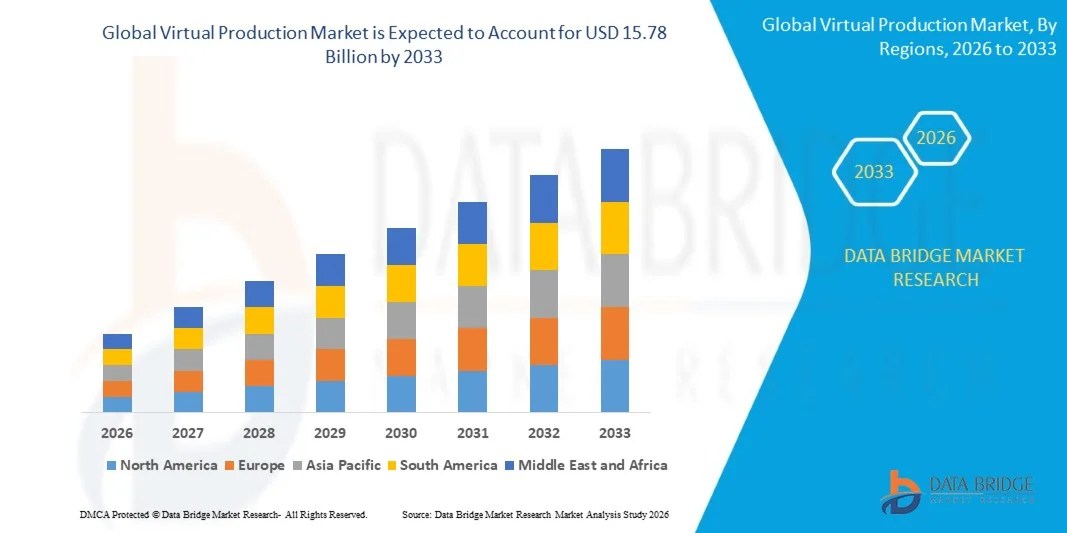
- As per Data Bridge Market Research Analysis the global virtual production market size was valued at USD 2.89 Billion in 2025 and is expected to reach USD 15.78 Billion by 2033, at a CAGR of 23.63% during the forecast period
- Rising demand is driven by the need for high-quality, real-time visual content in film, television, and gaming industries, growing adoption of LED walls and motion capture technologies, increasing integration of virtual and augmented reality (VR/AR) in production pipelines, expansion of cloud-based rendering and real-time collaboration tools, and the rising focus on cost- and time-efficient production processes
Market Size and Forecast:
- Global Market Value (2025): USD 2.89 Billion
- Expected Market Value (2033): USD 15.78 Billion
- Forecast CAGR (2026–2033): 23.63%
What are the Major Takeaways of Virtual Production Market?
- Growing adoption of virtual production solutions among studios, independent filmmakers, and game developers across developed and developing regions is creating substantial growth opportunities for the market
- Increasing investment in training, skilled workforce development, and advanced production infrastructure will further enhance market expansion
- Challenges include high initial capital expenditure, complex system integration, and limited availability of skilled personnel for operating advanced virtual production technologies, which may restrain market growth
- North America dominated the virtual production market with a 41.69% revenue share in 2025, driven by strong growth in film & TV production, advanced adoption of real-time rendering tools, rapid expansion of virtual studios, and increasing use of XR stages across the U.S. and Canada
- Asia-Pacific is projected to register the fastest CAGR of 9.64% from 2026 to 2033, driven by rapid expansion in film and OTT content creation, strong gaming and animation industries, and rising adoption of LED walls and XR-based virtual studios in China, Japan, India, and South Korea
- The Hardware segment dominated the market with a 45.2% share in 2025, driven by widespread adoption of LED volumes, camera tracking systems, motion capture equipment, and high-performance GPU setups across film studios, broadcast houses, and gaming companies
Report Scope and Virtual Production Market Segmentation
|
Attributes |
Virtual Production Key Market Insights |
|
Segments Covered |
|
|
Countries Covered |
North America
Europe
Asia-Pacific
Middle East and Africa
South America
|
|
Key Market Players |
|
|
Market Opportunities |
|
|
Value Added Data Infosets |
In addition to the insights on market scenarios such as market value, growth rate, segmentation, geographical coverage, and major players, the market reports curated by the Data Bridge Market Research also include in-depth expert analysis, pricing analysis, brand share analysis, consumer survey, demography analysis, supply chain analysis, value chain analysis, raw material/consumables overview, vendor selection criteria, PESTLE Analysis, Porter Analysis, and regulatory framework. |
What is the Key Trend in the Virtual Production Market?
“Increasing Adoption of Real-Time, LED Volume, and Cloud-Integrated Virtual Production Technologies”
- The virtual production market is witnessing growing adoption of LED walls, real-time rendering engines, and cloud-integrated production pipelines designed to accelerate filmmaking, gaming, and media content creation
- Manufacturers are introducing flexible, modular, and camera-tracked LED volume solutions that allow dynamic backgrounds, immersive environments, and real-time visual effects integration
- Rising demand for cost-effective, scalable, and collaborative virtual production setups is driving usage across film studios, broadcast houses, advertising agencies, and gaming companies
- For instance, companies such as Epic Games, Adobe, Autodesk, and Unreal Engine have enhanced their virtual production solutions with real-time compositing, cloud rendering, and AI-assisted animation features
- Increasing need for faster production cycles, remote collaboration, and high-quality visual storytelling is accelerating the shift toward PC- and cloud-based virtual production platforms
- As media and entertainment increasingly rely on real-time visualization and immersive content, Virtual Productions are expected to remain central to creative workflows and production efficiency
What are the Key Drivers of Virtual Production Market?
- Rising demand for real-time, cost-efficient, and high-fidelity virtual production platforms to accelerate film, broadcast, and gaming content creation
- For instance, in 2025, leading companies such as Epic Games, Adobe, and Autodesk upgraded their solutions to support LED volume integration, cloud rendering, and AI-powered animation workflows
- Growing adoption of immersive technologies, virtual sets, and remote production across the U.S., Europe, and Asia-Pacific is boosting market demand
- Advancements in GPU processing, real-time rendering engines, AI-driven animation, and collaborative cloud platforms have strengthened performance, scalability, and production efficiency
- Rising use of mixed reality, metaverse content, and interactive storytelling is creating demand for integrated virtual production pipelines
- Supported by steady investments in media studios, cloud infrastructure, and real-time visualization tools, the virtual production market is expected to experience strong long-term growth
Which Factor is Challenging the Growth of the Virtual Production Market?
- High costs associated with LED volume setups, motion tracking systems, and cloud rendering platforms limit adoption among small studios and independent content creators
- For instance, during 2024–2025, fluctuations in GPU and LED panel prices, software licensing costs, and cloud computing expenses increased operational budgets for several global providers
- Complexity in operating LED walls, integrating camera tracking, and managing real-time rendering pipelines increases the need for skilled professionals and specialized training
- Limited awareness in emerging markets regarding virtual production workflows, hardware integration, and cloud rendering options slows adoption
- Competition from traditional production methods, green screen setups, and lower-cost virtual set solutions creates pricing pressure and reduces differentiation
- To address these challenges, companies are focusing on modular LED systems, cloud-based pipelines, AI-assisted workflows, and training resources to expand global adoption of virtual productions
How is the Virtual Production Market Segmented?
The market is segmented on the basis of offering, type, and end user.
• By Offering
On the basis of offering, the virtual production market is segmented into Hardware, Software, and Services. The Hardware segment dominated the market with a 45.2% share in 2025, driven by widespread adoption of LED volumes, camera tracking systems, motion capture equipment, and high-performance GPU setups across film studios, broadcast houses, and gaming companies. Hardware solutions provide high-fidelity real-time rendering, enhanced visual effects integration, and immersive production capabilities, making them essential for modern media workflows.
The Services segment is projected to grow at the fastest CAGR from 2026 to 2033, supported by rising demand for cloud rendering, virtual production consulting, technical support, and training services. As studios increasingly adopt LED walls, virtual sets, and cloud pipelines, professional services become crucial for seamless implementation, workflow optimization, and remote collaboration.
• By Type
On the basis of type, the market is segmented into Pre-production, Production, and Post-production. The Production segment dominated with a 51.3% share in 2025, fueled by extensive use of real-time LED volumes, camera tracking, and virtual set integration for filming, live events, and broadcast content. Production workflows benefit from faster rendering, interactive visualization, and immediate feedback for creative teams.
The Post-production segment is projected to grow at the fastest CAGR from 2026 to 2033, driven by adoption of cloud-based compositing, real-time editing, and AI-assisted visual effects. Increasing demand for remote collaboration, rapid turnaround, and high-quality finishing in films, TV, and gaming accelerates investment in post-production virtual production solutions.
• By End User
On the basis of end user, the market is segmented into Automotive and Transportation, Aerospace and Defence, IT and Telecommunications, Education and Government, Electronics and Semiconductor, Industrial, and Healthcare. The Electronics and Semiconductor segment dominated with a 38.7% share in 2025, supported by high adoption of virtual production for training simulations, interactive visualization, product demonstrations, and digital prototyping.
The Automotive and Transportation segment is projected to grow at the fastest CAGR from 2026 to 2033, driven by increasing use of virtual production for vehicle design visualization, training simulators, autonomous vehicle testing, and immersive infotainment content. Rising adoption of high-fidelity rendering, interactive environments, and real-time simulation solutions is accelerating deployment across automotive and transportation sectors globally.
Which Region Holds the Largest Share of the Virtual Production Market?
- North America dominated the virtual production market with a 41.69% revenue share in 2025, driven by strong growth in film & TV production, advanced adoption of real-time rendering tools, rapid expansion of virtual studios, and increasing use of XR stages across the U.S. and Canada. High investment in LED walls, camera-tracking systems, and virtual sets continues to accelerate the adoption of virtual production across entertainment, advertising, gaming, and live events
- Leading companies in North America are introducing advanced real-time engines, volumetric capture systems, and AI-driven production workflows, strengthening the region’s technological edge in cinematic content creation. Continuous expansion of Hollywood studios, gaming hubs, and OTT content creators further supports long-term growth
- Strong infrastructure, availability of skilled VFX artists, and the presence of major technology players reinforce the region’s leadership in global virtual production innovation
U.S. Virtual Production Market Insight
The U.S. is the largest contributor in North America, driven by strong demand from Hollywood studios, rapid adoption of LED-volume stages, and widespread use of real-time VFX pipelines. Increasing investments in high-budget films, streaming content, esports, and commercial shoots fuel demand for advanced virtual production solutions. The presence of leading engine developers, virtual studio builders, and tech innovators further strengthens market dominance. Expanding applications in automotive advertising, corporate training, and immersive media continue to boost adoption across industries.
Canada Virtual Production Market Insight
Canada contributes significantly to the regional market, supported by growing film production hubs in Toronto, Vancouver, and Montreal. Increasing adoption of real-time rendering tools, camera tracking systems, and motion capture technology drives strong market growth. Government-backed film incentives, skilled VFX talent, and expanding gaming and animation industries further enhance adoption. Rising demand for virtual sets in advertising, episodic content, and indie filmmaking strengthens Canada’s footprint in the North American market.
Asia-Pacific Virtual Production Market
Asia-Pacific is projected to register the fastest CAGR of 9.64% from 2026 to 2033, driven by rapid expansion in film and OTT content creation, strong gaming and animation industries, and rising adoption of LED walls and XR-based virtual studios in China, Japan, India, and South Korea. Large-scale production of movies, TV shows, live entertainment, and digital advertising is accelerating the shift toward real-time virtual workflows. Growth in 5G, AI-based VFX, and advanced display technologies further strengthens regional market expansion.
China Virtual Production Market Insight
China is the largest contributor in Asia-Pacific, supported by booming film production, strong government backing for digital entertainment, and rising demand for high-end VFX and virtual sets. Large studios are rapidly adopting LED stages, real-time engines, and volumetric capture systems for films, gaming, and online content. Strong manufacturing capabilities for LED panels and motion tracking systems also support domestic and export growth.
Japan Virtual Production Market Insight
Japan exhibits steady growth driven by advancements in robotics, precision imaging, and high-end animation industries. Strong demand for virtual studios in broadcasting, gaming, and commercial production accelerates technology adoption. Japan’s focus on ultra-high-quality content creation, low-latency systems, and real-time rendering strengthens the country’s position as a premium market for virtual production tools.
India Virtual Production Market Insight
India is emerging as a major growth hub, fueled by rapid expansion of Bollywood and regional film industries, rising OTT content creation, and growing interest in affordable virtual studio solutions. Increasing use of real-time engines, motion capture, and green-screen virtual sets in films, advertisements, and brand content is driving strong adoption. Government support for digital media and expanding VFX/animation talent pools further accelerate market penetration.
South Korea Virtual Production Market Insight
South Korea contributes significantly due to strong demand from K-drama, K-pop, gaming, and advertising sectors. Rapid development of immersive entertainment, advanced display technologies, and high-performance real-time engines drives adoption of LED-based virtual production systems. Strong innovation ecosystems and continued investment in digital media infrastructure support sustained market expansion.
Which are the Top Companies in Virtual Production Market?
The virtual production industry is primarily led by well-established companies, including:
- Adobe (U.S.)
- Autodesk (U.S.)
- Epic Games (U.S.)
- NVIDIA (U.S.)
- Pixar (U.S.)
- 360Rize (U.S.)
- Arashi Vision Inc (China)
- BORIS FX, INC (U.S.)
- HTC Corporation (Taiwan)
- Mo-Sys Engineering Ltd. (U.K.)
- Panocam3d.com (U.S.)
- Side Effects Software Inc (Canada)
- Technicolor (France)
- Vicon Motion Systems Ltd. (U.K.)
What are the Recent Developments in Global Virtual Production Market?
- In July 2023, ROE Visual announced a strategic partnership with Illusion XR Studio, Pixotope, and AVI-SPL, aiming to execute an XR broadcast in Dubai to deliver immersive experiences and industry insights to content creators, film and TV professionals, broadcasters, and esports audiences, reinforcing its commitment to advancing next-generation virtual production technologies
- In July 2023, Mo-Sys unveiled the StarTracker Max, featuring enhanced real-time camera tracking capabilities designed to improve precision and accuracy for virtual production, filmmaking, and broadcast environments, strengthening Mo-Sys’s position as a leader in advanced camera tracking solutions
- In June 2023, Mo-Sys announced a collaboration with 3LR Lighting and Bendac, focused on demonstrating the capabilities of its newly introduced StarTracker Max solution, further expanding the company’s ecosystem presence and showcasing its technological innovation in virtual production workflows
- In May 2023, LG announced the launch of its micro-LED display, LG MAGNIT, developed for production studios to improve content creation with superior picture quality, simplified installation, and flexible control options, marking a significant enhancement in high-performance display solutions for professional production environments
- In May 2023, Autodesk introduced the advanced features of Autodesk Forma, its new industry cloud platform designed for early-stage planning and design with AI-driven automation and environmental intelligence, empowering architects to streamline workflows and dedicate more time to creative decision-making

- Interactive Data Analysis Dashboard
- Company Analysis Dashboard for high growth potential opportunities
- Research Analyst Access for customization & queries
- Competitor Analysis with Interactive dashboard
- Latest News, Updates & Trend analysis
- Harness the Power of Benchmark Analysis for Comprehensive Competitor Tracking
Global Virtual Production Market, Supply Chain Analysis and Ecosystem Framework
To support market growth and help clients navigate the impact of geopolitical shifts, DBMR has integrated in-depth supply chain analysis into its Global Virtual Production Market research reports. This addition empowers clients to respond effectively to global changes affecting their industries. The supply chain analysis section includes detailed insights such as Global Virtual Production Market consumption and production by country, price trend analysis, the impact of tariffs and geopolitical developments, and import and export trends by country and HSN code. It also highlights major suppliers with data on production capacity and company profiles, as well as key importers and exporters. In addition to research, DBMR offers specialized supply chain consulting services backed by over a decade of experience, providing solutions like supplier discovery, supplier risk assessment, price trend analysis, impact evaluation of inflation and trade route changes, and comprehensive market trend analysis.
Data collection and base year analysis are done using data collection modules with large sample sizes. The stage includes obtaining market information or related data through various sources and strategies. It includes examining and planning all the data acquired from the past in advance. It likewise envelops the examination of information inconsistencies seen across different information sources. The market data is analysed and estimated using market statistical and coherent models. Also, market share analysis and key trend analysis are the major success factors in the market report. To know more, please request an analyst call or drop down your inquiry.
The key research methodology used by DBMR research team is data triangulation which involves data mining, analysis of the impact of data variables on the market and primary (industry expert) validation. Data models include Vendor Positioning Grid, Market Time Line Analysis, Market Overview and Guide, Company Positioning Grid, Patent Analysis, Pricing Analysis, Company Market Share Analysis, Standards of Measurement, Global versus Regional and Vendor Share Analysis. To know more about the research methodology, drop in an inquiry to speak to our industry experts.
Data Bridge Market Research is a leader in advanced formative research. We take pride in servicing our existing and new customers with data and analysis that match and suits their goal. The report can be customized to include price trend analysis of target brands understanding the market for additional countries (ask for the list of countries), clinical trial results data, literature review, refurbished market and product base analysis. Market analysis of target competitors can be analyzed from technology-based analysis to market portfolio strategies. We can add as many competitors that you require data about in the format and data style you are looking for. Our team of analysts can also provide you data in crude raw excel files pivot tables (Fact book) or can assist you in creating presentations from the data sets available in the report.













