


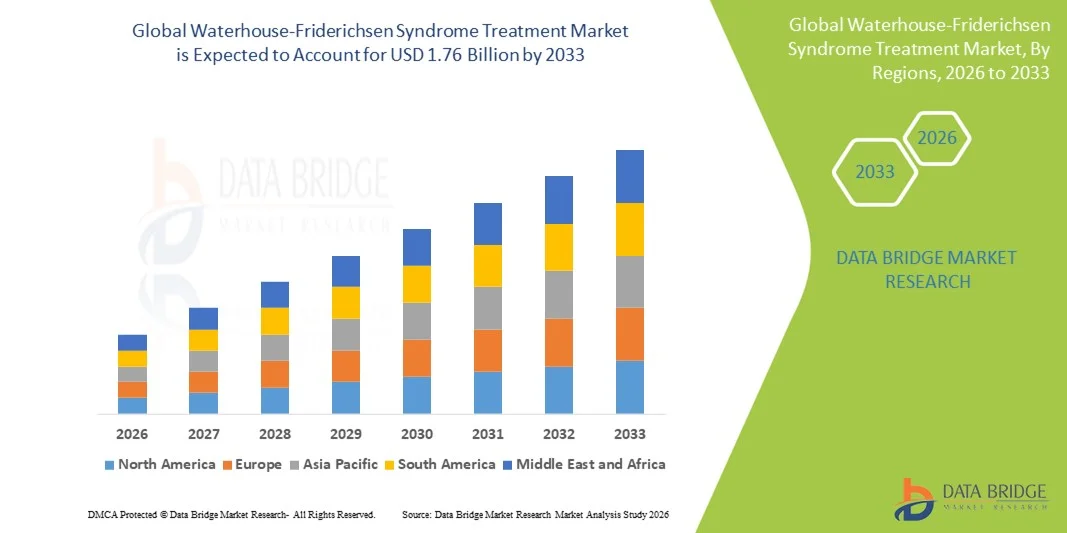
Waterhouse-Friderichsen Syndrome Treatment Market Size
- The global Waterhouse-Friderichsen Syndrome treatment market size was valued at USD 1.21 billion in 2025 and is expected to reach USD 1.76 billion by 2033, at a CAGR of 5.00% during the forecast period
- The market growth is mainly driven by increasing awareness, better-defined reimbursement frameworks and rising healthcare affordability in key regions
- The increasing prevalence of the syndrome, particularly in emerging markets, due to improved diagnostics and healthcare access is contributing to market expansion, Also, R&D efforts by pharmaceutical companies are creating opportunities for better or more targeted therapies
Waterhouse-Friderichsen Syndrome Treatment Market Analysis
- Waterhouse‑Friderichsen Syndrome treatment market focuses on managing a rare and life-threatening condition, also referred to as Fatal Pneumococcal Waterhouse-Friderichsen Syndrome, characterized by adrenal gland failure triggered by severe bacterial infections. Treatment involves rapid antibiotic therapy, corticosteroid replacement, and intensive supportive care
- The escalating demand for Waterhouse‑Friderichsen Syndrome treatment is primarily fueled by growing awareness of the syndrome, improved sepsis detection, and better access to emergency and critical care facilities across both developed and emerging markets
- North America dominated the Waterhouse‑Friderichsen Syndrome treatment market with the largest revenue share in 2025, accounting for 42.5%, driven by advanced critical care infrastructure, high healthcare expenditure, and strong adoption of intensive treatment protocols, particularly in hospitals and emergency care units in the U.S.
- Asia-Pacific is expected to be the fastest-growing region in the Waterhouse‑Friderichsen Syndrome treatment market during the forecast period due to rising healthcare investments, expansion of intensive care units, and increasing medical research initiatives related to rare adrenal insufficiency disorders
- Septic Shock segment dominated the market in 2025 with a share of 46.8%, due to its critical impact on patient survival and prioritization in intensive treatment protocols
Report Scope and Waterhouse-Friderichsen Syndrome Treatment Market Segmentation
|
Attributes |
Waterhouse-Friderichsen Syndrome Treatment Key Market Insights |
|
Segments Covered |
|
|
Countries Covered |
North America
Europe
Asia-Pacific
Middle East and Africa
South America
|
|
Key Market Players |
|
|
Market Opportunities |
|
|
Value Added Data Infosets |
In addition to the insights on market scenarios such as market value, growth rate, segmentation, geographical coverage, and major players, the market reports curated by the Data Bridge Market Research also include in-depth expert analysis, patient epidemiology, pipeline analysis, pricing analysis, and regulatory framework |
Waterhouse-Friderichsen Syndrome Treatment Market Trends
Advancements in Rapid Diagnosis and Critical Care Integration
- A significant and accelerating trend in the Waterhouse‑Friderichsen Syndrome treatment market is the integration of rapid diagnostic tools and AI-assisted monitoring in critical care settings, improving early detection and patient survival
- For instance, point-of-care adrenal function tests enable ICU clinicians to quickly identify adrenal insufficiency, allowing timely corticosteroid replacement and supportive interventions
- AI integration in treatment protocols enables features such as predictive alerts for septic shock onset and monitoring vital signs to optimize therapy decisions, with systems notifying clinicians of critical changes in patient condition
- The seamless integration of diagnostic tools with electronic health records (EHR) and ICU monitoring systems facilitates centralized patient management, enabling coordinated intervention for adrenal crises alongside other critical conditions
- This trend towards smarter, faster, and more interconnected critical care management is fundamentally reshaping treatment protocols for WFS, with companies developing AI-enabled decision support systems to guide therapy in real time
- The demand for treatment solutions that offer rapid detection, predictive monitoring, and integrated ICU workflow support is growing rapidly, as healthcare providers prioritize survival outcomes and treatment efficiency in rare adrenal failure cases
- Increasing collaborations between diagnostic tool manufacturers and hospital networks are driving adoption of automated adrenal crisis detection platforms, improving ICU workflow efficiency
- Integration of telemedicine solutions in ICU care is emerging as a trend, enabling remote monitoring and expert consultation for WFS patients in regions with limited specialist availability
Waterhouse-Friderichsen Syndrome Treatment Market Dynamics
Driver
Growing Need Due to Rising Sepsis Awareness and Critical Care Access
- The increasing prevalence of severe bacterial infections and rising awareness of adrenal crises is a significant driver for the heightened demand for WFS treatment
- For instance, in March 2025, a hospital group in North America implemented rapid adrenal function screening in ICU patients with sepsis, improving early corticosteroid administration and patient outcomes
- As clinicians become more aware of potential adrenal insufficiency during septic shock, treatment protocols involving prompt steroid replacement, fluid resuscitation, and antibiotic therapy provide life-saving interventions
- Furthermore, expansion of ICU capacity and critical care accessibility in emerging markets is making WFS treatment increasingly available, with specialized protocols being integrated into standard sepsis management guidelines
- The adoption of standardized treatment algorithms, early warning scoring systems, and real-time monitoring for adrenal crises is propelling the use of intensive treatment approaches across hospitals globally
- Increasing funding and grants for rare adrenal disease research are driving development of improved therapeutic protocols and emergency care strategies
- Growing awareness campaigns by medical associations and rare disease networks are promoting timely diagnosis and early intervention, further boosting demand for WFS treatment
Restraint/Challenge
Limited Patient Pool and High Treatment Complexity
- The rarity and acute nature of WFS pose a significant challenge to broader market growth, as the limited patient pool reduces commercial incentive for large-scale therapy development
- For instance, high-acuity cases often require ICU-level care, specialized diagnostic tests, and multidisciplinary intervention, which are not widely available in all regions, limiting market penetration
- Addressing these challenges through improved clinician training, broader ICU availability, and development of standardized rapid-diagnosis protocols is crucial for expanding market access
- In addition, high costs associated with intensive care, corticosteroid therapy, and advanced monitoring tools can be a barrier to treatment adoption, particularly in low-resource healthcare settings
- Overcoming these constraints through healthcare infrastructure investment, cost-effective diagnostic solutions, and increased awareness of adrenal crisis management will be vital for sustained growth of the WFS treatment market
- Variability in regulatory approvals for emergency interventions across regions can delay market expansion and adoption of standardized WFS therapies
- Limited availability of specialized ICU staff trained in adrenal crisis management further restricts treatment scalability in emerging markets
Waterhouse-Friderichsen Syndrome Treatment Market Scope
The market is segmented on the basis of synonyms and symptoms.
- By Synonyms
On the basis of synonyms, the Waterhouse–Friderichsen Syndrome treatment market is segmented into fatal pneumococcal waterhouse-friderichsen syndrome and waterhouse-friderichsen syndrome. the Waterhouse-Friderichsen Syndrome segment dominated the market with the largest revenue share in 2025, driven by its broader recognition in clinical practice and medical literature. Healthcare providers and hospitals often prioritize protocols and treatment guidelines under this synonym, leading to higher adoption of intensive care and corticosteroid therapy. The dominance is also supported by standardized diagnostic procedures and reporting systems that reference this term, enhancing consistency in treatment application. Furthermore, awareness campaigns, clinical training, and research studies frequently use “Waterhouse-Friderichsen Syndrome,” which strengthens its prevalence in hospital settings. The segment also benefits from robust critical care infrastructure in regions such as North America and Europe, where most documented cases are treated. Finally, the segment sees significant demand due to its use in medical coding and insurance reimbursement frameworks, facilitating financial support for life-saving interventions.
The Fatal Pneumococcal Waterhouse-Friderichsen Syndrome segment is expected to witness the fastest growth rate from 2026 to 2033, driven by increasing incidence of severe bacterial infections and rising awareness among critical care providers. For instance, hospitals are integrating rapid sepsis and adrenal function screening protocols specifically for pneumococcal infections to reduce mortality. The segment growth is also supported by advances in pathogen-specific antibiotic therapy and ICU supportive care, which improve patient survival rates. Growing clinical research in rare pneumococcal cases further fuels adoption, alongside the development of targeted treatment guidelines for high-risk patients. In addition, awareness of pneumococcal vaccination and early intervention strategies is increasing in emerging markets, contributing to faster uptake. Technological integration with ICU monitoring systems and predictive algorithms for septic shock further enhances the efficacy and adoption of treatments under this synonym.
- By Symptoms
On the basis of symptoms, the Waterhouse–Friderichsen Syndrome treatment market is segmented into fever, petechiae, septic shock, and disseminated intravascular coagulation (DIC). The Septic Shock segment dominated the market in 2025 with a market share of 46.8% due to its critical impact on patient survival and prioritization in intensive treatment protocols. Septic shock drives the need for rapid intervention with corticosteroids, antibiotics, and fluid resuscitation, making it the most resource-intensive and widely treated symptom. Hospitals and ICUs often focus protocols and monitoring systems around septic shock recognition, which elevates treatment adoption for this segment. In addition, standardized early warning scores and predictive ICU monitoring tools are frequently used for septic shock, increasing clinical focus. The segment also benefits from robust reimbursement policies and critical care funding, especially in developed markets. Moreover, clinical training programs emphasize management of septic shock in adrenal crises, further strengthening the segment’s dominance.
The Petechiae segment is expected to witness the fastest growth from 2026 to 2033, driven by increasing recognition of skin manifestations as early indicators of adrenal hemorrhage and systemic infection. For instance, dermatological screening protocols in emergency departments help clinicians detect petechiae early, enabling timely intervention. The segment growth is also supported by awareness campaigns highlighting subtle physical signs in sepsis patients, which improves early diagnosis rates. In addition, emerging markets are adopting training modules to help frontline healthcare workers identify petechiae and refer patients promptly for intensive care. Technological integration with AI-assisted visual recognition tools is further accelerating adoption. The growing focus on early detection of adrenal crisis and sepsis in pediatric and adult populations also contributes to the rising importance of this segment.
Waterhouse-Friderichsen Syndrome Treatment Market Regional Analysis
- North America dominated the Waterhouse‑Friderichsen Syndrome treatment market with the largest revenue share in 2025, accounting for 42.5%, driven by advanced critical care infrastructure, high healthcare expenditure, and strong adoption of intensive treatment protocols, particularly in hospitals and emergency care units in the U.S.
- Healthcare providers in the region highly value the availability of rapid diagnostic tools, ICU-level monitoring, and standardized treatment guidelines, which enable timely corticosteroid replacement and intensive supportive care for WFS patients
- This widespread adoption is further supported by strong awareness of rare adrenal disorders, robust reimbursement frameworks, and a growing emphasis on hospital-based emergency care, establishing North America as a leading market for WFS treatment in both adult and pediatric populations
U.S. Waterhouse-Friderichsen Syndrome Treatment Market Insight
The U.S. Waterhouse–Friderichsen Syndrome treatment market captured the largest revenue share in 2025 within North America, fueled by advanced ICU infrastructure, high awareness of adrenal crises, and widespread adoption of rapid sepsis and adrenal function screening protocols. Healthcare providers are increasingly prioritizing early detection and intensive supportive care to improve patient survival. The growing integration of AI-assisted monitoring, electronic health records, and tele-ICU services further propels the market. Moreover, strong reimbursement frameworks and hospital protocols supporting corticosteroid therapy contribute significantly to market expansion.
Europe Waterhouse–Friderichsen Syndrome Treatment Market Insight
The Europe Waterhouse–Friderichsen Syndrome treatment market is projected to expand at a substantial CAGR throughout the forecast period, primarily driven by well-established healthcare systems, stringent ICU protocols, and increasing awareness of adrenal insufficiency. Rising urbanization and the need for rapid intervention in sepsis-related adrenal crises are fostering adoption. European hospitals are incorporating treatment protocols into both adult and pediatric care, with focus on early diagnosis and standardized corticosteroid therapy. The region is experiencing significant growth across public hospitals, private healthcare facilities, and specialized critical care centers.
U.K. Waterhouse–Friderichsen Syndrome Treatment Market Insight
The U.K. Waterhouse–Friderichsen Syndrome treatment market is anticipated to grow at a noteworthy CAGR during the forecast period, driven by rising awareness of adrenal crises and increasing prevalence of severe bacterial infections. Concerns regarding mortality from septic shock and adrenal insufficiency are encouraging hospitals to adopt rapid diagnostic tests and standardized treatment protocols. The U.K.’s advanced healthcare infrastructure, coupled with robust research initiatives and clinical training programs, is expected to continue stimulating market growth in both hospital and ICU settings.
Germany Waterhouse–Friderichsen Syndrome Treatment Market Insight
The Germany Waterhouse–Friderichsen Syndrome treatment market is expected to expand at a considerable CAGR during the forecast period, fueled by growing awareness of rare adrenal disorders and the emphasis on advanced ICU and emergency care facilities. Germany’s well-developed healthcare system, combined with focus on precision medicine and critical care innovation, promotes adoption. Hospitals are increasingly integrating rapid adrenal function tests and AI-assisted monitoring to manage adrenal crises effectively. The integration of treatment protocols with hospital workflow management systems is becoming prevalent, aligning with the country’s healthcare standards.
Asia-Pacific Waterhouse–Friderichsen Syndrome Treatment Market Insight
The Asia-Pacific Waterhouse–Friderichsen Syndrome treatment market is poised to grow at the fastest CAGR during the forecast period of 2026 to 2033, driven by rising healthcare investments, expanding ICU capacity, and increasing awareness of sepsis-related adrenal insufficiency in countries such as China, Japan, and India. The region’s growing inclination towards early detection and intensive treatment, supported by government health initiatives, is driving adoption. Furthermore, increasing telemedicine integration, rapid adrenal testing, and development of standardized treatment protocols are expanding access to critical care.
Japan Waterhouse–Friderichsen Syndrome Treatment Market Insight
The Japan Waterhouse–Friderichsen Syndrome treatment market is gaining momentum due to the country’s high-tech healthcare infrastructure, advanced ICU systems, and focus on patient survival in adrenal crises. Hospitals are adopting AI-assisted monitoring and rapid sepsis detection tools to improve outcomes. The Japanese market emphasizes early intervention, integration with electronic health records, and comprehensive supportive care, driving growth. Moreover, the aging population is such likely to increase demand for efficient and easily administered adrenal crisis treatments in both residential care and hospital settings.
India Waterhouse–Friderichsen Syndrome Treatment Market Insight
The India Waterhouse–Friderichsen Syndrome treatment market accounted for the largest market revenue share in Asia-Pacific in 2025, attributed to rising awareness of rare adrenal disorders, expanding ICU infrastructure, and government initiatives to improve critical care access. India is emerging as a hub for early sepsis detection and adrenal insufficiency management, and treatment adoption is increasing in hospitals, emergency care units, and specialty clinics. Affordable diagnostic solutions, telemedicine integration, and healthcare workforce training are key factors propelling the market in India
Waterhouse-Friderichsen Syndrome Treatment Market Share
The Waterhouse-Friderichsen Syndrome Treatment industry is primarily led by well-established companies, including:
- Pfizer Inc., (U.S.)
- Merck & Co., Inc., (U.S.)
- Novartis AG (Switzerland)
- Takeda Pharmaceutical Company Limited (Japan)
- Sanofi (France)
- GSK plc (U.K.)
- Sandoz Group AG (Switzerland)
- Teva Pharmaceutical Industries Ltd (Israel)
- Amphastar Pharmaceuticals, Inc (U.S.)
- Viatris Inc. (U.S.)
- Hikma Pharmaceuticals PLC (U.K.)
- Amneal Pharmaceuticals LLC. (U.S.)
- Eton Pharmaceuticals. (U.S.)
- Cerata Pharmaceuticals LLP (India)
- Taj Pharma India Ltd., (India)
- Mallinckrodt Pharmaceuticals plc (Ireland)
- Lupin (India)
- Aurobindo Pharma Limited (India)
- Sun Pharmaceutical Industries Ltd (India)
What are the Recent Developments in Global Waterhouse-Friderichsen Syndrome Treatment Market?
- In March 2025, a case report described a young woman who died of bilateral adrenal hemorrhage and hemophagocytosis, triggered by Escherichia coli sepsis an unusual pathogen for Waterhouse–Friderichsen Syndrome. The authors noted how E. coli can cause both severe inflammatory activation (hemophagocytic lymphohistiocytosis) and adrenal hemorrhage, demonstrating a more complex disease mechanism than the classic meningococcal WFS
- In February 2023, a case was reported of WFS occurring in an asplenic patient following a seemingly minor dog bite, caused by Capnocytophaga canimorsus. Despite aggressive critical-care interventions, the patient developed septic shock and disseminated intravascular coagulation (DIC), underlining the risk of this pathogen in immunocompromised individuals and the need for swift diagnosis
- In August 2022, a fatal case of WFS was documented in a 61-year-old asplenic woman caused by C. canimorsus bacteremia, with post-mortem findings of bilateral adrenal necrosis. This case reinforced that even with intensive interventions mechanical ventilation, broad-spectrum antibiotics, corticosteroids, extracorporeal support prognosis remains extremely poor, emphasizing how critical early recognition and targeted antimicrobial coverage are
- In July 2022, clinicians reported a COVID-19–associated hyperinflammatory syndrome in an infant (8 weeks old) that mimicked WFS. The infant was successfully treated with cortisone and tocilizumab, resulting in full recovery. This suggests a potential role for immunomodulatory therapy in managing adrenal crises in hyperinflammatory states, not just bacterial sepsis
- In April 2022, a case report detailed Waterhouse–Friderichsen Syndrome associated with methicillin-resistant Staphylococcus aureus (MRSA) bacteremia in an adult intravenous drug user. The authors emphasized that adrenal hemorrhage can follow more common bacterial bloodstream infections, and that clinicians need heightened suspicion for acute adrenal insufficiency even in non‑meningococcal sepsis

- Interactive Data Analysis Dashboard
- Company Analysis Dashboard for high growth potential opportunities
- Research Analyst Access for customization & queries
- Competitor Analysis with Interactive dashboard
- Latest News, Updates & Trend analysis
- Harness the Power of Benchmark Analysis for Comprehensive Competitor Tracking
Data collection and base year analysis are done using data collection modules with large sample sizes. The stage includes obtaining market information or related data through various sources and strategies. It includes examining and planning all the data acquired from the past in advance. It likewise envelops the examination of information inconsistencies seen across different information sources. The market data is analysed and estimated using market statistical and coherent models. Also, market share analysis and key trend analysis are the major success factors in the market report. To know more, please request an analyst call or drop down your inquiry.
The key research methodology used by DBMR research team is data triangulation which involves data mining, analysis of the impact of data variables on the market and primary (industry expert) validation. Data models include Vendor Positioning Grid, Market Time Line Analysis, Market Overview and Guide, Company Positioning Grid, Patent Analysis, Pricing Analysis, Company Market Share Analysis, Standards of Measurement, Global versus Regional and Vendor Share Analysis. To know more about the research methodology, drop in an inquiry to speak to our industry experts.
Data Bridge Market Research is a leader in advanced formative research. We take pride in servicing our existing and new customers with data and analysis that match and suits their goal. The report can be customized to include price trend analysis of target brands understanding the market for additional countries (ask for the list of countries), clinical trial results data, literature review, refurbished market and product base analysis. Market analysis of target competitors can be analyzed from technology-based analysis to market portfolio strategies. We can add as many competitors that you require data about in the format and data style you are looking for. Our team of analysts can also provide you data in crude raw excel files pivot tables (Fact book) or can assist you in creating presentations from the data sets available in the report.












