What is the Waterproof Breathable Textiles (WBT) Market Size and Growth Rate?
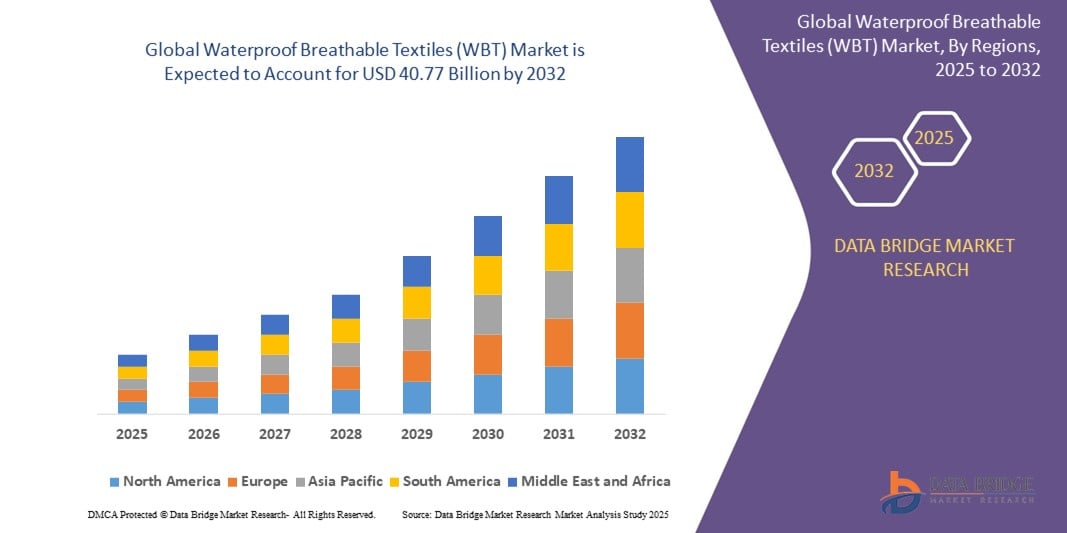
- As per Data Bridge Market Research Analysis the global waterproof breathable textiles (WBT) market size was valued at USD 24.82 billion in 2024 and is expected to reach USD 40.77 billion by 2032, at a CAGR of 6.40% during the forecast period
- The Market growth is primarily driven by increasing demand for lightweight, durable, and weather-resistant fabrics in outdoor apparel, sports goods, and protective clothing, coupled with rising consumer awareness of performance-driven textile
- Growing applications in healthcare and mobitech sectors, along with advancements in smart and biomimetic fabrics, are further propelling market expansion
Market Size & Forecast
Global Market Value (2024): USD 24.82 billion
Expected Market Value (2032): USD 40.77 billion
Forecast CAGR (2025–2032): 6.40%
What are the Major Takeaways of Waterproof Breathable Textiles (WBT) Market?
- The waterproof breathable textiles market is experiencing robust growth due to rising consumer preference for high-performance textiles that offer comfort, breathability, and protection against environmental elements
- The demand for eco-friendly and sustainable fabrics, particularly those made from recyclable materials such as polyester and polyurethane, is encouraging manufacturers to innovate with advanced membrane and coating technologies
- Asia-Pacific dominates the revenue growth of the waterproof breathable textiles market, holding the largest revenue share of 36.1% in 2024, driven by a strong presence of textile manufacturers, increasing demand for outdoor and sports apparel, and growth in the automotive OEM market
- Europe is projected to be the fastest-growing region during the forecast period, fueled by rising adoption of advanced textiles in protective clothing, healthcare, and hometech applications, along with stringent regulations promoting sustainable and high-performance materials
- The membrane segment holds the largest market revenue share of 65% in 2024, supported by the widespread use of microporous and hydrophilic membranes in outdoor and protective clothing due to their superior breathability and waterproofing properties
Report Scope and Waterproof Breathable Textiles (WBT) Market Segmentation
|
Attributes |
Waterproof Breathable Textiles (WBT) Key Market Insights |
|
Segments Covered |
|
|
Countries Covered |
North America
Europe
Asia-Pacific
Middle East and Africa
South America
|
|
Key Market Players |
|
|
Market Opportunities |
|
|
Value Added Data Infosets |
In addition to the insights on market scenarios such as market value, growth rate, segmentation, geographical coverage, and major players, the market reports curated by the Data Bridge Market Research also include in-depth expert analysis, geographically represented company-wise production and capacity, network layouts of distributors and partners, detailed and updated price trend analysis and deficit analysis of supply chain and demand. |
What is the Key Trend in the Waterproof Breathable Textiles (WBT) Market?
“Rising Preference for Advanced Membrane-Based WBT”
- Microporous and hydrophilic membranes are gaining traction due to their superior balance of waterproofing and breathability, ensuring comfort in extreme weather condition
- These membranes allow moisture vapor to escape while preventing water penetration, making them ideal for high-performance outdoor and sports apparel
- In regions with diverse climates, such as Asia Pacific, these textiles are favored for their versatility in applications such as sportswear and protective clothing
- Luxury outdoor brands, such as The North Face and Patagonia, are increasingly incorporating combination microporous and hydrophilic membranes to enhance functionality and appeal to premium buyers.
- For instance, Gore-Tex, a leading brand in WBT, offers advanced membrane-based fabrics for outerwear, driving market demand
- Retailers and manufacturers are bundling WBT-based products as value-added options, particularly in premium sportswear and protective gear markets
Waterproof Breathable Textiles (WBT) Market Dynamics
Driver
“Growing Demand for High-Performance Outdoor and Protective Clothing”
- Rising consumer awareness of the need for comfort and protection in extreme weather is boosting demand for WBT in applications such as sportswear, protective clothing, and general apparel
- WBT fabrics provide moisture management, keeping users dry and comfortable by allowing sweat vapor to escape while blocking rain or wind, critical for outdoor activities in regions such as Asia Pacific and Europe
- These textiles enhance durability and safety in protective clothing, such as firefighting gear and medical attire, by offering breathability alongside liquid resistance
- The rise of sustainable and eco-friendly textiles, such as those made from recycled polyester or bio-based materials, aligns with consumer preferences for environmentally responsible products, further driving market growth
- Automotive OEMs in Asia Pacific, the dominant revenue-generating region, are integrating WBT into vehicle interiors, such as seat covers, to enhance passenger comfort and durability in premium models
Restraint/Challenge
“High Production Costs and Regulatory Standards”
- The high cost of advanced WBT materials, such as microporous membranes and smart breathable fabrics, limits their adoption in mass-market apparel, restricting market growth
- Stringent regulatory standards for textile production, particularly in Europe, impose restrictions on chemical usage and environmental impact, complicating manufacturing processes for WBT producers
- Compliance with certifications such as OEKO-TEX and Bluesign adds to production costs, deterring smaller manufacturers and limiting market scalability
- Inconsistent global standards for textile performance, such as breathability and waterproofing metrics, create challenges for manufacturers operating across regions such as Asia Pacific and Europe
- High costs and regulatory hurdles discourage widespread adoption in price-sensitive markets, potentially slowing the expansion of WBT applications in general clothing and accessories
How is the Waterproof Breathable Textiles (WBT) Market Segmented?
The market is segmented on the basis of type, raw material, form, fabric type, and application.
- By Type
On the basis of type, the market is segmented into closely woven fabrics, microporous membranes and coatings, hydrophilic membranes and coatings, combination of microporous and hydrophilic membranes and coatings, retroreflective microbeads, smart breathable fabrics, fabrics based on biomimetics, and others. The microporous membranes and coatings segment holds the largest market revenue share of 38.7% in 2024, driven by their superior waterproofing and breathability properties, making them ideal for outdoor and performance apparel. Their widespread use in sports and protective clothing further boosts their dominance.
The smart breathable fabrics segment is expected to witness the fastest growth rate of 13.3% from 2025 to 2032, fueled by advancements in wearable technology and increasing consumer demand for textiles that adapt to environmental conditions, enhancing comfort and functionality in applications such as sportswear and healthcare.
- By Raw Material
On the basis of raw material, the market is segmented into polyurethane, ePTFE, polyester, polypropylene, nylon, silk, wool, cotton, viscose rayon, high-density fabrics (HDF), and others. The ePTFE segment dominates with a market revenue share of 43.5% in 2024, owing to its exceptional durability, lightweight properties, and high performance in extreme weather conditions, making it a preferred choice for outdoor and military applications.
The polyurethane segment is projected to grow at the fastest rate of 12.5% from 2025 to 2032, driven by its versatility, cost-effectiveness, and increasing adoption in fashion and general clothing due to its ability to balance waterproofing and breathability.
- By Form
On the basis of form, the market is divided into laminated and coated forms. The laminated segment holds the largest market share of 60.3% in 2024, attributed to its enhanced durability and ability to integrate multiple layers for superior performance in demanding applications such as sportswear and protective clothing.
The coated segment is anticipated to experience the fastest growth rate of 10.9% from 2025 to 2032, driven by advancements in coating technologies that offer lightweight, flexible solutions for general clothing and accessories.
- By Fabric Type
On the basis of fabric type, the market is segmented into densely woven, membrane, and coated fabrics. The membrane segment leads with a revenue share of 55.7% in 2024, driven by its widespread use in high-performance applications such as outdoor gear and healthcare textiles due to its excellent breathability and waterproofing balance.
The coated fabric segment is expected to grow at the fastest rate of 13.2% from 2025 to 2032, fueled by rising demand for cost-effective, lightweight textiles in sports goods and general clothing.
- By Distribution Channel
On the basis of distribution channel, the market is segmented into offline and online channels. The offline segment dominates with a revenue share of 68.4% in 2024, driven by consumer preference for in-store purchases of high-value textiles, where tactile evaluation and expert consultation are valued, particularly for protective and sports applications.
The online segment is projected to grow at the fastest rate of 14.7% from 2025 to 2032, propelled by the rise of e-commerce platforms, increasing consumer trust in online purchasing, and the convenience of accessing a wide range of WBT products.
-
- By Application
On the basis of application, the market is segmented into general clothing and accessories, sports goods, protective clothing, hometech, mobitech, healthcare, and others. The sports goods segment holds the largest revenue share of 34.8% in 2024, driven by the growing popularity of outdoor activities and demand for high-performance, breathable fabrics in sportswear.
The healthcare segment is expected to witness the fastest growth rate of 15.3% from 2025 to 2032, fueled by increasing adoption of WBT in medical textiles, such as surgical gowns and wound dressings, where breathability and infection control are critical.
Which Region Holds the Largest Share of the Waterproof Breathable Textiles (WBT) Market?
- Asia-Pacific dominates the revenue growth of the waterproof breathable textiles market, holding the largest revenue share of 36.1% in 2024, driven by a strong presence of textile manufacturers, increasing demand for outdoor and sports apparel, and growth in the automotive OEM market
- Europe is projected to be the fastest-growing region during the forecast period, fueled by rising adoption of advanced textiles in protective clothing, healthcare, and hometech applications, along with stringent regulations promoting sustainable and high-performance materials
- The region’s focus on innovation in smart textiles and biomimetic fabrics, coupled with high consumer awareness of eco-friendly materials, supports robust growth.
U.S. Waterproof Breathable Textiles (WBT) Market Insight
The U.S. is expected to lead growth in the North American waterproof breathable textiles market, driven by strong demand for sports goods, outdoor apparel, and protective clothing. Increasing consumer awareness of sustainability and performance benefits, coupled with advancements in smart textiles, fuels market expansion. The integration of waterproof breathable textiles in automotive and healthcare applications further enhances growth, supported by robust aftermarket and OEM adoption.
Europe Waterproof Breathable Textiles Market Insight
Europe’s waterproof breathable textiles market is anticipated to experience significant growth, driven by regulatory mandates promoting safety and sustainability in textiles, particularly in protective clothing and healthcare applications. Countries such as Germany and France lead adoption due to their advanced textile industries and focus on eco-friendly innovations. The rising popularity of outdoor sports and smart textiles also contributes to market expansion.
U.K. Waterproof Breathable Textiles Market Insight
The U.K. market is expected to witness steady growth, driven by demand for high-performance textiles in sports goods and protective clothing. Consumer preference for sustainable and breathable fabrics, combined with increasing adoption in automotive and healthcare applications, supports market growth. Regulatory emphasis on workplace safety and environmental concerns further accelerates waterproof breathable textiles adoption.
Germany Waterproof Breathable Textiles Market Insight
Germany is a key growth driver in the European waterproof breathable textiles market, fueled by its advanced textile manufacturing sector and consumer demand for innovative, sustainable fabrics. The integration of WBT in premium automotive interiors and healthcare textiles, along with a strong focus on energy-efficient and eco-friendly solutions, drives market expansion. The aftermarket for customized WBT products also contributes significantly.
Asia-Pacific Waterproof Breathable Textiles Market Insight
The Asia-Pacific region dominates with a 36.1% revenue share in 2024, driven by large-scale textile production, rising disposable incomes, and growing demand for sports and outdoor apparel in countries such as China, India, and Japan. Government initiatives promoting sustainable manufacturing and smart textiles, combined with the region’s leadership in automotive OEM production, further enhance market growth.
Japan Waterproof Breathable Textiles Market Insight
Japan’s waterproof breathable textiles market is expected to witness robust growth, driven by consumer preference for high-quality, technologically advanced textiles in sports, healthcare, and automotive applications. The presence of major textile manufacturers and strong OEM integration of WBT in mobitech applications accelerate market penetration. Rising demand for sustainable and smart fabrics also supports growth.
China Waterproof Breathable Textiles Market Insight
China holds the largest share of the Asia-Pacific waterproof breathable textiles market, propelled by rapid urbanization, increasing consumer demand for performance apparel, and strong domestic textile manufacturing capabilities. The growing adoption of waterproof breathable textiles in healthcare, sports, and automotive applications, combined with competitive pricing and government support for smart textiles, drives market accessibility and growth.
Which are the Top Companies in Waterproof Breathable Textiles (WBT) Market?
The waterproof breathable textiles (WBT) industry is primarily led by well-established companies, including:
- Nike Inc. (U.S.)
- TORAY INDUSTRIES, INC. (Japan)
- JACK WOLFSKIN (Germany)
- Sympatex (Germany)
- W. L. Gore & Associates, Inc. (U.S.)
- Helly Hansen Group (Norway)
- Rudolf GmbH (Germany)
- HeiQ Materials AG (Switzerland)
- Schoeller Switzerland (Switzerland)
- Polartec (U.S.)
- Marmot Mountain LLC. (U.S.)
- ALPEX PROTECTION (France)
- Nextec Applications (U.S.)
- DEREKDUCK INDUSTRIES CORP. (Taiwan)
- Mountain Hardwear (U.S.)
What are Latest Developments in Waterproof Breathable Textiles (WBT) Market?
- In January 2025, Polartec and Unifi expanded their partnership to scale production of REPREVE 100 fabrics, made entirely from post-consumer recycled plastic bottles. This collaboration increased Polartec’s recycled product line to over 30% of total production, significantly reducing carbon emissions and energy consumption. The initiative strengthens Polartec’s presence in the eco-friendly waterproof breathable textile (WBT) market, catering to growing consumer demand for sustainable outdoor apparel and sportswear. By advancing REPREVE 100, both companies reinforce their commitment to environmental responsibility and innovation in performance fabrics
- In April 2024, HeiQ Materials AG, a Swiss-based leader in textile innovation, introduced new proprietary treatments designed to enhance waterproofing, breathability, and durability. These advancements target activewear and outdoor gear, developed through collaborations with universities and industry experts. HeiQ’s latest innovations strengthen its competitive edge in the waterproof breathable textile (WBT) market, addressing growing consumer demand for high-performance, sustainable fabrics. The company showcased its cutting-edge biobased technologies at Techtextil 2024, highlighting solutions such as HeiQ Mint and HeiQ Cool
- In October 2023, several textile companies consolidated operations through mergers and acquisitions to strengthen their biodegradable waterproof breathable textile (WBT) offerings. These strategic moves integrated specialized suppliers into vertically controlled operations, improving material traceability and production efficiency. The trend supports market growth by addressing consumer preferences for sustainable, high-performance textiles in sportswear and medical applications. Companies such as Archroma and Tex Tech Industries played key roles in these acquisitions, enhancing innovation and sustainability in technical textiles
- In January 2021, BenQ Materials introduced Xpore, an innovative waterproof and breathable textile technology designed for superior comfort with an eco-friendly approach. Xpore offers exceptional water resistance and breathability, meeting consumer demands in sportswear and outdoor gear. This launch solidifies BenQ Materials’ position as a key innovator in the waterproof breathable textile (WBT) market, particularly in regions prioritizing sustainable and high-performance fabrics. Xpore’s advanced nanoporous membrane technology enhances durability while maintaining environmental responsibility
- In January 2021, The North Face introduced FUTURELIGHT, a revolutionary breathable waterproof material developed using advanced nanospinning technology and sustainable practices. This innovative fabric enhances comfort and durability, catering to outdoor enthusiasts and high-performance outerwear applications. FUTURELIGHT strengthens The North Face’s market leadership by addressing growing consumer demand for eco-conscious, functional textiles designed for extreme weather conditions. Its cutting-edge design ensures superior breathability and waterproofing, making it a game-changer in outdoor apparel

- Interactive Data Analysis Dashboard
- Company Analysis Dashboard for high growth potential opportunities
- Research Analyst Access for customization & queries
- Competitor Analysis with Interactive dashboard
- Latest News, Updates & Trend analysis
- Harness the Power of Benchmark Analysis for Comprehensive Competitor Tracking
Data collection and base year analysis are done using data collection modules with large sample sizes. The stage includes obtaining market information or related data through various sources and strategies. It includes examining and planning all the data acquired from the past in advance. It likewise envelops the examination of information inconsistencies seen across different information sources. The market data is analysed and estimated using market statistical and coherent models. Also, market share analysis and key trend analysis are the major success factors in the market report. To know more, please request an analyst call or drop down your inquiry.
The key research methodology used by DBMR research team is data triangulation which involves data mining, analysis of the impact of data variables on the market and primary (industry expert) validation. Data models include Vendor Positioning Grid, Market Time Line Analysis, Market Overview and Guide, Company Positioning Grid, Patent Analysis, Pricing Analysis, Company Market Share Analysis, Standards of Measurement, Global versus Regional and Vendor Share Analysis. To know more about the research methodology, drop in an inquiry to speak to our industry experts.
Data Bridge Market Research is a leader in advanced formative research. We take pride in servicing our existing and new customers with data and analysis that match and suits their goal. The report can be customized to include price trend analysis of target brands understanding the market for additional countries (ask for the list of countries), clinical trial results data, literature review, refurbished market and product base analysis. Market analysis of target competitors can be analyzed from technology-based analysis to market portfolio strategies. We can add as many competitors that you require data about in the format and data style you are looking for. Our team of analysts can also provide you data in crude raw excel files pivot tables (Fact book) or can assist you in creating presentations from the data sets available in the report.