


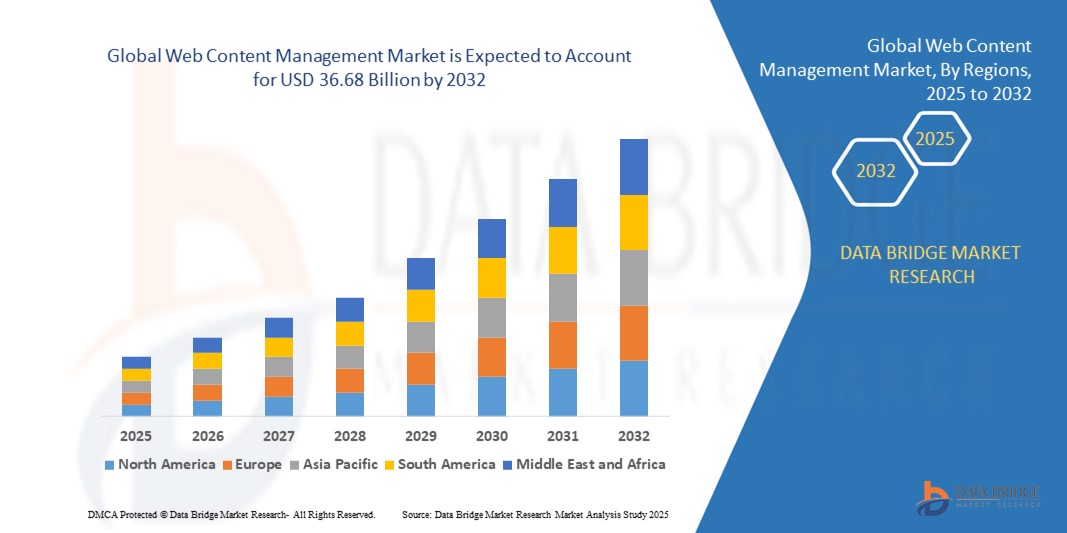
What is the Global Web Content Management Market Size and Growth Rate?
- The global web content management market size was valued at USD 11.26 billion in 2024 and is expected to reach USD 36.68 billion by 2032, at a CAGR of 15.90% during the forecast period
- The proliferation of web services as a result of cheap internet access and smartphone use is expected to fuel market expansion over the forecast period. The use of Wordpress to easily create websites, along with the presence of talented employees to create a content repository, can auger well for the market. The attractiveness of such sites and the use of plug-ins to acquire attention in worldwide searches may fuel the web content management business
What are the Major Takeaways of Web Content Management Market?
- The development of websites for brands that require an online presence is propelling the worldwide web content management industry forward. Furthermore, digital media and the inclination for surfing for information can create a market opportunities
- However, integration of content management systems with enterprise servers may stifle market expansion. The growth of software as a service (SaaS) firm and a lack of API understanding can make web content management migration more difficult, thus challenging market growth
- North America dominated the web content management market with the largest revenue share of 41.36% in 2024, supported by the strong presence of global technology leaders, high digital adoption rates, and widespread demand for personalized online experiences
- The Asia-Pacific web content management market is poised to grow at the fastest CAGR of 7.6% from 2025 to 2032, driven by rising digital penetration, increasing investments in IT infrastructure, and rapid growth of e-commerce
- The solution segment dominated the market with the largest revenue share of 65.4% in 2024, driven by the widespread adoption of core web content management platforms for website management, content publishing, personalization, and analytics
Report Scope and Web Content Management Market Segmentation
|
Attributes |
Web Content Management Key Market Insights |
|
Segments Covered |
|
|
Countries Covered |
North America
Europe
Asia-Pacific
Middle East and Africa
South America
|
|
Key Market Players |
|
|
Market Opportunities |
|
|
Value Added Data Infosets |
In addition to the insights on market scenarios such as market value, growth rate, segmentation, geographical coverage, and major players, the market reports curated by the Data Bridge Market Research also include in-depth expert analysis, pricing analysis, brand share analysis, consumer survey, demography analysis, supply chain analysis, value chain analysis, raw material/consumables overview, vendor selection criteria, PESTLE Analysis, Porter Analysis, and regulatory framework. |
What is the Key Trend in the Web Content Management Market?
Enhanced Convenience Through AI and Voice Integration
- A significant trend in the global web content management (WCM) market is the integration of artificial intelligence (AI) and voice-controlled ecosystems such as Amazon Alexa, Google Assistant, and Apple Siri. This combination enhances user convenience, personalization, and operational efficiency in managing digital content
- For instance, Adobe Experience Manager integrates AI-powered Adobe Sensei for automated content tagging and personalization, while Sitecore uses AI for predictive analytics to improve customer engagement. Similarly, Oracle Content Management integrates with Google Assistant, enabling voice-driven content search and publishing
- AI-driven web content management platforms are increasingly capable of understanding user behavior, recommending content strategies, and improving SEO effectiveness, while voice control allows hands-free operation for tasks such as publishing, editing, and retrieving content
- The integration of web content management systems with digital assistants and broader enterprise platforms creates centralized control, enabling marketers to manage content, campaigns, and analytics through unified interfaces
- This trend is reshaping expectations for enterprise content management, pushing vendors such as Adobe, Sitecore, and Acquia to deliver AI-enabled and voice-integrated solutions for personalized and automated experiences
- As businesses continue to prioritize seamless automation, personalization, and smart digital experiences, the demand for AI- and voice-integrated web content management systems is growing rapidly across industries
What are the Key Drivers of Web Content Management Market?
- The rising demand for personalized digital experiences, along with the growing adoption of omnichannel marketing strategies, is a major driver fueling web content management market growth
- For instance, in May 2024, Adobe Inc. enhanced its Experience Manager with AI-driven content intelligence, helping enterprises automate personalization and improve user engagement. Such innovations by leading players are expected to accelerate market expansion
- Businesses increasingly require real-time content delivery, analytics, and customization to meet consumer expectations across websites, mobile apps, and social platforms, driving demand for advanced web content management systems
- The surge in digital transformation initiatives and the adoption of cloud-based solutions are further strengthening the market, enabling scalable and cost-effective content management across enterprises of all sizes
- The ability of web content management systems to provide features such as workflow automation, multi-language support, content analytics, and integration with CRM and marketing automation platforms is a key factor driving adoption in both SMEs and large enterprises
Which Factor is Challenging the Growth of the Web Content Management Market?
- Cybersecurity vulnerabilities and data privacy concerns pose significant challenges for the web content management market. Since these systems manage sensitive customer and enterprise data, they are prime targets for cyberattacks
- For instance, recent breaches in CMS platforms such as WordPress and Drupal have raised concerns among enterprises about adopting WCM solutions without robust security frameworks
- Vendors must prioritize advanced encryption, multi-factor authentication, and compliance with global regulations such as GDPR and CCPA to ensure user trust. Companies such as Sitecore and Acquia highlight their strong compliance and data protection features to address these concerns
- Another key barrier is the high cost of advanced web content management platforms, which may limit adoption among SMEs, especially in developing economies. While open-source and affordable options such as WordPress and Joomla are available, premium platforms with AI and advanced analytics often come with significant licensing and implementation costs
- Overcoming these challenges through stronger cybersecurity measures, flexible pricing models, and customer education will be essential for sustained web content management market growth
How is the Web Content Management Market Segmented?
The market is segmented on the basis of component, organization size, deployment, application and end-user.
- By Component
On the basis of component, the web content management market is segmented into solution and services. The solution segment dominated the market with the largest revenue share of 65.4% in 2024, driven by the widespread adoption of core web content management platforms for website management, content publishing, personalization, and analytics. Enterprises rely on comprehensive solutions such as Adobe Experience Manager, Sitecore, and Oracle Content Management to ensure consistent brand experiences across digital channels.
The services segment is anticipated to witness the fastest CAGR from 2025 to 2032, fueled by the rising need for consulting, integration, and managed services. As organizations face challenges in deploying and customizing web content management platforms, demand for third-party service providers is growing. Increasing complexity in omnichannel marketing and the need for continuous upgrades further enhance the role of services. This dual growth highlights a balance between robust software solutions and value-added services.
- By Organization Size
On the basis of organization size, the market is segmented into small and medium enterprises (SMEs) and large enterprises. The large enterprises segment held the largest revenue share of 58.7% in 2024, supported by their significant investments in digital transformation and omnichannel marketing strategies. Large organizations, particularly in BFSI, retail, and media, prioritize advanced WCM solutions for content personalization, workflow automation, and global scalability.
The SMEs segment is projected to witness the fastest growth rate during 2025–2032, driven by the increasing availability of affordable cloud-based web content management platforms. SMEs are adopting solutions such as WordPress VIP, Drupal, and Acquia Cloud to improve digital presence and customer engagement at lower costs. The demand for scalable, flexible, and easy-to-deploy platforms is rising, especially among startups and mid-sized businesses. The combination of affordability and agility positions SMEs as a dynamic growth driver for the web content management market.
- By Deployment
On the basis of deployment, the market is divided into on-premise and on-cloud. The on-premise segment accounted for the largest market share of 54.1% in 2024, driven by its strong adoption in regulated industries such as BFSI, healthcare, and government, where data security, compliance, and customization are critical. Enterprises in these sectors prefer on-premise solutions for greater control over content storage and governance.
However, the on-cloud segment is expected to expand at the fastest CAGR from 2025 to 2032, fueled by the shift toward SaaS-based content management platforms that offer scalability, cost-effectiveness, and remote accessibility. Cloud-based deployment also supports integration with AI, analytics, and omnichannel delivery, making it an attractive choice for SMEs and enterprises pursuing digital-first strategies. Growing demand for remote work solutions and real-time collaboration further accelerates cloud adoption in the web content management industry.
- By Application
On the basis of application, the market is segmented into website management, document management, workflow management, social media management, content scheduling/deployment, access control, workforce optimization, and others. The website management segment dominated the market with the largest share of 37.8% in 2024, as businesses prioritize creating dynamic websites, personalized content, and engaging user experiences. WCM platforms streamline website updates, SEO optimization, and analytics, making them indispensable for brand visibility.
The social media management segment is projected to grow at the fastest CAGR from 2025 to 2032, driven by the surge in digital marketing and influencer-driven campaigns. Enterprises increasingly seek centralized web content management tools to manage multiple social platforms, schedule posts, and track engagement. Similarly, workflow management and content scheduling are gaining traction as enterprises emphasize automation. The growing demand for unified platforms that manage diverse content across digital touchpoints underscores the expanding scope of applications.
- By End-User
On the basis of end-user, the web content management market is segmented into media and entertainment, healthcare, BFSI, education, retail, travel and tourism, hospitality, and others. The media and entertainment segment accounted for the largest market share of 32.5% in 2024, owing to the industry’s dependence on advanced content management for streaming platforms, online publishing, and digital advertising. Companies such as Netflix, Disney, and Hulu heavily rely on robust web content management platforms for large-scale, personalized content delivery.
The healthcare segment is expected to witness the fastest growth from 2025 to 2032, driven by the increasing need for secure content management, patient portals, and telehealth platforms. The adoption of web content management in healthcare enables organizations to provide real-time patient information, educational content, and secure document sharing. Retail and BFSI also continue to be strong contributors, driven by e-commerce growth and digital banking services. This highlights the widening application base of web content management solutions across industries.
Which Region Holds the Largest Share of the Web Content Management Market?
- North America dominated the web content management market with the largest revenue share of 41.36% in 2024, supported by the strong presence of global technology leaders, high digital adoption rates, and widespread demand for personalized online experiences
- Organizations in the region prioritize digital transformation, omnichannel marketing, and customer engagement, driving significant investments in advanced WCM solutions
- The region’s strong IT infrastructure, high disposable incomes, and tech-savvy population further contribute to WCM adoption across industries such as media, retail, BFSI, and healthcare
U.S. Web Content Management Market Insight
The U.S. captured the largest revenue share of 81% in North America in 2024, driven by enterprises’ strong focus on digital marketing, automation, and personalized content delivery. Businesses across media, e-commerce, and BFSI increasingly adopt cloud-based web content management solutions, integrated with AI, analytics, and omnichannel capabilities to enhance customer experiences. The growing demand for seamless integration with voice assistants, mobile apps, and CRM systems is further fueling adoption. This solidifies the U.S. as the dominant hub for innovation in the web content management market.
Europe Web Content Management Market Insight
The Europe web content management market is projected to grow at a substantial CAGR during the forecast period, driven by stringent data privacy regulations (GDPR) and the rising need for secure, compliant content management platforms. Adoption is further accelerated by rapid urbanization, rising digitalization, and demand for multi-language and localized content across diverse markets. Both enterprises and SMEs are implementing web content management solutions in sectors such as education, retail, and media, with increased demand for personalized, efficient, and regulation-compliant platforms.
U.K. Web Content Management Market Insight
The U.K. market is anticipated to grow at a noteworthy CAGR, supported by a strong e-commerce ecosystem, retail digitalization, and increasing adoption of AI-driven content personalization. Businesses are prioritizing content automation, targeted marketing, and omnichannel delivery to meet consumer expectations. The rising emphasis on cybersecurity, cloud adoption, and regulatory compliance is encouraging enterprises to deploy advanced web content management platforms, driving continuous growth in the U.K.
Germany Web Content Management Market Insight
The Germany market is expected to expand at a considerable CAGR, underpinned by the country’s focus on innovation, sustainability, and secure digital infrastructure. Enterprises are investing in privacy-focused and eco-conscious web content management solutions, aligning with Germany’s emphasis on secure and sustainable technology adoption. Strong demand from manufacturing, automotive, and BFSI sectors is fueling growth, with increasing integration of web content management into broader digital ecosystems, including IoT and smart business platforms.
Which Region is the Fastest Growing Region in the Web Content Management Market?
The Asia-Pacific web content management market is poised to grow at the fastest CAGR of 7.6% from 2025 to 2032, driven by rising digital penetration, increasing investments in IT infrastructure, and rapid growth of e-commerce. Countries such as China, Japan, and India are leading the shift toward digital platforms, with enterprises focusing on customer engagement, content personalization, and digital branding. APAC’s position as a manufacturing hub for web content management solutions and government-led digitalization initiatives make the region a key growth frontier.
Japan Web Content Management Market Insight
The Japan web content management market is growing rapidly, supported by the country’s high-tech culture, rising demand for smart business solutions, and aging population requiring simplified digital platforms. Enterprises in Japan prioritize automation, AI-enabled personalization, and IoT integration, fueling the adoption of advanced web content management systems. The increasing number of smart offices and connected businesses is further accelerating web content management deployment, positioning Japan as a strong growth market in APAC.
China Web Content Management Market Insight
The China web content management market accounted for the largest revenue share in APAC in 2024, owing to rapid urbanization, a growing middle class, and the nation’s push toward digital ecosystems and smart cities. Domestic enterprises and global players are investing in scalable and affordable web content management platforms, making solutions more accessible to SMEs and large corporations asuch as. With its booming e-commerce, social media, and mobile-first consumer base, China represents one of the most lucrative growth opportunities for the global web content management market.
Which are the Top Companies in Web Content Management Market?
The web content management industry is primarily led by well-established companies, including:
- Vodafone Group Plc (U.K.)
- Telefonaktiebolaget LM Ericsson (Sweden)
- T-Mobile USA, Inc. (U.S.)
- Telstra (Australia)
- Sierra Wireless (Canada)
- PureSoftware (India)
- SEQUANS (France)
- Orange Business Services (France)
- TELUS (Canada)
- Adobe Inc. (U.S.)
- IBM Corporation (U.S.)
- OpenText Corporation (Canada)
- Oracle (U.S.)
- SDL plc (U.K.)
- Episerver Inc. (U.S.)
- Acquia Inc. (U.S.)
- Sitecore Corporation A/S (Denmark)
What are the Recent Developments in Global Web Content Management Market?
- In January 2025, the latest version of NetSuite introduced significant upgrades to enhance user experience and functionalities. Key improvements included stronger integration capabilities, advanced content personalization, and more streamlined workflows. These upgrades position NetSuite's WCM offerings to better support businesses in delivering customized and engaging digital experiences to their audiences
- In September 2024, Progress announced an agreement to acquire ShareFile, the SaaS-native, AI-powered collaboration platform from Cloud Software Group. ShareFile primarily focuses on document-centric collaboration for industries such as business services, financial services, healthcare, and construction. This acquisition strengthens Progress’s ability to offer more comprehensive solutions for enterprise collaboration and digital transformation
- In July 2024, Lumen Technologies and Microsoft entered into a partnership aimed at advancing Lumen's digital transformation through the Microsoft Cloud. As part of this collaboration, Microsoft selected Lumen to expand its network capacity, supporting the growing demand for data centers fueled by AI advancements. This partnership highlights the critical role of cloud and network integration in meeting the next generation of enterprise needs
- In June 2024, RWS launched HAI, a digital self-service platform that merges AI-powered technology with linguistic expertise to deliver fast, secure, and professional translations. This platform enables easier market entry for businesses while removing traditional barriers to global expansion. The introduction of HAI reflects RWS’s commitment to driving innovation in translation and localization services
- In March 2024, Adobe and Microsoft partnered to integrate Adobe Experience Cloud workflows with Microsoft Copilot for Microsoft 365. This collaboration connects applications and eliminates data silos, improving efficiency in tools such as Outlook, Microsoft Teams, and Word. The joint effort enhances marketing workflows, enabling organizations to streamline tasks from content creation to delivery more effectively

- Interactive Data Analysis Dashboard
- Company Analysis Dashboard for high growth potential opportunities
- Research Analyst Access for customization & queries
- Competitor Analysis with Interactive dashboard
- Latest News, Updates & Trend analysis
- Harness the Power of Benchmark Analysis for Comprehensive Competitor Tracking
Data collection and base year analysis are done using data collection modules with large sample sizes. The stage includes obtaining market information or related data through various sources and strategies. It includes examining and planning all the data acquired from the past in advance. It likewise envelops the examination of information inconsistencies seen across different information sources. The market data is analysed and estimated using market statistical and coherent models. Also, market share analysis and key trend analysis are the major success factors in the market report. To know more, please request an analyst call or drop down your inquiry.
The key research methodology used by DBMR research team is data triangulation which involves data mining, analysis of the impact of data variables on the market and primary (industry expert) validation. Data models include Vendor Positioning Grid, Market Time Line Analysis, Market Overview and Guide, Company Positioning Grid, Patent Analysis, Pricing Analysis, Company Market Share Analysis, Standards of Measurement, Global versus Regional and Vendor Share Analysis. To know more about the research methodology, drop in an inquiry to speak to our industry experts.
Data Bridge Market Research is a leader in advanced formative research. We take pride in servicing our existing and new customers with data and analysis that match and suits their goal. The report can be customized to include price trend analysis of target brands understanding the market for additional countries (ask for the list of countries), clinical trial results data, literature review, refurbished market and product base analysis. Market analysis of target competitors can be analyzed from technology-based analysis to market portfolio strategies. We can add as many competitors that you require data about in the format and data style you are looking for. Our team of analysts can also provide you data in crude raw excel files pivot tables (Fact book) or can assist you in creating presentations from the data sets available in the report.













