


What is the Middle East and Africa Cannabidiol (CBD) Oil Market Size and Growth Rate?
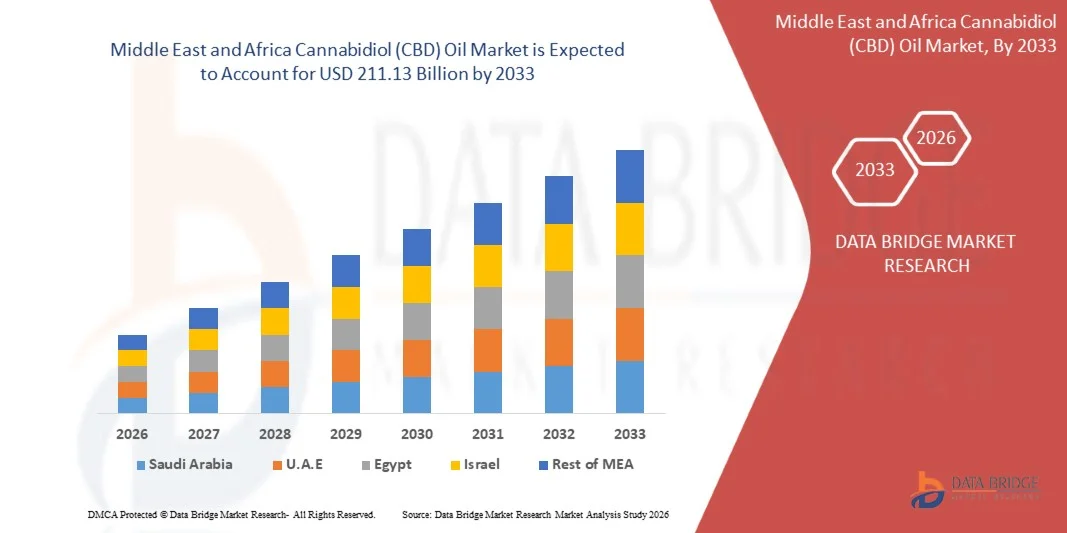
- As per Data Bridge Market Research analysis, the Middle East and Africa Cannabidiol (CBD) oil market was valued at USD 25.41 billion in 2025 and is projected to reach USD 211.13 billion by 2033, growing at a CAGR of 30.30% from 2026 to 2033.
- The market is experiencing consistent growth driven by increasing consumer interest in natural wellness products, gradual regulatory developments surrounding hemp-derived CBD, and expanding applications across pharmaceutical, personal-care, and wellness products.
- The growing demand for plant-based health and wellness solutions, combined with regulatory relaxation in selected markets such as South Africa and Israel, is encouraging investment in CBD cultivation, extraction, and product development. Increasing healthcare expenditure and exposure to global wellness trends are also supporting adoption, while improvements in local processing capabilities and distribution channels are creating opportunities for CBD oil commercialization across the Middle East and Africa
Market Size & Forecast
- Global Market Value (2025): USD 25.41 Billion
- Expected Market Value (2033): USD 211.13 Billion
- Forecast CAGR (2026–2033): 30.30%
- Leading Country in 2025: South Africa
- Fastest Growing Country: United Arab Emirates
What are the Major Takeaways of the Middle East and Africa Cannabidiol (CBD) Oil Market?
- South Africa dominated the Middle East and Africa Cannabidiol (CBD) oil market with the largest revenue share of 42.2% in 2025, supported by regulatory developments, expanding cannabis commercialization, and growing demand for CBD-based wellness and personal-care products
- United Arab Emirates is expected to be the fastest-growing country at a CAGR of 16.95% from 2026 to 2033, fueled by its developing regulatory framework, strong trade infrastructure, and growing interest in compliant cannabidiol products.
- The hemp oil segment led the market with a 55.72% share in 2025, driven by its broader applicability in wellness, personal care, nutraceutical, and cosmetic formulations
- Marijuana oil are the fastest-growing type, projected to register a CAGR of 13.1%, reflecting the surge in development of medical cannabis programs and growing research into cannabinoid-based therapeutic applications.
- The original segment dominated the product type category with a 58.0% revenue share in 2025, led by consumer preference for straightforward CBD formulations containing cannabidiol as the primary active ingredient.
- Unflavored accounted for 62.0% of the market share in 2025, preferred by consumer preference for relatively pure CBD oil formulations and their flexibility across different applications
- The pharma and nutraceuticals segment is the fastest-growing application category, with a CAGR of 25.0%, driven by increasing research into cannabinoid-based therapeutic and wellness applications.
Report Scope and Middle East and Africa Cannabidiol (CBD) Oil Market Segmentation
|
Attributes |
Middle East and Africa Cannabidiol (CBD) Oil Key Market Insights |
|
Segments Covered |
|
|
Countries Covered |
Middle East and Africa
|
|
Key Market Players |
|
|
Market Opportunities |
|
|
Value Added Data Infosets |
In addition to the insights on market scenarios such as market value, growth rate, segmentation, geographical coverage, and major players, the market reports curated by the Data Bridge Market Research also include import export analysis, production capacity overview, production consumption analysis, price trend analysis, climate change scenario, supply chain analysis, value chain analysis, raw material/consumables overview, vendor selection criteria, PESTLE Analysis, Porter Analysis, and regulatory framework. |
What is the Key Trend in the Middle East and Africa Cannabidiol (CBD) Oil Market?
- The Middle East and Africa CBD oil market is witnessing increasing diversification into CBD-infused skincare, beauty, and personal-care products, as manufacturers expand beyond traditional CBD oil formulations and target growing consumer interest in plant-based wellness products.
- For instance, in July 2025, South African company Shanti Natural Care launched a CBD-infused skincare line, expanding cannabidiol applications into creams, lotions, shampoos, and other personal-care products and demonstrating the growing diversification of CBD formulations in the regional market.
- Regulatory developments are also encouraging the emergence of more formally regulated CBD product categories, particularly in South Africa, where qualifying low-dose CBD products can be regulated under Schedule 0.
- For instance, in October 2024, South African skincare brand OptoDerm introduced its CBD Hydrating Serum, designed for post-procedure skincare and demonstrating the increasing integration of cannabidiol into professional skincare and cosmetic formulations.
- As CBD manufacturers increasingly develop skincare, beauty, wellness, and other compliant formulations, product diversification and regulatory clarity are expected to remain important trends shaping the Middle East and Africa CBD oil market.
What are the Key Drivers of the Middle East and Africa Cannabidiol (CBD) Oil Market?
- The growing investment in local cannabis cultivation, CBD extraction, processing, and commercialization is increasing the availability of regionally produced CBD oil and supporting the development of domestic cannabis value chains.
- For instance, in April 2024, the Eastern Cape government announced an initial investment pledge of more than R100 million for indoor cannabis cultivation, packaging, cannabidiol (CBD) extraction, and manufacturing operations, supporting the development of local cultivation and CBD-processing capabilities in South Africa.
- Increasing consumer awareness of CBD-based wellness and beauty applications is encouraging manufacturers to introduce new formulations spanning skincare, beauty, haircare, and other consumer-health categories.
- For instance, in September 2024, the South African government reported that 1,110 permits had been issued for hemp cultivation, while R124 million had been commissioned for research covering cannabis breeding for medicinal and other uses, supporting the development of the domestic cannabis value chain and CBD-related product applications
- As regional manufacturers expand production capabilities and consumer-facing applications, investment in cultivation, extraction, product development, and distribution is expected to support continued expansion of the Middle East and Africa CBD oil market.
Which Factors are Challenging the Growth of the Middle East and Africa Cannabidiol (CBD) Oil Market?
- Regulatory uncertainty and differing national restrictions remain major challenges for CBD oil companies, as permissible product types, cannabinoid concentrations, licensing requirements, and permitted applications vary considerably across Middle Eastern and African markets.
- For instance, in January 2025, South African medical cannabis company Cilo Cybin halted the production and supply of its CBD range for the domestic market because of continued regulatory challenges, instead focusing on exports to Australia and European countries, highlighting the impact of regulatory uncertainty on CBD commercialization.
- These regulatory differences increase compliance costs and make cross-border commercialization more difficult for CBD manufacturers, distributors, and retailers seeking to expand across multiple countries.
- In addition, strict regulations in some Middle Eastern markets can substantially restrict the range of CBD-containing consumer products that companies can legally manufacture, import, or sell, limiting regional market penetration.
- For instance, in March 2025, the South African government announced further consultation on regulations governing cannabis- and hemp-containing foodstuffs after concerns over unregulated imported products, demonstrating the regulatory uncertainty surrounding permissible CBD and hemp-based consumer products.
- Consequently, fragmented regulations, product-specific restrictions, licensing requirements, and changing compliance frameworks continue to create barriers to CBD oil commercialization across the Middle East and Africa.
How is the Middle East and Africa Cannabidiol (CBD) Oil Market Segmented?
The Middle East and Africa Cannabidiol (CBD) oil market is segmented on the basis of type, product type, product category, application, and distribution channel.
- By Type
On the basis of type, the Middle East and Africa cannabidiol (CBD) oil market is segmented into hemp oil and marijuana oil. The hemp oil segment dominated the market with an estimated 55.72% share in 2025, owing to its broader applicability in wellness, personal care, nutraceutical, and cosmetic formulations. Hemp-derived CBD generally contains very low levels of THC, making it more suitable for markets and applications where THC restrictions are stringent. Increasing availability of hemp-derived raw materials is supporting CBD oil production. Manufacturers are also incorporating hemp-derived CBD into oils, supplements, skincare products, and wellness formulations. Growing consumer interest in plant-based ingredients is further supporting demand for hemp-derived products.
The marijuana oil segment is projected to register the fastest growth at an estimated CAGR of 13.1%, during forecast period, driven by increasing development of medical cannabis programs and growing research into cannabinoid-based therapeutic applications. Medical cannabis frameworks in selected African markets are creating opportunities for regulated marijuana-derived products. Pharmaceutical research is also encouraging the development of standardized cannabinoid formulations. Improvements in controlled cultivation and extraction technologies are supporting consistent marijuana-derived oil production. Increasing investment in medical cannabis infrastructure may further strengthen demand.
- By Product Type
On the basis of product type, the Middle East and Africa cannabidiol (CBD) oil market is segmented into original and blended. The original segment dominated the market with an estimated 58.0% share in 2025, supported by consumer preference for straightforward CBD formulations containing cannabidiol as the primary active ingredient. Original CBD oils can be used directly or incorporated into a wide range of downstream products. Their relatively simple formulation makes them suitable for wellness, nutraceutical, personal-care, and cosmetic applications. Manufacturers can also use original CBD oil as a base for customized formulations. Increasing consumer awareness of CBD products is supporting demand for clearly positioned standalone formulations.
The blended segment is projected to register the fastest growth at an estimated CAGR of 19.0% during forecast period, driven by increasing development of CBD oils combined with botanical extracts, essential oils, vitamins, and other functional ingredients. Blended formulations allow manufacturers to differentiate products in an increasingly diverse CBD marketplace. Combining CBD with complementary ingredients can support targeted wellness and personal-care positioning. Such formulations are particularly relevant to skincare, relaxation, beauty, and nutraceutical applications. Manufacturers are increasingly experimenting with multifunctional formulations to improve consumer appeal.
- By Product Category
On the basis of product category, the Middle East and Africa cannabidiol (CBD) oil market is segmented into unflavored and flavored. The unflavored segment dominated the market with an estimated 62.0% share in 2025, supported by consumer preference for relatively pure CBD oil formulations and their flexibility across different applications. Unflavored CBD oils can be incorporated into food, beverages, nutraceuticals, cosmetics, and wellness products without significantly altering the intended flavor profile. They also provide manufacturers with greater flexibility when developing downstream formulations. Growing interest in minimally formulated wellness products is supporting demand for unflavored variants. Their suitability for mixing with other ingredients further increases their commercial applicability.
The flavored segment is projected to register the fastest growth at an estimated CAGR of 18.5% during forecast period, driven by manufacturers' efforts to improve the taste and overall consumer experience of CBD oils. Flavors such as mint, citrus, vanilla, and berry can help reduce the characteristic taste of cannabidiol. Improved sensory appeal may encourage trial among consumers who are unfamiliar with CBD oil. Flavored formulations are particularly relevant to orally consumed products and functional wellness applications. Manufacturers are increasingly introducing differentiated flavor combinations to strengthen product positioning.
- By Application
On the basis of application, the Middle East and Africa cannabidiol (CBD) oil market is segmented into food and beverages, personal care/cosmetics, pharma and nutraceuticals, and industrial application. The personal care/cosmetics segment dominated the market with an estimated 56.09% share in 2025, supported by the growing incorporation of CBD into skincare and beauty products. CBD-infused skincare products accounted for the largest share of the broader MEA CBD oil and CBD consumer health market, reflecting strong interest in cannabidiol-based topical formulations. CBD is increasingly incorporated into creams, moisturizers, serums, masks, cleansers, and other personal-care products. Rising interest in plant-derived cosmetic ingredients is encouraging product development. Manufacturers are also combining CBD with botanical extracts and other functional cosmetic ingredients.
The pharma and nutraceuticals segment is projected to register the fastest growth at an estimated CAGR of 25.0% during forecast period, driven by increasing research into cannabinoid-based therapeutic and wellness applications. Pharmaceutical companies and researchers are investigating standardized cannabinoid formulations for different medical applications. Expansion of regulated medical cannabis frameworks in selected African markets is creating additional opportunities for pharmaceutical CBD products. Growing consumer interest in natural and plant-based wellness solutions is also supporting nutraceutical applications. Improvements in extraction, purification, and formulation technologies are enhancing product consistency.
- By Distribution Channel
On the basis of distribution channel, the Middle East and Africa cannabidiol (CBD) oil market is segmented into direct and indirect. The indirect segment dominated the market with an estimated 60.0% share in 2025, supported by the broader reach of pharmacies, specialty retailers, wellness stores, distributors, and other intermediaries. Indirect channels allow manufacturers to reach consumers without establishing extensive proprietary distribution networks. Retail and specialty channels can also provide consumers with access to product information and professional guidance. E-commerce intermediaries are expanding product visibility in markets where CBD sales are legally permitted. Established distribution networks also simplify logistics and regional market access.
The direct segment is projected to register the fastest growth at an estimated CAGR of 16.0% during forecast period, driven by increasing adoption of direct-to-consumer websites and proprietary digital sales channels. Direct distribution allows CBD manufacturers to maintain greater control over product presentation, pricing, customer communication, and brand positioning. Digital channels can also provide companies with information about consumer preferences and purchasing behavior. Increasing e-commerce adoption is creating additional opportunities for direct sales in markets where regulations permit CBD products. Manufacturers can use digital platforms to provide detailed product information and educational content.
Which Country Holds the Largest Share of the Middle East and Africa Cannabidiol (CBD) Oil Market?
- South Africa dominated the Middle East and Africa Cannabidiol (CBD) oil market with the largest revenue share of 42.2% in 2025, supported by regulatory developments, expanding cannabis commercialization, and growing demand for CBD-based wellness and personal-care products
- ·The country also benefits from evolving cannabis regulations, growing cultivation and processing capabilities, and increasing availability of CBD-infused skincare, beauty, and wellness products. South Africa's established position within the regional cannabis value chain is further supporting market development. Increasing investment in cannabis-related production and growing consumer awareness of CBD applications continue to strengthen the country's leadership position in the Middle East and Africa market.
United Arab Emirates Cannabidiol (CBD) Oil Market Insight
The United Arab Emirates cannabidiol (CBD) oil market is witnessing consistent growth due to evolving regulations governing industrial hemp, increasing interest in wellness products, and the country's strong trade and distribution infrastructure. Businesses are increasingly exploring compliant hemp-derived applications across personal care, cosmetics, and industrial products. Moreover, growing regulatory attention toward industrial hemp and controlled cannabinoid applications is contributing to market development, while the country's established logistics ecosystem supports potential distribution across regional markets.
Saudi Arabia Cannabidiol (CBD) Oil Market Insight
The Saudi Arabia cannabidiol (CBD) oil market is growing steadily, driven by increasing awareness of wellness products, expanding personal-care and beauty industries, and gradual developments surrounding cannabis-related regulations. Growing consumer interest in plant-based ingredients and functional wellness products is supporting potential demand for CBD applications where permitted. In addition, the country's expanding pharmaceutical, nutraceutical, and cosmetics sectors are creating opportunities for future cannabinoid-based product development, subject to applicable regulatory requirements.
Egypt Cannabidiol (CBD) Oil Market Insight
The Egypt cannabidiol (CBD) oil market is experiencing developing growth, supported by increasing interest in natural wellness ingredients, expanding pharmaceutical manufacturing capabilities, and growing consumer awareness of plant-based products. The country's established pharmaceutical and personal-care industries provide potential opportunities for CBD-based formulations in permitted applications. Furthermore, increasing attention toward cannabis cultivation, research, and regulated medical applications is contributing to the development of the broader cannabinoid ecosystem in Egypt.
Israel Cannabidiol (CBD) Oil Market Insight
The Israel cannabidiol (CBD) oil market is developing steadily due to the country’s established medical cannabis ecosystem, advanced cannabis research capabilities, and increasing focus on cannabinoid-based product development. Pharmaceutical companies and research institutions are increasingly exploring cannabinoids for therapeutic applications, supporting demand for standardized CBD formulations. In addition, Israel’s strong biotechnology sector, established cannabis cultivation expertise, and ongoing research into cannabinoid applications are contributing to the development of the CBD oil market.
Which are the Top Companies in Middle East and Africa Cannabidiol (CBD) Oil Market?
The Middle East and Africa Cannabidiol (CBD) oil industry is primarily led by well-established companies, including:
- Cilo Cybin Holdings Ltd (South Africa)
- Afriplex (South Africa)
- Labat Africa Limited (South Africa)
- Cannsun (South Africa)
- AfricaBUD (South Africa)
- Ivory Medical (Zimbabwe)
- Back 2 Roots (South Africa)
- Isoganics (South Africa)
- Palesa CBD (South Africa)
- Cannaco (South Africa)
- Vitozol (South Africa)
- The Cannabis Co (South Africa)
- CANNALIFE (South Africa)
- inCura (South Africa)
- KANIWARI (South Africa)
- Nativa Complex (South Africa)
- Mama G (South Africa)
- Herbal Solutions (South Africa)
- Cannasutra (South Africa)
- Cannabis Oil South Africa (South Africa)
What are Latest Developments in Middle East and Africa Cannabidiol (CBD) Oil Market?
- In July 2025, South African company Shanti Natural Care launched a CBD-infused skincare line inspired by African traditions, supported by the Technology Innovation Agency (TIA). The product range incorporates cannabidiol into creams, lotions, shampoos, wellness drops, and other personal-care formulations, combining indigenous botanical knowledge with biotechnology. The development demonstrates the continued expansion of CBD applications beyond traditional oils into skincare and cosmeceutical products in the regional market.
- In June 2024, South African medical cannabis company Cilo Cybin became the first medical cannabis company to list on the Johannesburg Stock Exchange’s Alternative Exchange. The listing supported the company’s strategy of expanding its medical cannabis manufacturing activities and accessing investment to develop its operations in the growing legal cannabis sector. Cilo Cybin also operates in cannabis oils and pharmaceutical ingredients, highlighting increasing commercialization of cannabinoid-based products in South Africa.
- In March 2023, South African companies Afriplex and the Cannabis Research Institute developed technology to extract CBD isolate from locally cultivated cannabis. The technology was developed at Afriplex’s Paarl-based manufacturing facility and focused on producing CBD isolate without the THC component. This development strengthened local capabilities for CBD extraction and supported the advancement of domestically produced cannabinoid ingredients for pharmaceutical and wellness applications.
- In March 2022, South African medical cannabis company Cilo Cybin launched locally manufactured oil-based cannabinoid products using a self-emulsifying drug delivery system (SEDDS). The company stated that the technology was designed to improve the absorption of cannabinoid formulations and represented a move toward more advanced locally manufactured CBD products. The launch demonstrated increasing investment in formulation and drug-delivery technologies for cannabinoid products in South Africa.
- In September 2021, U.K.-based CBD and nutrition brand fourfive officially launched its CBD product range in South Africa through more than 100 Dis-Chem stores and an online channel. The launch expanded the availability of CBD products through established retail and digital distribution networks and brought an internationally developed CBD brand into the South African market. The development also highlighted the growing role of retail pharmacies and e-commerce in distributing cannabidiol-based consumer products across the region

- Interactive Data Analysis Dashboard
- Company Analysis Dashboard for high growth potential opportunities
- Research Analyst Access for customization & queries
- Competitor Analysis with Interactive dashboard
- Latest News, Updates & Trend analysis
- Harness the Power of Benchmark Analysis for Comprehensive Competitor Tracking
Middle East And Africa Cbd Oil Market, Supply Chain Analysis and Ecosystem Framework
To support market growth and help clients navigate the impact of geopolitical shifts, DBMR has integrated in-depth supply chain analysis into its Middle East And Africa Cbd Oil Market research reports. This addition empowers clients to respond effectively to global changes affecting their industries. The supply chain analysis section includes detailed insights such as Middle East And Africa Cbd Oil Market consumption and production by country, price trend analysis, the impact of tariffs and geopolitical developments, and import and export trends by country and HSN code. It also highlights major suppliers with data on production capacity and company profiles, as well as key importers and exporters. In addition to research, DBMR offers specialized supply chain consulting services backed by over a decade of experience, providing solutions like supplier discovery, supplier risk assessment, price trend analysis, impact evaluation of inflation and trade route changes, and comprehensive market trend analysis.
Data collection and base year analysis are done using data collection modules with large sample sizes. The stage includes obtaining market information or related data through various sources and strategies. It includes examining and planning all the data acquired from the past in advance. It likewise envelops the examination of information inconsistencies seen across different information sources. The market data is analysed and estimated using market statistical and coherent models. Also, market share analysis and key trend analysis are the major success factors in the market report. To know more, please request an analyst call or drop down your inquiry.
The key research methodology used by DBMR research team is data triangulation which involves data mining, analysis of the impact of data variables on the market and primary (industry expert) validation. Data models include Vendor Positioning Grid, Market Time Line Analysis, Market Overview and Guide, Company Positioning Grid, Patent Analysis, Pricing Analysis, Company Market Share Analysis, Standards of Measurement, Global versus Regional and Vendor Share Analysis. To know more about the research methodology, drop in an inquiry to speak to our industry experts.
Data Bridge Market Research is a leader in advanced formative research. We take pride in servicing our existing and new customers with data and analysis that match and suits their goal. The report can be customized to include price trend analysis of target brands understanding the market for additional countries (ask for the list of countries), clinical trial results data, literature review, refurbished market and product base analysis. Market analysis of target competitors can be analyzed from technology-based analysis to market portfolio strategies. We can add as many competitors that you require data about in the format and data style you are looking for. Our team of analysts can also provide you data in crude raw excel files pivot tables (Fact book) or can assist you in creating presentations from the data sets available in the report.













