


Middle East and Africa Gloves Market Overview
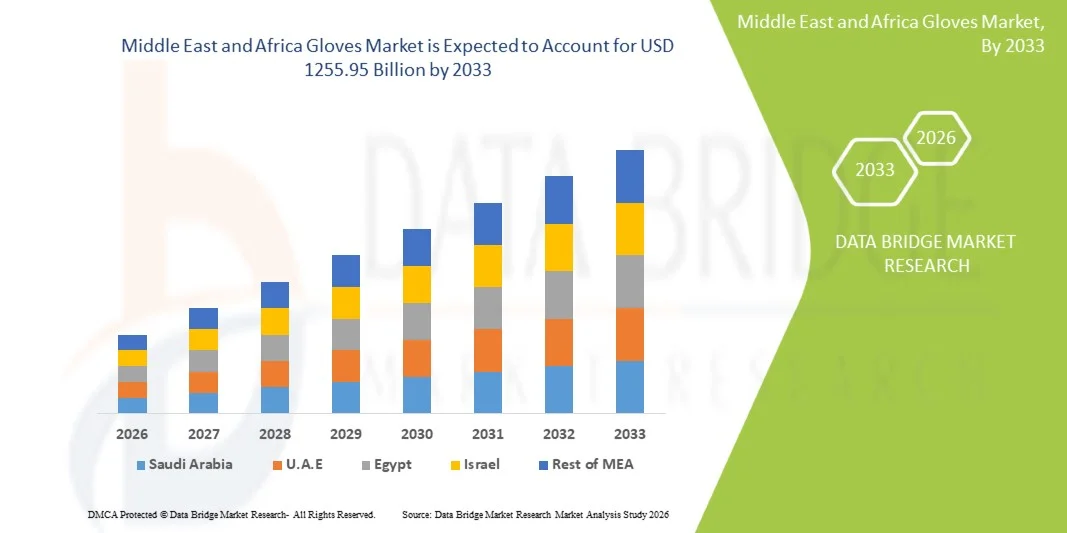
The Middle East and Africa Gloves market was valued at USD 747.58 billion in 2025 and is projected to reach USD 1255.95 billion by 2033, growing at a CAGR of 6.70% from 2026 to 2033. The Middle East and Africa Gloves market is experiencing consistent growth driven by increasing awareness of workplace safety and hygiene, rising demand for personal protective equipment (PPE), and expanding applications across healthcare, industrial, food processing, and laboratory settings. Growing emphasis on infection prevention, employee safety regulations, and product quality standards is further supporting market expansion across the region.
The increasing prevalence of healthcare-associated infections, stringent occupational safety regulations, and growing demand for disposable and reusable protective gloves are compelling hospitals, manufacturing facilities, food processing companies, and research laboratories to adopt high-quality hand protection solutions. Nitrile, latex, vinyl, and specialty gloves are increasingly replacing conventional protective products in many applications, offering enhanced durability, chemical resistance, comfort, and contamination control. In addition, rising industrial activities, expanding healthcare infrastructure, and growing awareness regarding worker safety and hygiene practices are accelerating demand for advanced glove technologies, providing users with reliable, cost-effective, and regulatory-compliant protection solutions.
Key Market Trends & Insights
- Saudi Arabia dominated the Middle East and Africa Gloves market in 2025, accounting for an estimated 31.68% share, driven by expanding healthcare infrastructure, increasing industrial safety requirements, growing construction activities, and rising demand for disposable and protective gloves across healthcare, oil & gas, manufacturing, and food processing sectors.
- The Disposable segment dominated the market with a share of 67.92% in 2025 due to its widespread adoption in healthcare, food processing, laboratories, and pharmaceutical applications where contamination prevention is critical.
- The U.A.E. is expected to be the fastest-growing country in the Middle East and Africa Gloves market, registering a CAGR of 6.8% from 2026 to 2033, fueled by increasing healthcare investments, growing workplace safety awareness, expanding industrial and logistics sectors, and rising demand for high-quality protective gloves across healthcare, hospitality, food service, and manufacturing industries.
- The Disposable Gloves segment dominated the market with a 65.71% revenue share in 2025, owing to extensive usage in healthcare, food handling, laboratory, and hygiene-sensitive environments.
- The Chemical Protection application segment accounted for 28.63% of the market in 2025, supported by increasing use of protective gloves in chemical processing, pharmaceuticals, laboratories, and industrial manufacturing facilities.
- The Medical & Healthcare segment dominated the end-user category with a 39.47% share in 2025, driven by rising patient volumes, infection prevention protocols, and growing demand for examination and surgical gloves.
- The Offline distribution channel accounted for 72.15% of the market in 2025, preferred by hospitals, industrial buyers, and institutional purchasers due to established procurement networks and bulk purchasing agreements.
Market Size & Forecast
- Middle East and Africa Market Value (2025): USD 747.58 Billion
- Expected Market Value (2033): USD 1255.95 Billion
- Forecast CAGR (2026–2033): 6.70%
- Leading Region in 2025: U.K.
- Fastest Growing Region: Germany
Report Scope and Middle East and Africa Gloves Market Segmentation
|
Attributes |
Gloves Key Market Insights |
|
Segments Covered |
|
|
Countries Covered |
Middle East and Africa · Saudi Arabia · U.A.E. · South Africa · Egypt · Israel · Rest of Middle East and Africa |
|
Key Market Players |
• Ansell Limited (Australia) |
|
Market Opportunities |
· Growing Demand for Nitrile and Disposable Gloves in Healthcare Settings · Expansion of Workplace Safety Regulations Across Industrial Sectors · Rising Adoption of Sustainable and Eco-Friendly Gloves |
|
Value Added Data Infosets |
In addition to the insights on market scenarios such as market value, growth rate, segmentation, geographical coverage, and major players, the market reports curated by the Data Bridge Market Research also include in-depth expert analysis, geographically represented company-wise production and capacity, network layouts of distributors and partners, detailed and updated price trend analysis and deficit analysis of supply chain and demand. |
Middle East and Africa Gloves Market Trends
Trend: Rising Demand for Sustainable and High-Performance Protective Gloves
The Middle East and Africa gloves market is witnessing a growing shift toward sustainable and high-performance hand protection solutions across healthcare, industrial, and food processing sectors. Manufacturers are increasingly introducing eco-friendly disposable gloves, biodegradable materials, and reusable protective gloves to address sustainability goals and regulatory requirements. At the same time, demand for advanced gloves offering enhanced chemical resistance, cut protection, puncture resistance, and thermal insulation is increasing across manufacturing, construction, automotive, and metal fabrication industries. The trend is further supported by stricter workplace safety standards and growing employer focus on reducing occupational injuries while improving worker comfort and productivity.
Middle East and Africa Gloves Market Dynamics
Key Market Driver: Stringent Workplace Safety Regulations and Growing Healthcare Demand
The increasing emphasis on occupational safety and infection prevention is a major driver of the Middle East and Africa Gloves market. Regulatory frameworks established by European workplace safety authorities require the use of appropriate personal protective equipment (PPE) across industries including healthcare, manufacturing, construction, food processing, and chemical handling. The healthcare sector remains a major consumer of disposable gloves, supported by rising surgical procedures, patient examinations, and infection-control protocols. According to healthcare industry data, millions of medical examinations and procedures are conducted annually across Europe, generating substantial demand for nitrile, latex, and vinyl gloves. In addition, increasing awareness regarding worker safety and hygiene compliance continues to drive glove adoption across industrial environments.
Key Restraint/Challenge: Volatility in Raw Material Prices and Environmental Concerns
A significant challenge facing the Middle East and Africa Gloves market is the fluctuation in raw material costs, particularly for nitrile, natural rubber latex, neoprene, and other synthetic polymers used in glove manufacturing. Variations in raw material availability, supply chain disruptions, and energy costs can directly impact production expenses and profit margins for manufacturers. In addition, increasing environmental concerns regarding the disposal of single-use gloves have prompted stricter waste management requirements and sustainability expectations from regulators and end users.
For instance, healthcare facilities and industrial organizations across Middle East and Africa are increasingly evaluating waste reduction initiatives and sustainable procurement policies, creating pressure on manufacturers to develop environmentally responsible glove solutions while maintaining product performance and regulatory compliance.
Key Market Opportunity: Expansion of Advanced Protective Gloves Across Industrial Applications
The growing demand for specialized hand protection solutions presents a significant opportunity for the Middle East and Africa Gloves market. Industries such as automotive manufacturing, metal fabrication, electronics, chemical processing, and construction are increasingly adopting advanced gloves that provide superior cut resistance, chemical protection, thermal insulation, and dexterity. The rising use of Kevlar gloves, puncture-resistant gloves, and chemical-resistant nitrile gloves is supporting market growth across high-risk work environments.
Furthermore, technological advancements in glove materials and manufacturing processes are enabling the development of lighter, more durable, and ergonomically designed products. The increasing adoption of reusable protective gloves and sustainable glove technologies is creating new opportunities for manufacturers to expand their product portfolios and address evolving safety, environmental, and performance requirements across Europe.
Middle East and Africa Gloves Market Scope
The Gloves market is segmented on the basis of product type, type, application, end user, and distribution channel.
- By Product Type
On the basis of product type, the Middle East and Africa Gloves market is segmented into Nitrile Gloves, Latex Gloves, Vinyl Gloves, Puncture Resistant Gloves, Polyethylene Gloves, Cotton Fabric Gloves, Butyl Gloves, Aluminized Gloves, Neoprene Gloves, Kevlar Gloves, Leather Gloves, and Others. The Nitrile Gloves segment dominated the market with a 31.84% share in 2025 due to its superior puncture resistance, chemical protection, and latex-free composition, making it highly suitable for healthcare, laboratory, food processing, and industrial applications. The increasing prevalence of healthcare-associated infections and growing emphasis on workplace safety have significantly boosted demand for nitrile gloves across Europe. In addition, nitrile gloves offer enhanced durability, flexibility, and user comfort compared to traditional alternatives. The segment also benefits from stringent occupational safety regulations and rising adoption in manufacturing industries. Growing awareness regarding infection control and hygiene standards further supports market expansion. Furthermore, increasing investments in healthcare infrastructure and industrial safety programs are reinforcing demand. These factors collectively contribute to the dominant position of the nitrile gloves segment across the Middle East and Africa market.
The Kevlar Gloves segment is expected to witness the fastest CAGR of 7.4% from 2026 to 2033, driven by the increasing need for advanced hand protection in high-risk industrial environments. Kevlar gloves provide exceptional cut resistance, heat protection, and mechanical durability, making them ideal for metal fabrication, automotive manufacturing, construction, and heavy engineering applications. The growing focus on employee safety and accident prevention is accelerating adoption across industrial sectors. In addition, stringent workplace safety regulations are encouraging employers to invest in high-performance protective equipment. Technological advancements in glove materials and ergonomic designs are improving user comfort and productivity. Rising industrial automation and expansion of manufacturing activities across Middle East and Africa are also contributing to demand growth. Furthermore, increasing awareness regarding occupational hazards is expected to sustain long-term market expansion for the segment.
- By Type
On the basis of type, the Middle East and Africa Gloves market is segmented into Disposable and Reusable. The Disposable segment dominated the market with a share of 67.92% in 2025 due to its widespread adoption in healthcare, food processing, laboratories, and pharmaceutical applications where contamination prevention is critical. Disposable gloves offer convenience, cost-effectiveness, and superior infection control benefits, making them the preferred choice among end users. The increasing volume of medical procedures and growing awareness regarding hygiene standards continue to support segment growth. In addition, stringent healthcare regulations and infection prevention protocols have accelerated demand across hospitals and clinics. Food safety compliance requirements and industrial hygiene practices are also driving adoption. The availability of nitrile, latex, and vinyl disposable gloves further expands application versatility. Growing healthcare expenditures and rising focus on public health safety continue to reinforce the segment’s leading position across Europe.
The Reusable segment is anticipated to register the fastest CAGR of 6.9% from 2026 to 2033, driven by increasing demand for durable and cost-efficient hand protection solutions across industrial and commercial environments. Reusable gloves offer enhanced resistance to chemicals, abrasions, and mechanical hazards, making them suitable for construction, manufacturing, chemical processing, and maintenance applications. Rising sustainability initiatives and efforts to reduce disposable waste are encouraging organizations to adopt reusable protective products. In addition, advancements in glove materials and coating technologies are improving durability and performance. Employers are increasingly investing in long-lasting protective equipment to optimize operational costs. Growing awareness regarding environmental responsibility and workplace safety is further accelerating adoption. These factors are expected to support strong growth of the reusable gloves segment throughout the forecast period.
- By Application
On the basis of application, the Middle East and Africa Gloves market is segmented into Biological, Chemical, Mechanical, Thermal, Anti-Static, and Others. The Biological segment dominated the market with a share of 29.76% in 2025 due to the extensive use of protective gloves in healthcare facilities, laboratories, pharmaceutical manufacturing, and biotechnology environments. The increasing focus on infection prevention, contamination control, and worker safety has significantly boosted demand for biological protection gloves across Europe. Healthcare professionals rely heavily on gloves to minimize exposure to pathogens and maintain hygiene standards during medical procedures. In addition, rising healthcare expenditures, growing diagnostic testing activities, and expanding pharmaceutical research operations are supporting market growth. Strict regulatory requirements governing healthcare safety and infection control further strengthen demand. The widespread adoption of disposable nitrile and latex gloves also contributes to the segment’s leadership position. These factors collectively reinforce the dominance of the biological application segment in the Middle East and Africa market.
The Chemical segment is projected to witness the fastest CAGR of 7.2% from 2026 to 2033, driven by increasing demand for chemical-resistant gloves across manufacturing, petrochemical, pharmaceutical, laboratory, and industrial processing sectors. Workers handling hazardous substances require specialized gloves that provide superior protection against chemical exposure and contamination risks. The implementation of stringent occupational health and safety regulations across Middle East and Africa is accelerating adoption. In addition, growing investments in chemical manufacturing and industrial production are creating favorable growth opportunities. Advancements in glove materials such as butyl rubber, neoprene, and nitrile compounds are improving chemical resistance and user safety. Rising awareness regarding workplace hazard prevention is further contributing to market expansion. These factors are expected to drive substantial growth in the chemical application segment during the forecast period.
- By End User
On the basis of end user, the Middle East and Africa Gloves market is segmented into Medical & Healthcare, Food & Beverage, Fire Protection, Construction, Manufacturing Industries, Metal Fabrication, Electronics, and Others. The Medical & Healthcare segment dominated the market with a share of 38.54% in 2025 due to the extensive use of gloves in hospitals, clinics, diagnostic laboratories, ambulatory care centers, and pharmaceutical facilities. Growing emphasis on infection prevention and patient safety has increased glove consumption across healthcare settings. Rising surgical procedures, diagnostic testing volumes, and healthcare workforce expansion are supporting market growth. In addition, strict healthcare regulations concerning hygiene compliance and contamination control continue to reinforce demand. The widespread use of disposable nitrile and latex gloves for examination and surgical procedures further strengthens the segment's position. Increasing investments in healthcare infrastructure and public health initiatives are also contributing to market expansion. These factors collectively maintain the Medical & Healthcare segment as the leading end-user category across Europe.
The Electronics segment is expected to register the fastest CAGR of 7.5% from 2026 to 2033, driven by increasing demand for anti-static and contamination-free gloves in semiconductor manufacturing, electronics assembly, and precision engineering applications. As electronic components become smaller and more sophisticated, manufacturers require specialized gloves to prevent electrostatic discharge and product contamination. Growing investments in electronics production facilities across Middle East and Africa are creating favorable market opportunities. In addition, expanding adoption of automation, advanced manufacturing technologies, and cleanroom operations is accelerating demand. Technological advancements in anti-static glove materials are improving product performance and worker comfort. Rising demand for consumer electronics, electric vehicles, and smart devices is further supporting segment growth. These factors are expected to contribute significantly to the rapid expansion of the electronics end-user segment.
- By Distribution Channel
On the basis of distribution channel, the Middle East and Africa Gloves market is segmented into Online, Offline, and Others. The Offline segment dominated the market with a share of 72.41% in 2025 due to the strong presence of distributors, wholesalers, industrial suppliers, healthcare procurement networks, and specialty safety equipment providers across the region. Large-volume purchases by hospitals, manufacturing facilities, laboratories, and construction companies are primarily conducted through established offline distribution channels. These channels offer product inspection, technical guidance, after-sales support, and long-term supply agreements, which remain important purchasing considerations for institutional buyers. In addition, established relationships between manufacturers and distributors facilitate efficient product availability and supply chain management. The widespread presence of regional safety equipment suppliers further strengthens market penetration. These factors collectively reinforce the dominant position of the offline distribution channel in the Middle East and Africa gloves market.
The Online segment is anticipated to witness the fastest CAGR of 8.1% from 2026 to 2033, driven by the rapid expansion of e-commerce platforms and digital procurement solutions. Businesses and consumers are increasingly utilizing online channels due to convenience, broader product availability, competitive pricing, and faster purchasing processes. The growing adoption of digital procurement systems by healthcare facilities and industrial organizations is further supporting growth. In addition, manufacturers are expanding direct-to-customer sales strategies through online platforms to improve market reach and customer engagement. Advancements in logistics infrastructure and secure payment technologies are enhancing buyer confidence. Rising internet penetration and digital transformation initiatives across Middle East and Africa continue to accelerate adoption. These factors are expected to drive strong growth of the online distribution channel throughout the forecast period.
Middle East and Africa Gloves Market Regional Analysis
The Middle East and Africa Gloves market remains a significant contributor to the global gloves industry, driven by expanding healthcare infrastructure, increasing industrialization, growing workplace safety awareness, and rising demand for personal protective equipment across multiple end-use sectors. The widespread use of disposable and reusable gloves in healthcare, food processing, manufacturing, construction, oil & gas, chemical processing, and logistics industries continues to support market expansion across the region. Rising focus on occupational health and safety compliance, infection prevention measures, and hygiene standards is encouraging greater adoption of protective gloves among healthcare professionals and industrial workers. Furthermore, advancements in glove materials, including nitrile, neoprene, latex, and specialty protective gloves, are enhancing product performance and expanding application areas throughout the Middle East and Africa region.
Saudi Arabia Gloves Market Insight
Saudi Arabia dominated the Middle East and Africa Gloves market in 2025, accounting for an estimated 31.68% share, driven by expanding healthcare infrastructure, increasing industrial safety requirements, growing construction activities, and rising demand for disposable and protective gloves across healthcare, oil & gas, manufacturing, and food processing sectors. The country's ongoing investments in healthcare modernization, industrial diversification initiatives, and large-scale infrastructure projects continue to support strong glove consumption. In addition, stringent workplace safety regulations and increasing awareness regarding employee protection are accelerating the adoption of industrial safety gloves across various sectors. Growing utilization of nitrile gloves, chemical-resistant gloves, cut-resistant gloves, and disposable medical gloves is further contributing to market growth. The expanding presence of healthcare facilities and industrial operations is expected to maintain Saudi Arabia's leading position in the regional gloves market.
U.A.E. Gloves Market Insight
The U.A.E. is expected to be the fastest-growing country in the Middle East and Africa Gloves market, registering a CAGR of 6.8% from 2026 to 2033, fueled by increasing healthcare investments, growing workplace safety awareness, expanding industrial and logistics sectors, and rising demand for high-quality protective gloves across healthcare, hospitality, food service, and manufacturing industries. The country's strong focus on healthcare excellence, occupational safety compliance, and industrial development is creating favorable growth opportunities for glove manufacturers and suppliers. In addition, increasing investments in hospitals, diagnostic centers, pharmaceutical facilities, and food processing operations are driving demand for disposable gloves and specialty protective gloves. The rapid expansion of logistics, warehousing, aviation, and hospitality sectors is also contributing to higher glove consumption. Furthermore, growing adoption of advanced hand protection solutions and increasing emphasis on employee safety are expected to further strengthen the gloves market in the U.A.E. throughout the forecast period.
Middle East and Africa Gloves Market Share
The Gloves industry is primarily led by well-established companies, including:
- Ansell Limited (Australia)
- Top Glove Corporation Bhd (Malaysia)
- Hartalega Holdings Berhad (Malaysia)
- Kossan Rubber Industries Bhd (Malaysia)
- Supermax Corporation Berhad (Malaysia)
- Semperit AG Holding (Austria)
- MAPA Professional (France)
- Uvex Safety Group (Germany)
- Honeywell International Inc. (U.S.)
- 3M Company (U.S.)
- Kimberly-Clark Corporation (U.S.)
- Cardinal Health, Inc. (U.S.)
- Medline Industries, LP (U.S.)
- Halyard Health (Owens & Minor, Inc.) (U.S.)
- Hartmann Group (Germany)
- B. Braun Melsungen AG (Germany)
- Mölnlycke Health Care AB (Sweden)
- Unigloves (United Kingdom)
- Globus Group (United Kingdom)
- Shield Scientific B.V. (Netherlands)
- Berner International GmbH (Germany)
- Würth Group (Germany)
- Ejendals AB (Sweden)
- SHOWA Group (Japan)
- Dipped Products PLC (Sri Lanka)
- Riverstone Holdings Limited (Malaysia)
- Rubix Group (France)
- Delta Plus Group (France)
- ATG® (Advanced Technology Gloves) (Sri Lanka)
- Protective Industrial Products, Inc. (U.S.)
Latest Developments in Middle East and Africa Gloves Market
- In February 2022, Bulwark and DuPont announced the launch of the new iQ Series Advantage Collection FR Gloves, the world’s first NFPA 2112-compliant flame-resistant glove collection. Developed using DuPont Nomex and Kevlar technologies, the collection was designed for workers in oil & gas and industrial environments, offering enhanced flame resistance, cut protection, durability, and dexterity. The launch highlighted growing innovation in specialized industrial hand protection solutions
- In May 2022, Honeywell announced the launch of its DC365 Small Surgical N95 Respirator and a reusable half-mask respirator for healthcare professionals. While primarily focused on respiratory protection, the launch expanded Honeywell’s broader healthcare PPE portfolio and reflected the company’s continued investment in advanced protective equipment used alongside medical gloves and other infection-control products
- In January 2024, Kimberly-Clark Professional announced the launch of Kimtech Polaris Nitrile Exam Gloves, designed to provide enhanced protection, durability, and comfort for laboratory professionals. The gloves were developed to offer high tensile strength, superior barrier protection, and improved user comfort while supporting applications in pharmaceutical manufacturing, biotechnology, and laboratory environments
- In February 2024, DuPont announced the winners of its 10th Annual North America Protection Innovation Awards, recognizing manufacturers that developed advanced glove and sleeve designs utilizing DuPont Kevlar and Nomex technologies. The awards showcased innovations focused on multi-risk protection, including cut, heat, flame, and arc-flash resistance, reflecting the increasing demand for high-performance industrial gloves
- In May 2024, Kimberly-Clark Professional™ announced that its Kimtech™ Polaris™ Nitrile Exam Glove became the first exam glove and PPE product to receive the ACT Environmental Impact Factor Label from My Green Lab®. The achievement highlighted growing industry emphasis on sustainability, transparency, and environmental performance within the disposable glove segment
- In June 2024, Kimberly-Clark Professional launched Kimtech Polaris Nitrile Exam Gloves in Canada, expanding the availability of its premium nitrile glove portfolio. The gloves were approved by Health Canada and designed for laboratory, pharmaceutical, biotechnology, and medical device manufacturing applications, while also supporting recycling initiatives through the RightCycle Program

- Interactive Data Analysis Dashboard
- Company Analysis Dashboard for high growth potential opportunities
- Research Analyst Access for customization & queries
- Competitor Analysis with Interactive dashboard
- Latest News, Updates & Trend analysis
- Harness the Power of Benchmark Analysis for Comprehensive Competitor Tracking
Data collection and base year analysis are done using data collection modules with large sample sizes. The stage includes obtaining market information or related data through various sources and strategies. It includes examining and planning all the data acquired from the past in advance. It likewise envelops the examination of information inconsistencies seen across different information sources. The market data is analysed and estimated using market statistical and coherent models. Also, market share analysis and key trend analysis are the major success factors in the market report. To know more, please request an analyst call or drop down your inquiry.
The key research methodology used by DBMR research team is data triangulation which involves data mining, analysis of the impact of data variables on the market and primary (industry expert) validation. Data models include Vendor Positioning Grid, Market Time Line Analysis, Market Overview and Guide, Company Positioning Grid, Patent Analysis, Pricing Analysis, Company Market Share Analysis, Standards of Measurement, Global versus Regional and Vendor Share Analysis. To know more about the research methodology, drop in an inquiry to speak to our industry experts.
Data Bridge Market Research is a leader in advanced formative research. We take pride in servicing our existing and new customers with data and analysis that match and suits their goal. The report can be customized to include price trend analysis of target brands understanding the market for additional countries (ask for the list of countries), clinical trial results data, literature review, refurbished market and product base analysis. Market analysis of target competitors can be analyzed from technology-based analysis to market portfolio strategies. We can add as many competitors that you require data about in the format and data style you are looking for. Our team of analysts can also provide you data in crude raw excel files pivot tables (Fact book) or can assist you in creating presentations from the data sets available in the report.













