


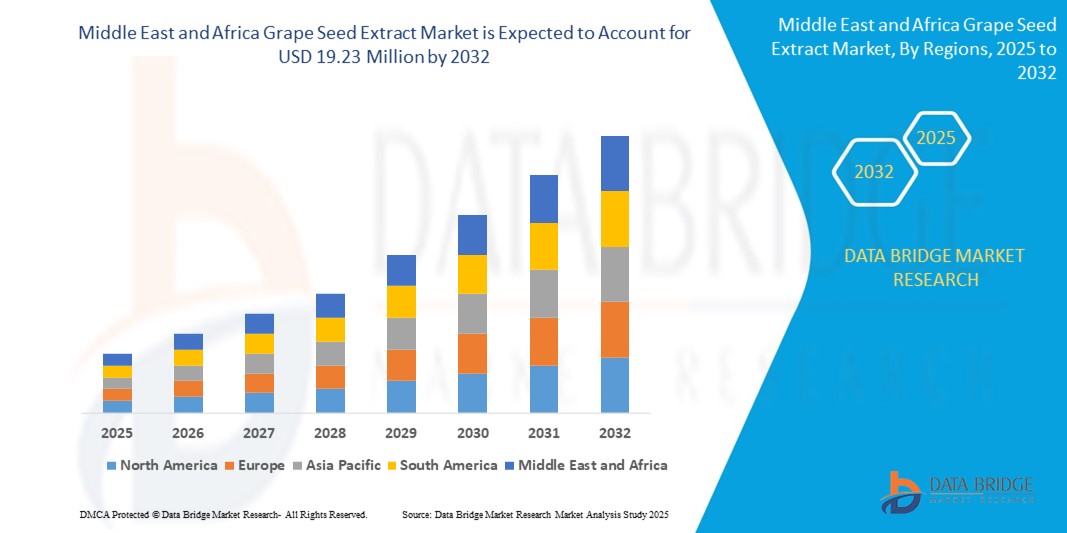
What is the Middle East and Africa Grape Seed Extract Market Size and Growth Rate?
- The Middle East and Africa grape seed extract market size was valued at USD 12.62 million in 2024 and is expected to reach USD 19.23 million by 2032, at a CAGR of5.40% during the forecast period
- The grape seed extract market is a dynamic industry focused on products derived from grape seeds. This market has seen significant growth due to the rising demand for natural antioxidants and health supplements
- Grape seed extract is known for its potential health benefits, including its antioxidant properties and potential to support cardiovascular health. It is utilized in various sectors, including dietary supplements, cosmetics, and food and beverage industries. The market's expansion is driven by increasing consumer awareness of its health advantages and the trend toward natural and plant-based products
What are the Major Takeaways of Grape Seed Extract Market?
- Grape seed extract contains antioxidants and polyphenols that can benefit skin health, such as reducing signs of aging and promoting skin elasticity. This presents a growing opportunity for incorporating grape seed extract into skincare products, creating a niche market for anti-aging and natural skincare solutions
- As people become more health-conscious and seek alternatives to synthetic ingredients, grape seed extract, known for its natural antioxidants and potential health benefits, gains popularity, driving market growth
- U.A.E. is projected to dominate the Middle East and Africa grape seed extract market with a revenue share of 42.63% in 2024, fueled by its leadership in premium dietary supplements, functional foods, and clean-label nutraceuticals
- Saudi Arabia is anticipated to witness the fastest CAGR of 6.79% from 2025 to 2032, supported by growing awareness of preventive healthcare and increasing demand for functional ingredients in beverages, supplements, and beauty products
- The Food Grade segment dominated the market with the largest revenue share of 44.2% in 2024, attributed to its widespread usage in functional foods, beverages, and clean-label supplements
Report Scope and Grape Seed Extract Market Segmentation
|
Attributes |
Grape Seed Extract Key Market Insights |
|
Segments Covered |
|
|
Countries Covered |
Middle East and Africa
|
|
Key Market Players |
|
|
Market Opportunities |
|
|
Value Added Data Infosets |
In addition to the insights on market scenarios such as market value, growth rate, segmentation, geographical coverage, and major players, the market reports curated by the Data Bridge Market Research also include in-depth expert analysis, pricing analysis, brand share analysis, consumer survey, demography analysis, supply chain analysis, value chain analysis, raw material/consumables overview, vendor selection criteria, PESTLE Analysis, Porter Analysis, and regulatory framework. |
What is the Key Trend in the Grape Seed Extract Market?
“Clean Label Formulations and Polyphenol-Driven Nutraceuticals”
- A defining trend in the grape seed extract market is the rising demand for clean-label nutraceuticals powered by polyphenols, proanthocyanidins, and antioxidants. Consumers are increasingly scrutinizing product labels for transparency, origin, and scientific efficacy, propelling demand for naturally derived, minimally processed functional ingredients
- For instance, Nexira (France) and Polyphenolics (U.S.) are investing in traceable grape sourcing, solvent-free extractions, and ingredient standardization, ensuring high purity and consistency in polyphenol content for use in dietary supplements and cosmeceuticals
- Advanced encapsulation technologies such as liposomal delivery and nanoemulsion formats are enhancing the bioavailability of grape seed extracts, enabling better absorption and targeted release, especially in functional beverages and anti-aging formulations
- Sustainability also plays a pivotal role—grape seed extract is increasingly being positioned as an upcycled ingredient derived from wine industry by-products, contributing to waste reduction and circular economy principles
- Companies such as Botanic Innovations (U.S.), Naturex (France), and ConnOils LLC (U.S.) are adopting sustainable sourcing frameworks and green extraction techniques such as supercritical CO₂ to align with growing regulatory and consumer demands for eco-friendly production
- This trend is transforming grape seed extract from a commodity antioxidant into a premium functional ingredient, unlocking applications across wellness, clean beauty, sports nutrition, and therapeutic product categories
What are the Key Drivers of Grape Seed Extract Market?
- The surge in preventive health consciousness and aging populations is driving the adoption of plant-based antioxidants, particularly grape seed extract, which is rich in oligomeric proanthocyanidins (OPCs) known for their cardiovascular, skin, and metabolic health benefits
- For instance, in March 2024, Nexira launched Cognivia+, a polyphenol-rich cognitive supplement incorporating grape seed extract, addressing the growing demand for natural nootropics and mental performance enhancers
- The global clean beauty wave is propelling the use of grape seed extract in skincare and personal care, leveraging its anti-inflammatory, antimicrobial, and collagen-boosting properties. Brands are formulating with grape seed extract to meet consumer demand for safer, botanical alternatives to synthetic actives
- Regulatory backing from EFSA, FDA, and other food safety authorities recognizing the safety and efficacy of grape seed extract is fostering product innovation across functional foods, beverages, and nutraceuticals
- Rising R&D in bioavailability-enhanced formulations and growing awareness of grape seed extract's role in reducing oxidative stress and supporting immune modulation further boost its market relevance
- In addition, the popularity of vegan, gluten-free, and allergen-free supplements is contributing to wider market penetration, especially among lifestyle-conscious urban populations
Which Factor is challenging the Growth of the Grape Seed Extract Market?
- One of the main challenges is the lack of global standardization in OPC content measurement, leading to inconsistent product quality, poor efficacy, and consumer mistrust. This creates a fragmented competitive landscape with price undercutting and variable ingredient integrity
- For instance, studies have found that some commercially available grape seed extract products contain less than 30% of labeled polyphenol content, negatively impacting consumer perception and industry credibility
- High production costs associated with advanced extraction methods such as supercritical CO₂ and subcritical water extraction can hinder scalability, especially for small and medium manufacturers trying to compete in price-sensitive markets
- Supply chain constraints due to limited grape seed availability, seasonal fluctuations, and dependence on wine-making regions can affect raw material sourcing, particularly for pharma-grade or high-OPC extracts
- Furthermore, the bitter taste and poor solubility of grape seed extract restrict its use in some food and beverage formulations unless encapsulated or masked, which can add additional formulation costs
- Overcoming these issues will require investment in quality assurance protocols, ingredient standardization, improved label transparency, and greater consumer education on the health benefits and sourcing ethics of grape seed extract
How is the Grape Seed Extract Market Segmented?
The market is segmented on the basis of grade, form, extraction method, nature, OPC content, ORAC value, polyphenol content, category, application, and distribution channel.
- By Grade
On the basis of grade, the market is segmented into Food Grade, Pharma Grade, and Others. The Food Grade segment dominated the market with the largest revenue share of 44.2% in 2024, attributed to its widespread usage in functional foods, beverages, and clean-label supplements. Rising consumer preference for natural antioxidants in everyday nutrition is fueling segment growth.
The Pharma Grade segment is projected to grow at the fastest CAGR from 2025 to 2032, driven by increasing clinical use of OPCs in cardiovascular and anti-inflammatory formulations.
- By Form
The market is segmented into Powders, Liquid Extracts, Encapsulated Extracts, Concentrates, and Others. The Powders segment held the highest share of 37.6% in 2024, owing to their longer shelf life, ease of incorporation into food, drinks, and capsules, and wide usage in nutraceutical blends.
The Encapsulated Extracts segment is expected to expand rapidly due to rising demand for dosage precision and convenience in dietary supplements.
- By Extraction Method
On the basis of extraction method, the market is segmented into Conventional/Mechanical, Solvent Extraction, Supercritical Extraction, Subcritical Extraction, and Others. Solvent Extraction dominated the segment with a revenue share of 41.3% in 2024, largely due to its cost-efficiency and high yield output. It is especially favored by mid-scale manufacturers across food and pharma industries.
Supercritical Extraction is anticipated to grow at the fastest pace, backed by its solvent-free, eco-friendly process and high-purity extract output, aligning with clean-label and green manufacturing trends.
- By Nature
Based on nature, the market is categorized into Conventional and Organic. The Conventional segment accounted for the largest revenue share of 65.5% in 2024, due to its broader availability, lower pricing, and widespread usage in food processing and cosmetics.
Meanwhile, the Organic segment is witnessing faster growth due to increasing consumer trust in certified organic supplements and the rise of eco-conscious lifestyles.
- By Oligomeric Proanthocyanidin (OPC) Content
The market is segmented into Less Than 50%, 60%, 70%, 80%, 95%, and More Than 95%. The 95% OPC content segment dominated with a revenue share of 38.7% in 2024, owing to its superior antioxidant potency and demand in premium-grade supplements and clinical formulations.
The 70% OPC segment is expected to register strong growth due to its balanced cost-effectiveness and efficacy, making it suitable for mid-tier health products.
- By Oxygen Radical Absorbance Capacity (ORAC)
Segments include Less Than 8000 µmole Te/G, 8000 - 10000 µmole Te/G, 11000 - 15000 µmole Te/G, 16000 - 20000 µmole Te/G, and More Than 20000 µmole Te/G. The 11000 - 15000 µmole Te/G range held the highest share of 34.1% in 2024, given its optimal balance between antioxidant value and formulation flexibility.
However, the More Than 20000 µmole Te/G segment is rapidly expanding, driven by demand for ultra-potent extracts in anti-aging skincare and pharma-grade applications.
- By Polyphenols Content
Segmented into Less Than 80%, 80%, 85%, 90%, 95%, More Than 95%, and Others. The 90% polyphenol content segment dominated with a share of 32.4% in 2024, due to its high bioactive value in cardiovascular and metabolic health products.
The More Than 95% segment is expected to witness accelerated growth, especially in the pharma and cosmeceutical sectors.
- By Category
The market is segmented into GMO and Non-GMO. The Non-GMO segment led the market with a dominant share of 71.9% in 2024, bolstered by clean-label trends and consumer skepticism towards genetically modified ingredients.
The GMO segment remains niche but is seeing stable demand in price-sensitive bulk ingredient applications.
- By Application
Segmented into Food, Beverages, Dietary Supplements, Pharmaceutical, Personal Care, Cosmetics, Animal Nutrition, and Others. The Dietary Supplements segment held the largest share of 39.8% in 2024, thanks to heightened demand for antioxidant-rich formulations targeting heart health, immunity, and aging.
The Cosmetics segment is anticipated to grow swiftly, supported by growing interest in natural anti-aging and skin-repair actives.
- By Distribution Channel
The market is bifurcated into Store-Based Retailers and Non-Store Based Retailers. Store-Based Retailers accounted for the highest revenue share of 56.3% in 2024, driven by the dominance of pharmacies, health food chains, and supermarkets in supplement distribution.
However, Non-Store Based Retailers are registering the fastest CAGR, as e-commerce platforms and direct-to-consumer models gain traction for personalized wellness products.
Which Region Holds the Largest Share of the Grape Seed Extract Market?
- U.A.E. is projected to dominate the Middle East and Africa grape seed extract market with a revenue share of 42.63% in 2024, fueled by its leadership in premium dietary supplements, functional foods, and clean-label nutraceuticals
- The country's advanced retail infrastructure and consumer demand for natural antioxidant-rich products have driven strong market penetration across pharmacies, health food stores, and e-commerce platforms
- U.A.E.'s strategic positioning as a regional trade hub has attracted major European and U.S.-based suppliers to distribute grape seed extract products across the GCC and North African markets
Which Region is the Fastest Growing Region in the Grape Seed Extract Market?
Saudi Arabia is anticipated to witness the fastest CAGR of 6.79% from 2025 to 2032, supported by growing awareness of preventive healthcare and increasing demand for functional ingredients in beverages, supplements, and beauty products. The government’s Vision 2030 focus on healthcare modernization and rising health-conscious consumer base is stimulating interest in polyphenol- and OPC-rich extracts. Local manufacturers are also expanding distribution via pharmacies and e-commerce, making Saudi Arabia an emerging hotspot for grape seed extract suppliers in the region.
Which are the Top Companies in Grape Seed Extract Market?
The grape seed extract industry is primarily led by well-established companies, including:
- Naturex (France)
- NetQem (U.S.)
- Botanic Innovations (U.S.)
- Polyphenolics (U.S.)
- Nexira (France)
- Hunan Nutramax (China)
- Piping Rock Health Products, LLC (U.S.)
- ConnOils LLC (U.S.)
What are the Recent Developments in Middle East and Africa Grape Seed Extract Market?
- In July 2024, Nexira introduced two new products—Okralin Fat Binder and VinOseed Grape Seed Extract, the latter being a water-extracted, sulfite-free ingredient rich in OPC and available in crystal form for instant dissolution with Kosher certification. This launch strengthens Nexira’s clean-label nutraceutical portfolio and appeals to health-conscious consumers seeking natural antioxidant solutions
- In July 2024, Alvinesa Natural Ingredients acquired Industrias Vínicas (Chile) and Dervinsa (Argentina), positioning itself as a global leader in grape seed oil, tartaric acid, and cream of tartar production. This move significantly boosts Alvinesa’s global production capabilities and solidifies its role in the natural ingredients sector
- In April 2024, Nordmann, a chemical distributor, announced the supply of a new water-soluble grape seed extract containing high levels of oligomeric proanthocyanidins (OPC) and low levels of gallic acid and monomers, designed for use in beverages, functional foods, and supplements. This product expansion supports the growing demand for clean, water-soluble ingredients in the functional food and nutraceutical industries
- In February 2023, a study published in Scientific Reports explored a combination of grape seed extract, lactic acid, and pea protein for the management of bacterial vaginosis (BV), a common bacterial vaginal infection. This research highlights grape seed extract’s potential role in natural, plant-based therapeutic formulations

- Interactive Data Analysis Dashboard
- Company Analysis Dashboard for high growth potential opportunities
- Research Analyst Access for customization & queries
- Competitor Analysis with Interactive dashboard
- Latest News, Updates & Trend analysis
- Harness the Power of Benchmark Analysis for Comprehensive Competitor Tracking
Middle East And Africa Grape Seed Extract Market, Supply Chain Analysis and Ecosystem Framework
To support market growth and help clients navigate the impact of geopolitical shifts, DBMR has integrated in-depth supply chain analysis into its Middle East And Africa Grape Seed Extract Market research reports. This addition empowers clients to respond effectively to global changes affecting their industries. The supply chain analysis section includes detailed insights such as Middle East And Africa Grape Seed Extract Market consumption and production by country, price trend analysis, the impact of tariffs and geopolitical developments, and import and export trends by country and HSN code. It also highlights major suppliers with data on production capacity and company profiles, as well as key importers and exporters. In addition to research, DBMR offers specialized supply chain consulting services backed by over a decade of experience, providing solutions like supplier discovery, supplier risk assessment, price trend analysis, impact evaluation of inflation and trade route changes, and comprehensive market trend analysis.
Data collection and base year analysis are done using data collection modules with large sample sizes. The stage includes obtaining market information or related data through various sources and strategies. It includes examining and planning all the data acquired from the past in advance. It likewise envelops the examination of information inconsistencies seen across different information sources. The market data is analysed and estimated using market statistical and coherent models. Also, market share analysis and key trend analysis are the major success factors in the market report. To know more, please request an analyst call or drop down your inquiry.
The key research methodology used by DBMR research team is data triangulation which involves data mining, analysis of the impact of data variables on the market and primary (industry expert) validation. Data models include Vendor Positioning Grid, Market Time Line Analysis, Market Overview and Guide, Company Positioning Grid, Patent Analysis, Pricing Analysis, Company Market Share Analysis, Standards of Measurement, Global versus Regional and Vendor Share Analysis. To know more about the research methodology, drop in an inquiry to speak to our industry experts.
Data Bridge Market Research is a leader in advanced formative research. We take pride in servicing our existing and new customers with data and analysis that match and suits their goal. The report can be customized to include price trend analysis of target brands understanding the market for additional countries (ask for the list of countries), clinical trial results data, literature review, refurbished market and product base analysis. Market analysis of target competitors can be analyzed from technology-based analysis to market portfolio strategies. We can add as many competitors that you require data about in the format and data style you are looking for. Our team of analysts can also provide you data in crude raw excel files pivot tables (Fact book) or can assist you in creating presentations from the data sets available in the report.













