


Middle East and Africa Internal Neurostimulation Devices Market Overview
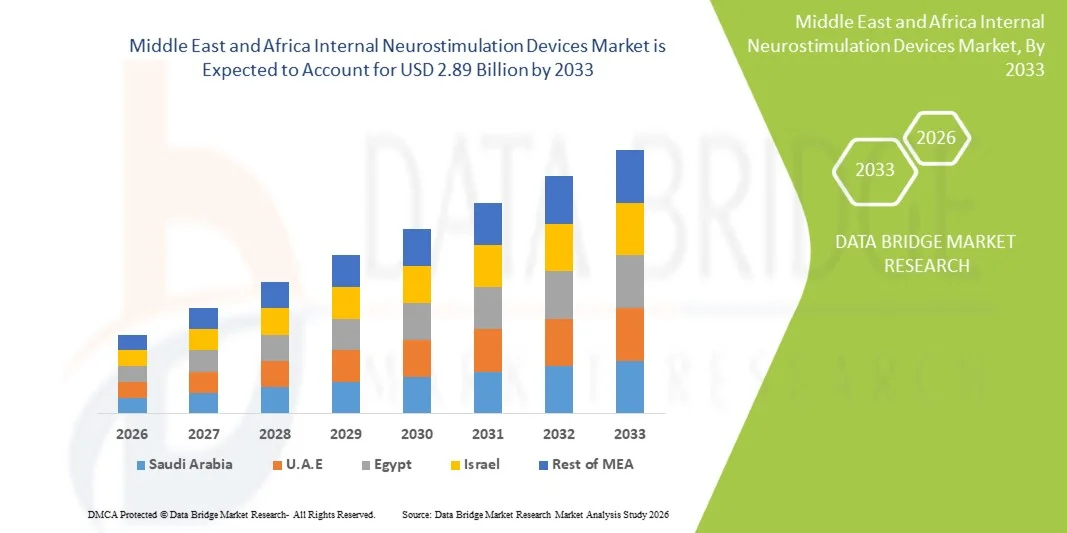
The Middle East and Africa Internal Neurostimulation Devices market was valued at USD 1.39 billion in 2025 and is projected to reach USD 2.89 billion by 2033, growing at a CAGR of 9.60% from 2026 to 2033. The market is experiencing steady growth driven by rising prevalence of neurological disorders such as chronic pain, epilepsy, Parkinson’s disease, and depression, along with increasing demand for minimally invasive and targeted neuromodulation therapies. Rapid advancements in neurostimulation technologies, including closed-loop systems, rechargeable implantable devices, and AI-enabled stimulation control, are further enhancing treatment precision and patient outcomes. Expanding clinical applications across neurology, psychiatry, and pain management are also supporting broader adoption of internal neurostimulation devices in hospitals and specialty clinics.
The increasing burden of drug-resistant neurological conditions, combined with limitations of conventional pharmacological treatments, is encouraging healthcare providers and patients to adopt implantable neurostimulation therapies as long-term management solutions. Growing clinical evidence supporting the efficacy of deep brain stimulation (DBS), spinal cord stimulation (SCS), and vagus nerve stimulation (VNS), along with improving reimbursement frameworks in developed markets, is further accelerating market adoption. In addition, rising investments in neurotechnology research and expanding use of personalized neuromodulation therapies are driving sustained growth across both developed and emerging healthcare systems.
Key Market Trends & Insights
- Saudi Arabia dominated the Middle East and Africa Internal Neurostimulation Devices market with the largest revenue share of 36.41% in 2025, supported by a high prevalence of neurological disorders, rapidly advancing healthcare infrastructure, strong adoption of implantable neuromodulation therapies, and robust government investment in specialized tertiary care hospitals. The country also benefits from increasing availability of advanced neurosurgical procedures, rising healthcare expenditure, and strong integration of technologies such as Spinal Cord Stimulation (SCS) and Deep Brain Stimulation (DBS), further strengthening its leadership position in the regional market.
- The Spinal Cord Stimulation (SCS) segment dominated the market with a 45.32% share in 2025, owing to its strong clinical adoption in chronic pain management, especially for failed back surgery syndrome and neuropathic pain conditions
- The U.A.E is expected to be the fastest-growing country in the Middle East and Africa Internal Neurostimulation Devices market at a CAGR of 8.1% from 2026 to 2033, fueled by rising awareness regarding neurological disorders, expanding healthcare infrastructure, and increasing investment in advanced neurosurgical and neurotechnology solutions. Rapid development of world-class hospitals, growing adoption of AI-enabled and minimally invasive neurostimulation devices, and strong government initiatives to position the country as a medical tourism hub are further accelerating market growth across the U.A.E.
- Deep Brain Stimulation segment is witnessing strong growth, supported by rising prevalence of Parkinson’s disease and other movement disorders, increasing procedural success rates, and ongoing advancements in adaptive and minimally invasive neurostimulation technologies.
- Direct Tender segment accounts for 62.15% of the market in 2025, due to bulk procurement by hospitals, government healthcare systems, and specialty neurology centers, along with long-term institutional contracts and centralized purchasing systems.
Market Size & Forecast
- Middle East and Africa Market Value (2025): USD 1.39 Billion
- Expected Market Value (2033): USD 2.89 Billion
- Forecast CAGR (2026–2033): 9.60%
- Leading Region in 2025: North America
- Fastest Growing Region: Asia-Pacific
Report Scope and Middle East and Africa Internal Neurostimulation Devices Market Segmentation
|
Attributes |
Internal Neurostimulation Devices Key Market Insights |
|
Segments Covered |
|
|
Countries Covered |
Middle East and Africa · Saudi Arabia · U.A.E. · South Africa · Egypt · Israel · Rest of Middle East and Africa |
|
Key Market Players |
• Medtronic plc (Ireland) |
|
Market Opportunities |
· Rising prevalence of neurological and chronic disorders · Technological advancements in implantable neurostimulation devices · Expanding healthcare infrastructure and reimbursement support |
|
Value Added Data Infosets |
In addition to the insights on market scenarios such as market value, growth rate, segmentation, geographical coverage, and major players, the market reports curated by the Data Bridge Market Research also include in-depth expert analysis, geographically represented company-wise production and capacity, network layouts of distributors and partners, detailed and updated price trend analysis and deficit analysis of supply chain and demand. |
Middle East and Africa Internal Neurostimulation Devices Market Trends
Trend: Growing Adoption of Neurostimulation in Advanced Clinical & Neuromodulation Applications
The Middle East and Africa Internal Neurostimulation Devices market is witnessing strong adoption across advanced therapeutic and performance-driven neuromodulation applications. Devices such as Spinal Cord Stimulation (SCS), Deep Brain Stimulation (DBS), and Vagus Nerve Stimulation (VNS) are increasingly used for treatment-resistant neurological conditions. For instance, more than 10 million people Middle East and Africaly live with Parkinson’s disease, while epilepsy affects nearly 50 million people worldwide, creating a large patient base for DBS and VNS therapies. Leading companies such as Medtronic plc (Percept™ DBS platform) and Boston Scientific Corporation (Vercise™ DBS system) are expanding high-precision, adaptive stimulation technologies. Similarly, Abbott Laboratories is advancing closed-loop neurostimulation systems (e.g., Proclaim™ DRG therapy) for chronic pain management. Growing integration of AI-based programming, adaptive stimulation, and remote patient monitoring is further enhancing therapy personalization and long-term outcomes.
Middle East and Africa Internal Neurostimulation Devices Market Dynamics
Key Market Driver: Rising Burden of Chronic Neurological and Pain Disorders
A major driver is the increasing Middle East and Africa prevalence of chronic neurological and functional disorders such as chronic pain, Parkinson’s disease, epilepsy, and urinary incontinence. Chronic pain alone affects an estimated 1 in 5 adults Middle East and Africaly, significantly driving demand for Spinal Cord Stimulation (SCS) systems. The rising aging population is also contributing to higher incidence of neurodegenerative disorders. Companies such as Nevro Corp. (high-frequency SCS systems) and LivaNova PLC (VNS Therapy for epilepsy and depression) are experiencing growing clinical adoption as healthcare systems shift toward minimally invasive, long-term neuromodulation therapies. Increasing clinical evidence supporting improved quality of life and reduced opioid dependence is further accelerating market penetration.
Key Restraint/Challenge: High Cost and Limited Accessibility of Implantable Systems
A significant restraint in the Middle East and Africa Internal Neurostimulation Devices market is the high cost of implantation, device programming, and long-term therapy management. Advanced DBS and SCS systems can cost tens of thousands of dollars per patient, including surgical procedures, device implantation, and follow-up programming. This limits adoption in price-sensitive regions, particularly in parts of Asia-Pacific, Latin America, and Africa. In addition, reimbursement variability across countries remains a key barrier despite strong clinical outcomes. Even leading players such as NeuroPace Inc. (responsive neurostimulation for epilepsy) face adoption challenges due to insurance approval complexity and post-implantation monitoring requirements. Surgical risks, device replacement cycles, and lack of specialized neurosurgical expertise in emerging economies further restrict market expansion.
Key Market Opportunity: Integration of Closed-Loop Systems, AI, and Next-Generation Neuromodulation Platforms
A major opportunity lies in the development of closed-loop, AI-enabled neurostimulation systems that automatically adjust stimulation based on real-time neural feedback. Companies such as Saluda Medical Pty Ltd (Evoke closed-loop SCS system) are pioneering adaptive stimulation technologies that improve pain relief outcomes compared to traditional open-loop systems. Increasing R&D in brain-computer interface (BCI) integration and smart implantable devices is enabling more precise therapy delivery. The growing adoption of remote programming and cloud-connected neurostimulators is expanding access to long-term care monitoring. In addition, rising investments in neurological research infrastructure—particularly in the U.S., Europe, and China—are enabling large-scale clinical trials and faster regulatory approvals. Emerging applications such as gastric electrical stimulation for gastroparesis and sacral nerve stimulation for bladder disorders are also opening new therapeutic segments. This combination of AI integration, expanding indications, and improved device connectivity is expected to significantly expand the addressable market over the next decade.
Middle East and Africa Internal Neurostimulation Devices Market Scope
The Internal Neurostimulation Devices market is segmented on the basis of product type and distribution channel.
- By Product Type
On the basis of product type, the Middle East and Africa Internal Neurostimulation Devices market is segmented into Spinal Cord Stimulation (SCS), Deep Brain Stimulation (DBS), Vagus Nerve Stimulation (VNS), Sacral Nerve Stimulation, and Gastric Electrical Stimulation. The Spinal Cord Stimulation (SCS) segment dominated the market with a 45.32% share in 2025, owing to its strong clinical adoption in chronic pain management, especially for failed back surgery syndrome and neuropathic pain conditions. Increasing preference for minimally invasive pain therapies over long-term opioid use is significantly driving demand. Leading companies such as Abbott Laboratories, Nevro Corp., and Boston Scientific Corporation are continuously innovating high-frequency and closed-loop SCS systems to improve patient outcomes. Rising Middle East and Africa chronic pain prevalence—affecting nearly 1.5 billion people worldwide—is further strengthening segment dominance. The availability of rechargeable and MRI-compatible devices has increased adoption in developed healthcare markets. Strong reimbursement frameworks in the U.S. and Europe are also supporting procedural volumes. Increasing outpatient neuromodulation procedures is further boosting demand. Overall, SCS remains the most widely implanted neurostimulation therapy Middle East and Africaly.
The Deep Brain Stimulation (DBS) segment is expected to witness the fastest growth at a CAGR of 8.2% from 2026 to 2033, driven by increasing neurological disorder prevalence such as Parkinson’s disease, essential tremor, and dystonia. DBS is gaining traction due to its effectiveness in managing treatment-resistant movement disorders. Technological advancements such as adaptive DBS and closed-loop stimulation systems are improving precision therapy delivery. Companies like Medtronic plc and Boston Scientific Corporation are expanding next-generation DBS platforms with AI-assisted programming. Rising Middle East and Africa Parkinson’s disease cases—expected to exceed 12 million by 2040—are accelerating demand. Expanding neurology centers in Asia-Pacific and Europe are increasing procedural accessibility. Growing clinical trials exploring DBS for psychiatric disorders like depression and OCD are further widening applications. Improved surgical techniques and minimally invasive implantation methods are reducing risks. Increasing insurance coverage approvals is also boosting adoption rates. These factors collectively position DBS as the fastest-expanding product segment.
- By Distribution Channel
On the basis of distribution channel, the Middle East and Africa Internal Neurostimulation Devices market is segmented into Direct Tender and Third-Party Service Provider. The Direct Tender segment dominated the market with a 62.48% share in 2025, primarily due to large-scale procurement by hospitals, government healthcare systems, and specialized neurology centers. Direct purchasing ensures cost efficiency, standardized procurement, and long-term supplier contracts. Major manufacturers such as Medtronic plc, Abbott Laboratories, and Boston Scientific Corporation rely heavily on institutional tenders for bulk device deployment. Government healthcare programs in the U.S., Germany, and Japan significantly contribute to tender-based acquisitions. Increasing demand for cost-controlled neurostimulation therapies in public healthcare systems further strengthens this channel. Hospitals prefer direct procurement to ensure device authenticity, warranty coverage, and regulatory compliance. Large neurostimulation implantation programs also depend on structured tender agreements. The presence of centralized purchasing systems in developed markets further enhances dominance. High-volume DBS and SCS procedures in tertiary care hospitals reinforce this channel leadership. Overall, direct tender remains the backbone of large-scale market distribution.
The Third-Party Service Provider segment is expected to witness the fastest growth at a CAGR of 7.6% from 2026 to 2033, driven by expanding access to specialized neuromodulation services in emerging markets. Third-party distributors and service providers help bridge the gap between manufacturers and smaller healthcare facilities. Increasing demand for flexible financing models and device leasing options is accelerating adoption. Companies are partnering with regional medical distributors to improve penetration in Asia-Pacific, Latin America, and the Middle East. Rising awareness of neurostimulation therapies among private clinics is further supporting growth. These providers also offer installation, training, and post-implantation support services, improving treatment accessibility. Growth of outpatient neurology clinics is expanding demand for third-party channels. In addition, increasing complexity of neurostimulation devices requires specialized service expertise. Digital health integration and remote programming support are also enhancing service provider roles. Overall, this channel is becoming critical for market expansion in cost-sensitive regions.
Middle East and Africa Internal Neurostimulation Devices Market Regional Analysis
The Middle East and Africa Internal Neurostimulation Devices market remains an emerging yet steadily expanding regional segment, driven by rising neurological disorder prevalence, improving healthcare infrastructure, and increasing adoption of advanced neuromodulation therapies. Growing utilization of Deep Brain Stimulation (DBS) for movement disorders and Spinal Cord Stimulation (SCS) for chronic pain conditions is supporting market development across major healthcare systems. Strong government investment in tertiary care hospitals, particularly in Gulf Cooperation Council (GCC) countries, along with expanding access to neurosurgical procedures, is further strengthening market growth. Increasing collaboration between international medical device companies and regional healthcare providers is enhancing technology transfer and clinical capabilities. Rising awareness regarding early diagnosis and treatment of neurological conditions is also contributing to higher procedural volumes across the region.
Saudi Arabia Internal Neurostimulation Devices Market Insight
The Saudi Arabia Internal Neurostimulation Devices market dominated the Middle East and Africa region with the largest revenue share of 36.41% in 2025, supported by a high prevalence of neurological disorders, rapidly advancing healthcare infrastructure, strong adoption of implantable neuromodulation therapies, and robust government investment in specialized tertiary care hospitals. The country benefits from increasing availability of advanced neurosurgical procedures, rising healthcare expenditure, and strong integration of technologies such as Spinal Cord Stimulation (SCS) and Deep Brain Stimulation (DBS). Continuous expansion of specialty neurology centers and increasing adoption of AI-assisted neurostimulation systems are further reinforcing its leadership position in the regional market.
U.A.E Internal Neurostimulation Devices Market Insight
The U.A.E Internal Neurostimulation Devices market is expected to be the fastest-growing country in the Middle East and Africa region at a CAGR of 8.1% from 2026 to 2033, fueled by rising awareness regarding neurological disorders, expanding healthcare infrastructure, and increasing investment in advanced neurosurgical and neurotechnology solutions. Rapid development of world-class hospitals and specialty neurology centers, along with strong government initiatives to position the country as a global medical tourism hub, is significantly accelerating market growth. In addition, growing adoption of AI-enabled, minimally invasive neurostimulation devices and increasing collaboration with global medtech companies are further enhancing treatment accessibility and clinical adoption across the U.A.E.
Middle East and Africa Internal Neurostimulation Devices Market Share
The Internal Neurostimulation Devices industry is primarily led by well-established companies, including:
- Medtronic plc (Ireland)
- Boston Scientific Corporation (U.S.)
- Abbott Laboratories (U.S.)
- LivaNova PLC (U.K.)
- Nevro Corp. (U.S.)
- Aleva Neurotherapeutics SA (Switzerland)
- Synapse Biomedical Inc. (U.S.)
- Saluda Medical Pty Ltd (Australia)
- Integer Holdings Corporation (U.S.)
- NeuroPace Inc. (U.S.)
- SceneRay Corporation (China)
- Beijing PINS Medical Co., Ltd. (China)
- Beijing Simcere Medical Science Co., Ltd. (China)
- Renishaw plc (U.K.)
- Elekta AB (Sweden)
- Soterix Medical Inc. (U.S.)
- Neuronetics Inc. (U.S.)
- Fisher Wallace Laboratories (U.S.)
- Magstim Company Ltd. (U.K.)
- Bioness Inc. (U.S.)
- Beijing iSurg Medical Technology Co., Ltd. (China)
- Neurosigma Inc. (U.S.)
- Greatbatch Medical (U.S.)
- Helius Medical Technologies Inc. (U.S.)
- Synapse Biomedical (U.S.)
- Nuvectra Corporation (U.S.)
Latest Developments in Middle East and Africa Internal Neurostimulation Devices Market
- In June 2021, Medtronic plc, a Middle East and Africa leader in neuromodulation therapies, received U.S. FDA approval for its Percept PC Deep Brain Stimulation (DBS) system, designed for Parkinson’s disease and essential tremor patients. The device introduced BrainSense technology, enabling clinicians to capture brain signals and personalize stimulation therapy. This approval marked a major step toward adaptive and data-driven neurostimulation for movement disorders
- In February 2022, Precisis GmbH received FDA Breakthrough Device Designation for its EASEE brain stimulation system, intended for epilepsy treatment. The designation highlighted increasing regulatory support for minimally invasive neurostimulation technologies targeting drug-resistant neurological disorders
- In February 2022, FDA approval was granted for rechargeable neurostimulation technology used in bowel and bladder control therapies, expanding sacral nerve stimulation applications. This development strengthened adoption of neuromodulation devices for urological disorders such as urinary retention and overactive bladder
- In May 2023, Abbott Laboratories received FDA approval for its full portfolio of Spinal Cord Stimulation (SCS) systems for chronic back pain patients who are not eligible for surgery. The approval included both Proclaim and Eterna platforms, significantly expanding treatment access for chronic pain management
- In April 2024, Medtronic received FDA approval for the Inceptiv closed-loop spinal cord stimulation system, the company’s first SCS device capable of real-time automatic adjustment of stimulation. This innovation improved therapy comfort and reduced overstimulation during patient movement, marking a shift toward intelligent neuromodulation systems
- In May 2024, Abbott’s Spinal Cord Stimulation (SCS) systems received FDA clearance updates expanding device indications and portfolio enhancements. This strengthened the company’s leadership in chronic pain neuromodulation therapies across the U.S. market
- In February 2025, Medtronic earned FDA approval for BrainSense Adaptive Deep Brain Stimulation (aDBS), the world’s first adaptive DBS system for Parkinson’s disease. The system automatically adjusts stimulation in real time based on brain activity, representing a major advancement in closed-loop neurostimulation technology
- In August 2025, Nyxoah received FDA approval for its Genio hypoglossal nerve stimulation system for moderate to severe obstructive sleep apnea (OSA). This expanded the application of neurostimulation beyond neurological disorders into sleep-related respiratory conditions
- In September 2025, the FDA approved a vagus nerve stimulation (VNS) device for the treatment of rheumatoid arthritis patients not responding to conventional therapy. This marked a breakthrough expansion of VNS applications into autoimmune disease management
- In December 2025, Medtronic expanded its neurostimulation portfolio with next-generation DBS systems designed to enhance precision therapy for movement disorders. This reflects continued innovation toward AI-driven and personalized neuromodulation platforms

- Interactive Data Analysis Dashboard
- Company Analysis Dashboard for high growth potential opportunities
- Research Analyst Access for customization & queries
- Competitor Analysis with Interactive dashboard
- Latest News, Updates & Trend analysis
- Harness the Power of Benchmark Analysis for Comprehensive Competitor Tracking
Data collection and base year analysis are done using data collection modules with large sample sizes. The stage includes obtaining market information or related data through various sources and strategies. It includes examining and planning all the data acquired from the past in advance. It likewise envelops the examination of information inconsistencies seen across different information sources. The market data is analysed and estimated using market statistical and coherent models. Also, market share analysis and key trend analysis are the major success factors in the market report. To know more, please request an analyst call or drop down your inquiry.
The key research methodology used by DBMR research team is data triangulation which involves data mining, analysis of the impact of data variables on the market and primary (industry expert) validation. Data models include Vendor Positioning Grid, Market Time Line Analysis, Market Overview and Guide, Company Positioning Grid, Patent Analysis, Pricing Analysis, Company Market Share Analysis, Standards of Measurement, Global versus Regional and Vendor Share Analysis. To know more about the research methodology, drop in an inquiry to speak to our industry experts.
Data Bridge Market Research is a leader in advanced formative research. We take pride in servicing our existing and new customers with data and analysis that match and suits their goal. The report can be customized to include price trend analysis of target brands understanding the market for additional countries (ask for the list of countries), clinical trial results data, literature review, refurbished market and product base analysis. Market analysis of target competitors can be analyzed from technology-based analysis to market portfolio strategies. We can add as many competitors that you require data about in the format and data style you are looking for. Our team of analysts can also provide you data in crude raw excel files pivot tables (Fact book) or can assist you in creating presentations from the data sets available in the report.













