


Middle East and Africa Invisible Orthodontics Market Overview
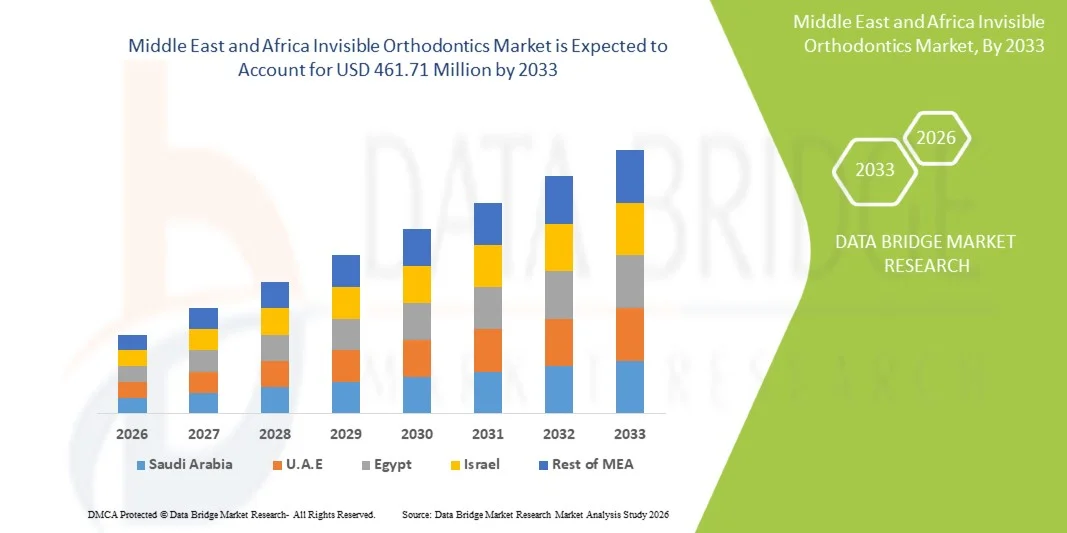
The Middle East and Africa invisible orthodontics market was valued at USD 231.72 million in 2025 and is projected to reach USD 461.71 million by 2033, growing at a CAGR of 9.00% from 2026 to 2033. The market is witnessing steady expansion driven by increasing aesthetic awareness, rising demand for discreet dental treatments, and growing adoption of advanced orthodontic solutions such as clear aligners and lingual braces across urban populations in the region. Improvements in dental infrastructure and expanding private dental clinic networks are further supporting market penetration across key countries.
The rising prevalence of malocclusion and other dental alignment disorders, combined with increasing disposable incomes and greater willingness to invest in cosmetic dentistry, is accelerating the adoption of invisible orthodontics in the Middle East and Africa. In addition, the growing influence of social media-driven beauty standards, expansion of medical tourism in countries such as the UAE, and technological advancements in 3D scanning and digital treatment planning are enabling faster, more precise, and more personalized orthodontic treatments across the region.
Key Market Trends & Insights
- The United Arab Emirates dominated the Middle East and Africa invisible orthodontics market in 2025 with a 34.26% revenue share, supported by advanced cosmetic dentistry infrastructure, high disposable income, strong medical tourism inflow, and widespread adoption of clear aligner treatments in private dental chains.
- The Products segment led the market with a 62.84% share in 2025, driven by strong adoption of clear aligners, advanced bracket systems, and digital orthodontic devices used in treatment planning and execution.
- South Africa is projected to be the fastest-growing country from 2026 to 2033 with a CAGR of 7.6%, fueled by expanding private healthcare investment, rising awareness of orthodontic care, and increasing penetration of modern dental technologies in metropolitan areas.
- Services are the fastest-growing products and services, projected to register a CAGR of 8.3%, reflecting the surge in demand for digital treatment planning, remote monitoring, and teledentistry-based orthodontic consultations.
- The Adults segment dominated the age group category with a 64.17% revenue share in 2025, led by rising aesthetic consciousness, professional appearance requirements, and higher disposable income among working-age populations.
- Malocclusion accounted for 46.52% of the market, preferred by its high prevalence across both adult and adolescent populations in MEA.
- The Crowding segment is the fastest-growing application category, with a CAGR of 8.1%, driven by the rising urban dietary habits and genetic prevalence of dental overcrowding.
Market Size & Forecast
- Global Market Value (2025): USD 231.72 Million
- Expected Market Value (2033): USD 461.71 Million
- Forecast CAGR (2026–2033): 9.00%
- Leading Country in 2025: United Arab Emirates
- Fastest Growing Country: South Africa
Report Scope and Middle East and Africa Invisible Orthodontics Market Segmentation
|
Attributes |
Middle East and Africa Invisible Orthodontics Key Market Insights |
|
Segments Covered |
|
|
Countries Covered |
Middle East and Africa · Saudi Arabia · U.A.E. · South Africa · Egypt · Israel · Rest of Middle East and Africa |
|
Key Market Players |
· Align Technology, Inc. (U.S.) · Straumann Group (Switzerland) · 3M (U.S.) · Dentsply Sirona Inc. (U.S.) · Envista Holdings Corporation (U.S.) · Henry Schein, Inc. (U.S.) · SmileDirectClub, Inc. (U.S.) · Institut Straumann AG (Switzerland) · Planmeca Oy (Finland) · GC Corporation (Japan) · Shofu Inc. (Japan) · Ormco Corporation (U.S.) · American Orthodontics Corporation (U.S.) · TP Orthodontics, Inc. (U.S.) · DB Orthodontics Limited (U.K.) · Great Lakes Dental Technologies (U.S.) · BioHorizons, Inc. (U.S.) · Angelalign Technology Inc. (China) · Modern Dental Group Limited (Hong Kong) · Ivoclar Vivadent AG (Liechtenstein) |
|
Market Opportunities |
· Expansion of teledentistry and remote orthodontic monitoring platforms · Rising medical tourism for cosmetic dentistry · Increasing partnerships between global aligner manufacturers and local dental clinic chains |
|
Value Added Data Infosets |
In addition to the insights on market scenarios such as market value, growth rate, segmentation, geographical coverage, and major players, the market reports curated by the Data Bridge Market Research also include in-depth expert analysis, patient epidemiology, pipeline analysis, pricing analysis, and regulatory framework. |
Middle East and Africa Invisible Orthodontics Market Trends
Trend: Rapid Adoption of Digital Clear Aligner Ecosystems in Cosmetic Dentistry
Invisible orthodontics in the MEA region is undergoing a structural shift from conventional orthodontic workflows to fully digitized, AI-assisted treatment ecosystems. The adoption of intraoral scanners, 3D treatment simulation software, and automated aligner manufacturing is significantly improving treatment precision, turnaround time, and patient comfort. Dental clinics in high-income MEA countries are increasingly integrating cloud-based orthodontic platforms that enable real-time treatment monitoring and remote adjustments, reducing the need for frequent in-clinic visits. For instance, clinics in the UAE are deploying AI-powered smile design and virtual treatment preview systems to improve patient conversion rates, while premium dental centers in Saudi Arabia are using fully digital chairside scanning and aligner tracking systems to enhance workflow efficiency and reduce treatment duration.
Middle East and Africa Invisible Orthodontics Market Dynamics
Key Market Driver: Rising Demand for Aesthetic Dentistry and Urban Cosmetic Awareness
The demand for invisible orthodontics in MEA is being strongly driven by rising aesthetic consciousness, particularly among young adults and working professionals in urban centers. Social media influence, increasing exposure to global beauty standards, and the importance of appearance in professional environments are encouraging patients to opt for discreet orthodontic solutions such as clear aligners over traditional braces. At the same time, rising disposable income in GCC countries and expanding private healthcare insurance coverage are making premium orthodontic treatments more financially accessible. For instance, in Saudi Arabia and the UAE, a growing number of patients are choosing premium clear aligner systems due to their removability, comfort, and minimal lifestyle disruption, while cosmetic dentistry clinics in Qatar and Kuwait are reporting higher demand for customized, digitally planned orthodontic treatments among adult patients.
Key Restraint/Challenge: High Treatment Costs and Limited Orthodontic Specialist Availability
Despite strong demand, the MEA invisible orthodontics market is constrained by high treatment costs and uneven distribution of specialized orthodontic expertise, particularly across African nations. Advanced clear aligner treatments require digital infrastructure, skilled orthodontists, and continuous patient monitoring, which significantly increases overall treatment expenses and limits accessibility in lower-income populations. In many African countries, the lack of trained orthodontic professionals and limited access to intraoral scanning and digital treatment planning tools further restrict market penetration outside major metropolitan areas.
For instance, in Nigeria and Kenya, traditional metal braces remain more widely used due to affordability constraints and fewer clinics offering advanced aligner-based treatment, while even in parts of Egypt and Morocco, access to high-end digital orthodontic systems is largely concentrated in private urban dental centers.
Key Market Opportunity: Expansion of Digital Teledentistry and Cross-Border Cosmetic Dental Service Models
The MEA invisible orthodontics market presents strong growth potential through the rapid expansion of teledentistry platforms, cross-border dental care networks, and digitally enabled orthodontic treatment models. These systems allow patients to receive consultations, treatment planning, and progress monitoring remotely, significantly improving access to specialist orthodontic care in underserved and geographically dispersed regions. Integration of AI-driven diagnostics, cloud-based treatment tracking, and virtual smile simulation tools is enabling orthodontists to manage larger patient volumes with greater efficiency while maintaining treatment accuracy. For instance, UAE-based premium dental groups are increasingly offering remote orthodontic consultation services to patients in African countries, while Saudi Arabia is witnessing collaborations between local dental chains and global clear aligner manufacturers to deliver fully digital, end-to-end orthodontic treatment pathways that reduce dependency on physical clinic visits and expand market reach.
Middle East and Africa Invisible Orthodontics Market Scope
The Middle East and Africa invisible orthodontics market is segmented on the basis of products and services, age group, application, end user, and distribution channel
- By Products and Services
On the basis of products and services, the Middle East and Africa invisible orthodontics market is segmented into products and services. The Products segment dominated the market with a 62.84% share in 2025, driven by strong adoption of clear aligners, advanced bracket systems, and digital orthodontic devices used in treatment planning and execution. High demand for customized aligner kits, intraoral scanners, and 3D-printed dental models is significantly supporting product dominance. Dental clinics across UAE and Saudi Arabia are increasingly investing in premium aligner systems due to rising patient preference for aesthetic treatment solutions. The segment benefits from rapid technological advancements in CAD/CAM-based orthodontics and AI-driven smile design platforms. Expanding distribution networks of global aligner manufacturers further strengthens product penetration. Continuous innovation in material science is improving comfort, transparency, and treatment efficiency.
The Services segment is expected to witness the fastest growth at a CAGR of 8.3% from 2026 to 2033, driven by rising demand for digital treatment planning, remote monitoring, and teledentistry-based orthodontic consultations. Service-based models are gaining traction among clinics seeking end-to-end orthodontic management support from global aligner providers. Increasing adoption of subscription-based aligner treatment plans and AI-assisted case monitoring is accelerating growth. Clinics in Africa are increasingly outsourcing orthodontic planning services due to limited specialist availability. Growing cross-border dental consultations between GCC countries and African patients is further boosting service demand. Integration of cloud-based orthodontic platforms is enhancing scalability and accessibility of services.
- By Age Group
On the basis of age group, the market is segmented into adults, teenagers, and children. The Adults segment dominated the market with a 64.17% share in 2025, driven by rising aesthetic consciousness, professional appearance requirements, and higher disposable income among working-age populations. Adults are more likely to opt for invisible orthodontics due to lifestyle compatibility and discreet treatment benefits. Increasing prevalence of malocclusion and late orthodontic correction is further supporting demand. Corporate professionals and urban populations in GCC countries are key contributors to segment growth. Social media influence and beauty standards are also driving treatment uptake. Dental clinics are increasingly offering premium aligner packages tailored for adult patients.
The Teenagers segment is projected to be the fastest growing at a CAGR of 7.9% from 2026 to 2033, supported by increasing parental awareness of early orthodontic correction and rising acceptance of clear aligners among younger populations. Teen-specific aligner systems with compliance indicators are improving treatment adoption. Schools and pediatric dental programs in urban MEA regions are increasingly promoting orthodontic screening. Growing affordability of aligners is making them accessible to middle-income families. Expansion of pediatric dental clinics and orthodontic awareness campaigns is further driving growth. Digital monitoring tools are also improving adherence in teenage patients.
- By Application
On the basis of application, the market is segmented into malocclusion, crowding, excessive spacing, and others. The Malocclusion segment dominated the market with a 46.52% share in 2025, driven by its high prevalence across both adult and adolescent populations in MEA. Misalignment issues are increasingly being treated using clear aligners due to their effectiveness in mild to moderate cases. Rising awareness of oral health and aesthetic correction is boosting treatment rates. Clinics in GCC countries are increasingly using digital diagnostics for malocclusion correction. Growing access to advanced orthodontic planning tools is improving treatment accuracy. Preventive dental screening programs are also supporting early diagnosis.
The Crowding segment is expected to be the fastest growing at a CAGR of 8.1% from 2026 to 2033, driven by rising urban dietary habits and genetic prevalence of dental overcrowding. Clear aligners are increasingly preferred for crowding correction due to better comfort and aesthetics compared to traditional braces. Advances in sequential aligner technology are improving treatment outcomes. Increasing orthodontic awareness in African urban centers is accelerating adoption. Digital treatment simulation is helping patients visualize correction results. Expansion of cosmetic dentistry clinics is further supporting segment growth.
- By End User
On the basis of end user, the market is segmented into hospitals, dental clinics, orthodontics clinics, and others. The Dental Clinics segment dominated the market with a 57.36% share in 2025, driven by widespread availability of advanced orthodontic tools, digital scanning systems, and strong patient inflow for cosmetic treatments. Dental clinics are the primary access point for clear aligner treatments in urban MEA regions. Increasing investment in private dental infrastructure is strengthening this dominance. Clinics in UAE and Saudi Arabia are adopting fully digital orthodontic workflows. Growing patient preference for specialized outpatient care is further boosting demand. Strong presence of international dental chains is also contributing to growth.
The Orthodontics Clinics segment is expected to be the fastest growing at a CAGR of 8.0% from 2026 to 2033, driven by increasing specialization in advanced aligner treatments and complex dental corrections. These clinics are increasingly equipped with AI-based treatment planning systems and 3D imaging technologies. Rising demand for premium orthodontic care is shifting patients toward specialized providers. Expansion of orthodontic training programs in MEA is increasing specialist availability. High treatment success rates in specialized clinics are improving patient trust. Growing referrals from general dentists are further accelerating growth.
- By Distribution Channel
On the basis of distribution channel, the market is segmented into direct sales and third-party distributors. The Direct Sales segment dominated the market with a 68.19% share in 2025, driven by strong presence of global clear aligner manufacturers directly supplying products to large dental chains and orthodontic clinics. Direct engagement allows better customization, training support, and software integration for treatment planning. Major OEMs prefer direct contracts with premium clinics in GCC countries. This model ensures higher margins and stronger brand control. Increasing digital orthodontic platforms are further strengthening direct procurement systems.
The Third-Party Distributors segment is expected to be the fastest growing at a CAGR of 7.8% from 2026 to 2033, driven by expanding dental product accessibility in African countries and smaller MEA markets. Distributors play a key role in reaching semi-urban and rural dental clinics. They also support inventory management and localized supply chains. Increasing demand for affordable orthodontic solutions is boosting distributor-led sales. Partnerships between global manufacturers and regional distributors are improving market penetration. Growth in emerging dental markets is further accelerating this channel.
Middle East and Africa Invisible Orthodontics Market Regional Analysis
The United Arab Emirates dominated the Middle East and Africa invisible orthodontics market in 2025 with a 34.26% revenue share, supported by advanced cosmetic dentistry infrastructure, high disposable income, strong medical tourism inflow, and widespread adoption of clear aligner treatments in private dental chains. The country also benefits from high disposable income, rapid medical tourism growth, and strong patient preference for aesthetic, digitally guided orthodontic solutions. Increasing use of AI-based smile design systems, 3D scanning technologies, and fully digital treatment planning platforms continues to strengthen the UAE’s leadership position in the MEA invisible orthodontics market.
The UAE Invisible Orthodontics Market Insight
The UAE invisible orthodontics market is witnessing strong growth due to rising demand for cosmetic dentistry, high disposable income levels, and widespread adoption of advanced clear aligner technologies across premium dental clinics. The country’s highly developed private healthcare ecosystem, along with strong presence of international dental chains and medical tourism inflows, is driving adoption across adult and teenage populations. In addition, increasing use of AI-based smile design systems, 3D intraoral scanning, and fully digital orthodontic treatment planning is accelerating market expansion across the UAE.
Saudi Arabia Invisible Orthodontics Market Insight
The Saudi Arabia invisible orthodontics market is experiencing steady growth supported by increasing awareness of dental aesthetics, rising healthcare spending under national transformation programs, and expanding private dental infrastructure. Growing demand for discreet orthodontic treatments among young professionals and urban populations is driving clear aligner adoption across the country. Furthermore, increasing integration of digital dentistry tools, orthodontic specialization, and government-backed healthcare modernization initiatives are enhancing treatment accessibility and quality in Saudi Arabia.
South Africa Invisible Orthodontics Market Insight
The South Africa invisible orthodontics market is expanding gradually, driven by rising awareness of oral health, increasing urban middle-class population, and growing adoption of private dental care services. Demand for clear aligners is increasing in metropolitan areas such as Johannesburg and Cape Town, where advanced dental clinics are more widely available. In addition, improvements in dental infrastructure, rising availability of trained orthodontists, and increasing exposure to global cosmetic dentistry trends are supporting steady market growth in South Africa.
Egypt Invisible Orthodontics Market Insight
The Egypt invisible orthodontics market is witnessing moderate growth due to increasing demand for aesthetic dental treatments, rising urbanization, and gradual expansion of private dental clinics. Awareness of orthodontic correction is improving among younger populations, particularly in major cities such as Cairo and Alexandria. Moreover, growing availability of cost-effective aligner solutions, increasing penetration of digital dentistry technologies, and rising investments in healthcare infrastructure are contributing to the expansion of invisible orthodontics in Egypt.
Middle East and Africa Invisible Orthodontics Market Share
The Middle East and Africa invisible orthodontics industry is primarily led by well-established companies, including:
- Align Technology, Inc. (U.S.)
- Straumann Group (Switzerland)
- 3M (U.S.)
- Dentsply Sirona Inc. (U.S.)
- Envista Holdings Corporation (U.S.)
- Henry Schein, Inc. (U.S.)
- SmileDirectClub, Inc. (U.S.)
- Institut Straumann AG (Switzerland)
- Planmeca Oy (Finland)
- GC Corporation (Japan)
- Shofu Inc. (Japan)
- Ormco Corporation (U.S.)
- American Orthodontics Corporation (U.S.)
- TP Orthodontics, Inc. (U.S.)
- DB Orthodontics Limited (U.K.)
- Great Lakes Dental Technologies (U.S.)
- BioHorizons, Inc. (U.S.)
- Angelalign Technology Inc. (China)
- Modern Dental Group Limited (Hong Kong)
- Ivoclar Vivadent AG (Liechtenstein)
Latest Developments in Middle East and Africa Invisible Orthodontics Market
- In January 2026, the company introduced ClinCheck Live Plan in Saudi Arabia, an AI-enabled system that reduces orthodontic treatment planning time to nearly 15 minutes, allowing dentists to generate ready-to-use aligner treatment plans during patient visits and further advancing automation and efficiency in the regional invisible orthodontics market
- In November 2025, the company further expanded its academic collaboration programs across the UAE, Saudi Arabia, and Kuwait, bringing together orthodontic educators and clinicians to promote adoption of intraoral scanning, digital treatment simulation, and standardized aligner protocols, thereby strengthening long-term clinical capacity in the region
- In September 2025, Align Technology launched the iTero Lumina intraoral scanning system across key Middle Eastern markets, including the UAE, Qatar, and Saudi Arabia, enabling faster and more accurate digital impressions that directly integrate with Invisalign treatment planning software, significantly improving clinical efficiency and patient comfort
- In June 2025, Align Technology expanded its Invisalign clinical education and roadshow programs across the Middle East, particularly in the UAE and Saudi Arabia, to strengthen adoption of digital orthodontics and improve practitioner expertise in clear aligner therapies. The initiative focused on enhancing orthodontists’ capabilities in managing complex cases using AI-driven treatment planning and advanced digital workflows, supporting the region’s shift toward fully digitized orthodontic care systems
- In February 2023, Align Technology expanded its Invisalign clear aligner system across GCC countries such as the UAE, Saudi Arabia, Kuwait, Bahrain, Oman, and Qatar, increasing accessibility to multiple treatment options and accelerating the adoption of aesthetic orthodontic solutions across premium dental clinics.

- Interactive Data Analysis Dashboard
- Company Analysis Dashboard for high growth potential opportunities
- Research Analyst Access for customization & queries
- Competitor Analysis with Interactive dashboard
- Latest News, Updates & Trend analysis
- Harness the Power of Benchmark Analysis for Comprehensive Competitor Tracking
Data collection and base year analysis are done using data collection modules with large sample sizes. The stage includes obtaining market information or related data through various sources and strategies. It includes examining and planning all the data acquired from the past in advance. It likewise envelops the examination of information inconsistencies seen across different information sources. The market data is analysed and estimated using market statistical and coherent models. Also, market share analysis and key trend analysis are the major success factors in the market report. To know more, please request an analyst call or drop down your inquiry.
The key research methodology used by DBMR research team is data triangulation which involves data mining, analysis of the impact of data variables on the market and primary (industry expert) validation. Data models include Vendor Positioning Grid, Market Time Line Analysis, Market Overview and Guide, Company Positioning Grid, Patent Analysis, Pricing Analysis, Company Market Share Analysis, Standards of Measurement, Global versus Regional and Vendor Share Analysis. To know more about the research methodology, drop in an inquiry to speak to our industry experts.
Data Bridge Market Research is a leader in advanced formative research. We take pride in servicing our existing and new customers with data and analysis that match and suits their goal. The report can be customized to include price trend analysis of target brands understanding the market for additional countries (ask for the list of countries), clinical trial results data, literature review, refurbished market and product base analysis. Market analysis of target competitors can be analyzed from technology-based analysis to market portfolio strategies. We can add as many competitors that you require data about in the format and data style you are looking for. Our team of analysts can also provide you data in crude raw excel files pivot tables (Fact book) or can assist you in creating presentations from the data sets available in the report.













