


What is the Middle East and Africa Polyvinyl Chloride (PVC) Compound Market Size and Overview?
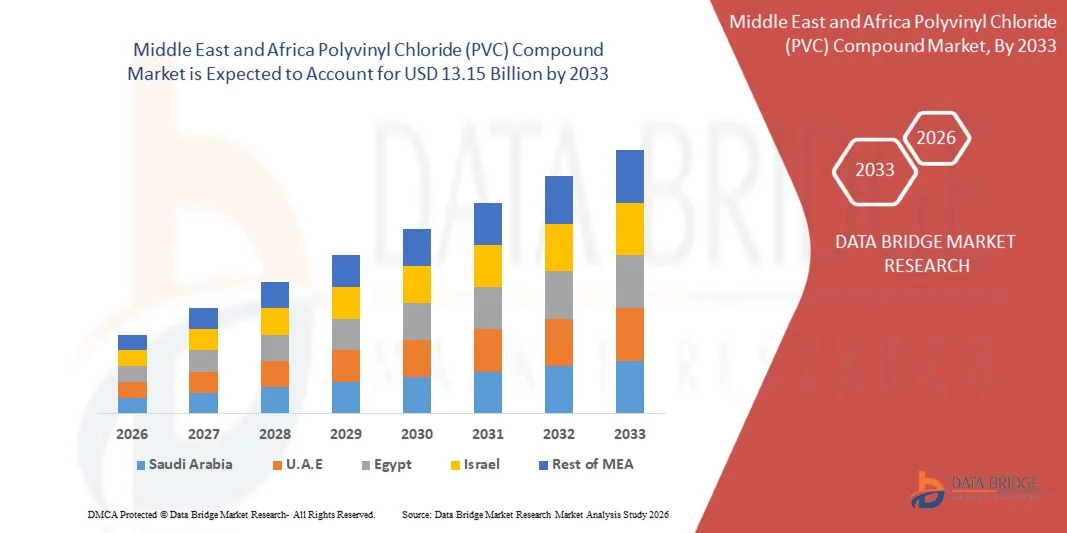
As per Data Bridge Market Research Analysis the Middle East and Africa Polyvinyl Chloride (PVC) Compound market was valued at USD 9.69 Billion in 2025 and is projected to reach USD 13.15 Billion by 2033, growing at a CAGR of 3.9% from 2026 to 2033. The market is experiencing consistent growth driven by rising infrastructure development, increasing construction activities, and growing demand for durable and cost-effective polymer materials across residential, commercial, and industrial sectors. Expanding urbanization, government-led housing projects, and large-scale water management initiatives are further supporting PVC compound adoption across the region. Strengthening petrochemical production capabilities and improving downstream processing infrastructure are also contributing to sustained market growth.
The increasing focus on infrastructure modernization and economic diversification programs, particularly in Gulf Cooperation Council countries, is accelerating the use of PVC compounds in pipes, fittings, profiles, electrical insulation, and building materials. Growing investments in petrochemical integration and capacity expansion are enhancing regional self-sufficiency, while rising demand from emerging economies in Africa is further broadening the consumption base. In addition, the shift toward lightweight, corrosion-resistant, and long-life construction materials continues to strengthen PVC compound penetration across key end-use industries in the Middle East and Africa region.
Market Size & Forecast
- Market Value (2025): USD 9.69 Billion
- Expected Market Value (2033): USD 13.15 Billion
- Forecast CAGR (2026–2033): 3.9%
- Leading country in 2025: Saudi Arabia
- Fastest Growing Country: Nigeria
What are the Major Takeaways of Middle East and Africa Polyvinyl Chloride (PVC) Compound Market?
- Saudi Arabia dominated the Middle East and Africa Polyvinyl Chloride (PVC) Compound market with the largest revenue share of 24.40% in 2025, supported by large-scale infrastructure development, strong construction activity, and expanding industrial diversification initiatives under Vision 2030
- The rigid product segment led the market with a 58.20% share in 2025, driven by extensive utilization in pipes, fittings, profiles, and construction materials where high strength, durability, and chemical resistance are required
- Nigeria is expected to be the fastest-growing country at a CAGR of 3.01% from 2026 to 2033, fueled by rapid urbanization, rising population growth, and increasing investments in housing and public infrastructure development
- Functional additives are the fastest-growing raw material type, projected to register a CAGR of 13% from 2026 to 2033, supported by increasing demand for enhanced performance characteristics such as flame retardancy, UV resistance, and impact strength
- The Dry PVC compound segment dominated the compound category with a 57.6% revenue share in 2025, led by its wide usage in extrusion and injection molding applications. High processing efficiency, reduced energy consumption, and better storage stability make it highly preferred in industrial manufacturing
- Non-plasticized PVC accounted for 55% of the market in 2025, preferred by strong usage in rigid applications such as pipes, window frames, and construction profiles
- The injection molding segment is the fastest-growing manufacturing process category, with a CAGR of 12% from 2026 to 2033, driven by increasing demand for complex and precision PVC components
Report Scope and Middle East and Africa Polyvinyl Chloride (PVC) Compound Market Segmentation
|
Attributes |
Polyvinyl Chloride (PVC) Compound Key Market Insights |
|
Segments Covered |
|
|
Countries Covered |
Middle East and Africa
|
|
Key Market Players |
|
|
Market Opportunities |
|
|
Value Added Data Infosets |
|
What is the Key Trend in the Middle East and Africa Polyvinyl Chloride (PVC) Compound Market?
Trend: Rising PVC Use in Construction and Infrastructure
The Middle East and Africa Polyvinyl Chloride (PVC) Compound market is witnessing strong growth due to increasing demand from construction, water management, and urban infrastructure development projects. PVC compounds are widely used in pipes, fittings, profiles, and electrical applications due to their durability, corrosion resistance, and cost efficiency. Large-scale infrastructure programs across the GCC, including Saudi Arabia’s Vision 2030 megaprojects such as NEOM, are significantly boosting consumption of PVC-based materials.
Companies such as Qatar Vinyl Company have strengthened regional supply capacity through the launch of Qatar’s first PVC plant in Mesaieed with a 350,000 tons/year capacity in 2025, enhancing availability for construction and export markets.
Middle East and Africa Polyvinyl Chloride (PVC) Compound Market Dynamics
Key Market Driver: Rising Demand for Durable and Low-Cost Materials
The increasing need for cost-effective, long-lasting construction materials is a major driver of the Middle East and Africa PVC Compound market. PVC compounds are increasingly replacing traditional materials such as metal and concrete in piping, insulation, and building applications due to their lightweight nature and resistance to corrosion and chemicals. Rapid urbanization and infrastructure expansion in countries such as Saudi Arabia, the U.A.E., and Egypt are further accelerating demand.
Companies such as Saudi Basic Industries Corporation (SABIC) are supporting this demand through integrated petrochemical operations that ensure stable feedstock supply for PVC and related downstream applications, strengthening regional production efficiency.
Key Restraint/Challenge: Raw Material Price Volatility
Fluctuations in raw material costs, particularly PVC resin and feedstock derived from ethylene and chlorine, remain a key challenge for the market. Price instability directly impacts production costs and profit margins for compound manufacturers, especially in import-dependent African markets. Variations in global energy prices and supply chain disruptions further add to cost uncertainty across the value chain.
Companies such as Egyptian Petrochemicals Co. (EPC) and TCI Sanmar Chemicals have reflected this volatility through periodic PVC price adjustments in 2024, highlighting the sensitivity of regional markets to feedstock and demand fluctuations.
Key Market Opportunity: Electrical Insulation and Wiring Demand
Growing demand for PVC compounds in electrical insulation, cable sheathing, and wiring applications presents a strong growth opportunity in the region. Expanding power generation projects, renewable energy installations, and rapid urban electrification are driving consumption of high-performance PVC materials. Increasing investments in smart grids and industrial electrification further support this segment’s expansion across Middle Eastern and African economies.
Companies such as Borouge (ADNOC and Borealis joint venture) are actively expanding advanced polymer and compounding capabilities to support high-quality electrical and infrastructure-grade applications, strengthening regional supply for growing energy and utility networks.
How is the Middle East and Africa Polyvinyl Chloride (PVC) Compound Market Segmented?
The Polyvinyl Chloride (PVC) Compound market is segmented on the basis of product type, type, compound, manufacturing process, raw material, and end-user.
- By Product Type
On the basis of product type, the Polyvinyl Chloride (PVC) Compound market is segmented into rigid product and flexible product. The rigid product segment dominated the market with the largest share of 58.20% in 2025, driven by extensive utilization in pipes, fittings, profiles, and construction materials where high strength, durability, and chemical resistance are required. Strong demand from infrastructure development, urban housing expansion, and water management systems further strengthens adoption of rigid PVC compounds. The segment benefits from cost efficiency, long lifecycle performance, and ease of processing in large-scale manufacturing environments. Growing replacement of traditional materials such as metal and concrete continues to reinforce its dominance. Continuous demand from building and construction applications supports sustained leadership.
The flexible product segment is projected to register the fastest growth at a CAGR of 12% from 2026 to 2033, driven by rising demand in cables, films, flooring, and medical tubing applications. Increasing adoption in automotive interiors and consumer goods is supporting expansion of flexible PVC usage. Enhanced formulation technologies with improved plasticizer performance are improving flexibility and thermal stability. Expanding healthcare applications requiring soft and durable polymer materials further accelerate growth. Rising demand for lightweight and adaptable materials across industrial applications strengthens long-term adoption trends.
- By Type
On the basis of type, the Polyvinyl Chloride (PVC) Compound market is segmented into non-plasticized PVC and plasticized PVC. The non-plasticized PVC segment dominated the market with a share of 55% in 2025, driven by strong usage in rigid applications such as pipes, window frames, and construction profiles. High mechanical strength, chemical resistance, and weather durability make it highly suitable for infrastructure applications. Increasing investments in water distribution and sanitation systems further support adoption. Its long-term stability and low maintenance requirements reinforce its preference in large-scale construction projects. Continuous demand from urban infrastructure development sustains segment dominance.
The plasticized PVC segment is projected to register the fastest growth at a CAGR of 11% from 2026 to 2033, driven by increasing demand for flexible applications such as cables, medical devices, and packaging films. Rising use in healthcare tubing and blood bags is significantly boosting adoption. Improved plasticizer technologies are enhancing flexibility, safety, and performance consistency. Expanding automotive and electrical applications requiring soft insulation materials further support growth. Growing industrial shift toward lightweight and adaptable polymer solutions strengthens segment expansion.
- By Compound
On the basis of compound, the Polyvinyl Chloride (PVC) Compound market is segmented into dry PVC compound and wet PVC compound. The dry PVC compound segment dominated the market with a share of 57.6% in 2025, driven by its wide usage in extrusion and injection molding applications. High processing efficiency, reduced energy consumption, and better storage stability make it highly preferred in industrial manufacturing. Strong demand from pipe, profile, and cable industries further supports adoption. Its compatibility with automated production systems enhances scalability. Continuous industrial demand for cost-efficient processing materials reinforces dominance.
The wet PVC compound segment is projected to register the fastest growth at a CAGR of 10.5% from 2026 to 2033, driven by increasing use in specialized coating and dipping applications. Rising demand for surface finishing in automotive interiors and industrial equipment is supporting growth. Improved dispersion characteristics and enhanced formulation control are increasing product quality. Expanding applications in protective coatings and niche industrial uses further accelerate adoption. Growing emphasis on performance-driven material engineering supports long-term expansion.
- By Manufacturing Process
On the basis of manufacturing process, the Polyvinyl Chloride (PVC) Compound market is segmented into injection molding, extrusion, and others. The extrusion segment dominated the market with a share of 50% in 2025, driven by extensive use in pipes, cables, sheets, and profiles manufacturing. High production efficiency, continuous processing capability, and cost-effectiveness make it the most widely adopted method. Strong demand from construction and infrastructure sectors further supports utilization. Its ability to produce uniform and high-quality outputs enhances industrial preference. Continuous expansion of building materials production reinforces segment leadership.
The injection molding segment is projected to register the fastest growth at a CAGR of 12% from 2026 to 2033, driven by increasing demand for complex and precision PVC components. Rising use in automotive parts, medical devices, and consumer goods is accelerating adoption. Improved mold design technologies and automation are enhancing production efficiency and accuracy. Growing need for customized and high-performance components further supports expansion. Increasing industrial focus on product design flexibility strengthens long-term growth.
- By Raw Material
On the basis of raw material, the Polyvinyl Chloride (PVC) Compound market is segmented into PVC resin, plasticizers, stabilizers, lubricants, fillers, functional additives, and alloying polymers. The PVC resin segment dominated the market with a share of 42% in 2025, driven by its fundamental role as the primary base material in all PVC compound formulations. Strong availability, cost efficiency, and consistent quality make it the most essential input in manufacturing. High demand from construction, packaging, and electrical industries further reinforces usage. Its compatibility with various additives enhances formulation flexibility. Continuous large-scale production ensures sustained dominance.
The functional additives segment is projected to register the fastest growth at a CAGR of 13% from 2026 to 2033, driven by increasing demand for enhanced performance characteristics such as flame retardancy, UV resistance, and impact strength. Rising adoption in automotive, electrical, and high-performance construction applications is supporting growth. Advancements in material engineering are enabling more efficient and sustainable additive solutions. Expanding regulatory requirements for safety and durability further accelerate usage. Growing focus on advanced PVC formulations strengthens segment expansion.
- By End-User
On the basis of end-user, the Polyvinyl Chloride (PVC) Compound market is segmented into medical, building and construction, packaging, automotive, consumer goods, electrical and electronics, and others. The building and construction segment dominated the market with a share of 48% in 2025, driven by extensive use in pipes, profiles, flooring, and insulation materials. Rapid urbanization, infrastructure modernization, and housing development projects strongly support demand. PVC compounds offer durability, cost efficiency, and corrosion resistance, making them ideal for long-term construction use. Increasing government investment in public infrastructure further strengthens adoption. Continuous expansion of residential and commercial construction activities reinforces segment leadership.
The medical segment is projected to register the fastest growth at a CAGR of 13% from 2026 to 2033, driven by rising demand for flexible and safe polymer materials in healthcare applications. Increasing use in IV bags, tubing, and disposable medical devices is supporting growth. Improved material safety standards and biocompatibility enhancements are accelerating adoption. Expanding healthcare infrastructure and rising patient care requirements further drive demand. Continuous innovation in medical-grade PVC compounds strengthens long-term growth prospects.
Which Region Holds the Largest Share of the Middle East and Africa Polyvinyl Chloride (PVC) Compound Market?
Saudi Arabia dominated the Polyvinyl Chloride (PVC) Compound market and accounted for the largest revenue share of 24.40% in 2025, driven by large-scale infrastructure development, strong construction activity, and expanding industrial diversification initiatives under Vision 2030. Rising demand for PVC compounds in pipes, fittings, profiles, and electrical insulation materials is accelerating adoption across residential, commercial, and industrial construction projects. The country benefits from strong government-backed investments in smart cities, water distribution networks, and megaproject developments such as NEOM and other urban expansion programs. Growing petrochemical integration and abundant feedstock availability further strengthen domestic PVC compound production capabilities. Increasing focus on durable, corrosion-resistant, and cost-efficient construction materials continues to reinforce Saudi Arabia’s dominant position in the regional market.
Nigeria Polyvinyl Chloride (PVC) Compound Market Insight
The Nigeria market is projected to register the fastest growth at a CAGR of 3.01% from 2026 to 2033, driven by rapid urbanization, rising population growth, and increasing investments in housing and public infrastructure development. Expanding demand for PVC compounds in water supply systems, electrical conduits, packaging, and low-cost construction materials is significantly supporting market expansion. Infrastructure modernization programs and growing construction activity in urban centers such as Lagos and Abuja are accelerating material consumption. Increasing penetration of affordable building materials and rising replacement of traditional construction inputs are further strengthening adoption. Continuous development of residential housing projects and utility infrastructure continues to position Nigeria as the fastest-growing PVC compound market in the region.
U.A.E. Polyvinyl Chloride (PVC) Compound Market Insight
The U.A.E. PVC Compound market is witnessing steady expansion, supported by strong growth in construction, real estate development, and advanced infrastructure projects across major cities such as Dubai and Abu Dhabi. Increasing demand for high-performance PVC compounds in architectural profiles, piping systems, and electrical applications is driving market penetration. The country’s focus on sustainable urban development and smart city initiatives is encouraging adoption of durable and energy-efficient construction materials. Expansion of industrial zones, commercial infrastructure, and hospitality projects further strengthens consumption of PVC compounds. Growing emphasis on high-quality building standards and advanced material technologies continues to support long-term market growth across the U.A.E.
Which are the Top Companies in Middle East and Africa Polyvinyl Chloride (PVC) Compound Market?
The Polyvinyl Chloride (PVC) Compound industry is primarily led by well-established companies, including:
- 3M (U.S.)
- XPEL, Inc. (U.S.)
- Dow (U.S.)
- Eastman Chemical Company (U.S.)
- Hexis S.A.S (France)
- PremiumShield (U.S.)
- STEK-USA (U.S.)
- Reflek Technologies Corporation (U.S.)
- GRAFITYP (Belgium)
- ORAFOL Europe GmbH (Germany)
- DuPont (U.S.)
- DAIKIN (Japan)
- Optic Shield (Czechia)
- Solvay (Belgium)
- SCHWEITZER-MAUDUIT INTERNATIONAL, INC. (U.S.)
- Saint-Gobain (France)
- Avery Dennison Corporation (U.S.)
What are Latest Developments in Middle East and Africa Polyvinyl Chloride (PVC) Compound Market?
- In June 2025, Qatar Vinyl Company—a joint venture of Mesaieed Petrochemical Holding Company, QAPCO Q.P.J.S.C, and QatarEnergy—announced the launch of Qatar’s first PVC plant in Mesaieed with a design capacity of 350,000 tons per year. The development is expected to significantly strengthen regional PVC supply and reduce import dependence across the Middle East, particularly for construction-grade and industrial PVC compounds. With Europe identified as a key export destination, the project enhances Qatar’s position in global PVC trade flows and supports downstream demand in infrastructure and manufacturing applications. It also reinforces the country’s integration into the international petrochemical value chain through large-scale export-oriented production
- In May 2025, Borouge (ADNOC and Borealis joint venture) announced expansion of its downstream polymer and compounding capabilities in the U.A.E., focusing on high-performance materials used in construction, piping, and electrical applications. The development is expected to improve regional supply of advanced PVC-compatible materials and support rising infrastructure demand across the Gulf. It also strengthens the U.A.E.’s export competitiveness by increasing value-added production and reducing reliance on imported compounds. This expansion further consolidates Borouge’s role as a major supplier in the regional polymer and PVC ecosystem
- In March 2025, Saudi Basic Industries Corporation (SABIC) advanced optimization initiatives across its chlor-alkali and vinyl value chain operations to improve efficiency and strengthen feedstock integration for PVC-related production in Saudi Arabia. The development is expected to ensure more stable and cost-efficient supply of raw materials used in PVC compounds for construction, electrical, and industrial applications. It supports Vision 2030 industrial diversification goals by improving downstream petrochemical competitiveness and operational efficiency. This initiative reinforces Saudi Arabia’s leadership position in the regional PVC compound market through stronger vertical integration
- In January 2025, OQ (Oman Investment Authority) progressed its petrochemical expansion strategy by strengthening its downstream chemical production ecosystem, indirectly supporting the PVC value chain through improved availability of key intermediates and industrial feedstocks. The development is expected to enhance Oman’s integration into GCC polymer supply networks and improve stability of raw materials used in construction and industrial PVC applications. It also supports diversification of Oman’s energy sector while increasing its participation in regional petrochemical trade flows. This initiative contributes to improved supply resilience across the Middle East PVC compound market
- In September 2024, Egyptian Petrochemicals Co. (EPC) and TCI Sanmar Chemicals (S.A.E.) announced revised PVC pricing strategies amid subdued regional demand conditions. EPC maintained stable pricing for PVC K67-68 grades, while TCI Sanmar reduced prices across select grades, reflecting competitive pressure and fluctuating feedstock costs. The pricing adjustments are expected to influence downstream purchasing behavior among converters and construction material manufacturers in North Africa. This development highlights ongoing market sensitivity in Egypt’s PVC sector and its impact on regional pricing dynamics and trade flows

- Interactive Data Analysis Dashboard
- Company Analysis Dashboard for high growth potential opportunities
- Research Analyst Access for customization & queries
- Competitor Analysis with Interactive dashboard
- Latest News, Updates & Trend analysis
- Harness the Power of Benchmark Analysis for Comprehensive Competitor Tracking
Middle East And Africa Pvc Compound Market, Supply Chain Analysis and Ecosystem Framework
To support market growth and help clients navigate the impact of geopolitical shifts, DBMR has integrated in-depth supply chain analysis into its Middle East And Africa Pvc Compound Market research reports. This addition empowers clients to respond effectively to global changes affecting their industries. The supply chain analysis section includes detailed insights such as Middle East And Africa Pvc Compound Market consumption and production by country, price trend analysis, the impact of tariffs and geopolitical developments, and import and export trends by country and HSN code. It also highlights major suppliers with data on production capacity and company profiles, as well as key importers and exporters. In addition to research, DBMR offers specialized supply chain consulting services backed by over a decade of experience, providing solutions like supplier discovery, supplier risk assessment, price trend analysis, impact evaluation of inflation and trade route changes, and comprehensive market trend analysis.
Data collection and base year analysis are done using data collection modules with large sample sizes. The stage includes obtaining market information or related data through various sources and strategies. It includes examining and planning all the data acquired from the past in advance. It likewise envelops the examination of information inconsistencies seen across different information sources. The market data is analysed and estimated using market statistical and coherent models. Also, market share analysis and key trend analysis are the major success factors in the market report. To know more, please request an analyst call or drop down your inquiry.
The key research methodology used by DBMR research team is data triangulation which involves data mining, analysis of the impact of data variables on the market and primary (industry expert) validation. Data models include Vendor Positioning Grid, Market Time Line Analysis, Market Overview and Guide, Company Positioning Grid, Patent Analysis, Pricing Analysis, Company Market Share Analysis, Standards of Measurement, Global versus Regional and Vendor Share Analysis. To know more about the research methodology, drop in an inquiry to speak to our industry experts.
Data Bridge Market Research is a leader in advanced formative research. We take pride in servicing our existing and new customers with data and analysis that match and suits their goal. The report can be customized to include price trend analysis of target brands understanding the market for additional countries (ask for the list of countries), clinical trial results data, literature review, refurbished market and product base analysis. Market analysis of target competitors can be analyzed from technology-based analysis to market portfolio strategies. We can add as many competitors that you require data about in the format and data style you are looking for. Our team of analysts can also provide you data in crude raw excel files pivot tables (Fact book) or can assist you in creating presentations from the data sets available in the report.













