


Middle East and Africa Wound Care Monitoring Market Size
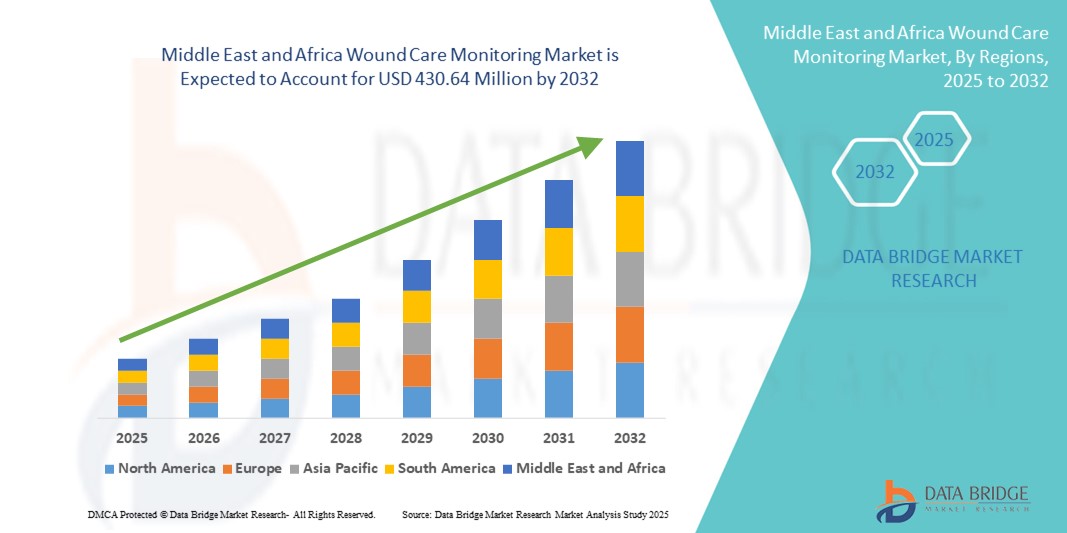
- The Middle East and Africa wound care monitoring market size was valued at USD 324.51 million in 2024 and is expected to reach USD 430.64 million by 2032, at a CAGR of 3.60% during the forecast period
- The market growth is primarily driven by an increasing incidence of chronic wounds, diabetes, and pressure ulcers across the region, alongside greater awareness of advanced wound management practices
- In addition, expanding healthcare infrastructure and rising government initiatives focused on improving wound care outcomes are fostering the adoption of innovative monitoring technologies. These aligned drivers are propelling the demand for wound care monitoring solutions, substantially enhancing the market's development trajectory
Middle East and Africa Wound Care Monitoring Market Analysis
- Wound care monitoring technologies, which enable continuous assessment of wound healing and early detection of complications, are gaining prominence across healthcare systems in the Middle East and Africa due to the increasing burden of chronic wounds, diabetic ulcers, and post-surgical infections
- The growing demand for wound care monitoring is primarily driven by the rising prevalence of diabetes, a growing elderly population, and heightened awareness of the benefits of early and technology-enabled wound management among patients and healthcare providers
- South Africa dominated the wound care monitoring market with the largest revenue share of 35% in 2024, supported by its relatively advanced healthcare infrastructure, higher incidence of chronic wounds, and increasing adoption of digital health solutions across clinical settings
- The United Arab Emirates is expected to be the fastest growing country in the wound care monitoring market during the forecast period, owing to substantial investments in healthcare innovation, expanding smart hospital projects, and government support for digital transformation in wound care services
- The devices segment led the wound care monitoring market with a market share of 49.2% in 2024, driven by growing demand for wearable sensors, imaging systems, and diagnostic tools that enable real-time wound tracking and facilitate timely clinical interventions
Report Scope and Middle East and Africa Wound Care Monitoring Market Segmentation
|
Attributes |
Middle East and Africa Wound Care Monitoring Key Market Insights |
|
Segments Covered |
|
|
Countries Covered |
Middle East and Africa
|
|
Key Market Players |
|
|
Market Opportunities |
|
|
Value Added Data Infosets |
In addition to the insights on market scenarios such as market value, growth rate, segmentation, geographical coverage, and major players, the market reports curated by the Data Bridge Market Research also include in-depth expert analysis, pricing analysis, brand share analysis, consumer survey, demography analysis, supply chain analysis, value chain analysis, raw material/consumables overview, vendor selection criteria, PESTLE Analysis, Porter Analysis, and regulatory framework. |
Middle East and Africa Wound Care Monitoring Market Trends
Advancing Wound Monitoring Through Smart Diagnostics and Remote Care
- A significant and accelerating trend in the Middle East and Africa wound care monitoring market is the integration of smart diagnostic technologies and remote monitoring tools to improve wound assessment, healing outcomes, and healthcare accessibility across diverse settings. These innovations are transforming traditional wound management practices by enabling real-time data collection and remote intervention
- For instance, the use of portable wound imaging systems such as MolecuLight and 3D measurement devices is expanding in countries such as South Africa and the UAE, allowing clinicians to detect infections earlier and personalize treatment strategies more effectively
- Remote wound monitoring platforms are also gaining traction, enabling healthcare professionals to track wound healing progress using secure apps and cloud-based platforms. This is particularly valuable in rural or underserved regions where in-person visits are limited, improving continuity of care for chronic wound patients
- The integration of AI-powered analytics into wound care software is supporting clinicians with predictive insights, such as identifying stagnation in healing or recommending dressing changes based on wound exudate levels. These features significantly reduce treatment delays and enhance patient engagement in their own care
- With increasing investment in smart healthcare solutions, several hospitals in the UAE and Saudi Arabia are incorporating wound monitoring systems into broader telemedicine networks, allowing seamless coordination between primary care and specialists
- This trend toward technology-enabled, patient-centered wound care is reshaping the standard of treatment delivery across the region. As a result, companies such as Smith+Nephew and Coloplast are expanding their regional presence with solutions that support AI diagnostics, mobile compatibility, and clinician workflow integration
Middle East and Africa Wound Care Monitoring Market Dynamics
Driver
Rising Chronic Wound Incidence and Demand for Better Healing Outcomes
- The growing prevalence of chronic wounds due to diabetes, aging populations, and post-operative complications is a major driver of wound care monitoring adoption across the Middle East and Africa. As healthcare systems strive to improve outcomes and reduce hospital readmission rates, demand for accurate wound monitoring solutions is increasing rapidly
- For instance, in February 2024, Smith+Nephew announced the launch of a portable wound visualization device in the UAE, supporting home-based wound care and clinical decision-making in remote environments. Such developments are accelerating regional adoption of smart wound care tools
- As patients and providers seek faster and more informed wound healing, solutions that offer consistent tracking, imaging, and data sharing capabilities are being favored over manual assessments. Wound monitoring devices not only help clinicians identify complications early but also support evidence-based treatment plans, leading to better patient outcomes
- Furthermore, as hospitals in countries such as Saudi Arabia, Kenya, and South Africa undergo digital transformation, integrating smart wound care monitoring into electronic health record systems is improving care coordination, particularly for patients with long-term wound care needs
- The region’s growing investment in home care solutions and mobile health (mHealth) platforms is also expanding access to wound monitoring technologies, particularly for elderly and rural patients. This is contributing to higher adoption rates in both public and private healthcare sectors
Restraint/Challenge
Limited Access, High Costs, and Lack of Skilled Personnel
- Despite growing interest, the widespread adoption of wound care monitoring technologies in the Middle East and Africa is hampered by infrastructure limitations, cost barriers, and shortages of trained personnel, especially in lower-income countries or rural areas
- For instance, the upfront investment required for advanced imaging devices and remote platforms remains a challenge for many public hospitals in sub-Saharan Africa. Without adequate funding or government support, healthcare providers are often forced to rely on conventional wound management practices
- In addition, the lack of skilled healthcare workers trained in the use of digital wound monitoring tools can result in underutilization or improper interpretation of wound data, undermining the effectiveness of the technology
- Moreover, inconsistent access to internet connectivity and digital infrastructure, particularly in remote areas of countries such as Nigeria or Ethiopia, poses further challenges for the use of cloud-based or real-time wound tracking systems
- Addressing these challenges through capacity-building programs, public-private partnerships, localized device manufacturing, and scaled-down versions of existing solutions can help bridge the access gap. Greater regional collaboration and support from global medtech firms will also be essential in overcoming adoption hurdles and ensuring sustained market growth
Middle East and Africa Wound Care Monitoring Market Scope
The market is segmented on the basis of product, modality, product type, wound type, application, end user, and distribution channel.
- By Product
On the basis of product, the Middle East and Africa wound care monitoring market is segmented into devices and wound assessment apps. The devices segment dominated the market with the largest revenue share of 49.2% in 2024, driven by growing adoption of portable imaging systems, sensors, and diagnostic tools that enable accurate measurement and real-time monitoring of wounds. Hospitals and advanced care settings increasingly prefer these devices to support clinical decision-making and improve treatment outcomes.
The wound assessment apps segment is anticipated to witness the fastest growth from 2025 to 2032, fueled by the growing penetration of smartphones, digital health initiatives, and the need for remote wound tracking in underserved regions. These mobile apps offer clinicians and patients easy-to-use interfaces for capturing wound images, tracking healing, and sharing data with healthcare providers, thus enhancing accessibility and reducing follow-up delays.
- By Modality
On the basis of modality, the Middle East and Africa wound care monitoring market is segmented into wearable and non-wearable systems. The non-wearable segment held the largest revenue share in 2024, owing to the extensive use of handheld scanners, imaging systems, and camera-based diagnostic tools in hospitals and clinics. These systems offer precise wound measurement and imaging without direct contact, improving infection control and clinical efficiency.
The wearable segment is expected to grow at the fastest CAGR from 2025 to 2032, driven by rising interest in continuous wound monitoring, especially in long-term care and home healthcare settings. These smart wearable patches and sensors track wound conditions such as temperature, moisture, and exudate levels, helping to detect infections early and personalize care strategies.
- By Product Type
On the basis of product type, the Middle East and Africa wound care monitoring market is segmented into contact wound measuring devices and non-contact wound measuring devices. The non-contact segment accounted for the largest market share in 2024 due to its safety benefits, ease of use, and widespread application in infection-sensitive environments. These devices are preferred for reducing cross-contamination risks and ensuring high patient compliance.
The contact segment is projected to experience steady growth during the forecast period, especially in resource-limited settings where affordability and simplicity of use are critical. These tools are commonly used in clinics and rural areas for initial wound assessments where high-tech non-contact options are unavailable.
- By Wound Type
On the basis of wound type, the Middle East and Africa wound care monitoring market is segmented into chronic wounds and acute wounds. The chronic wounds segment dominated the market in 2024 with a notable share, driven by the rising burden of diabetes, pressure ulcers, and vascular diseases across the region. Long healing durations and higher complication risks necessitate regular monitoring, which drives demand for wound care monitoring technologies.
The acute wounds segment is expected to grow steadily during forecast period, supported by increasing surgical volumes, trauma cases, and emergency care needs. Hospitals and trauma centers are increasingly adopting advanced monitoring solutions to ensure timely recovery and reduce postoperative infections.
- By Application
On the basis of application, the Middle East and Africa wound care monitoring market is segmented into wound healing monitoring, wound assessment, infection detection, and treatment monitoring. The wound healing monitoring segment held the largest share in 2024, supported by its central role in tracking wound progress and guiding clinical decisions.
The infection detection segment is expected to witness the fastest growth through 2032, as early identification of infections is critical in preventing complications, reducing hospital stays, and improving patient outcomes. New technologies that detect biomarkers or visual indicators of infection are gaining traction in both clinical and remote care settings.
- By End User
On the basis of end user, the Middle East and Africa wound care monitoring market is segmented into hospitals, clinics, home healthcare, long-term care facilities, trauma centers, and others. The hospitals segment led the market in 2024 due to higher patient volumes, better access to advanced technologies, and the availability of skilled personnel. Hospitals also serve as major buyers of wound monitoring systems through direct procurement processes.
The home healthcare segment is projected to grow at the fastest rate from 2025 to 2032, fueled by increasing demand for remote care, rising geriatric population, and the shift towards decentralized wound management enabled by mobile apps and wearable monitoring solutions.
- By Distribution Channel
On the basis of distribution channel, the Middle East and Africa wound care monitoring market is segmented into direct tenders and retail sales. The direct tenders segment held the largest market share in 2024, driven by bulk purchases from hospitals, public healthcare facilities, and government institutions across countries such as South Africa, Saudi Arabia, and Kenya.
The retail sales segment is expected to grow steadily during forecast period, supported by the expansion of e-commerce platforms, rising availability of smart wound care products through pharmacies, and increased consumer preference for home-based monitoring tools.
Middle East and Africa Wound Care Monitoring Market Regional Analysis
- South Africa dominated the wound care monitoring market with the largest revenue share of 35% in 2024, supported by its relatively advanced healthcare infrastructure, higher incidence of chronic wounds, and increasing adoption of digital health solutions across clinical settings
- Healthcare providers in South Africa increasingly recognize the benefits of wound monitoring solutions for improving patient outcomes, especially in managing diabetic ulcers, pressure injuries, and post-surgical wounds
- The country’s leadership in the market is further supported by expanding public-private healthcare partnerships, investment in smart diagnostic tools, and a growing demand for telemedicine-enabled wound care, making advanced monitoring technologies more accessible across both urban hospitals and rural clinics
The South Africa Wound Care Monitoring Market Insight
The South Africa wound care monitoring market captured the largest revenue share in the region in 2024, driven by its relatively advanced healthcare system and a high burden of chronic and surgical wounds. The country is seeing growing adoption of non-contact imaging tools and mobile wound assessment platforms, particularly in hospital networks and wound care centers. South Africa’s emphasis on reducing hospital readmissions and improving patient outcomes through technology-enabled solutions is fueling growth. Supportive public health programs and an increasing number of collaborations with international medtech firms are also enhancing the availability of innovative wound care technologies.
United Arab Emirates Wound Care Monitoring Market Insight
The United Arab Emirates wound care monitoring market is projected to grow at a robust CAGR during the forecast period, driven by strong government support for healthcare digitalization and smart hospital initiatives. The country’s focus on AI-integrated health solutions and its embrace of mobile and wearable devices is accelerating the integration of advanced wound monitoring systems in clinical practice. In addition, the high demand for premium healthcare services among both residents and medical tourists is supporting the adoption of real-time wound tracking tools. The UAE’s investment in smart infrastructure and telehealth platforms continues to provide a strong foundation for market expansion.
Saudi Arabia Wound Care Monitoring Market Insight
The Saudi Arabia wound care monitoring market is expected to expand considerably, supported by the country’s healthcare transformation under Vision 2030. The government’s push for modernization of hospital systems, combined with increased healthcare spending, is driving the adoption of wound imaging devices and remote monitoring solutions. High rates of diabetes and obesity are contributing to the rising burden of chronic wounds, prompting demand for technology-based solutions to improve healing outcomes. Public-private partnerships and collaborations with global medical device companies are enhancing the availability and distribution of smart wound care tools across the kingdom.
Nigeria Wound Care Monitoring Market Insight
The Nigeria wound care monitoring market is witnessing gradual growth, primarily driven by an increasing need for improved wound care in both urban and rural regions. Although the healthcare system faces infrastructural challenges, there is growing interest in affordable and portable monitoring tools that can be used in community health programs and primary care settings. Rising awareness of chronic wound complications and the potential for remote care solutions is encouraging the adoption of mobile health applications and simple diagnostic tools. Support from NGOs and regional partnerships is also playing a role in increasing access to essential wound care technologies.
Middle East and Africa Wound Care Monitoring Market Share
The Middle East and Africa Wound Care Monitoring industry is primarily led by well-established companies, including:
- Smith+Nephew (U.K.)
- Mölnlycke Health Care AB (Sweden)
- B. Braun SE (Germany)
- Coloplast A/S (Denmark)
- ConvaTec Group PLC (U.K.)
- Paul Hartmann AG (Germany)
- Medtronic (Ireland)
- Derma Sciences, Inc. (U.S.)
- Urgo Medical (France)
- Lohmann & Rauscher GmbH & Co. KG (Germany)
- Integra LifeSciences Corporation (U.S.)
- MediPurpose Pte Ltd (Singapore)
- Essity AB (Sweden)
- DeRoyal Industries, Inc. (U.S.)
- Milsuch asn & Company (U.S.)
- Systagenix Wound Management, Ltd. (U.K.)
- Aranz Medical Ltd. (New Zealand)
- WoundVision, LLC (U.S.)
- MolecuLight Inc. (Canada)
What are the Recent Developments in Middle East and Africa Wound Care Monitoring Market?
- In May 2024, Smith+Nephew expanded its footprint in the Middle East by launching an advanced wound imaging system in the United Arab Emirates aimed at improving chronic wound management. The device, designed for real-time assessment and infection detection, is part of the company’s broader strategy to support digital health adoption in the region. This development reinforces Smith+Nephew’s commitment to delivering data-driven wound care solutions that enhance clinical decision-making and patient outcomes across diverse healthcare environments
- In April 2024, MolecuLight Corp. partnered with a leading hospital network in South Africa to deploy its point-of-care fluorescence imaging devices for wound assessment and bacterial detection. This collaboration enables clinicians to visualize wound conditions more accurately, promoting faster interventions and optimized treatment plans. The initiative reflects the growing demand for innovative diagnostics in the region and MolecuLight’s strategic focus on expanding its presence in emerging healthcare markets
- In March 2024, Coloplast A/S launched a regional training initiative across Kenya and Nigeria to support the adoption of smart wound care monitoring devices among healthcare professionals. The program includes hands-on workshops and e-learning modules focused on using digital wound assessment tools to improve healing outcomes and reduce complications. This development highlights Coloplast’s commitment to education and capacity building while fostering increased usage of connected wound care technologies
- In February 2024, Aranz Medical, known for its 3D wound imaging systems, announced a pilot program in collaboration with healthcare providers in Saudi Arabia. The initiative aims to test the effectiveness of non-contact wound measurement tools in outpatient and home care settings, where infection risk and access limitations are significant. This strategic move aligns with the country's digital health transformation goals under Vision 2030
- In January 2024, WoundVision partnered with a long-term care provider network in Egypt to integrate its thermal imaging and documentation platform for early detection of pressure injuries. The deployment supports proactive wound management in elderly care settings and demonstrates growing interest in smart monitoring systems. This development underscores WoundVision’s focus on improving preventative care and expanding access to advanced wound diagnostics across the Middle East and Africa

- Interactive Data Analysis Dashboard
- Company Analysis Dashboard for high growth potential opportunities
- Research Analyst Access for customization & queries
- Competitor Analysis with Interactive dashboard
- Latest News, Updates & Trend analysis
- Harness the Power of Benchmark Analysis for Comprehensive Competitor Tracking
Data collection and base year analysis are done using data collection modules with large sample sizes. The stage includes obtaining market information or related data through various sources and strategies. It includes examining and planning all the data acquired from the past in advance. It likewise envelops the examination of information inconsistencies seen across different information sources. The market data is analysed and estimated using market statistical and coherent models. Also, market share analysis and key trend analysis are the major success factors in the market report. To know more, please request an analyst call or drop down your inquiry.
The key research methodology used by DBMR research team is data triangulation which involves data mining, analysis of the impact of data variables on the market and primary (industry expert) validation. Data models include Vendor Positioning Grid, Market Time Line Analysis, Market Overview and Guide, Company Positioning Grid, Patent Analysis, Pricing Analysis, Company Market Share Analysis, Standards of Measurement, Global versus Regional and Vendor Share Analysis. To know more about the research methodology, drop in an inquiry to speak to our industry experts.
Data Bridge Market Research is a leader in advanced formative research. We take pride in servicing our existing and new customers with data and analysis that match and suits their goal. The report can be customized to include price trend analysis of target brands understanding the market for additional countries (ask for the list of countries), clinical trial results data, literature review, refurbished market and product base analysis. Market analysis of target competitors can be analyzed from technology-based analysis to market portfolio strategies. We can add as many competitors that you require data about in the format and data style you are looking for. Our team of analysts can also provide you data in crude raw excel files pivot tables (Fact book) or can assist you in creating presentations from the data sets available in the report.













