North America Historical Building/Heavy Masonry Construction Market Overview
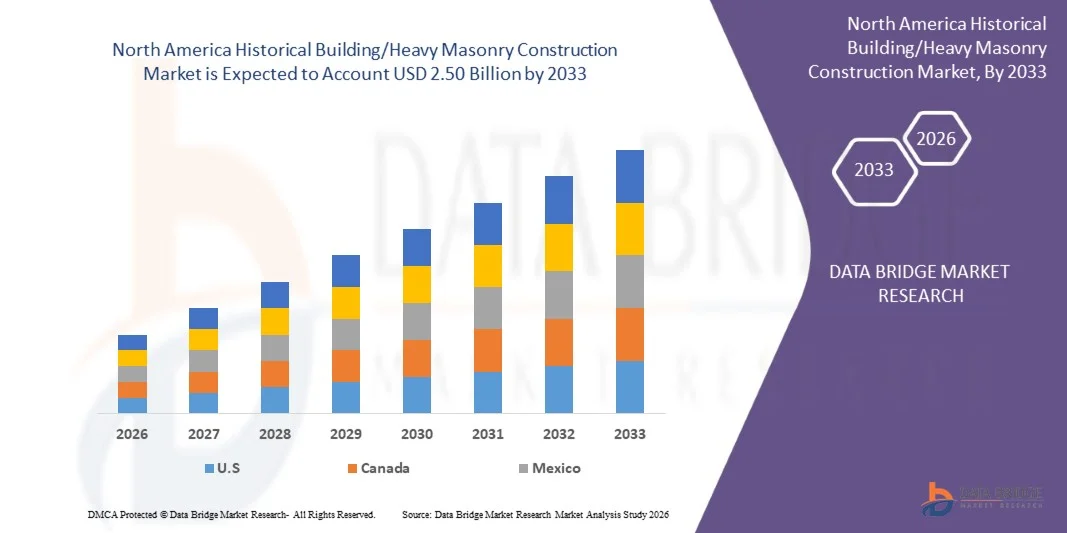
The North America historical building/heavy masonry construction market was valued at USD 1.81 billion in 2025 and is projected to reach USD 2.50 billion by 2033, growing at a CAGR of 4.13% from 2026 to 2033. The market is witnessing steady growth driven by increasing restoration and preservation activities of heritage structures, rising government funding for cultural conservation projects, and growing emphasis on maintaining architectural authenticity in urban redevelopment initiatives.
The expansion of tourism-driven infrastructure development, coupled with stringent regulations for preserving historically significant buildings, is further supporting market demand. In addition, advancements in masonry repair technologies, sustainable construction materials, and specialized restoration techniques are enabling more efficient rehabilitation of aging structures, thereby strengthening the adoption of heavy masonry construction practices across North America.
Key Market Trends & Insights
- U.S. dominated the North America historical building/heavy masonry construction market with the largest revenue share of 78.4% in 2025, supported by extensive federal and state-level heritage conservation programs, large-scale restoration of historic civic infrastructure, and strong presence of specialized construction and restoration contractors across key metropolitan regions.
- Canada is expected to be the fastest-growing region, recording a CAGR of 4.6% from 2026 to 2033, driven by increasing government funding for heritage conservation, growing urban redevelopment initiatives, and rising adoption of sustainable masonry restoration practices in historic districts such as Quebec City, Toronto, and Ottawa.
- The Restoration and Preservation segment held the largest market revenue share of approximately 28.6% in 2025 driven by extensive demand for full-scale rehabilitation of heritage structures, government-funded conservation programs, and adaptive reuse of aging civic and commercial buildings across the U.S. and Canada. Restoration services are widely preferred due to their ability to maintain historical authenticity while improving structural safety and compliance with modern building codes.
- The Structural Steel Repair or Replacement segment is projected to register the fastest growth at a CAGR of 5.1% from 2026 to 2033, driven by increasing retrofitting requirements in older masonry buildings exposed to seismic risks and long-term material degradation. Rising adoption of hybrid restoration techniques combining steel reinforcement with traditional masonry systems is further accelerating segment expansion.
- The Government segment held the largest market revenue share of approximately 34.2% in 2025 driven by large-scale funding programs for heritage conservation, public infrastructure restoration, and preservation of historic civic buildings such as courthouses, museums, and administrative structures. Government ownership dominates due to structured preservation mandates and long-term maintenance investments supported by federal and municipal bodies.
- The Heritage Agencies segment is projected to register the fastest growth at a CAGR of 4.8% from 2026 to 2033, driven by increasing involvement of specialized conservation bodies and non-profit organizations in safeguarding culturally significant monuments and historical districts. Rising collaboration between public authorities and heritage foundations is further supporting segment growth.
- The Bricks & Blocks segment held the largest market revenue share of approximately 31.5% in 2025 driven by widespread use in historical urban architecture, restoration of colonial-era buildings, and structural rebuilding projects across North American cities. Bricks remain the most commonly used material due to their historical authenticity, durability, and compatibility with traditional masonry structures.
- The Nanolime segment is projected to register the fastest growth at a CAGR of 6.3% from 2026 to 2033, driven by increasing adoption of advanced conservation materials for strengthening and consolidating aging stone structures without altering original aesthetics. Rising usage in sensitive restoration projects involving cathedrals, monuments, and heritage façades is further driving segment expansion.
- The Museums segment held the largest market revenue share of approximately 27.9% in 2025 driven by continuous investment in cultural infrastructure, renovation of aging museum buildings, and increasing tourism-related preservation funding across the U.S. and Canada. Museums require frequent structural maintenance and façade conservation to preserve artifacts and architectural heritage.
- The Religious Monuments segment is projected to register the fastest growth at a CAGR of 4.9% from 2026 to 2033, driven by rising restoration activities of churches, cathedrals, and historic temples supported by religious trusts and public heritage funding programs. Increasing cultural preservation initiatives and community-driven conservation efforts are further accelerating segment growth.
Market Size & Forecast
- Market Value (2025): USD 1.81 Billion
- Expected Market Value (2033): USD 2.50 Billion
- Forecast CAGR (2026–2033): 4.13%
- Leading Region in 2025: North America
- Fastest Growing Region: Asia-Pacific
Report Scope and North America Historical Building/Heavy Masonry Construction Market Segmentation
|
Attributes |
North America Historical Building/Heavy Masonry Construction Key Market Insights |
|
Segments Covered |
|
|
Countries Covered |
North America
|
|
Key Market Players |
• Bechtel (U.S.) |
|
Market Opportunities |
• Heritage Building Restoration Expansion |
|
Value Added Data Infosets |
In addition to the insights on market scenarios such as market value, growth rate, segmentation, geographical coverage, and major players, the market reports curated by the Data Bridge Market Research also include in-depth expert analysis, pricing analysis, brand share analysis, consumer survey, demography analysis, supply chain analysis, value chain analysis, raw material/consumables overview, vendor selection criteria, PESTLE Analysis, Porter Analysis, and regulatory framework. |
North America Historical Building/Heavy Masonry Construction Market Trends
Trend: Growth In Heritage Restoration And Sustainable Masonry Construction Practices
Increasing focus on preserving historically significant structures while adopting sustainable, durable, and low-carbon construction practices across North America. Rising urban redevelopment initiatives and strict preservation regulations are encouraging the use of traditional heavy masonry techniques combined with modern restoration technologies.
In modern construction and renovation projects, contractors are increasingly using advanced mortar systems and structural reinforcement techniques, For instance in stone and brick restoration of 19th-century government buildings and heritage landmarks, to maintain architectural authenticity while improving structural integrity and seismic resistance. In the U.S., federal and state-funded programs such as the Historic Preservation Fund have supported thousands of restoration projects, contributing over USD 200 million annually in preservation grants to protect culturally significant buildings.
The rapid expansion of adaptive reuse projects in urban centers is also increasing demand for heavy masonry restoration in commercial-to-residential conversions and public infrastructure upgrades. In addition, engineering firms and preservation authorities continue to rely on specialized masonry conservation methods, such as lime-based mortars used in the restoration of buildings such as Boston’s historic district and Canada’s Parliament heritage structures, due to their compatibility with original construction materials and long-term durability. Growing validation through large-scale restoration projects in 2025 across the U.S. and Canada integrating modern structural strengthening systems with traditional masonry techniques is improving building lifespan by an estimated 20–30% under long-term environmental stress conditions.
Global North America Historical Building/Heavy Masonry Construction Market Dynamics
Key Market Driver: Rising Investment In Heritage Conservation And Urban Redevelopment Projects
Governments and private developers across North America are increasing investments in the preservation and adaptive reuse of historic buildings to support cultural tourism, urban revitalization, and sustainable construction goals. Aging infrastructure across major cities is creating strong demand for structural rehabilitation using heavy masonry techniques to preserve architectural integrity while meeting modern safety standards.
Public sector programs such as the U.S. National Park Service preservation initiatives and Canada’s Federal Heritage Buildings Review Office are actively funding restoration projects for courthouses, museums, and civic buildings, accelerating market growth. Municipal redevelopment authorities are also integrating heritage conservation into urban planning frameworks to enhance cultural value and real estate attractiveness.
In addition, rising commercial redevelopment of historic warehouses and industrial buildings into retail, office, and hospitality spaces is further driving demand for masonry strengthening and restoration services. Real-world restoration projects in 2024 across New York and Toronto integrating structural retrofitting with original brick façade preservation demonstrated cost savings of approximately 15–20% compared to complete reconstruction approaches while maintaining historical compliance standards
Key Restraint/Challenge: High Restoration Costs And Skilled Labor Shortage
Heavy masonry restoration requires specialized craftsmanship, high-quality traditional materials, and detailed structural assessment, making it significantly more expensive than conventional construction methods. Limited availability of skilled masons trained in historical restoration techniques further increases project timelines and labor costs across North America.
In addition, strict regulatory compliance requirements for heritage buildings often extend approval cycles, delaying project execution and increasing administrative expenses for developers. The need for custom material sourcing, such as historically accurate stone and brick replacements, further adds to overall project costs and limits scalability in cost-sensitive urban redevelopment projects.
Industry estimates indicate that heritage masonry restoration projects can cost 25–40% more than standard commercial renovation projects, particularly in cases involving structural stabilization and façade preservation of century-old buildings in dense urban environments
Key Market Opportunity: Expansion Of Adaptive Reuse And Sustainable Urban Development Projects
The growing trend of adaptive reuse of historical buildings is creating significant opportunities for heavy masonry construction and restoration services across North America. Developers are increasingly converting old industrial facilities, warehouses, and civic structures into modern residential, commercial, and mixed-use developments while preserving their original architectural character.
Urban centers such as Chicago, New York, and Montreal are witnessing strong redevelopment activity where historical masonry structures are being integrated into smart city planning initiatives to improve sustainability and reduce construction waste. For instance, adaptive reuse projects in downtown Toronto and San Francisco have demonstrated material reuse efficiencies of nearly 30–50% compared to new construction.
In addition, advancements in structural reinforcement technologies, lime-based restoration materials, and digital building assessment tools are improving project efficiency and enabling more accurate preservation planning. Growing adoption of green building certifications, such as LEED for historic rehabilitation projects, is further supporting market expansion across North America’s heritage construction sector.
North America Historical Building/Heavy Masonry Construction Market Scope
The market is segmented on the basis of construction services, ownership, materials, and building type.
• By Construction Services
On the basis of construction services, the North America historical building/heavy masonry construction market is segmented into Brick and Stone Repair or Replacement, Repointing, Building Cleaning or Sealing, Expansion Joint Systems Repair, Epoxy Injection, Restoration and Preservation, Caulking and Sealants, Exterior Wall Coating, Wall Ties, Structural Steel Repair or Replacement, Flashing Systems, and Others. The Restoration and Preservation segment held the largest market revenue share of approximately 28.6% in 2025 driven by extensive demand for full-scale rehabilitation of heritage structures, government-funded conservation programs, and adaptive reuse of aging civic and commercial buildings across the U.S. and Canada. Restoration services are widely preferred due to their ability to maintain historical authenticity while improving structural safety and compliance with modern building codes.
The Structural Steel Repair or Replacement segment is projected to register the fastest growth at a CAGR of 5.1% from 2026 to 2033, driven by increasing retrofitting requirements in older masonry buildings exposed to seismic risks and long-term material degradation. Rising adoption of hybrid restoration techniques combining steel reinforcement with traditional masonry systems is further accelerating segment expansion.
• By Ownership
On the basis of ownership, the North America historical building/heavy masonry construction market is segmented into Sole-Ownership, Joint Tenancy, Government, Society, Heritage Agencies, Corporate, and Others. The Government segment held the largest market revenue share of approximately 34.2% in 2025 driven by large-scale funding programs for heritage conservation, public infrastructure restoration, and preservation of historic civic buildings such as courthouses, museums, and administrative structures. Government ownership dominates due to structured preservation mandates and long-term maintenance investments supported by federal and municipal bodies.
The Heritage Agencies segment is projected to register the fastest growth at a CAGR of 4.8% from 2026 to 2033, driven by increasing involvement of specialized conservation bodies and non-profit organizations in safeguarding culturally significant monuments and historical districts. Rising collaboration between public authorities and heritage foundations is further supporting segment growth.
• By Materials
On the basis of materials, the North America historical building/heavy masonry construction market is segmented into Stone, Mortar, Bricks & Blocks, Concrete, Timber, Paint, Nanolime, and Others. The Bricks & Blocks segment held the largest market revenue share of approximately 31.5% in 2025 driven by widespread use in historical urban architecture, restoration of colonial-era buildings, and structural rebuilding projects across North American cities. Bricks remain the most commonly used material due to their historical authenticity, durability, and compatibility with traditional masonry structures.
The Nanolime segment is projected to register the fastest growth at a CAGR of 6.3% from 2026 to 2033, driven by increasing adoption of advanced conservation materials for strengthening and consolidating aging stone structures without altering original aesthetics. Rising usage in sensitive restoration projects involving cathedrals, monuments, and heritage façades is further driving segment expansion.
• By Building Type
On the basis of building type, the North America historical building/heavy masonry construction market is segmented into War Memorials, Palaces, Mansions, Castles, Museums, Residential, Religious Monuments, and Others. The Museums segment held the largest market revenue share of approximately 27.9% in 2025 driven by continuous investment in cultural infrastructure, renovation of aging museum buildings, and increasing tourism-related preservation funding across the U.S. and Canada. Museums require frequent structural maintenance and façade conservation to preserve artifacts and architectural heritage.
The Religious Monuments segment is projected to register the fastest growth at a CAGR of 4.9% from 2026 to 2033, driven by rising restoration activities of churches, cathedrals, and historic temples supported by religious trusts and public heritage funding programs. Increasing cultural preservation initiatives and community-driven conservation efforts are further accelerating segment growth.
North America Historical Building/Heavy Masonry Construction Market Regional Analysis
U.S. Historical Building/Heavy Masonry Construction Market Insight
The U.S. historical building/heavy masonry construction market captured the largest revenue share in 2025 within North America, driven by extensive federal and state funding for historic preservation projects and large-scale restoration of landmark buildings such as courthouses, museums, and government facilities. Increasing adoption of adaptive reuse strategies in cities such as New York, Boston, and Chicago is further supporting market expansion. Rising demand for structural retrofitting, façade restoration, and seismic strengthening of older masonry buildings is also fueling growth, alongside strong participation from private developers engaged in heritage-based commercial redevelopment projects.
Canada Historical Building/Heavy Masonry Construction Market Insight
The Canada historical building/heavy masonry construction market is expected to witness steady growth from 2026 to 2033, supported by increasing investments in cultural heritage preservation, urban renewal initiatives, and government-backed conservation programs. The country’s emphasis on maintaining historic districts and landmark buildings in cities such as Toronto, Ottawa, and Quebec City is driving demand for advanced masonry restoration services. Rising integration of sustainable construction materials, including lime-based mortars and low-carbon restoration techniques, is further strengthening market adoption across public infrastructure and religious heritage sites.
North America Historical Building/Heavy Masonry Construction Market Share
The North America Historical Building/Heavy Masonry Construction industry is primarily led by well-established companies, including:
• Bechtel (U.S.)
• Fluor (U.S.)
• Jacobs (U.S.)
• AECOM (U.S.)
• Kiewit Corporation (U.S.)
• Clark Construction Group (U.S.)
• Gilbane Building Company (U.S.)
• DPR Construction (U.S.)
• Hensel Phelps (U.S.)
• JE Dunn Construction (U.S.)
• Mortenson Construction (U.S.)
• McCarthy Building Companies (U.S.)
• Walsh Group (U.S.)
• Granite Construction (U.S.)
• PCL Construction (Canada)

- Interactive Data Analysis Dashboard
- Company Analysis Dashboard for high growth potential opportunities
- Research Analyst Access for customization & queries
- Competitor Analysis with Interactive dashboard
- Latest News, Updates & Trend analysis
- Harness the Power of Benchmark Analysis for Comprehensive Competitor Tracking
Data collection and base year analysis are done using data collection modules with large sample sizes. The stage includes obtaining market information or related data through various sources and strategies. It includes examining and planning all the data acquired from the past in advance. It likewise envelops the examination of information inconsistencies seen across different information sources. The market data is analysed and estimated using market statistical and coherent models. Also, market share analysis and key trend analysis are the major success factors in the market report. To know more, please request an analyst call or drop down your inquiry.
The key research methodology used by DBMR research team is data triangulation which involves data mining, analysis of the impact of data variables on the market and primary (industry expert) validation. Data models include Vendor Positioning Grid, Market Time Line Analysis, Market Overview and Guide, Company Positioning Grid, Patent Analysis, Pricing Analysis, Company Market Share Analysis, Standards of Measurement, Global versus Regional and Vendor Share Analysis. To know more about the research methodology, drop in an inquiry to speak to our industry experts.
Data Bridge Market Research is a leader in advanced formative research. We take pride in servicing our existing and new customers with data and analysis that match and suits their goal. The report can be customized to include price trend analysis of target brands understanding the market for additional countries (ask for the list of countries), clinical trial results data, literature review, refurbished market and product base analysis. Market analysis of target competitors can be analyzed from technology-based analysis to market portfolio strategies. We can add as many competitors that you require data about in the format and data style you are looking for. Our team of analysts can also provide you data in crude raw excel files pivot tables (Fact book) or can assist you in creating presentations from the data sets available in the report.