


What is the North America Vital signs monitoring Market Size and Growth Rate?
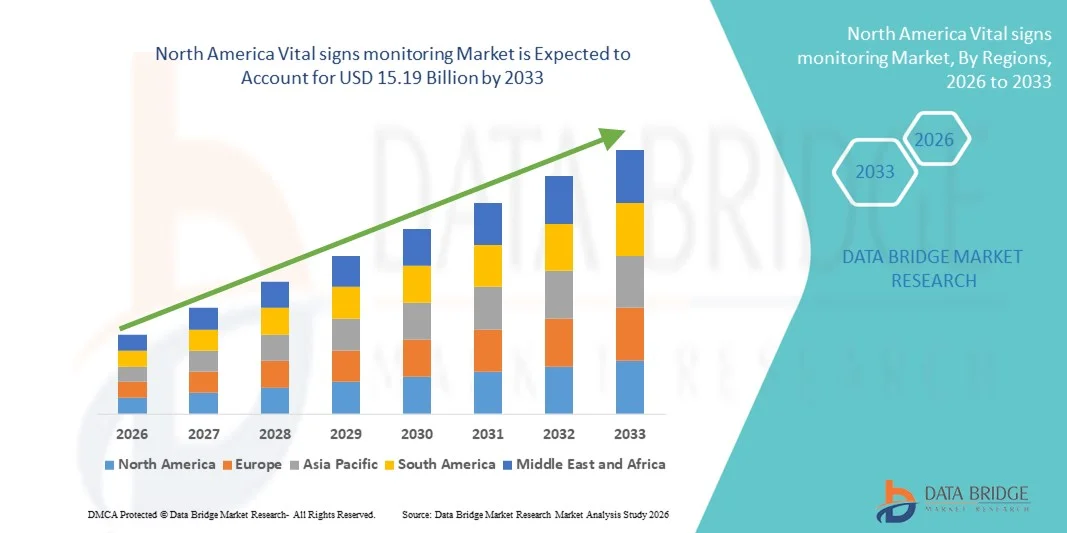
- As per Data Bridge Market Research Analysis the North America vital signs monitoring market size was valued at USD 9.11 billion in 2025 and is expected to reach USD 15.19 billion by 2033, at a CAGR of 6.60% during the forecast period
- The market growth is largely fueled by rising adoption of remote patient monitoring technologies, strong healthcare infrastructure across the U.S. and Canada, and an increasing prevalence of chronic conditions that necessitate regular tracking of vital parameters such as heart rate, blood pressure, respiratory rate and oxygen saturation
- Furthermore, growing consumer and provider demand for accurate, user‑friendly, and connected monitoring devices in both hospital and home‑care environments is establishing vital signs monitoring solutions as essential components of modern healthcare delivery systems. These converging factors are accelerating the uptake of vital signs monitoring technologies, thereby significantly boosting the industry’s growth
Market Size & Forecast
- Global Market Value (2025): USD 9.11 billion
- Expected Market Value (2033): USD 15.19 billion
- Forecast CAGR (2026–2033): 6.60%
What are the Major Takeaways of North America Vital signs monitoring Market?
- Vital signs monitoring devices, enabling continuous measurement of parameters such as temperature, blood pressure, and oxygen saturation, are increasingly critical components of modern healthcare delivery in hospitals, clinics, and home-care settings due to their ability to provide real-time data, support remote monitoring, and integrate with digital health ecosystems
- The growing demand for vital signs monitoring solutions is primarily driven by rising prevalence of chronic diseases, aging populations, increasing adoption of remote patient monitoring technologies, and the need for timely clinical decision-making to improve patient outcomes
- The U.S. dominated the North America vital signs monitoring market with the largest revenue share of 70.8% in 2025, characterized by advanced healthcare infrastructure, high healthcare expenditure, and a strong presence of leading medical device manufacturers, with substantial adoption across hospitals, physician offices, and home healthcare settings, propelled by innovations in wearable, wireless, and AI-enabled monitoring devices
- Canada is expected to be the fastest growing country in the North America vital signs monitoring market during the forecast period due to rising healthcare investments, increasing geriatric population, and expanding awareness of remote monitoring solutions
- Blood pressure monitors dominated the North America vital signs monitoring market with a market share of 42.3% in 2025, driven by their widespread use in hospitals, physician offices, and home healthcare due to ease of use, reliability, and their critical role in chronic disease management
Report Scope and North America Vital signs monitoring Market Segmentation
|
Attributes |
North America Vital signs monitoring Key Market Insights |
|
Segments Covered |
|
|
Countries Covered |
North America
|
|
Key Market Players |
|
|
Market Opportunities |
|
|
Value Added Data Infosets |
In addition to the insights on market scenarios such as market value, growth rate, segmentation, geographical coverage, and major players, the market reports curated by the Data Bridge Market Research also include in-depth expert analysis, patient epidemiology, pipeline analysis, pricing analysis, and regulatory framework |
What is the Key Trend in the North America Vital signs monitoring Market?
Enhanced Patient Care Through Wearables and AI Integration
- A significant and accelerating trend in the North America vital signs monitoring market is the growing integration of wearable devices and artificial intelligence (AI) into patient monitoring systems, enhancing real-time health tracking and predictive insights
- For instance, the BioSticker wearable monitor continuously tracks multiple vital signs and integrates AI algorithms to alert caregivers of potential anomalies, enabling timely interventions. Similarly, Masimo’s Radius-7 can provide wireless monitoring of oxygen saturation and pulse rate, supporting hospital and home-care applications
- AI integration in vital signs monitoring enables predictive analytics for early detection of deterioration and personalized patient insights, for instance, some EarlySense systems analyze sleep and movement patterns to predict health risks and can send alerts if unusual vital sign trends are detected
- The seamless integration of vital signs monitoring devices with electronic health records (EHRs) and telehealth platforms facilitates centralized monitoring of multiple patients, allowing clinicians to manage and respond to vital sign changes efficiently from a single interface
- This trend towards more intelligent, connected, and patient-centric monitoring solutions is fundamentally reshaping healthcare expectations, consequently driving companies such as iHealth to develop AI-enabled wearable monitors with predictive alerts and seamless integration into remote care platforms
- The demand for vital signs monitoring devices that combine wearable technology, AI, and connectivity is growing rapidly across hospitals, physician offices, and home healthcare settings, as stakeholders increasingly prioritize convenience, safety, and continuous patient care
- In addition, the expansion of cloud-based monitoring platforms enables hospitals and home-care providers to monitor multiple patients simultaneously, improving operational efficiency and reducing the need for constant in-person supervision
North America Vital signs monitoring Market Dynamics
Driver
Increasing Need Due to Chronic Disease Prevalence and Remote Care Adoption
- The rising prevalence of chronic diseases, aging populations, and the increasing adoption of remote patient monitoring solutions are significant drivers for the heightened demand for vital signs monitoring devices
- For instance, in March 2025, Masimo announced the expansion of its wearable patient monitoring portfolio to include continuous remote monitoring devices for chronic care, highlighting the industry’s focus on connected solutions
- As healthcare providers seek early detection and timely interventions, vital signs monitors offer features such as continuous tracking, predictive alerts, and integration with telehealth platforms, providing a compelling upgrade over traditional spot-check devices
- Furthermore, the growing popularity of home healthcare services and telemedicine is making vital signs monitors integral components of patient care, enabling clinicians to remotely monitor multiple physiological parameters
- The convenience of wireless, portable monitoring, integration with smartphones or tablets, and real-time alerting capabilities are key factors propelling the adoption of vital signs monitoring across hospitals, physician offices, and home healthcare settings
- The trend towards AI-enabled analytics and patient-centric monitoring solutions, combined with increasing awareness among healthcare providers and patients, further contributes to sustained market growth
- For instance, integration of multi-parameter monitoring with wearable patches allows seamless transition from hospital to home care, supporting patient recovery and reducing readmission rates
- In addition, increasing government and private funding for digital health initiatives is driving adoption of connected monitoring devices, creating new opportunities for device manufacturers and software developers
Restraint/Challenge
Data Privacy Concerns and High Device Costs
- Concerns surrounding data privacy and cybersecurity of connected patient monitoring devices pose a significant challenge to broader market penetration, as these devices rely on network connectivity and cloud-based software
- For instance, reports of vulnerabilities in remote monitoring systems have made some hospitals and home-care providers cautious about adopting connected vital signs monitors
- Addressing these concerns through secure encryption, HIPAA-compliant platforms, and regular software updates is crucial for building trust, with companies such as iHealth and Masimo emphasizing their advanced security features to reassure users
- In addition, the relatively high cost of advanced monitoring systems compared to basic devices can be a barrier for smaller clinics or budget-conscious patients, particularly when devices include AI analytics, multi-parameter monitoring, or wearable form factors
- While prices are gradually decreasing, the perceived premium for connected, AI-enabled monitoring solutions can hinder widespread adoption among cost-sensitive end-users, especially in non-hospital settings
- Overcoming these challenges through enhanced security, patient and provider education, and development of affordable, user-friendly devices will be vital for sustained market growth in North America
- For instance, interoperability issues between different monitoring devices and hospital IT systems can slow adoption, requiring standardized platforms and protocols to ensure seamless integration
- Furthermore, limited technical expertise among caregivers and patients in using advanced monitoring systems may restrict usage, highlighting the need for intuitive designs, training programs, and robust customer support
How is the North America Vital signs monitoring Market Segmented?
The market is segmented on the basis of product type and end use.
- By Product Type
On the basis of product type, the North America vital signs monitoring market is segmented into temperature monitoring devices, blood pressure monitors, and pulse oximeters. Blood Pressure Monitors dominated the market with the largest market revenue share of 42.3% in 2025, driven by their critical role in monitoring hypertension and cardiovascular health across hospitals, physician offices, and home healthcare settings. These devices are widely used due to their ease of use, accuracy, and reliability in both clinical and personal care settings. Hospitals and clinics prioritize blood pressure monitoring as part of routine check-ups and chronic disease management programs. The availability of connected and wireless models further enhances their adoption, enabling remote patient monitoring and data sharing with healthcare providers. Manufacturers are also focusing on portable and cuffless blood pressure monitors, catering to home healthcare and telemedicine needs. Continuous product innovation and integration with digital health platforms further strengthen their dominant position in the market.
Temperature Monitoring Devices are anticipated to witness the fastest growth rate of 18.9% CAGR from 2026 to 2033, fueled by increasing adoption in home healthcare, ambulatory centers, and emergency care settings. The COVID-19 pandemic accelerated the demand for non-contact infrared thermometers and wearable temperature sensors. Healthcare providers prefer these devices for quick, accurate, and hygienic monitoring of patients’ body temperature. Integration with AI-enabled alert systems and mobile health applications allows real-time notifications for fever or abnormal temperature trends. Rising awareness of early disease detection and preventive care is driving consumer interest in home-use temperature monitoring devices. In addition, hospitals are investing in automated temperature monitoring systems to streamline patient flow and enhance infection control measures.
- By End Use
On the basis of end use, the North America vital signs monitoring market is segmented into hospitals, physician’s offices, home healthcare, ambulatory centers, emergency care centers, and others. Hospitals dominated the market with the largest revenue share of 50.2% in 2025, driven by the high patient volume and the critical need for continuous monitoring of vital signs. Hospitals prioritize multi-parameter monitoring systems that can measure blood pressure, heart rate, oxygen saturation, and temperature simultaneously. Integration with electronic health records (EHR) allows clinicians to track patient trends, optimize interventions, and reduce response times for emergencies. Hospitals are increasingly adopting wireless and wearable monitors to enable mobility within wards while ensuring patient safety. Advanced AI analytics in these devices support early detection of patient deterioration, reducing ICU admissions and readmissions. Government funding and hospital initiatives to upgrade infrastructure also contribute to the high adoption rate in hospital settings.
Home Healthcare is expected to witness the fastest CAGR of 19.4% from 2026 to 2033, fueled by the growing aging population, rising prevalence of chronic diseases, and expansion of telehealth services. Home healthcare providers and patients increasingly adopt wearable vital signs monitors for continuous remote monitoring, reducing the need for frequent hospital visits. Connected devices provide real-time alerts to caregivers and clinicians, enabling proactive intervention. User-friendly mobile applications and integration with telemedicine platforms enhance convenience and engagement for patients. The trend towards patient-centered care and home-based chronic disease management is driving strong growth in this end-use segment. Insurance reimbursement policies and government incentives for home monitoring programs further support adoption.
Which Region Holds the Largest Share of the North America Vital signs monitoring Market?
- The U.S. dominated the North America vital signs monitoring market with the largest revenue share of 70.8% in 2025, characterized by advanced healthcare infrastructure, high healthcare expenditure, and a strong presence of leading medical device manufacturers
- Healthcare providers and patients in the region highly value the convenience, accuracy, and real-time data offered by vital signs monitoring devices, along with seamless integration into electronic health records (EHRs) and telehealth platforms
- This widespread adoption is further supported by strong healthcare infrastructure, high healthcare expenditure, a tech-savvy population, and the growing emphasis on home healthcare and remote patient monitoring, establishing vital signs monitoring devices as essential tools for hospitals, physician offices, and home care services
The U.S. Vital Signs Monitoring Market Insight
The U.S. vital signs monitoring market captured the largest revenue share of 70.8% in 2025 within North America, fueled by the rapid adoption of connected healthcare devices and increasing demand for remote patient monitoring. Healthcare providers and patients are prioritizing real-time tracking of blood pressure, oxygen saturation, and temperature to improve patient outcomes. The growing trend of home healthcare and telemedicine, combined with strong demand for wearable, AI-enabled monitors, further propels the market. Moreover, integration with electronic health records (EHRs) and mobile health applications is significantly contributing to market expansion by enabling seamless data sharing and proactive patient care.
Canada Vital Signs Monitoring Market Insight
The Canada vital signs monitoring market is projected to expand at a substantial CAGR throughout the forecast period, primarily driven by rising healthcare investments, an aging population, and increasing awareness of remote monitoring solutions. The adoption of connected and wireless devices is growing across hospitals, physician offices, and home healthcare settings. Canadian consumers and healthcare providers value convenience, accuracy, and real-time alerts, which encourage adoption in both new healthcare facilities and upgrades to existing systems. Government initiatives supporting telehealth and chronic disease management programs further stimulate market growth.
Mexico Vital Signs Monitoring Market Insight
The Mexico vital signs monitoring market is poised to grow at a notable CAGR during the forecast period, driven by increasing healthcare infrastructure development, rising urbanization, and expanding awareness of chronic disease management. Hospitals, clinics, and home healthcare providers are adopting connected and portable monitoring devices to enhance patient care and improve operational efficiency. For instance, the growing integration of wireless blood pressure monitors and pulse oximeters into telemedicine platforms allows clinicians to monitor patients remotely and intervene proactively. Affordable and user-friendly monitoring solutions are gaining popularity among both healthcare providers and patients. Government support for digital health initiatives and preventive care programs is also encouraging adoption across public and private healthcare sectors.
Which are the Top Companies in North America Vital signs monitoring Market?
The North America Vital signs monitoring industry is primarily led by well-established companies, including:
- Qardio, Inc. (U.S.)
- Masimo Corporation (U.S.)
- Nonin Medical, Inc. (U.S.)
- SunTech Medical, Inc. (U.S.)
- GE HealthCare (U.S.)
- Omron Healthcare, Inc. (U.S.)
- Welch Allyn, Inc. (U.S.)
- Philips Healthcare (Netherlands)
- Mindray DS USA, Inc. (U.S.)
- CAS Medical Systems, Inc. (U.S.)
- A&D Company, Ltd. (Japan)
- NIHON KOHDEN CORPORATION (Japan)
- Draeger Medical Systems, Inc. (U.S.)
- Boston Scientific Corporation (U.S.)
- OSI Systems, Inc. (U.S.)
- Natus Medical Incorporated (U.S.)
- Hill Rom Holdings, Inc. (U.S.)
- Baxter (U.S.)
- Medtronic (Ireland)
- Nihon Seimitsu Sokki Co., Ltd. (Japan)
What are Latest Developments in North America Vital signs monitoring Market?
- In April 2025, industry discussions highlighted the growing adoption of AI‑powered patient monitors and innovations in next‑gen vital signs tracking technologies, noting trends toward wireless, portable systems that improve accuracy and extend care beyond traditional clinical settings as part of broader market growth
- In April 2024, GE HealthCare announced that it won U.S. Food and Drug Administration (FDA) 510(k) clearance for its Portrait VSM vital signs monitor, marking a key advancement in wireless hospital monitoring technology and enabling broader deployment of vital signs monitoring solutions across critical care settings in the United States
- In October 2023, Dozee launched “Dozee Pro Ex”, an ambulatory connected patient monitoring system offering continuous wireless tracking of vital signs including ECG rhythm, blood pressure, heart rate, oxygen saturation, and respiration rate designed to support seamless patient monitoring across care settings
- In August 2023, GE HealthCare received FDA clearance for its Portrait Mobile wireless hospital vital sign monitor, expanding its portfolio of advanced patient monitoring devices with added mobility and connectivity for real‑time clinical use
- In December 2022, Dozee received U.S. FDA 510(k) clearance for its contactless vital signs measurement technology, enabling cloud‑connected vital sign tracking from under‑mattress and bedside sensors, which supports remote monitoring and automated vital signs reporting to healthcare providers

- Interactive Data Analysis Dashboard
- Company Analysis Dashboard for high growth potential opportunities
- Research Analyst Access for customization & queries
- Competitor Analysis with Interactive dashboard
- Latest News, Updates & Trend analysis
- Harness the Power of Benchmark Analysis for Comprehensive Competitor Tracking
Data collection and base year analysis are done using data collection modules with large sample sizes. The stage includes obtaining market information or related data through various sources and strategies. It includes examining and planning all the data acquired from the past in advance. It likewise envelops the examination of information inconsistencies seen across different information sources. The market data is analysed and estimated using market statistical and coherent models. Also, market share analysis and key trend analysis are the major success factors in the market report. To know more, please request an analyst call or drop down your inquiry.
The key research methodology used by DBMR research team is data triangulation which involves data mining, analysis of the impact of data variables on the market and primary (industry expert) validation. Data models include Vendor Positioning Grid, Market Time Line Analysis, Market Overview and Guide, Company Positioning Grid, Patent Analysis, Pricing Analysis, Company Market Share Analysis, Standards of Measurement, Global versus Regional and Vendor Share Analysis. To know more about the research methodology, drop in an inquiry to speak to our industry experts.
Data Bridge Market Research is a leader in advanced formative research. We take pride in servicing our existing and new customers with data and analysis that match and suits their goal. The report can be customized to include price trend analysis of target brands understanding the market for additional countries (ask for the list of countries), clinical trial results data, literature review, refurbished market and product base analysis. Market analysis of target competitors can be analyzed from technology-based analysis to market portfolio strategies. We can add as many competitors that you require data about in the format and data style you are looking for. Our team of analysts can also provide you data in crude raw excel files pivot tables (Fact book) or can assist you in creating presentations from the data sets available in the report.













