The global electric vehicle market is experiencing rapid growth, driven by several positive factors. Governments worldwide are implementing supportive policies and incentives, further boosting the market growth. Technological advancements and expanding charging infrastructure enhance the convenience and viability of electric vehicles. Additionally, the growing focus on reducing greenhouse gas emissions and combating climate change creates a favorable environment for the continued expansion of the global electric vehicle market.
Access Full Report at https://www.databridgemarketresearch.com/reports/global-electric-vehicle-market
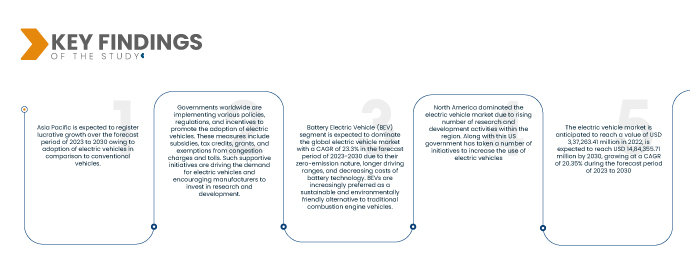
Data Bridge Market Research analyses that the Electric Vehicle Market is expected to grow to USD 3, 37,263.41 million in 2022, and is expected to reach USD 14, 84,355.71 million by 2030, growing at a CAGR of 20.35% during the forecast period of 2023 to 2030. The increasing awareness of environmental issues, such as air pollution and climate change, has led to a growing demand for electric vehicles as a cleaner and greener alternative to traditional combustion engine vehicles. Electric vehicles produce zero tailpipe emissions, contributing to a significant reduction in greenhouse gas emissions and improving air quality.
Key Findings of the Study
Growing charging infrastructure is expected to drive the market's growth rate
The expansion of charging infrastructure plays a pivotal role in driving the growth of the electric vehicle market. Investments in charging stations, both public and private, improve convenience and alleviate range anxiety, allowing electric vehicle owners to charge their vehicles easily. The establishment of fast-charging networks enables rapid charging, making electric vehicles more practical for long-distance travel. Furthermore, integrating charging infrastructure into urban planning ensures accessibility and promotes the widespread adoption of electric vehicles in cities and communities.
Report Scope and Market Segmentation
Report Metric
|
Details
|
Forecast Period
|
2023 to 2030
|
Base Year
|
2022
|
Historic Years
|
2021 (Customizable to 2015-2020)
|
Quantitative Units
|
Revenue in USD Million, Volumes in Units, Pricing in USD
|
Segments Covered
|
Component (Battery Cells and Packs, On-Board Charger, Infotainment System, Reducer, Fuel Stack, Power Control Unit, Battery Management System, Fuel Processor, Power Conditioner, Air Compressor, Humidifier, Others), Type (Battery Electric Vehicle, Plug-in Hybrid Electric Vehicle, and Fuel Cell Electric Vehicle), Vehicle Type (Passenger Cars, Two Wheelers, Commercial Vehicles), Propulsion Type (Plug-In Hybrid Electric Vehicles (PHEVs), Battery Electric Vehicles (BEVs), Hybrid Electric Vehicles (HEVs), and Fuel Cell Electric Vehicles (FCEVs), Charging Station Type (Normal Charging, Super Charging), Vehicle Class (Low-Priced, Mid-Priced, Luxury), Power Train (Parallel Hybrid, Series Hybrid, Combined Hybrid), Top Speed (<125 MPH, >125 MPH), Vehicle Drive Type (Front Wheel Drive, Rear Wheel Drive, All Wheel Drive), Vehicle Connectivity (Vehicle to Building, Vehicle to Grid, Vehicle to Vehicle, Vehicle to Everything), End Use (Private, Commercial Fleets)
|
Countries Covered
|
U.S., Canada and Mexico in North America, Germany, France, U.K., Netherlands, Switzerland, Belgium, Russia, Italy, Spain, Turkey, Rest of Europe in Europe, China, Japan, India, South Korea, Singapore, Malaysia, Australia, Thailand, Indonesia, Philippines, Rest of Asia-Pacific (APAC) in the Asia-Pacific (APAC), Saudi Arabia, U.A.E, South Africa, Egypt, Israel, Rest of Middle East and Africa (MEA) as a part of Middle East and Africa (MEA), Brazil, Argentina and Rest of South America as part of South America.
|
Market Players Covered
|
Ford Motor Company (U.S.), General Motors (U.S.), AUDI AG. (Germany), Kia India Private Ltd. (South Korea), Renault Group (France), Peugeot Motor Company plc (France), SAIC Motor Corporation Limited (China), Tesla (U.S.), Daimler Truck AG. (Germany), BMW AG (Germany), Hyundai Motor Company (South Korea), BYD Company Ltd. (China), Continental AG (Germany), Toyota Motor Sales, U.S.A., Inc. (Japan), Nissan Motor Co., Ltd. (Japan), Volkswagen AG (Germany), AB Volvo (Sweden), Honda Motor Co., Ltd. (Japan), Stellantis NV (Netherlands)
|
Data Points Covered in the Report
|
In addition to the market insights such as market value, growth rate, market segments, geographical coverage, market players, and market scenario, the market report curated by the Data Bridge Market Research team includes in-depth expert analysis, import/export analysis, pricing analysis, production consumption analysis, and pestle analysis.
|
Segment Analysis:
The electric vehicle market is segmented on the basis of components, type, vehicle type, propulsion type, charging station type, vehicle class, power train, top speed, vehicle drive type, vehicle connectivity and end use.
- On the basis of component, the electric vehicle market is segmented into battery cells and packs, on-board charger, infotainment system, reducer, fuel stack, power control unit, battery management system, fuel processor, power conditioner, air compressor, humidifier, others. Battery cells and packs segment is expected to dominate the global electric vehicle market with a CAGR of 24.5% in the forecast period of 2023-2030 due to their crucial role in powering electric vehicles. Advances in energy density, longevity, and cost reduction have made them essential for the growing demand for electric mobility and renewable energy storage.
In 2023, the battery cells and packs segment is expected to dominate the global electric vehicle market
In 2023, the battery cells and packs segment is expected to dominate the global electric vehicle market owing to their essential function in driving electric cars. They are now necessary to meet the rising demand for electric mobility and renewable energy storage due to improvements in energy density, longevity, and cost reduction with a CAGR of 24.5% in the forecast period of 2023-2030.
- On the basis of type, the electric vehicle market is segmented into battery electric vehicle, plug-in hybrid electric vehicle, and fuel cell electric vehicle. The battery electric vehicle (BEV) segment is expected to dominate the global electric vehicle market with a CAGR of 23.3% in the forecast period of 2023-2030 due to their zero-emission nature, longer driving ranges, and decreasing costs of battery technology. BEVs are increasingly preferred as a sustainable and environmentally friendly alternative to traditional combustion engine vehicles.
- On the basis of vehicle type, the electric vehicle market is segmented into passenger cars, two wheelers, commercial vehicles. Passenger cars segment is expected to dominate the global electric vehicle market with a CAGR of 24.5% in the forecast period of 2023-2030 due to their widespread usage for personal transportation. They cater to the needs of individuals and families, offering comfort, convenience, and a wide range of features and options, making them the most common vehicle type on the roads.
In 2023, the passenger cars segment is expected to dominate the global electric vehicle market
In 2023, the passenger Cars segment is expected to dominate the global electric vehicle market owing to their widespread use as a means of transportation for people. They are the most typical type of vehicle on the roads because they cater to the needs of both individuals and families while providing comfort, convenience, and a variety of features and options with a CAGR of 24.5% in the forecast period of 2023-2030.
- 根據推進類型(插電式混合動力電動車 (PHEVS)、電池電動車 (BEVS)、混合動力電動車 (HEVS) 和燃料電池電動車 (FCEVS)、充電站類型(正常充電、超級充電)。由於電池電動車 (BEV) 具有零排放特性、營運成本較低、基礎設施持續充電、超級充電)。由於電池電動車 (BEV) 具有零排放特性、營運成本較低、基礎設施持續電動車以及技術進步,預計在完善 2023-203% 電,的複合年增長率佔據全球電動車市場的主導地位,對於具有環保意識的消費者來說,這將成為越來越有吸引力和可行的選擇。
- 根據車輛等級,電動車市場分為低價、中價和豪華。預計中階價位車將在 2023-2030 年預測期內以 23.8% 的複合年增長率主導全球電動車市場,因為它們在價格和品質方面取得了平衡,並提供了功能、性能和舒適度的競爭性組合,吸引了廣泛的消費者
- 根據動力傳動系統,電動車市場分為並聯混合動力、串聯混合動力和組合混合動力。由於系列混合動力車能夠將內燃機與電動馬達結合起來,預計在 2023-2030 年的預測期內,該領域將以 22.3% 的複合年增長率佔據全球電動車市場的主導地位。這種配置可以提高燃油效率、減少排放,並能靈活地在動力源之間切換,為混合動力汽車技術提供平衡的方法。
- 根據最高速度,電動車市場細分為<125英里/小時和>125英里/小時。由於對高性能和跑車的需求,最高時速 >125 MPH 的車輛佔據了汽車市場的主導地位。這些車輛迎合了那些追求令人振奮的加速度、更高的馬力和最高速度以獲得刺激駕駛體驗的愛好者的需求。
- 根據車輛驅動類型,電動車市場分為前輪驅動、後輪驅動和全輪驅動。前輪驅動(FWD)車輛因其成本效益、更好的燃油效率和緊湊的設計而佔據汽車市場的主導地位。 FWD 為日常駕駛提供了良好的牽引力和操控性,使其成為轎車、掀背車和緊湊型 SUV 等各種車輛的熱門選擇。
- 根據車輛連接性,電動車市場細分為車輛與建築物、車輛與電網、車輛與車輛、車輛與一切。車輛連接領域以「車對車」(V2V)通訊為主,因為它具有提高道路安全的潛力。 V2V 使車輛能夠交換速度和位置等信息,以避免碰撞並改善交通流量,這使其成為未來智慧交通系統的關鍵技術。
- 根據最終用途,電動車市場分為私人車隊和商業車隊。由於個人交通需求旺盛,私人終端用途領域佔據汽車市場的主導地位。私家車迎合了個人的需求和喜好,提供了便利性、靈活性和個人化選擇,使其成為大多數消費者的首選。
主要參與者
Data Bridge Market Research 認為以下公司是電動車 市場的主要參與者,它們是上汽集團股份有限公司(中國)、特斯拉(美國)、戴姆勒卡車股份公司。 (德國)、BMW汽車公司(德國)、現代汽車公司(韓國)、比亞迪股份有限公司(中國)、大陸集團(德國)、豐田汽車銷售美國公司(日本)

市場開發
- 2021年,比亞迪在重慶發布了四款搭載刀片電池的全新電動車型。秦 Plus EV、E2 2021 EV、唐 EV 和宋 Plus EV 是配備尖端電池安全功能的新車型。這些配備尖端電池安全功能的新產品將吸引大量客戶,從而加速市場擴張。
- 2021年,大眾汽車攜手一汽、上汽,在中國展示了7人座純電動車ID.6 Crozz和ID.6 X。該款車輛有兩種不同的電池容量,分別為 58 kWh 和 77 kWh。這將滿足各種消費者的需求並有助於市場擴張。
區域分析
從地理上看,電動車市場報告涵蓋的國家有:北美洲的美國、加拿大和墨西哥,歐洲的德國、法國、英國、荷蘭、瑞士、比利時、俄羅斯、義大利、西班牙、土耳其,歐洲其他地區,中國、日本、印度、韓國、新加坡、馬來西亞、澳洲、泰國、印尼、菲律賓,亞太地區(APAC)的其他地區,沙烏地阿拉伯、阿拉伯聯合大公國、其他國家的歐洲、英國、其他地區(APAC)
根據 Data Bridge 市場研究分析:
2023-2030 年預測期內,北美是電動車市場的主導地區
北美在電動車市場的主導地位可歸因於多種因素。該地區引進了先進技術並開展了重大研發活動,促進了創新並推動了市場成長。此外,美國政府還實施了稅收優惠、補助金和基礎設施投資等各種措施來鼓勵人們使用電動車。這些支持措施促進了該地區在電動車市場的領先地位。
預計2023-2030 年預測期內,亞太地區將成為電動車市場成長最快的地區
由於政府對電動車應用的補貼和支持,亞太地區 (APAC) 的電動車市場預計將大幅成長。該地區各國已推出多項措施,例如為電動車購買者提供補貼以及推動安裝電動車充電基礎設施的舉措。政府的這些支持措施鼓勵消費者轉向電動車,並解決前期成本高、充電基礎設施有限等障礙,促進亞太地區電動車市場的成長。
有關電動車市場 報告的更多詳細信息,請點擊此處 - https://www.databridgemarketresearch.com/reports/global-electric-vehicle-market