



Global Mono and Diglycerides and Derivatives Market Segmentation, By Type (Mono and Diglycerides, Monoglyceride Derivatives, Fatty Acid Derivatives, Lecithin, and Others), Application (Bakery and Confectionary, Dairy Products, Convenience Foods, and Others), Source (Animal, Plant, and Biochemicals), Hydrophilic Groups (Cationic, Non-ionic, Anionic, and Amphoteric), Origin (Synthetic and Natural) - Industry Trends and Forecast to 2032
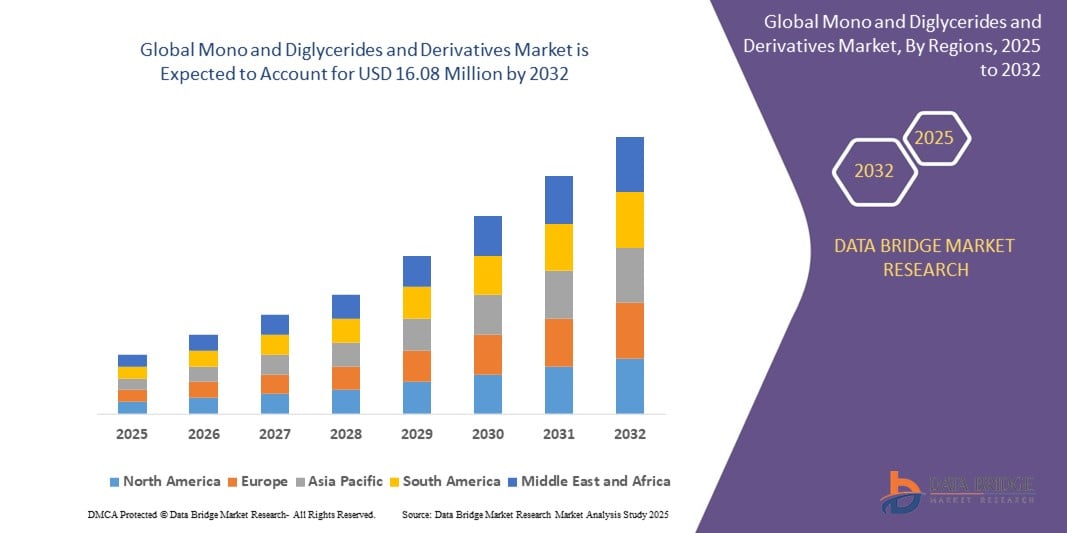
What is the Global Mono and Diglycerides and Derivatives Market Size and Growth Rate?
- The Global mono and diglycerides and derivatives market size was valued at USD 2.40 million in 2024 and is expected to reach USD 16.08 million by 2032, at a CAGR of 26.80% during the forecast period
- In the mono and diglycerides and derivatives market, technological advancements enhance production processes, ensuring higher purity and functionality of products. This fosters widespread applications across food, pharmaceuticals, and personal care sectors, benefiting manufacturers with increased efficiency, improved product quality, and expanded market opportunities
- For instance, the U.S. FDA closely regulates emulsifier safety, restricting their usage to specific foods and beverages in precise quantities. This stringent oversight boosts the country's market for emulsifiers, ensuring compliance and consumer trust while driving innovation in product formulations
What are the Major Takeaways of Mono and Diglycerides and Derivatives Market?
- Rising disposable incomes worldwide fuel a preference for convenient and indulgent foods such as baked goods and ready-to-eat meals. Mono and diglycerides, essential for enhancing texture and stability, meet consumer demands for quality. With greater purchasing power, consumers prioritize premium products, driving demand for mono and diglycerides across various processed foods
- North America dominated the mono and diglycerides and derivatives market with the largest revenue share of 38.4% in 2024, driven by strong demand for clean-label, plant-based emulsifiers and functional food ingredients
- Asia-Pacific mono and diglycerides and derivatives market is expected to grow at the fastest CAGR of 22.7% from 2025 to 2032, driven by rapid urbanization, rising disposable incomes, and increased consumption of processed and convenience foods
- The Mono and Diglycerides segment dominated the market with the largest revenue share of 41.3% in 2024, owing to their widespread application as emulsifiers and stabilizers in bakery, confectionery, dairy, and processed foods
Report Scope and Mono and Diglycerides and Derivatives Market Segmentation
|
Attributes |
Mono and Diglycerides and Derivatives Key Market Insights |
|
Segments Covered |
|
|
Countries Covered |
North America
Europe
Asia-Pacific
Middle East and Africa
South America
|
|
Key Market Players |
|
|
Market Opportunities |
|
|
Value Added Data Infosets |
In addition to the insights on market scenarios such as market value, growth rate, segmentation, geographical coverage, and major players, the market reports curated by the Data Bridge Market Research also include in-depth expert analysis, pricing analysis, brand share analysis, consumer survey, demography analysis, supply chain analysis, value chain analysis, raw material/consumables overview, vendor selection criteria, PESTLE Analysis, Porter Analysis, and regulatory framework. |
What is the Key Trend in the Mono and Diglycerides and Derivatives Market?
“Clean Label and Functional Ingredient Demand”
- A significant trend driving the global mono and diglycerides and derivatives market is the increasing demand for clean label, plant-based, and multifunctional food ingredients. Consumers are showing a clear preference for sustainable, minimally processed emulsifiers that enhance both product quality and health profiles, in line with the global movement toward transparent and natural food products
- For instance, Kerry Group (Ireland) offers clean label emulsifier solutions, including Mono and Diglycerides that cater to the growing need for natural, non-GMO, and allergen-free ingredients across bakery, dairy, and confectionery sectors. Similarly, DuPont (U.S.) focuses on plant-based mono and diglycerides offerings with an emphasis on label-friendly and functional performance
- Mono and Diglycerides and their derivatives are increasingly incorporated into mainstream food products, including bakery goods, dairy alternatives, frozen desserts, and processed foods, where they provide essential emulsification, texture enhancement, and shelf-life extension
- This evolving focus on clean label and functional benefits is reshaping product development, with companies emphasizing plant-derived, non-trans-fat mono and diglycerides that align with consumer expectations for health, sustainability, and ingredient transparency
- The demand for multifunctional emulsifiers is also driving innovation in food formulations, with manufacturers such as BASF SE (Germany) investing in sustainable production processes and bio-based derivatives to meet both regulatory and market demands
- As health-conscious consumers worldwide continue to prioritize natural ingredients and clean-label claims, the mono and diglycerides and derivatives market is poised for steady growth, particularly across North America, Europe, and Asia-Pacific food and beverage industries
What are the Key Drivers of Mono and Diglycerides and Derivatives Market?
- The increasing use of mono and diglycerides and derivatives as essential emulsifiers and stabilizers across food, personal care, and pharmaceutical industries is a primary driver of market growth. These ingredients enhance product texture, consistency, and shelf life while supporting clean-label and functional product claims
- For instance, in April 2024, Evonik Industries AG (Germany) introduced a new line of sustainable Mono and Diglycerides for food and cosmetic applications, focusing on plant-derived raw materials and eco-friendly processing, reflecting strong demand for ethical and sustainable ingredient sourcing
- The expanding demand for bakery products, convenience foods, and plant-based alternatives globally is further accelerating market growth. Mono and Diglycerides provide critical functionality in gluten-free, dairy-free, and reduced-fat formulations, aligning with evolving dietary trends
- In addition, increasing regulatory support for food-grade emulsifiers, especially in developed markets, is enabling broader adoption of Mono and Diglycerides across food, nutraceutical, and personal care industries. The trend toward healthier, clean-label, and sustainable products continues to drive the integration of these ingredients across multiple applications
Which Factor is challenging the Growth of the Mono and Diglycerides and Derivatives Market?
- Regulatory complexities related to ingredient labeling, permissible inclusion rates, and varying international standards present challenges for global market expansion. Disparities between regions such as the U.S., E.U., and Asia regarding additive approvals and labeling requirements create uncertainty for manufacturers
- For instance, differing clean-label definitions across countries and inconsistent enforcement of trans-fat bans lead to market fragmentation, complicating product development and global distribution strategies
- Furthermore, growing consumer scrutiny of food additives, even natural or plant-based ones, adds to the challenge. Despite their functional role, some consumers remain cautious about emulsifiers such as Mono and Diglycerides, associating them with highly processed foods
- Price volatility of plant-based raw materials, such as vegetable oils used for Mono and Diglycerides production, also impacts overall product costs, especially for premium, organic, or non-GMO variants. This limits affordability in price-sensitive markets and among smaller food manufacturers
- Addressing these challenges will require greater regulatory harmonization, transparent consumer communication, and continuous innovation to develop sustainable, competitively priced, and consumer-accepted Mono and Diglycerides and Derivatives solutions globally
How is the Mono and Diglycerides and Derivatives Market Segmented?
The market is segmented on the basis of type, application, source, hydrophilic groups, and origin.
- By Type
On the basis of type, the mono and diglycerides and derivatives market is segmented into Mono and Diglycerides, Monoglyceride Derivatives, Fatty Acid Derivatives, Lecithin, and Others. The Mono and Diglycerides segment dominated the market with the largest revenue share of 41.3% in 2024, owing to their widespread application as emulsifiers and stabilizers in bakery, confectionery, dairy, and processed foods. Their ability to improve texture, shelf life, and product consistency makes them essential ingredients across the food industry.
The Fatty Acid Derivatives segment is projected to witness the fastest growth from 2025 to 2032, driven by increasing use in personal care, industrial, and pharmaceutical formulations, along with growing demand for bio-based and multifunctional ingredients.
- By Application
On the basis of application, the market is segmented into Bakery and Confectionery, Dairy Products, Convenience Foods, and Others. The Bakery and Confectionery segment accounted for the largest market revenue share of 46.7% in 2024, fueled by the critical role of Mono and Diglycerides in enhancing dough stability, texture, and shelf life of bakery goods and confectionery products.
The Convenience Foods segment is anticipated to grow at the fastest CAGR from 2025 to 2032, driven by the rising consumption of ready-to-eat meals, frozen foods, and processed snacks, where Mono and Diglycerides help improve emulsification, mouthfeel, and product stability.
- By Source
On the basis of source, the mono and diglycerides and derivatives market is segmented into Animal, Plant, and Biochemicals. The Plant segment dominated the market with the largest revenue share of 59.5% in 2024, driven by the increasing consumer demand for plant-based, sustainable, and allergen-free emulsifier solutions, especially across food and personal care industries.
The Biochemicals segment is expected to experience the fastest growth from 2025 to 2032, as manufacturers adopt innovative bio-based production processes to meet sustainability goals and regulatory requirements for clean-label ingredients.
- By Hydrophilic Groups
On the basis of hydrophilic groups, the market is segmented into Cationic, Non-ionic, Anionic, and Amphoteric. The Non-ionic segment held the largest market share of 54.2% in 2024, owing to its versatility, compatibility with a wide range of formulations, and broad application across food, cosmetics, and pharmaceutical products. Non-ionic emulsifiers are favored for their stability and mildness in formulations.
The Amphoteric segment is projected to witness the fastest growth rate, driven by its increasing use in specialized personal care, industrial, and pharmaceutical applications that require pH-sensitive, multifunctional emulsifier systems.
- By Origin
On the basis of origin, the mono and diglycerides and derivatives market is segmented into Synthetic and Natural. The Natural segment dominated the market with the largest revenue share of 63.8% in 2024, driven by growing consumer preference for clean-label, plant-derived, and minimally processed ingredients, particularly across food, cosmetic, and wellness sectors.
The Synthetic segment is expected to witness moderate growth, offering cost-effective and standardized solutions for industrial, pharmaceutical, and food processing applications where consistent performance is essential.
Which Region Holds the Largest Share of the Mono and Diglycerides and Derivatives Market?
- North America dominated the mono and diglycerides and derivatives market with the largest revenue share of 38.4% in 2024, driven by strong demand for clean-label, plant-based emulsifiers and functional food ingredients
- The region's well-established food and beverage industry, along with rising consumer awareness of product quality, transparency, and sustainability, fuels market expansion
- Growing adoption of mono and diglycerides in bakery, confectionery, dairy, and personal care applications, supported by advanced manufacturing infrastructure and favorable regulatory frameworks, solidifies North America's leadership position
U.S. Mono and Diglycerides and Derivatives Market Insight
U.S. mono and diglycerides and derivatives market captured the largest revenue share within North America in 2024, supported by the rising demand for clean-label, non-GMO, and plant-based food ingredients. The rapid expansion of the processed food, functional beverage, and personal care sectors, combined with increasing consumer focus on product transparency and wellness, is accelerating adoption. In addition, key manufacturers in the U.S. are heavily investing in sustainable sourcing and bio-based production technologies to meet evolving market demands.
Europe Mono and Diglycerides and Derivatives Market Insight
Europe mono and diglycerides and derivatives market is projected to expand at a robust CAGR throughout the forecast period, driven by stringent food safety regulations and the growing preference for sustainable, plant-derived emulsifiers. European consumers prioritize eco-friendly, natural, and clean-label products across bakery, dairy, and confectionery sectors. Increasing demand for vegan, allergen-free, and organic formulations is propelling market growth, particularly in countries such as Germany, France, and the U.K.
U.K. Mono and Diglycerides and Derivatives Market Insight
U.K. market is expected to grow at a notable CAGR during the forecast period, supported by the rising popularity of plant-based and functional food products. Heightened health awareness, regulatory emphasis on clean-label ingredients, and increasing demand for transparent, sustainable food formulations drive the integration of Mono and Diglycerides in bakery, convenience foods, and personal care products. The U.K.'s evolving consumer preferences for natural emulsifiers contribute significantly to market growth.
Germany Mono and Diglycerides and Derivatives Market Insight
Germany market is projected to expand considerably during the forecast period, fueled by strong demand for high-performance, sustainable emulsifiers and growing applications in food, personal care, and industrial products. Germany’s emphasis on technological innovation, coupled with a focus on sustainability, is accelerating the adoption of plant-based Mono and Diglycerides. The market is further supported by increased consumer interest in functional foods, clean-label cosmetics, and environmentally conscious product choices.
Which Region is the Fastest Growing in the Mono and Diglycerides and Derivatives Market?
Asia-Pacific mono and diglycerides and derivatives market is expected to grow at the fastest CAGR of 22.7% from 2025 to 2032, driven by rapid urbanization, rising disposable incomes, and increased consumption of processed and convenience foods. Emerging markets such as China, India, and Southeast Asian countries are witnessing growing demand for food additives, plant-based ingredients, and sustainable emulsifiers. Government initiatives promoting food safety, coupled with expanding local manufacturing and improving distribution networks, further enhance market accessibility.
China Mono and Diglycerides and Derivatives Market Insight
China market accounted for the largest revenue share within Asia-Pacific in 2024, supported by the booming food processing industry, rising middle-class population, and increasing demand for functional food ingredients. The push towards modernization in food manufacturing, coupled with government efforts to promote food safety and quality, is accelerating the adoption of Mono and Diglycerides in bakery, dairy, and convenience foods. In addition, China's growing personal care and cosmetics industries contribute to market expansion.
Which are the Top Companies in Mono and Diglycerides and Derivatives Market?
The mono and diglycerides and derivatives industry is primarily led by well-established companies, including:
- Kerry Group (Ireland)
- Evonik Industries AG (Germany)
- DuPont (U.S.)
- BASF SE (Germany)
- Clariant (Switzerland)
- Koninklijke DSM N.V. (Netherlands)
- Akzonobel N.V. (Netherlands)
- Cargill Incorporated (U.S.)
- Lonza (Switzerland)
- Stepan Company (U.S.)
- The Lubrizol Corporation (U.S.)
What are the Recent Developments in GLOBAL Mono and Diglycerides and Derivatives Market?
- In March 2023, BASF introduced a new line of sustainably sourced mono- and diglycerides, aiming to expand its portfolio of eco-friendly and plant-based emulsifiers. This move reinforces the company's focus on sustainability and product innovation
- In September 2020, ADM announced a significant investment to expand its production capacity for mono- and diglycerides, enabling the company to meet increasing global demand for high-quality emulsifiers and strengthen its market presence
SKU-
Accédez en ligne au rapport sur le premier cloud mondial de veille économique

- Tableau de bord d'analyse de données interactif
- Tableau de bord d'analyse d'entreprise pour les opportunités à fort potentiel de croissance
- Accès d'analyste de recherche pour la personnalisation et les requêtes
- Analyse de la concurrence avec tableau de bord interactif
- Dernières actualités, mises à jour et analyse des tendances
- Exploitez la puissance de l'analyse comparative pour un suivi complet de la concurrence
Table des matières
1 INTRODUCTION
1.1 OBJECTIVES OF THE STUDY
1.2 MARKET DEFINITION
1.3 OVERVIEW OF GLOBAL MONO AND DIGLYCERIDES DERIVATIVES MARKET
1.4 CURRENCY AND PRICING
1.5 LIMITATION
1.6 MARKETS COVERED
2 MARKET SEGMENTATION
2.1 KEY TAKEAWAYS
2.2 ARRIVING AT THE GLOBAL MONO AND DIGLYCERIDES DERIVATIVES MARKETSIZE
2.2.1 VENDOR POSITIONING GRID
2.2.2 TECHNOLOGY LIFE LINE CURVE
2.2.3 MARKET GUIDE
2.2.4 COMPANY POSITIONING GRID
2.2.5 COMAPANY MARKET SHARE ANALYSIS
2.2.6 MULTIVARIATE MODELLING
2.2.7 DEMAND AND SUPPLY-SIDE VARIABLES
2.2.8 TOP TO BOTTOM ANALYSIS
2.2.9 STANDARDS OF MEASUREMENT
2.2.10 VENDOR SHARE ANALYSIS
2.2.11 DATA POINTS FROM KEY PRIMARY INTERVIEWS
2.2.12 DATA POINTS FROM KEY SECONDARY DATABASES
2.3 GLOBAL MONO AND DIGLYCERIDES DERIVATIVES MARKET: RESEARCH SNAPSHOT
2.4 ASSUMPTIONS
3 MARKET OVERVIEW
3.1 DRIVERS
3.2 RESTRAINTS
3.3 OPPORTUNITIES
3.4 CHALLENGES
4 EXECUTIVE SUMMARY
5 PREMIUM INSIGHTS
5.1 VALUE CHAIN ANALYSIS
5.2 SUPPLY CHAIN ANALYSIS
5.3 IMPORT-EXPORT ANALYSIS
5.4 PORTER’S FIVE FORCES ANALYSIS
5.4.1 BARGAINING POWER OF SUPPLIERS
5.4.2 BARGAINING POWER OF BUYERS/CONSUMERS
5.4.3 THREAT OF NEW ENTRANTS
5.4.4 THREAT OF SUBSTITUTE PRODUCTS
5.4.5 INTENSITY OF COMPETITIVE RIVALRY
5.5 RAW MATERIAL SOURCING ANALYSIS
5.6 OVERVIEW OF TECHNOLOGICAL INNOVATIONS
5.7 INDUSTRY TRENDS AND FUTURE PERSPECTIVE
5.8 GROWTH STRATEGIES ADOPTED BY KEY MARKET PLAYERS
5.9 FACTORS INFLUENCING PURCHASING DECISION OF END-USERS
6 IMPACT OF ECONOMIC SLOW DOWN ON MARKET
6.1 IMPACT ON PRICE
6.2 IMPACT ON SUPPLY CHAIN
6.3 IMPACT ON SHIPMENT
6.4 IMPACT ON COMPANY’S STRATEGIC DECISIONS
7 REGULATORY FRAMEWORK AND GUIDELINES
8 PRICING INDEX (PRICE AT B2B END & PRICES AT FOB)
9 PRODUCTION CAPACITY OF KEY MANUFACTURERES
10 BRAND OUTLOOK
10.1 COMPARATIVE BRAND ANALYSIS
10.2 PRODUCT VS BRAND OVERVIEW
11 GLOBAL MONO AND DIGLYCERIDES DERIVATIVES MARKET, BY TYPE, 2022-2031 (USD MILLION) (KILO TONS)
11.1 OVERVIEW
11.2 MONOGLYCERIDES
11.2.1 ACETYLATED MONOGLYCERIDES (ACETEM)
11.2.2 LACTYLATED MONOGLYCERIDES (LACTEM)
11.2.3 DIACETYL TARTARIC ACID MONOGLYCERIDES (DATEM)
11.2.4 CITRIC ACID ESTERS OF MONOGLYCERIDES (CITREM)
11.3 DIGLYCERIDE
11.3.1 1,2-DIACYLGLYCEROLS
11.3.2 1,3-DIACYLGLYCEROLS
12 GLOBAL MONO AND DIGLYCERIDES DERIVATIVES MARKET, BY SOURCE, 2022-2031 (USD MILLION) (KILO TONS)
12.1 OVERVIEW
12.2 ANIMAL
12.3 PLANT
12.4 ALGAE
12.5 BIOCHEMICALS
13 GLOBAL MONO AND DIGLYCERIDES DERIVATIVES MARKET, BY ORIGIN, 2022-2031 (USD MILLION) (KILO TONS)
13.1 OVERVIEW
13.2 NATURAL
13.3 SYNTHETIC
14 GLOBAL MONO AND DIGLYCERIDES DERIVATIVES MARKET, BY PRODUCTION PROCESS, 2022-2031 (USD MILLION) (KILO TONS)
14.1 OVERVIEW
14.2 CHEMICAL GLYCEROLYSIS
14.3 BIOLOGICAL OR ENZYMATIC PROCESS
14.4 OTHERS
15 GLOBAL MONO AND DIGLYCERIDES DERIVATIVES MARKET, BY FORM , 2022-2031 (USD MILLION) (KILO TONS)
15.1 OVERVIEW
15.2 POWDER
15.3 LIQUID
16 GLOBAL MONO AND DIGLYCERIDES DERIVATIVES MARKET, BY CATEGORY , 2022-2031 (USD MILLION) (KILO TONS)
16.1 OVERVIEW
16.2 REGULAR
16.3 DISTILLED
17 GLOBAL MONO AND DIGLYCERIDES DERIVATIVES MARKET, BY GMO CATEGORY, 2022-2031 (USD MILLION) (KILO TONS)
17.1 OVERVIEW
17.2 GMO
17.3 NON-GMO
18 GLOBAL MONO AND DIGLYCERIDES DERIVATIVES MARKET, BY FUNCTION, 2022-2031 (USD MILLION) (KILO TONS)
18.1 OVERVIEW
18.2 FAT REDUCTION
18.3 THAW STABILITY
18.4 IMPROVED AERATION
18.5 REDUCED STICKINESS
18.6 EMULSION
18.7 ANTISTICKINESS
18.8 OTHERS
19 GLOBAL MONO AND DIGLYCERIDES DERIVATIVES MARKET, BY APPLICATION, 2022-2031 (USD MILLION) (KILO TONS)
19.1 OVERVIEW
19.2 FOOD
19.2.1 FOOD, BY TYPE
19.2.1.1. BAKERY
19.2.1.1.1. BAKERY, BY TYPE
19.2.1.1.1.1 BREAD & ROLLS
19.2.1.1.1.2 CAKES, PASTRIES & TRUFFLE
19.2.1.1.1.3 BISCUIT
19.2.1.1.1.4 TART & PIES
19.2.1.1.1.5 BROWNIES
19.2.1.1.1.6 COOKIES & CRACKERS
19.2.1.1.1.7 TORTILLA
19.2.1.1.1.8 OTHERS
19.2.1.2. DAIRY PRODUCTS
19.2.1.2.1. DAIRY PRODUCTS, BY TYPE
19.2.1.2.1.1 YOGURT
19.2.1.2.1.1.1. FRESH
19.2.1.2.1.1.2. FROZEN
19.2.1.2.1.2 ICE CREAM
19.2.1.2.1.3 CHEESE
19.2.1.2.1.4 OTHERS
19.2.1.3. PROCESSED FOOD
19.2.1.3.1. PROCESSED FOOD, BY TYPE
19.2.1.3.1.1 READY MEALS
19.2.1.3.1.2 SAUCES, DRESSINGS AND CONDIMENTS
19.2.1.3.1.3 SOUPS
19.2.1.3.1.4 JAMS, PRESERVES & MARMALADES
19.2.1.3.1.5 CANNED FRUITS & VEGETABLES
19.2.1.3.1.6 FRUIT & VEGETABLE PUREE
19.2.1.3.1.7 PICKLES
19.2.1.3.1.8 OTHERS
19.2.1.4. CONFECTIONERY
19.2.1.4.1. CONFECTIONERY, BY TYPE
19.2.1.4.1.1 HARD-BOILED SWEETS
19.2.1.4.1.2 MINTS
19.2.1.4.1.3 GUMS & JELLIES
19.2.1.4.1.4 CHOCOLATE
19.2.1.4.1.5 CHOCOLATE SYRUPS
19.2.1.4.1.6 CARAMELS & TOFFEES
19.2.1.4.1.7 OTHERS
19.2.1.5. FROZEN DESSERTS
19.2.1.5.1. FROZEN DESSERTS, BY TYPE
19.2.1.5.1.1 GELATO
19.2.1.5.1.2 CUSTARD
19.2.1.5.1.3 SORBET
19.2.1.5.1.4 OTHERS
19.2.1.6. INFANT FORMULA
19.2.1.6.1. INFANT FORMULA, BY TYPE
19.2.1.6.1.1 FIRST INFANT FORMULA
19.2.1.6.1.2 ANTI-REFLUX (STAYDOWN) FORMULA
19.2.1.6.1.3 COMFORT FORMULA
19.2.1.6.1.4 HYPOALLERGENIC FORMULA
19.2.1.6.1.5 FOLLOW-ON FORMULA
19.2.1.6.1.6 OTHERS
19.2.1.7. FUCNTIONAL FOOD
19.2.1.8. MEAT & MEAT PRODUCTS
19.2.1.8.1. POULTRY PRODUCTS
19.2.1.8.2. BEEF PRODUCTS
19.2.1.8.3. PORK PRODUCTS
19.2.1.8.4. OTHERS
19.2.1.9. PLANT-BASED DAIRY ALTERNATIVES
19.2.1.9.1. PLANT-BASED DAIRY ALTERNATIVES, BY TYPE
19.2.1.9.1.1 PLANT-BASED CHEESE
19.2.1.9.1.2 PLANT-BASED BUTTER
19.2.1.9.1.3 PLANT-BASED YOGURT
19.2.1.9.1.4 OTHERS
19.2.1.10. PLANT-BASED MEAT ALTERNATIVES
19.2.1.10.1. PLANT-BASED MEAT ALTERNATIVES, BY TYPE
19.2.1.10.1.1 PLANT-BASED NUGGETS
19.2.1.10.1.2 PLANT-BASED BURGER PATTIES
19.2.1.10.1.3 PLANT-BASED SAUSAGES
19.2.1.10.1.4 OTHERS
19.2.1.11. CONVENIENCE FOOD
19.2.1.11.1. CONVENIENCE FOOD, BY TYPE
19.2.1.11.1.1 INSTANT NOODLES
19.2.1.11.1.2 PIZZA & PASTA
19.2.1.11.1.3 SANCKS& EXTRUDED SNACKS
19.2.1.11.1.4 REGULAR
19.2.1.11.1.5 FROZEN
19.2.1.11.1.6 BITES
19.2.1.11.1.7 WEDGES
19.2.1.11.1.8 FRENCH FRIES
19.2.1.11.1.9 NUGGETS
19.2.1.12. SPORTS NUTRITION
19.2.1.12.1. SPORTS NUTRTION, BY TYPE
19.2.1.12.1.1 SPORT DRINKS
19.2.1.12.1.2 PROTEIN POWDERS
19.2.1.12.1.3 OTEHRS
19.2.2 FOOD, BY MONO AND DIGLYCERIDES TYPE
19.2.2.1. MONOGLYCERIDES
19.2.2.1.1. ACETYLATED MONOGLYCERIDES (ACETEM)
19.2.2.1.2. LACTYLATED MONOGLYCERIDES (LACTEM)
19.2.2.1.3. DIACETYL TARTARIC ACID MONOGLYCERIDES (DATEM)
19.2.2.1.4. CITRIC ACID ESTERS OF MONOGLYCERIDES (CITREM)
19.2.2.2. DIGLYCERIDE
19.2.2.2.1. 1,2-DIACYLGLYCEROLS
19.2.2.2.2. 1,3-DIACYLGLYCEROLS
19.3 BEVERAGES
19.3.1 BEVERAGES, BY TYPE
19.3.1.1. SMOOTHIES
19.3.1.2. JUICES
19.3.1.3. DAIRY BASED DRINKS
19.3.1.3.1. REGULAR PROCESSED MILK
19.3.1.3.2. FLVORED MILK
19.3.1.3.3. MILK SHAKES
19.3.1.3.4. FUNCTIONAL BEVERAGES
19.3.1.4. FORTIFIED BEVERAGES
19.3.1.5. PLANT-BASED MILK
19.3.1.5.1. SOY MILK
19.3.1.5.2. ALMOND MILK
19.3.1.5.3. OAT MILK
19.3.1.5.4. CASHEW MILK
19.3.1.5.5. RICE MILK
19.3.1.5.6. OTHERS
19.3.1.6. OTHERS
19.3.2 BEVERAGE, BY MONO AND DIGLYCERIDES TYPE
19.3.2.1. MONOGLYCERIDES
19.3.2.1.1. ACETYLATED MONOGLYCERIDES (ACETEM)
19.3.2.1.2. LACTYLATED MONOGLYCERIDES (LACTEM)
19.3.2.1.3. DIACETYL TARTARIC ACID MONOGLYCERIDES (DATEM)
19.3.2.1.4. CITRIC ACID ESTERS OF MONOGLYCERIDES (CITREM)
19.3.2.2. DIGLYCERIDE
19.3.2.2.1. 1,2-DIACYLGLYCEROLS
19.3.2.2.2. 1,3-DIACYLGLYCEROLS
19.4 COSMETIC
19.4.1 COSMETIC, BY MONO AND DIGLYCERIDES TYPE
19.4.1.1. MONOGLYCERIDES
19.4.1.1.1. ACETYLATED MONOGLYCERIDES (ACETEM)
19.4.1.1.2. LACTYLATED MONOGLYCERIDES (LACTEM)
19.4.1.1.3. DIACETYL TARTARIC ACID MONOGLYCERIDES (DATEM)
19.4.1.1.4. CITRIC ACID ESTERS OF MONOGLYCERIDES (CITREM)
19.4.1.2. DIGLYCERIDE
19.4.1.2.1. 1,2-DIACYLGLYCEROLS
19.4.1.2.2. 1,3-DIACYLGLYCEROLS
19.5 DIETARY SUPPLEMENTS
19.5.1 DIETARY SUPPLEMENTS, BY MONO AND DIGLYCERIDES TYPE
19.5.1.1. MONOGLYCERIDES
19.5.1.1.1. ACETYLATED MONOGLYCERIDES (ACETEM)
19.5.1.1.2. LACTYLATED MONOGLYCERIDES (LACTEM)
19.5.1.1.3. DIACETYL TARTARIC ACID MONOGLYCERIDES (DATEM)
19.5.1.1.4. CITRIC ACID ESTERS OF MONOGLYCERIDES (CITREM)
19.5.1.2. DIGLYCERIDE
19.5.1.2.1. 1,2-DIACYLGLYCEROLS
19.5.1.2.2. 1,3-DIACYLGLYCEROLS
19.6 OTHERS
20 GLOBAL MONO AND DIGLYCERIDES DERIVATIVES MARKET, COMPANY LANDSCAPE
20.1 COMPANY SHARE ANALYSIS: GLOBAL
20.2 COMPANY SHARE ANALYSIS: NORTH AMERICA
20.3 COMPANY SHARE ANALYSIS: EUROPE
20.4 COMPANY SHARE ANALYSIS: ASIA-PACIFIC
20.5 MERGERS & ACQUISITIONS
20.6 NEW PRODUCT DEVELOPMENT & APPROVALS
20.7 EXPANSIONS & PARTNERSHIP
20.8 REGULATORY CHANGES
21 GLOBAL MONO AND DIGLYCERIDES DERIVATIVES MARKET, BY GEOGRAPHY, 2022-2031 (USD MILLION) (KILO TONS)
21.1 OVERVIEW (ALL SEGMENTATION PROVIDED ABOVE IS REPRESNTED IN THIS CHAPTER BY COUNTRY)
21.2 NORTH AMERICA
21.2.1 U.S.
21.2.2 CANADA
21.2.3 MEXICO
21.3 EUROPE
21.3.1 GERMANY
21.3.2 U.K.
21.3.3 ITALY
21.3.4 FRANCE
21.3.5 SPAIN
21.3.6 SWITZERLAND
21.3.7 NETHERLANDS
21.3.8 BELGIUM
21.3.9 RUSSIA
21.3.10 TURKEY
21.3.11 REST OF EUROPE
21.4 ASIA-PACIFIC
21.4.1 JAPAN
21.4.2 CHINA
21.4.3 SOUTH KOREA
21.4.4 INDIA
21.4.5 AUSTRALIA
21.4.6 SINGAPORE
21.4.7 THAILAND
21.4.8 INDONESIA
21.4.9 MALAYSIA
21.4.10 PHILIPPINES
21.4.11 REST OF ASIA-PACIFIC
21.5 SOUTH AMERICA
21.5.1 BRAZIL
21.5.2 ARGENTINA
21.5.3 REST OF SOUTH AMERICA
21.6 MIDDLE EAST AND AFRICA
21.6.1 SOUTH AFRICA
21.6.2 UAE
21.6.3 SAUDI ARABIA
21.6.4 KUWAIT
21.6.5 REST OF MIDDLE EAST AND AFRICA
22 GLOBAL MONO AND DIGLYCERIDES DERIVATIVES MARKET, SWOT & DBMR ANALYSIS
23 GLOBAL MONO AND DIGLYCERIDES DERIVATIVES MARKET, COMPANY PROFILES
23.1 LONZA
23.1.1 COMPANY OVERVIEW
23.1.2 REVENUE ANALYSIS
23.1.3 PRODUCT PORTFOLIO
23.1.4 RECENT DEVELOPMENTS
23.2 UNIVAR SOLUTIONS LLC.
23.2.1 COMPANY OVERVIEW
23.2.2 REVENUE ANALYSIS
23.2.3 PRODUCT PORTFOLIO
23.2.4 RECENT DEVELOPMENTS
23.3 ZANYU TECHNOLOGY GROUP CO., LTD
23.3.1 COMPANY OVERVIEW
23.3.2 REVENUE ANALYSIS
23.3.3 PRODUCT PORTFOLIO
23.3.4 RECENT DEVELOPMENTS
23.4 HANGZHOU FUCHUN FOOD ADDITIVES CO., LTD
23.4.1 COMPANY OVERVIEW
23.4.2 REVENUE ANALYSIS
23.4.3 PRODUCT PORTFOLIO
23.4.4 RECENT DEVELOPMENTS
23.5 CORBION
23.5.1 COMPANY OVERVIEW
23.5.2 REVENUE ANALYSIS
23.5.3 PRODUCT PORTFOLIO
23.5.4 RECENT DEVELOPMENTS
23.6 OLEON
23.6.1 COMPANY OVERVIEW
23.6.2 REVENUE ANALYSIS
23.6.3 PRODUCT PORTFOLIO
23.6.4 RECENT DEVELOPMENTS
23.7 ALFA CHEMISTRY
23.7.1 COMPANY OVERVIEW
23.7.2 REVENUE ANALYSIS
23.7.3 PRODUCT PORTFOLIO
23.7.4 RECENT DEVELOPMENTS
23.8 SOLUTEX
23.8.1 COMPANY OVERVIEW
23.8.2 REVENUE ANALYSIS
23.8.3 PRODUCT PORTFOLIO
23.8.4 RECENT DEVELOPMENTS
23.9 CALDIC
23.9.1 COMPANY OVERVIEW
23.9.2 REVENUE ANALYSIS
23.9.3 PRODUCT PORTFOLIO
23.9.4 RECENT DEVELOPMENTS
23.1 PURATOS
23.10.1 COMPANY OVERVIEW
23.10.2 REVENUE ANALYSIS
23.10.3 PRODUCT PORTFOLIO
23.10.4 RECENT DEVELOPMENTS
23.11 HANGZHOU GENGYANG CHEMICAL MATERIALS CO., LTD
23.11.1 COMPANY OVERVIEW
23.11.2 REVENUE ANALYSIS
23.11.3 PRODUCT PORTFOLIO
23.11.4 RECENT DEVELOPMENTS
23.12 BUNGE LIMITED
23.12.1 COMPANY OVERVIEW
23.12.2 REVENUE ANALYSIS
23.12.3 PRODUCT PORTFOLIO
23.12.4 RECENT DEVELOPMENTS
23.13 PARCHEM
23.13.1 COMPANY OVERVIEW
23.13.2 REVENUE ANALYSIS
23.13.3 PRODUCT PORTFOLIO
23.13.4 RECENT DEVELOPMENTS
23.14 ESTELLE CHEMICALS
23.14.1 COMPANY OVERVIEW
23.14.2 REVENUE ANALYSIS
23.14.3 PRODUCT PORTFOLIO
23.14.4 RECENT DEVELOPMENTS
23.15 MUSIM MAS
23.15.1 COMPANY OVERVIEW
23.15.2 REVENUE ANALYSIS
23.15.3 PRODUCT PORTFOLIO
23.15.4 RECENT DEVELOPMENTS
23.16 MUBY CHEMICALS
23.16.1 COMPANY OVERVIEW
23.16.2 REVENUE ANALYSIS
23.16.3 PRODUCT PORTFOLIO
23.16.4 RECENT DEVELOPMENTS
23.17 PALSGAARD A/S
23.17.1 COMPANY OVERVIEW
23.17.2 REVENUE ANALYSIS
23.17.3 PRODUCT PORTFOLIO
23.17.4 RECENT DEVELOPMENTS
23.18 ZHENGZHOU YIZELI INDUSTRIAL CO.,LTD
23.18.1 COMPANY OVERVIEW
23.18.2 REVENUE ANALYSIS
23.18.3 PRODUCT PORTFOLIO
23.18.4 RECENT DEVELOPMENTS
23.19 HENAN CHEMSINO INDUSTRY CO., LTD
23.19.1 COMPANY OVERVIEW
23.19.2 REVENUE ANALYSIS
23.19.3 PRODUCT PORTFOLIO
23.19.4 RECENT DEVELOPMENTS
23.2 MASSON TECHNOLOGY
23.20.1 COMPANY OVERVIEW
23.20.2 REVENUE ANALYSIS
23.20.3 PRODUCT PORTFOLIO
23.20.4 RECENT DEVELOPMENTS
23.21 BUSS-SMS-CANZLER GMBH
23.21.1 COMPANY OVERVIEW
23.21.2 REVENUE ANALYSIS
23.21.3 PRODUCT PORTFOLIO
23.21.4 RECENT DEVELOPMENTS
23.22 REJOICE LIFE INGREDIENTS
23.22.1 COMPANY OVERVIEW
23.22.2 REVENUE ANALYSIS
23.22.3 PRODUCT PORTFOLIO
23.22.4 RECENT DEVELOPMENTS
23.23 LASENOR EMUL, S.L.
23.23.1 COMPANY OVERVIEW
23.23.2 REVENUE ANALYSIS
23.23.3 PRODUCT PORTFOLIO
23.23.4 RECENT DEVELOPMENTS
NOTE: THE COMPANIES PROFILED IS NOT EXHAUSTIVE LIST AND IS AS PER OUR PREVIOUS CLIENT REQUIREMENT. WE PROFILE MORE THAN 100 COMPANIES IN OUR STUDY AND HENCE THE LIST OF COMPANIES CAN BE MODIFIED OR REPLACED ON REQUEST
24 RELATED REPORTS
25 CONCLUSION
26 QUESTIONNAIRE
27 ABOUT DATA BRIDGE MARKET RESEARCH

Méthodologie de recherche
La collecte de données et l'analyse de l'année de base sont effectuées à l'aide de modules de collecte de données avec des échantillons de grande taille. L'étape consiste à obtenir des informations sur le marché ou des données connexes via diverses sources et stratégies. Elle comprend l'examen et la planification à l'avance de toutes les données acquises dans le passé. Elle englobe également l'examen des incohérences d'informations observées dans différentes sources d'informations. Les données de marché sont analysées et estimées à l'aide de modèles statistiques et cohérents de marché. De plus, l'analyse des parts de marché et l'analyse des tendances clés sont les principaux facteurs de succès du rapport de marché. Pour en savoir plus, veuillez demander un appel d'analyste ou déposer votre demande.
La méthodologie de recherche clé utilisée par l'équipe de recherche DBMR est la triangulation des données qui implique l'exploration de données, l'analyse de l'impact des variables de données sur le marché et la validation primaire (expert du secteur). Les modèles de données incluent la grille de positionnement des fournisseurs, l'analyse de la chronologie du marché, l'aperçu et le guide du marché, la grille de positionnement des entreprises, l'analyse des brevets, l'analyse des prix, l'analyse des parts de marché des entreprises, les normes de mesure, l'analyse globale par rapport à l'analyse régionale et des parts des fournisseurs. Pour en savoir plus sur la méthodologie de recherche, envoyez une demande pour parler à nos experts du secteur.
Personnalisation disponible
Data Bridge Market Research est un leader de la recherche formative avancée. Nous sommes fiers de fournir à nos clients existants et nouveaux des données et des analyses qui correspondent à leurs objectifs. Le rapport peut être personnalisé pour inclure une analyse des tendances des prix des marques cibles, une compréhension du marché pour d'autres pays (demandez la liste des pays), des données sur les résultats des essais cliniques, une revue de la littérature, une analyse du marché des produits remis à neuf et de la base de produits. L'analyse du marché des concurrents cibles peut être analysée à partir d'une analyse basée sur la technologie jusqu'à des stratégies de portefeuille de marché. Nous pouvons ajouter autant de concurrents que vous le souhaitez, dans le format et le style de données que vous recherchez. Notre équipe d'analystes peut également vous fournir des données sous forme de fichiers Excel bruts, de tableaux croisés dynamiques (Fact book) ou peut vous aider à créer des présentations à partir des ensembles de données disponibles dans le rapport.











