Rising demand from plant-based and vegan nutrition is a key driver of the Europe, U.S., and China algae oil market, as consumers increasingly shift toward plant-derived and sustainable dietary sources. In Europe and the U.S., the rapid growth of vegan, vegetarian, and flexitarian populations has significantly increased demand for non-animal omega-3 alternatives, particularly DHA and EPA traditionally sourced from fish oil. Algae oil fits well within clean-label, cruelty-free, and environmentally responsible nutrition trends, making it a preferred ingredient in plant-based supplements, fortified foods, and functional beverages. In the U.S., strong awareness of allergen-free and non-GMO products further supports algae oil adoption among health-conscious consumers. Meanwhile, in China, while the vegan population is smaller, rising interest in plant-based nutrition among urban consumers and younger demographics is accelerating demand for algae-derived ingredients, especially in premium nutrition products. Additionally, concerns over marine sustainability, overfishing, and contamination in fish-based oils are encouraging manufacturers to adopt algae oil as a reliable, traceable, and plant-origin omega-3 source. This sustained shift toward plant-based nutrition across major economies continues to directly drive algae oil consumption across multiple end-use applications.
Access Full Report @ https://www.databridgemarketresearch.com/reports/europe-us-and-china-algae-oil-market
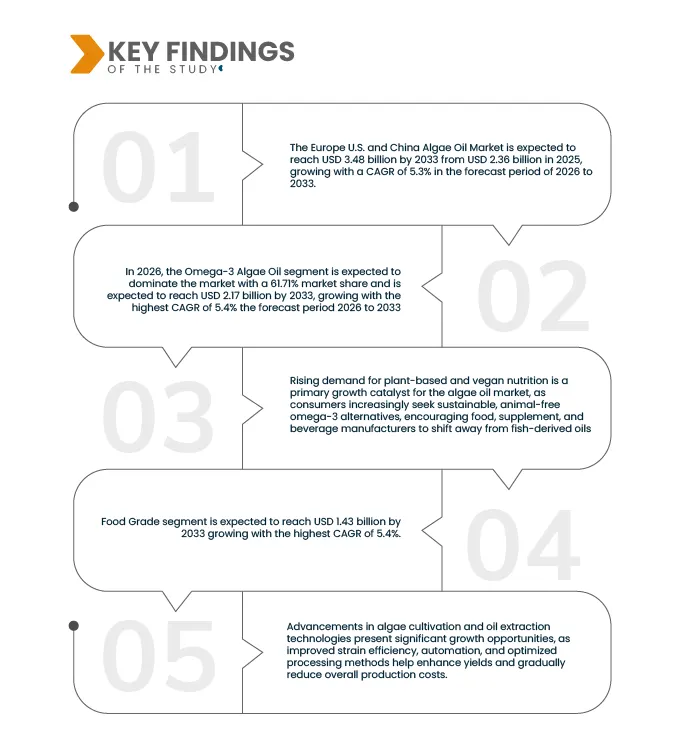
The Europe U.S. and China Algae Oil Market is expected to reach USD 3.48 billion by 2033 from USD 2.36 billion in 2025, growing with a CAGR of 5.3% in the forecast period of 2026 to 2033.
Key Findings of the Study
Growing Infant Formula Fortification Requirements
Growing Infant Formula Fortification Requirements is a key driver of the algae oil market across Europe, the U.S., and China, primarily due to the critical role of DHA in early-life nutrition. Regulatory authorities and pediatric health bodies across these regions increasingly emphasize the inclusion of docosahexaenoic acid (DHA) in infant formula to support brain development, visual acuity, and cognitive function during the first years of life. Algae oil has emerged as the preferred DHA source because it is a plant-based, contaminant-free, and highly consistent alternative to fish oil, aligning well with stringent safety standards for infant nutrition. In Europe, regulatory frameworks mandate DHA fortification in infant and follow-on formulas, directly driving steady demand for algae-derived DHA. In the U.S., strong parental awareness and premiumization of infant nutrition products encourage manufacturers to incorporate algae oil to differentiate formulations. Meanwhile, in China, heightened focus on infant health, strict quality controls, and increasing trust in scientifically validated ingredients have accelerated the adoption of algae oil in domestic and imported infant formula brands. Together, these factors make infant formula fortification a structurally strong and long-term demand driver for algae oil across all three regions.
Report Scope and Market Segmentation
|
Report Metric
|
Details
|
|
Forecast Period
|
2026 to 2033
|
|
Base Year
|
2025
|
|
Historic Years
|
2018-2024 (Customizable to 2013-2017)
|
|
Quantitative Units
|
Revenue in USD Million
|
|
Segments Covered
|
By Type (Omega-3 Algae Oil, Omega-6 Algae Oil, High Oleic Algae Oil, Protein-Rich Algae Oil, and Others [Palmitic, Lauric, etc.]), By Grade (Food Grade, Pharmaceutical Grade, Cosmetic Grade, and Industrial Grade), By Source (Microalgae, Macroalgae, Genetically Modified Algae, and Synthetic Algae Cultures), By Extraction Technology (Solvent Extraction, Supercritical CO₂ Extraction, Centrifugation, Enzymatic Extraction, Ultrasound-Assisted Extraction, and Other Advanced Technologies), By Application (Food & Beverages, Dietary Supplements, Pharmaceuticals, Animal Feed & Aquaculture, Cosmetics & Personal Care, Industrial Applications, and Others), By End User (Food & Beverage Manufacturers, Pharmaceutical Companies, Nutraceutical Companies, Animal Feed Producers, Cosmetic & Personal Care Companies, Industrial End Users, and Others), By Distribution Channel (Direct and Indirect), By Region/Country (Germany, United Kingdom, France, Italy, Spain, Netherlands, Switzerland, Belgium, and Rest of Europe, U.S., and China)
|
|
Countries Covered
|
India
|
|
Market Players Covered
|
|
|
Data Points Covered in the Report
|
In addition to the insights on market scenarios such as market value, growth rate, segmentation, geographical coverage, and major players, the market reports curated by the Data Bridge Market Research also include in-depth expert analysis, brand outlook, consumer buying behaviour, pricing analysis, vendor selection criteria among others.
|
Segment Analysis
The Europe U.S. and China Algae Oil Market is segmented into seven notable segments based on the type, grade, source, extraction technology, application, end user and distribution channel.
- On the basis of type, the Europe, U.S., and China Algae Oil Market is segmented into Omega-3 algae oil, Omega-6 algae oil, high oleic algae oil, protein-rich algae oil, and others (Palmitic, Lauric, etc.).
In 2026, the Omega-3 algae oil segment is anticipated to dominate the market
In 2026, the Omega-3 algae oil segment is anticipated to dominate the Europe, U.S., and China Algae Oil Market with 61.71% due to its widespread use in dietary supplements, infant nutrition, functional foods, and pharmaceutical applications, supported by strong consumer demand for plant-based omega-3 alternatives.
- On the basis of grade, the Europe, U.S., and China Algae Oil Market is segmented into food grade, pharmaceutical grade, cosmetic grade, and industrial grade.
In 2026, the food-grade segment is expected to dominate the market
In 2026, the food-grade segment is expected to dominate the market 40.79% due to increasing consumption of algae-based oils in dietary supplements, fortified foods, and infant nutrition, driven by rising health awareness and regulatory acceptance across key regions.
- On the basis of source, the Europe, U.S., and China Algae Oil Market is segmented into microalgae, macroalgae, genetically modified algae, and synthetic algae cultures.
In 2026, the microalgae segment is anticipated to hold the largest market
In 2026, the microalgae segment is anticipated to hold the largest market share 69.93% due to its high oil yield, consistent fatty acid profiles, scalability of cultivation, and widespread commercial adoption for omega-3 production.
- On the basis of extraction technology, the Europe, U.S., and China Algae Oil Market is segmented into solvent extraction, supercritical CO₂ extraction, centrifugation, enzymatic extraction, ultrasound-assisted extraction, and other advanced technologies
In 2026, the solvent extraction segment is expected to dominate the market
In 2026, the solvent extraction segment is expected to dominate the market with 50.06% due to its cost-effectiveness, high extraction efficiency, and established industrial-scale adoption across food, nutraceutical, and feed-grade algae oil production.
- On the basis of application, the Europe, U.S., and China Algae Oil Market is segmented into food and beverages, dietary supplements, pharmaceuticals, animal feed and aquaculture, cosmetics and personal care, industrial applications, and others.
In 2026, the dietary supplements segment is expected to dominate the market
In 2026, the dietary supplements segment is expected to dominate the market with 34.54% due to increasing consumer preference for preventive healthcare, growing demand for vegan omega-3 supplements, and strong sales through both offline and e-commerce channels.
- On the basis of end user, the Europe, U.S., and China Algae Oil Market is segmented into food and beverage manufacturers, pharmaceutical companies, nutraceutical companies, animal feed producers, cosmetic and personal care companies, industrial end users, and others.
In 2026, the nutraceutical companies’ segment is anticipated to dominate the market
In 2026, the nutraceutical companies’ segment is anticipated to dominate the market with 33.76% owing to the high incorporation of algae oil in dietary supplements, softgel capsules, and functional formulations, along with strong innovation activity and expanding consumer base across developed and emerging markets.
- On the basis of distribution channel, the Europe, U.S., and China Algae Oil Market is segmented into direct and indirect channels.
In 2026, the indirect distribution channel is expected to hold the largest share of the market
In 2026, the indirect distribution channel is expected to hold the largest share of the market with 64.31% due to its extensive reach, established supply networks, and increasing availability of algae oil–based products through retail and online platforms.
Major Players
DSM-Firmenich (Netherlands), ADM (United States), Corbion (Netherlands), Cargill (United States), and BASF (Germany)
Market Developments
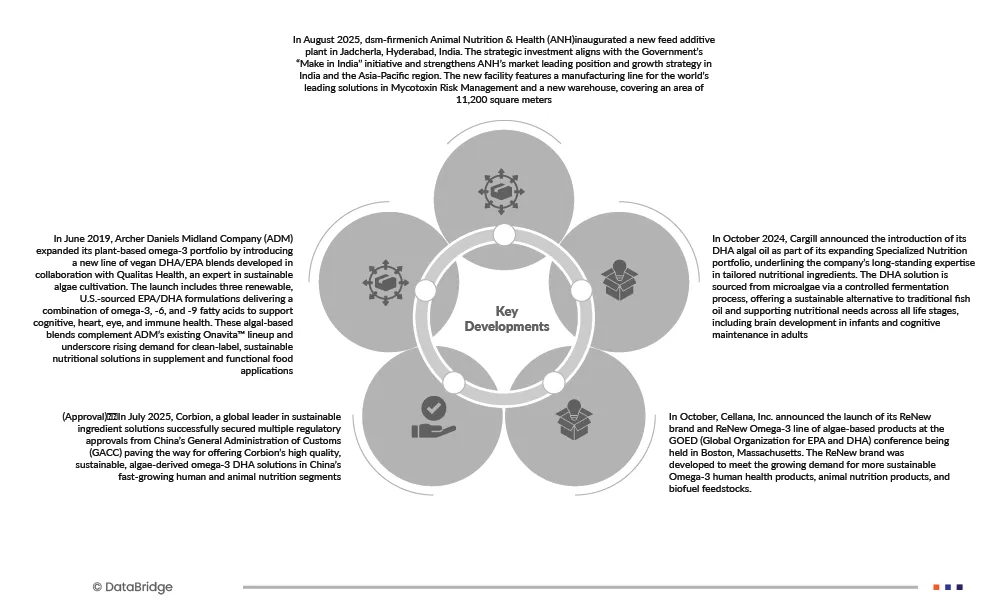
- In August 2025, dsm-firmenich Animal Nutrition & Health (ANH)inaugurated a new feed additive plant in Jadcherla, Hyderabad, India. The strategic investment aligns with the Government’s “Make in India” initiative and strengthens ANH’s market leading position and growth strategy in India and the Asia-Pacific region. The new facility features a manufacturing line for the world’s leading solutions in Mycotoxin Risk Management and a new warehouse, covering an area of 11,200 square meters.
- In June 2019, Archer Daniels Midland Company (ADM) expanded its plant-based omega-3 portfolio by introducing a new line of vegan DHA/EPA blends developed in collaboration with Qualitas Health, an expert in sustainable algae cultivation. The launch includes three renewable, U.S.-sourced EPA/DHA formulations delivering a combination of omega-3, -6, and -9 fatty acids to support cognitive, heart, eye, and immune health. These algal-based blends complement ADM’s existing Onavita™ lineup and underscore rising demand for clean-label, sustainable nutritional solutions in supplement and functional food applications.
- In July 2025, Corbion, a global leader in sustainable ingredient solutions successfully secured multiple regulatory approvals from China’s General Administration of Customs (GACC) paving the way for offering Corbion’s high quality, sustainable, algae-derived omega-3 DHA solutions in China’s fast-growing human and animal nutrition segments.
- In January 2026, Corbion, the sustainable food-ingredients company dedicated to preserving what matters, earned scores of A in Climate and A- in Water, as determined by CDP, a global non-profit that runs the world’s only independent environmental disclosure system.
- In October 2024, Cargill announced the introduction of its DHA algal oil as part of its expanding Specialized Nutrition portfolio, underlining the company’s long-standing expertise in tailored nutritional ingredients. The DHA solution is sourced from microalgae via a controlled fermentation process, offering a sustainable alternative to traditional fish oil and supporting nutritional needs across all life stages, including brain development in infants and cognitive maintenance in adults
As per Data Bridge Market Research analysis:
For more detailed information about the Europe U.S. and China Algae Oil Market report, click here – https://www.databridgemarketresearch.com/reports/europe-us-and-china-algae-oil-market