The global silk market is currently experiencing robust growth, significantly propelled by high government support for domestic silk production, particularly in key producing nations like India and China. Governments are increasingly recognizing the socio-economic importance of sericulture, which provides livelihoods to millions in rural areas and contributes to export revenues. This strategic backing, encompassing financial subsidies, technical training programs, research and development initiatives, and the establishment of dedicated silk boards, is fundamentally reshaping the industry. By fostering improved production quality, disease management, and market linkages, these policies empower farmers and reelers, leading to a more stable and efficient supply chain.
This ingrained governmental commitment makes the industry exceptionally resilient to external shocks and highly receptive to innovation and expansion, directly translating into a burgeoning supply and demand for silk across various applications globally.
Access Full Report @ https://www.databridgemarketresearch.com/reports/global-silk-market
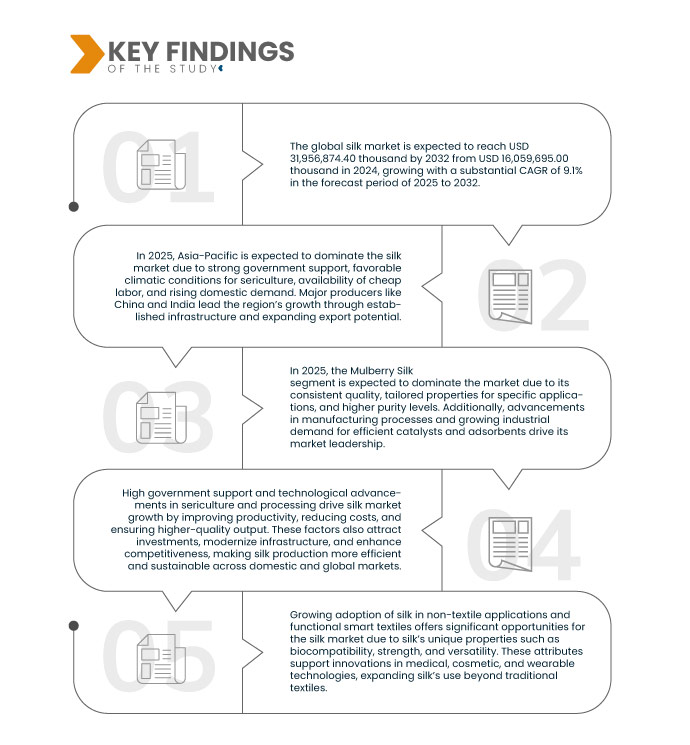
Data Bridge market research analyzes that the Global Silk Market is expected to reach USD 31,956,874.40 by 2032 from USD 16,059,695.00 in 2024, growing with a substantial CAGR of 9.1% in the forecast period of 2025 to 2032.
Key Findings of the Study
EXPANSION INTO EMERGING MARKETS & GROWING DISPOSABLE INCOME
The silk market is currently experiencing robust growth, significantly propelled by the expansion into emerging markets and growing disposable income, particularly in the burgeoning economies of Asia-Pacific. These influential demographic shifts, encompassing a rapidly expanding middle class and changing consumer aspirations, are fundamentally reshaping luxury and lifestyle trends. Unlike previous periods where luxury consumption was concentrated in developed nations, consumers in emerging markets are now characterized by increasing purchasing power, greater access to global trends through digital platforms, and a conscious pursuit of premium and high-quality goods. This ingrained demand makes them exceptionally receptive to high-quality natural products like silk, which align perfectly with their desire for luxury, status, and natural elegance, directly translating into a burgeoning demand for silk across various applications globally.
Based on the Instance above, it can be definitively concluded that expansion into emerging markets & growing disposable income is a primary and accelerating driver of the global silk market growth. This economic and demographic shift creates a larger consumer base with the financial capacity and desire for luxury products like silk, fostering increased demand globally..
Report Scope and Market Segmentation
|
Report Metric
|
Details
|
|
Forecast Period
|
2025 to 2032
|
|
Base Year
|
2024
|
|
Historic Years
|
2023 (Customizable to 2018-2022)
|
|
Quantitative Units
|
Revenue in USD
|
|
Segments Covered
|
By Type (Mulberry Silk, Tasar Silk/Wild Silk, Eri Silk, Spider Silk, Muga Silk, Anaphe Silk, Fagara Silk, Coan Silk, Mussel Silk, Sea Silk, Silk Charmeuse (Silk Satin), Chiffon Silk (Crepe Chiffon), Silk Dupioni (Duppioni Or Dupion), Silk Gauze, Fuji Silk, Silk Noil, Silk Shantung, Silk Organza, Silk Broadcloth, Silk Crepe, Habutai Silk / Habotai Silk, Silk Pongee and Others), Product Type (Raw Silk, Silk Yarns and Others), Weight (Light Weight, Medium Weight and Heavy Weight), By Ply (2 Ply, 3 Ply, 4 Ply and Others), Country Origin (Japan Silk, Indian Silk, Thailand Silk and Others), By Material (Pure Silk, Standard Silk and Blended Silk), By Production Process (Cocoon Production, Reeling, Throwing, Weaving, Dyeing and Others), End -User(Textile, Cosmetics, Medical and Others), Distribution Channel (Offline and Online)
|
|
Countries Covered
|
China, Japan, India, South Korea, Singapore, Thailand, Indonesia, Phillipines, Australia & New Zealand, Hong Kong, Taiwan, Vietnam, Uzbekistan, and Rest of Asia-Pacific, Germany, Italy, France, United Kingdom, Spain, Switzerland, Russia, Turkey, Belgium, Netherlands, Rest of Europe, U.S., Canada, Mexico, Brazil, Argentina, Rest of South America, South Africa, Egypt, Saudi Arabia, UAE, Israel, and Rest of Middle East and Africa
|
|
Market Players Covered
|
Anhui Bring Import & Export Trading Co., Ltd (China), Zhejiang Jiaxin Silk Corp., Ltd (China), SICHUAN NANCHONG LIUHE (GROUP) CO., LTD (China), Shengkun Silk Manufacturing Co., Ltd (China), Jinchengjiang Xinxing Silk Co., Ltd (China), Arun Yarns (India), WENSLI (China), Pratham Silks (India), LILYSILK (China), China National Silk Imp. & Exp. Wuxi Corp., Ltd. (China), ERIS GLOBAL LLP (India), NISHA SILK EXPORTS (India), Garima Silks (India), M. Jiju Silk Mills (India), STARLING SILK MILLS PVT. LTD. (India), Fishers Finery (USA), UNNATI SILK PRINTS PVT LTD (India), WUJIANG FIRST TEXTILE CO. LTD. (China), Orient Group (China)
|
|
Data Points Covered in the Report
|
In addition to the insights on market scenarios such as market value, growth rate, segmentation, geographical coverage, and major players, the market reports curated by the Data Bridge Market Research also include in-depth expert analysis, geographically represented company-wise production and capacity, network layouts of distributors and partners, detailed and updated price trend analysis and deficit analysis of supply chain and demand.
|
Segment Analysis
The global silk market is segmented into nine segments based on type, product type, weight, ply, country of origin, material, production process, end-user, distribution channel.
- On the basis of type, the market is segmented into Mulberry Silk, Tasar Silk/Wild Silk, Eri Silk, Muga Silk, Spider Silk, Anaphe Silk, Fagara Silk, Coan Silk, Mussel Silk, Sea Silk, Silk Charmeuse ( Silk Satin), Chiffon Silk (Crepe Chiffon), Silk Dupioni ( Duppioni Or Dupion), Silk Gauze, Fuji Silk, Silk Noil, Silk Shantung, Silk Organza, Silk Broadcloth, Silk Crepe, Habutai Silk / Habotai Silk, Silk Pongee, and Others.
In 2025, the Mulberry Silk segment is expected to dominate the market with a market
In 2025, the Mulberry Silk segment is expected to dominate the market with a 44.20% share due to its superior quality, smooth texture, strength, and widespread use in premium apparel and textile applications.
- On the basis of product type, the market is segmented into silk fabric, raw silk, silk yarns, silk waste, silk blends, degummed silk, and others.
In 2025, the silk fabric segment is expected to dominate the market
In 2025, the silk fabric segment is expected to dominate the market with a 31.53% share due to its luxurious feel, natural sheen, breathability, and high demand in fashion, interior décor, and traditional wear.
- On the basis of weight, the market is segmented into light weight, medium weight, and heavy weight.
In 2025, the light weight segment is expected to dominate the market
In 2025, the lightweight segment is expected to dominate the market with a 50.24% share due to its comfort, versatility, ease of layering, and increasing demand in summer clothing, activewear, and high-performance fashion and textile applications.
- On the basis of country of origin, the market is segmented into china silk, indian silk, japan silk, iran silk, thailand silk, and others.
In 2025, the china silk segment is expected to dominate the market
In 2025, the China silk segment is expected to dominate the market with a 59.07% share due to its rich heritage, large-scale production, superior quality, and strong global demand in textiles, fashion, and traditional garments.
- On the basis of material, the market is segmented into pure silk, blended silk, and standard silk.
In 2025, the pure silk segment is expected to dominate the market
In 2025, the pure silk segment is expected to dominate the market with a 71.44% share due to its premium quality, natural luster, durability, eco-friendliness, and high consumer preference in luxury fashion and traditional clothing.
- On the basis of production process, the market is segmented into cocoon production, reeling, weaving, dyeing, throwing, and others.
In 2025, the cocoon production segment is expected to dominate the market
In 2025, the cocoon production segment is expected to dominate the market with a 46.58% share due to increasing sericulture activities, government subsidies, and rising demand for raw silk. This stage is crucial for ensuring quality fiber output and supporting the entire silk value chain.
- On the basis of end-user, the market is segmented into textile, medical, and others.
In 2025, the textile segment is expected to dominate the market
In 2025, the textile segment is expected to dominate the market with a 75.83% share due to high demand for silk in apparel, home décor, and fashion industries, driven by its luxurious texture, breathability, and aesthetic appeal.
- On the basis of distribution channel, the market is segmented into offline, and online.
In 2025, the offline segment is expected to dominate the market
In 2025, the offline segment is expected to dominate the market with a 60.30% share due to consumer preference for physically inspecting fabric quality, experiencing texture firsthand, personalized customer service, immediate product availability, and trust in established retail outlets.
Major Players
Anhui Bring Import & Export Trading Co., Ltd (China), Zhejiang Jiaxin Silk Corp., Ltd (China), SICHUAN NANCHONG LIUHE (GROUP) CO., LTD (China), Shengkun Silk Manufacturing Co., Ltd (China), Jinchengjiang Xinxing Silk Co., Ltd (China), Arun Yarns (India), WENSLI (China), Pratham Silks (India), LILYSILK (China), China National Silk Imp. & Exp. Wuxi Corp., Ltd. (China), ERIS GLOBAL LLP (India), NISHA SILK EXPORTS (India), Garima Silks (India), M. Jiju Silk Mills (India), STARLING SILK MILLS PVT. LTD. (India), Fishers Finery (USA), UNNATI SILK PRINTS PVT LTD (India), WUJIANG FIRST TEXTILE CO. LTD. (China), Orient Group (China) among others as the major market players of the market.

Market Developments
- In August 2024, Wensli Group held the "Trendy Olympics: A Century of Silk Scarves" exhibition at Hangzhou Tower Shopping Center. This cultural event celebrated the Olympic spirit through silk artistry, blending modern design with traditional Chinese craftsmanship. It strengthened Wensli’s brand visibility, supported international cultural exchange, and showcased the company's innovation in themed product design, helping expand its global and domestic reach.
- In January 2024, Wensli Group was recognized as a national demonstration base for cultural and technological integration by China's Ministry of Industry and Information Technology and other governmental bodies. This acknowledgment highlighted Wensli's innovative use of Artificial Intelligence (AI) in silk design and production. The company's AI-driven design system, developed in collaboration with Wujie AI, boasts a database of over 500,000 patterns and more than 300 AI imaging algorithms. This system enables the creation of up to 100,000 unique silk scarf designs, facilitating rapid customization and efficient production. Additionally, Wensli has implemented eco-friendly digital machines that eliminate water usage in printing and dyeing processes, addressing environmental concerns in textile manufacturing.
- In Feburary 2025, Bolt Threads and Goddess Maintenance Co. have announced a USD 4 million annual partnership to integrate Bolt’s b-silk technology into a new biotech-powered beauty line. Launching Spring 2025 across 1,300+ U.S. retail locations via Sally Beauty, this collaboration marks a major milestone for sustainable, science-driven skincare, reinforcing Bolt’s position in the clean beauty market and expanding its reach.
- In October 2024, Bolt Projects Holdings expands its Vegan Silk Technology Platform with new product launches featuring b-silk, including Freaks of Nature sunscreens and upcoming color cosmetics. The company also teases the debut of xl-silk, its second proprietary ingredient. With more brand partnerships ahead, Bolt positions 2025 as a breakout year for sustainable, high-performance beauty innovation across haircare, skincare, and cosmetics.
- In January 2025, LILYSILK opened its first concept store in New York City, marking a key retail expansion. This move enhances brand visibility and customer engagement through a luxury, sustainable shopping experience. The store also supports eco-friendly initiatives, reinforcing the company’s commitment to sustainability.
As per Data Bridge Market Research analysis:
For more detailed information about the global silk market report, click here – https://www.databridgemarketresearch.com/reports/global-silk-market