


Asia-Pacific Tumor Ablation Market Size
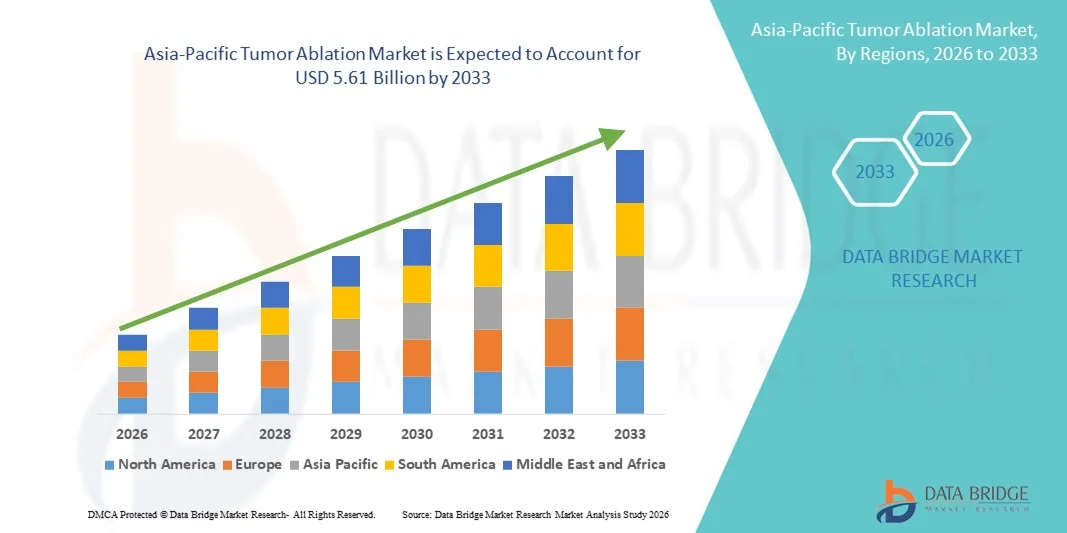
- The Asia-Pacific tumor ablation market size was valued at USD 2.36 billion in 2025 and is expected to reach USD 5.61 billion by 2033, at a CAGR of 11.45% during the forecast period
- The market growth is primarily driven by the rising prevalence of cancer across emerging and developed economies such as China, India, and Japan, coupled with increasing preference for minimally invasive treatment procedures
- Moreover, advancements in ablation technologies including radiofrequency, microwave, cryoablation, and high-intensity focused ultrasound (HIFU), along with expanding healthcare infrastructure and improving access to oncology care, are positioning tumor ablation as a cost-effective and efficient therapeutic option. These combined factors are significantly accelerating the adoption of tumor ablation systems across the Asia-Pacific region, thereby driving strong market growth
Asia-Pacific Tumor Ablation Market Analysis
- Tumor ablation procedures, which involve the localized destruction of cancerous tissues using minimally invasive techniques such as radiofrequency, microwave, cryoablation, and high-intensity focused ultrasound (HIFU), are increasingly becoming essential components of modern oncology treatment pathways across hospitals and specialty cancer centers due to their precision, shorter recovery times, and reduced complication rates
- The rising demand for tumor ablation is primarily driven by the increasing cancer burden, growing preference for minimally invasive therapies, expanding geriatric population, and continuous advancements in image-guided ablation technologies that enhance treatment accuracy and clinical outcomes
- China dominated the Asia-Pacific tumor ablation market with the largest revenue share of 38.4% in 2025, supported by a large oncology patient pool, rapid expansion of tertiary care hospitals, strong domestic medical device manufacturing capabilities, and increasing government initiatives aimed at strengthening cancer diagnosis and treatment infrastructure
- India is expected to be the fastest growing country in the Asia-Pacific tumor ablation market during the forecast period driven by rising cancer incidence, growing healthcare expenditure, improving access to advanced medical technologies, and expanding private hospital networks offering minimally invasive oncology procedures
- Radiofrequency ablation segment dominated the Asia-Pacific tumor ablation market with a market share of 41.7% in 2025, driven by its strong clinical validation, cost-effectiveness, widespread availability, and high adoption rates for treating liver, lung, kidney, and bone tumors across major hospitals and cancer care centers
Report Scope and Asia-Pacific Tumor Ablation Market Segmentation
|
Attributes |
Asia-Pacific Tumor Ablation Key Market Insights |
|
Segments Covered |
|
|
Countries Covered |
Asia-Pacific
|
|
Key Market Players |
|
|
Market Opportunities |
|
|
Value Added Data Infosets |
In addition to the insights on market scenarios such as market value, growth rate, segmentation, geographical coverage, and major players, the market reports curated by the Data Bridge Market Research also include in-depth expert analysis, patient epidemiology, pipeline analysis, pricing analysis, and regulatory framework |
Asia-Pacific Tumor Ablation Market Trends
Technological Advancements in Image-Guided and Minimally Invasive Ablation Systems
- A significant and accelerating trend in the Asia-Pacific tumor ablation market is the increasing integration of advanced imaging modalities and precision-guided navigation systems with ablation technologies, significantly enhancing procedural accuracy and clinical outcomes across oncology centers
- For instance, leading hospitals across China and Japan are adopting CT-, MRI-, and ultrasound-guided microwave and radiofrequency ablation systems to improve targeting accuracy and reduce damage to surrounding healthy tissues
- The integration of real-time imaging and temperature monitoring technologies enables physicians to precisely control ablation zones, minimize complications, and improve patient recovery times. For instance, advanced microwave ablation platforms now incorporate intelligent energy modulation features to ensure consistent tumor destruction while protecting adjacent organs
- The growing preference for minimally invasive oncology procedures is facilitating higher procedural volumes in tertiary hospitals and specialty cancer institutes, enabling shorter hospital stays and lower overall treatment costs compared to conventional surgical interventions
- This trend toward precision-driven, image-guided, and outpatient-compatible ablation therapies is reshaping cancer treatment pathways across Asia-Pacific. Consequently, medical device manufacturers are developing compact, high-efficiency ablation generators tailored for high-burden cancer markets
- The demand for technologically advanced tumor ablation systems is rising rapidly across both developed and emerging Asia-Pacific countries as healthcare providers increasingly prioritize precision, efficiency, and patient-centric cancer care
- Moreover, the growing adoption of robotic-assisted and AI-enabled ablation platforms is enhancing procedural consistency and reducing operator dependency, supporting broader acceptance among interventional oncology specialists
Asia-Pacific Tumor Ablation Market Dynamics
Driver
Increasing Cancer Burden and Expanding Healthcare Infrastructure
- The rising incidence of liver, lung, kidney, and bone cancers across Asia-Pacific, coupled with expanding healthcare infrastructure, is a major driver accelerating demand for tumor ablation procedures
- For instance, national cancer control initiatives in India are strengthening early diagnosis programs and expanding access to minimally invasive oncology treatments in public and private hospitals
- As cancer prevalence increases alongside aging populations, healthcare systems are actively adopting cost-effective and less invasive alternatives to open surgery, positioning tumor ablation as a preferred therapeutic approach for inoperable or high-risk patients
- Furthermore, increasing investments in tertiary care hospitals, oncology specialty centers, and medical device procurement are enabling broader adoption of advanced ablation systems across urban healthcare facilities
- The clinical benefits of reduced hospitalization time, minimal post-operative complications, and faster recovery are key factors propelling the use of ablation therapies in both public and private healthcare institutions. The growing availability of trained interventional radiologists and improved reimbursement structures further contribute to procedural growth
- Rising awareness regarding early-stage cancer detection and the expanding use of screening programs are increasing the eligible patient pool for localized ablation therapies
- Government initiatives aimed at strengthening domestic medical device manufacturing and reducing dependency on imports are supporting improved affordability and accessibility of tumor ablation systems
Restraint/Challenge
High Equipment Costs and Limited Skilled Expertise
- The high capital cost associated with advanced tumor ablation systems, including imaging-integrated platforms and disposable probes, presents a significant challenge to widespread adoption, particularly in lower-income healthcare settings
- For instance, smaller hospitals in emerging economies often face budget constraints that limit procurement of high-end microwave or cryoablation systems, restricting market penetration beyond metropolitan regions
- Addressing cost-related barriers through localized manufacturing, flexible pricing models, and government-supported procurement programs is critical for expanding accessibility. Companies are increasingly focusing on scalable and modular system designs to reduce upfront investment requirements
- In addition, the need for highly skilled interventional radiologists and specialized training for safe and effective ablation procedures limits rapid adoption in secondary and rural healthcare centers
- While awareness and training programs are gradually improving, disparities in technical expertise and infrastructure readiness continue to hinder uniform market expansion across Asia-Pacific
- Variability in reimbursement policies and limited insurance coverage for advanced ablation procedures in certain countries create financial uncertainties for both providers and patients
- Regulatory approval complexities and lengthy product evaluation timelines in some Asia-Pacific markets can delay the commercialization of next-generation ablation technologies, slowing innovation uptake
Asia-Pacific Tumor Ablation Market Scope
The market is segmented on the basis of type, cancer type, technology, mode of treatment, and end user.
- By Type
On the basis of type, the Asia-Pacific tumor ablation market is segmented into tumor ablation systems, image guidance products, and accessories. The tumor ablation systems segment dominated the market with the largest market revenue share in 2025, driven by high capital demand for radiofrequency, microwave, and cryoablation generators across tertiary hospitals. These systems form the core therapeutic component of ablation procedures and account for significant procurement investments in oncology centers. Increasing cancer incidence across countries such as China has further strengthened demand for advanced ablation platforms. Hospitals prioritize technologically advanced systems with integrated temperature monitoring and precision control features. Continuous product innovation and expansion of interventional oncology units are also contributing to segment dominance.
The image guidance products segment is anticipated to witness the fastest growth rate from 2026 to 2033, fueled by rising adoption of CT-, MRI-, and ultrasound-guided procedures. Accurate tumor localization and real-time monitoring significantly improve clinical outcomes and reduce recurrence rates. Growing emphasis on precision oncology and minimally invasive techniques is increasing demand for advanced navigation tools. Expanding installation of diagnostic imaging infrastructure across emerging economies is further supporting growth. In addition, integration of AI-enabled imaging software is enhancing procedural planning and boosting adoption rates.
- By Cancer Type
On the basis of cancer type, the market is segmented into liver cancer, brain cancer, lung cancer, bone cancer, kidney cancer, pancreatic cancer, breast cancer, and others. The liver cancer segment dominated the market in 2025 due to the high prevalence of hepatocellular carcinoma across Asia-Pacific, particularly in Japan and China. Tumor ablation is widely accepted as a first-line or adjunct therapy for early-stage liver tumors, especially for patients unsuitable for surgery. Strong clinical validation and favorable treatment outcomes have reinforced its widespread use. Increasing screening initiatives for hepatitis-related liver complications further expand the patient pool. The relatively lower procedural risk compared to surgical resection also supports segment leadership.
The lung cancer segment is projected to register the fastest growth during the forecast period, driven by rising smoking prevalence and growing air pollution levels in urban centers. Minimally invasive ablation offers a viable treatment option for inoperable lung tumors and elderly patients. Advancements in microwave ablation technology have improved treatment efficiency for pulmonary lesions. Expanding oncology infrastructure and early diagnostic capabilities are further accelerating growth. Increasing awareness of image-guided thoracic interventions also contributes to segment expansion.
- By Technology
On the basis of technology, the market is segmented into radiofrequency ablation, microwave ablation, cryoablation, and other technologies. The radiofrequency ablation segment dominated the market in 2025 with a market share of 41.7% owing to its long-standing clinical acceptance, cost-effectiveness, and broad application across multiple tumor types. It remains a preferred option in many hospitals due to its proven safety profile and established reimbursement pathways. The technology is widely utilized for liver, kidney, and bone tumor treatments. Availability of skilled professionals familiar with the technique further strengthens adoption. Continuous improvements in electrode design also sustain its market leadership.
The microwave ablation segment is expected to witness the fastest CAGR from 2026 to 2033, supported by its ability to generate higher intratumoral temperatures and treat larger tumors more efficiently. Microwave systems offer shorter procedure times and reduced heat-sink effects compared to traditional radiofrequency methods. Increasing investment in next-generation oncology equipment across Asia-Pacific hospitals is accelerating uptake. Growing clinical evidence supporting superior local tumor control is further driving demand. Technological advancements in generator portability and precision are also enhancing adoption.
- By Mode of Treatment
On the basis of mode of treatment, the market is segmented into percutaneous ablation, laparoscopic ablation, and surgical ablation. The percutaneous ablation segment dominated the market in 2025 due to its minimally invasive nature, shorter recovery times, and lower hospitalization costs. This approach is widely preferred for early-stage tumors and high-risk patients. Increased adoption of image-guided needle placement techniques enhances procedural precision. Hospitals favor percutaneous methods for their efficiency and reduced complication rates. Expanding outpatient oncology services further supports dominance.
The laparoscopic ablation segment is anticipated to grow at the fastest rate during the forecast period, driven by its suitability for tumors located in challenging anatomical regions. It provides better visualization than percutaneous methods while remaining less invasive than open surgery. Advancements in laparoscopic instruments and camera systems are improving clinical outcomes. Increasing surgeon expertise and training programs are supporting wider adoption. Rising patient preference for minimally invasive but controlled procedures also fuels growth.
- By End User
On the basis of end user, the market is segmented into hospitals, oncology clinics, and others. The hospitals segment dominated the Asia-Pacific tumor ablation market in 2025 due to the availability of advanced imaging infrastructure, skilled interventional radiologists, and comprehensive oncology departments. Large patient inflow and access to reimbursement systems further strengthen hospital-based procedures. Government investments in tertiary care expansion also support this dominance. Hospitals are primary centers for complex and multi-disciplinary cancer treatments. High procurement capacity for advanced ablation systems reinforces segment leadership.
The oncology clinics segment is expected to witness the fastest growth from 2026 to 2033, fueled by increasing decentralization of cancer care and expansion of specialized treatment centers. Clinics offer focused oncology services with shorter waiting times and cost-effective care pathways. Growing private healthcare investments across Asia-Pacific are strengthening clinic infrastructure. Rising demand for outpatient-based minimally invasive treatments further supports growth. In addition, partnerships between clinics and diagnostic centers are enhancing integrated cancer management solutions.
Asia-Pacific Tumor Ablation Market Regional Analysis
- China dominated the Asia-Pacific tumor ablation market with the largest revenue share of 38.4% in 2025, supported by a large oncology patient pool, rapid expansion of tertiary care hospitals, strong domestic medical device manufacturing capabilities, and increasing government initiatives aimed at strengthening cancer diagnosis and treatment infrastructure
- Healthcare providers in the country highly value the clinical precision, reduced recovery time, and cost-effectiveness offered by tumor ablation technologies compared to conventional surgical interventions
- This widespread adoption is further supported by growing healthcare expenditure, strong government-led cancer control programs, increasing availability of advanced imaging systems, and the expanding presence of domestic and international medical device manufacturers, establishing tumor ablation as a preferred localized cancer treatment solution
The China Tumor Ablation Market Insight
The China tumor ablation market captured the largest revenue share within Asia-Pacific in 2025, fueled by the country’s high cancer prevalence and expanding tertiary healthcare infrastructure. Hospitals are increasingly prioritizing minimally invasive oncology procedures to reduce hospitalization time and improve patient outcomes. The growing adoption of microwave and radiofrequency ablation technologies, supported by government-backed cancer control initiatives, is further propelling market expansion. Moreover, rising healthcare expenditure and strong domestic medical device manufacturing capabilities are significantly contributing to the market’s sustained growth trajectory.
Japan Tumor Ablation Market Insight
The Japan tumor ablation market is projected to expand at a substantial CAGR throughout the forecast period, primarily driven by an aging population and high incidence of liver and lung cancers. Advanced healthcare infrastructure and early adoption of precision-guided ablation technologies are fostering market development. Japanese healthcare providers emphasize minimally invasive and high-precision treatment modalities, accelerating integration of image-guided systems. Furthermore, supportive reimbursement policies and strong clinical research activities are reinforcing the country’s market growth.
India Tumor Ablation Market Insight
The India tumor ablation market is anticipated to grow at a noteworthy CAGR during the forecast period, driven by rising cancer incidence, improving diagnostic capabilities, and expanding private oncology networks. Increasing awareness regarding early-stage cancer treatment and minimally invasive procedures is encouraging hospitals to adopt advanced ablation systems. Government initiatives under national cancer programs and investments in healthcare infrastructure are supporting broader access to oncology services. In addition, the growing presence of cost-effective ablation technologies and skilled interventional radiologists is expected to further stimulate market growth.
South Korea Tumor Ablation Market Insight
The South Korea tumor ablation market is expected to expand at a considerable CAGR during the forecast period, fueled by advanced medical technology adoption and strong focus on innovation in oncology treatments. The country’s well-developed hospital infrastructure and high healthcare spending enable rapid integration of next-generation ablation platforms. Increasing clinical preference for image-guided minimally invasive therapies is strengthening procedural volumes. Moreover, ongoing research collaborations and expansion of specialized cancer centers are contributing to sustained market development.
Asia-Pacific Tumor Ablation Market Share
The Asia-Pacific Tumor Ablation industry is primarily led by well-established companies, including:
- Boston Scientific Corporation (U.S.)
- Medtronic (Ireland)
- AngioDynamics, Inc. (U.S.)
- Olympus Corporation (Japan)
- Stryker (U.S.)
- EDAP TMS S.A. (France)
- Hologic, Inc. (U.S.)
- Terumo Corporation (Japan)
- RF Medical Co., Ltd. (South Korea)
- IceCure Medical Ltd. (Israel)
- Merit Medical Systems, Inc. (U.S.)
- NeuWave Medical, Inc. (U.S.)
- SonaCare Medical, LLC (U.S.)
- Meril Life Sciences Pvt. Ltd. (India)
- Alpinion Medical Systems Co., Ltd. (South Korea)
- Profound Medical Inc. (Canada)
- Monteris Medical, Inc. (Canada)
- HealthTronics, Inc. (U.S.)
- STARmed Co., Ltd. (South Korea)
- MISONIX, Inc. (U.S.)
What are the Recent Developments in Asia-Pacific Tumor Ablation Market?
- In July 2025, Johnson & Johnson MedTech launched the VARIPULSE™ pulsed field ablation platform across Asia-Pacific for catheter ablation treatment of atrial fibrillation, marking a significant expansion of advanced ablation technology in the region’s interventional procedures. This system integrates pulsed field ablation with CARTO™ 3 electroanatomical mapping, enhancing precision and procedural outcomes
- In January 2024, Clinical Laserthermia Systems (CLS) received market approval for its entire TRANBERG® Thermal Therapy portfolio from the Health Sciences Authority (HSA) in Singapore, enabling commercialization of focal laser ablation systems for tumor treatment and signaling entry into the APAC oncology devices market
- In November 2023, IceCure Medical’s ProSense® cryoablation system received formal updated regulatory approval from India’s Central Drugs Standard Control Organization (CDSCO), aligning the technology with new regulatory requirements and supporting broader clinical adoption for cancer-related tumor ablation
- In November 2023, The ProSense® system in India updated regulatory status reinforced its commercial position in treating both benign and malignant tumors across multiple organs reflecting broader acceptance of minimally invasive cryoablation in major Asia-Pacific healthcare settings
- In May 2023, IceCure Medical completed the first installation of its ProSense® cryoablation system at Kovai Medical Center and Hospital in India, representing the first breast cancer cryoablation treatment offering in the country and expanding minimally invasive oncology options

- Interactive Data Analysis Dashboard
- Company Analysis Dashboard for high growth potential opportunities
- Research Analyst Access for customization & queries
- Competitor Analysis with Interactive dashboard
- Latest News, Updates & Trend analysis
- Harness the Power of Benchmark Analysis for Comprehensive Competitor Tracking
Data collection and base year analysis are done using data collection modules with large sample sizes. The stage includes obtaining market information or related data through various sources and strategies. It includes examining and planning all the data acquired from the past in advance. It likewise envelops the examination of information inconsistencies seen across different information sources. The market data is analysed and estimated using market statistical and coherent models. Also, market share analysis and key trend analysis are the major success factors in the market report. To know more, please request an analyst call or drop down your inquiry.
The key research methodology used by DBMR research team is data triangulation which involves data mining, analysis of the impact of data variables on the market and primary (industry expert) validation. Data models include Vendor Positioning Grid, Market Time Line Analysis, Market Overview and Guide, Company Positioning Grid, Patent Analysis, Pricing Analysis, Company Market Share Analysis, Standards of Measurement, Global versus Regional and Vendor Share Analysis. To know more about the research methodology, drop in an inquiry to speak to our industry experts.
Data Bridge Market Research is a leader in advanced formative research. We take pride in servicing our existing and new customers with data and analysis that match and suits their goal. The report can be customized to include price trend analysis of target brands understanding the market for additional countries (ask for the list of countries), clinical trial results data, literature review, refurbished market and product base analysis. Market analysis of target competitors can be analyzed from technology-based analysis to market portfolio strategies. We can add as many competitors that you require data about in the format and data style you are looking for. Our team of analysts can also provide you data in crude raw excel files pivot tables (Fact book) or can assist you in creating presentations from the data sets available in the report.













