


What is the Acute Myeloid Testing Market Size and Growth Rate?
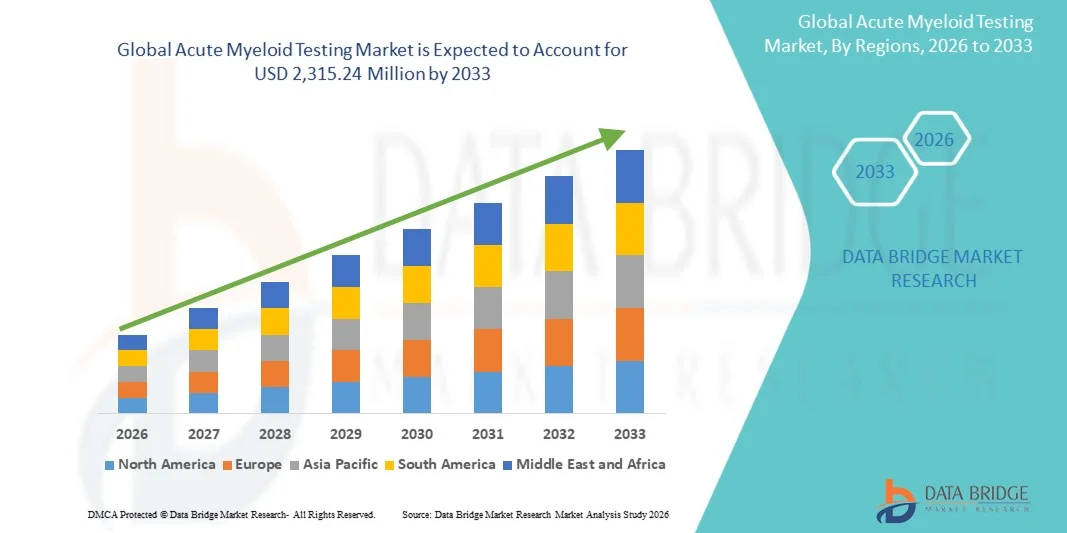
- As per Data Bridge Market Research Analysis the global acute myeloid testing market size was valued at USD 828.92 million in 2025 and is expected to reach USD 2,315.24 million by 2033, at a CAGR of 13.70% during the forecast period
- The market growth is largely fueled by the increasing prevalence of acute myeloid leukemia (AML) and advancements in molecular diagnostics, genetic profiling, and biomarker identification, enabling more precise and rapid testing
- Furthermore, rising demand from healthcare providers and research institutions for early detection, personalized treatment strategies, and improved patient outcomes is positioning acute myeloid testing as a critical component of modern hematology diagnostics. These converging factors are accelerating the adoption of AML testing solutions, thereby significantly boosting the industry's growth
Market Size & Forecast
- Global Market Value (2025): USD 828.92 million
- Expected Market Value (2033): USD 2,315.24 million
- Forecast CAGR (2026–2033): 13.70%
What are the Major Takeaways of Acute Myeloid Testing Market ?
- Acute myeloid testing, encompassing molecular, cytogenetic, and immunophenotyping assays for diagnosing and monitoring acute myeloid leukemia (AML), is increasingly essential in modern hematology and oncology care due to its ability to guide targeted therapies, risk stratification, and treatment monitoring in both clinical and research settings
- The escalating demand for acute myeloid testing is primarily driven by the rising prevalence of AML, growing awareness of early diagnosis benefits, and the increasing adoption of precision medicine approaches that rely on genetic and biomarker-based testing
- North America dominated the acute myeloid testing market with the largest revenue share of 38.7% in 2025, supported by advanced healthcare infrastructure, high adoption of molecular diagnostics, and the presence of leading diagnostic companies, with the U.S. witnessing substantial growth in AML testing due to investments in next-generation sequencing, personalized treatment strategies, and clinical trial expansion
- Asia-Pacific is expected to be the fastest growing region in the acute myeloid testing market during the forecast period due to increasing healthcare expenditure, expanding laboratory networks, and rising awareness of AML diagnosis and management
- Genetic AML biomarker segment dominated the acute myeloid testing market with a market share of 45.3% in 2025, driven by its critical role in identifying disease-causing mutations, guiding targeted therapies, and enabling early detection and prognosis of AML
Report Scope and Acute Myeloid Testing Market Segmentation
|
Attributes |
Acute Myeloid Testing Key Market Insights |
|
Segments Covered |
|
|
Countries Covered |
North America
Europe
Asia-Pacific
Middle East and Africa
South America
|
|
Key Market Players |
|
|
Market Opportunities |
|
|
Value Added Data Infosets |
In addition to the insights on market scenarios such as market value, growth rate, segmentation, geographical coverage, and major players, the market reports curated by the Data Bridge Market Research also include in-depth expert analysis, patient epidemiology, pipeline analysis, pricing analysis, and regulatory framework |
What is the Key Trend Acute Myeloid Testing Market?
“Advancements Through AI-Driven Diagnostics and NGS Integration”
- A significant and accelerating trend in the global acute myeloid testing market is the integration of artificial intelligence (AI) with next-generation sequencing (NGS) platforms, enabling more precise, rapid, and predictive AML diagnostics
- For instance, Sophia Genetics’ AI-powered platform analyzes genomic data to identify AML-associated mutations, assisting clinicians in selecting targeted therapies and predicting patient outcomes
- AI integration facilitates automated interpretation of complex genetic and biomarker profiles, reducing human error and improving diagnostic accuracy for personalized treatment strategies
- The incorporation of NGS and AI allows simultaneous detection of multiple genetic and epigenetic AML biomarkers, providing comprehensive disease insights from a single assay
- This trend towards more intelligent, data-driven, and integrative testing solutions is reshaping expectations for AML diagnostics, with companies such as Illumina developing AI-enabled platforms capable of rapid mutation profiling and predictive analytics
- Demand for AML testing solutions that combine AI, NGS, and biomarker analytics is increasing rapidly across both clinical and research settings, as healthcare providers aim for precise, personalized, and timely patient management
- Collaboration between diagnostic companies and pharmaceutical firms to co-develop companion diagnostics is creating new avenues for AI-driven AML testing, aligning diagnostics with emerging targeted therapies
Acute Myeloid Testing Market Dynamics
Driver
“Rising AML Prevalence and Precision Medicine Adoption”
- The increasing incidence of acute myeloid leukemia (AML), coupled with the growing adoption of precision medicine and targeted therapy approaches, is a major driver for the acute myeloid testing market
- For instance, in March 2025, Thermo Fisher Scientific expanded its Oncomine AML panel for NGS-based testing, improving detection of actionable mutations and supporting personalized therapy decisions
- As clinicians increasingly rely on biomarker-guided treatment plans, demand for molecular, genetic, and epigenetic AML testing is accelerating in hospitals, diagnostic labs, and research institutions
- Furthermore, rising awareness about the benefits of early detection, risk stratification, and minimal residual disease (MRD) monitoring is encouraging wider adoption of AML testing solutions
- The convenience and accuracy of advanced assays, combined with the ability to guide therapy selection and monitor treatment response, are propelling market growth across clinical and research applications
- Investments in advanced diagnostic infrastructure and expansion of laboratory networks further reinforce the market’s growth trajectory, making AML testing integral to modern oncology care
- For instance, partnerships between hospitals and diagnostic firms are facilitating the integration of AML testing into routine clinical workflows, enhancing early diagnosis and treatment planning
- Increasing government initiatives and funding for cancer genomics research are driving broader adoption of AML testing, particularly in public hospitals and research institutions
Restraint/Challenge
“High Costs and Regulatory Compliance Hurdles”
- The relatively high cost of advanced AML testing, coupled with stringent regulatory requirements, poses a significant challenge to broader market adoption
- For instance, delays in approval from regulatory bodies such as the FDA or EMA can slow the launch of new biomarker panels and assay kits, affecting market penetration
- Healthcare providers in developing regions may face budget constraints, limiting access to NGS-based or AI-driven AML diagnostics, while reimbursement policies remain inconsistent across countries
- Ensuring compliance with complex diagnostic regulations, data privacy laws, and laboratory standards is critical, requiring substantial investment in quality management and documentation
- While assay costs are gradually declining, the premium for high-throughput or multiplex testing can still restrict adoption among smaller clinics or research labs
- Overcoming these challenges through cost reduction strategies, regulatory harmonization, and broader insurance coverage will be vital for sustained market expansion
- For instance, the lack of standardized protocols across laboratories can lead to variability in test results, reducing clinician confidence and limiting adoption
- Shortages of skilled molecular diagnostic professionals in emerging markets further constrain the rapid deployment of AML testing solutions, highlighting the need for specialized training programs
How is the Acute Myeloid Testing Market Segmented ?
The market is segmented on the basis of biomarker type, product and service, technology, and end user.
- By Biomarker Type
On the basis of biomarker type, the acute myeloid testing market is segmented into genetic AML biomarker, epigenetic AML biomarker, and proteomic AML biomarker. The genetic AML biomarker segment dominated the market with the largest market revenue share of 45.3% in 2025, driven by its critical role in identifying disease-causing mutations and guiding targeted therapies. Genetic biomarkers such as FLT3, NPM1, and CEBPA mutations are widely used for risk stratification and therapy selection, making them a cornerstone of AML diagnostics. The high sensitivity, reproducibility, and clinical relevance of genetic biomarkers have made them the preferred choice for routine AML testing. In addition, ongoing advancements in next-generation sequencing (NGS) platforms have further enhanced the detection and interpretation of genetic AML biomarkers, supporting early diagnosis and personalized treatment strategies.
The epigenetic AML biomarker segment is expected to witness the fastest growth rate from 2026 to 2033 due to increasing research focus on DNA methylation and histone modification patterns for AML prognosis and therapy response monitoring. Epigenetic biomarkers provide insights into disease progression and treatment efficacy, complementing genetic data for a more comprehensive understanding of AML. Rising adoption in clinical trials and research settings, coupled with technological improvements in methylation-specific PCR and sequencing, is fueling their rapid uptake in both diagnostic and therapeutic applications.
- By Product and Service
On the basis of product and service, the acute myeloid testing market is segmented into assay kits and services. The assay kits segment dominated the market in 2025 due to the convenience of standardized testing, ease of use in clinical laboratories, and compatibility with high-throughput molecular diagnostic platforms. Assay kits for PCR, NGS, and immunophenotyping allow rapid detection of AML-specific biomarkers with consistent quality, facilitating routine testing and large-scale screening. The availability of pre-validated kits from leading companies ensures reliability, accuracy, and regulatory compliance, driving widespread adoption.
The services segment is expected to witness the fastest growth from 2026 to 2033 as hospitals, research institutions, and specialized diagnostic centers increasingly outsource complex AML testing procedures. Service-based models offer access to advanced technologies without the need for in-house infrastructure, including NGS, cytogenetics, and bioinformatics analysis. The flexibility, scalability, and cost-effectiveness of AML testing services make them highly attractive for academic research, clinical trials, and hospitals in emerging regions.
- By Technology
On the basis of technology, the acute myeloid testing market is segmented into PCR, IHC, NGS, cytogenetics, and others. The NGS segment dominated the market with the largest revenue share in 2025 due to its high-throughput capability, precision in detecting multiple mutations simultaneously, and growing adoption in personalized medicine. NGS platforms allow comprehensive genomic profiling of AML patients, enabling risk stratification, minimal residual disease (MRD) monitoring, and therapy guidance. Continuous technological advancements and decreasing costs of sequencing have further driven the adoption of NGS in clinical and research laboratories worldwide.
The PCR segment is expected to witness the fastest CAGR from 2026 to 2033, fueled by its cost-effectiveness, rapid turnaround time, and suitability for targeted mutation detection. PCR-based AML assays are particularly useful for routine diagnostics, MRD monitoring, and confirmation of known genetic mutations. Their compatibility with existing laboratory infrastructure, ease of automation, and reliability make PCR a preferred choice in both emerging and developed markets.
- By End User
On the basis of end user, the acute myeloid testing market is segmented into clinical laboratories, hospitals, academic and research institutes, cancer diagnostic institutes, and others. The hospitals segment dominated the market with the largest revenue share in 2025 due to the increasing integration of AML testing into routine patient care and personalized therapy programs. Hospitals benefit from on-site testing capabilities and immediate access to results, allowing clinicians to make timely treatment decisions. Rising awareness among healthcare providers and patients about early AML detection further drives adoption in hospitals.
The academic and research institutes segment is expected to witness the fastest growth from 2026 to 2033, supported by expanding AML research programs, clinical trials, and collaborations with diagnostic companies. These institutions increasingly rely on advanced testing technologies such as NGS, cytogenetics, and bioinformatics for disease modeling, drug development, and biomarker discovery. Growing government funding for hematology research and genomics projects also accelerates the adoption of AML testing in academic settings.
Which Region Holds the Acute Myeloid Testing Market ?
- North America dominated the acute myeloid testing market with the largest revenue share of 38.7% in 2025, supported by advanced healthcare infrastructure, high adoption of molecular diagnostics, and the presence of leading diagnostic companies
- Healthcare providers in the region prioritize early diagnosis, risk stratification, and personalized treatment plans, leveraging AML testing for more precise therapy selection and improved patient outcomes
- This strong adoption is further supported by advanced healthcare infrastructure, high R&D investment, and the presence of key diagnostic companies, establishing AML testing as a standard component of clinical care in hospitals, research institutes, and specialized laboratories
U.S. Acute Myeloid Testing Market Insight
The U.S. acute myeloid testing market captured the largest revenue share of 82% in 2025 within North America, fueled by the rising incidence of AML and the widespread adoption of advanced molecular, genetic, and biomarker-based diagnostics. Healthcare providers are prioritizing early detection, minimal residual disease (MRD) monitoring, and personalized treatment approaches, leveraging technologies such as NGS, PCR, and cytogenetics. The growing preference for hospital-based and specialized testing services, combined with robust demand for companion diagnostics and AI-driven data analysis, further propels the AML testing industry. Moreover, continuous investments in precision medicine, clinical trial expansions, and R&D for targeted therapies are significantly contributing to market growth. Collaborative initiatives between diagnostic companies and pharmaceutical firms are also enhancing the adoption of AML testing in routine clinical care.
Europe Acute Myeloid Testing Market Insight
The Europe acute myeloid testing market is projected to expand at a substantial CAGR throughout the forecast period, primarily driven by rising AML prevalence, increasing awareness of early diagnosis, and stringent healthcare regulations. Adoption of advanced diagnostic technologies, including NGS and PCR-based assays, is being supported by urbanized healthcare infrastructure and government programs promoting cancer diagnostics. European hospitals, research institutes, and specialized diagnostic laboratories are increasingly integrating AML testing into clinical workflows to support personalized therapy decisions. Rising participation in multicenter trials and academic research is further enhancing the market. Patients and providers are increasingly favoring early detection and risk stratification approaches, which are fueling adoption across residential, commercial, and institutional healthcare settings.
U.K. Acute Myeloid Testing Market Insight
The U.K. acute myeloid testing market is anticipated to grow at a noteworthy CAGR during the forecast period, driven by increasing AML awareness, rising demand for biomarker-guided therapies, and integration of precision medicine in hospitals. Concerns regarding treatment efficacy, patient survival rates, and early detection are encouraging hospitals, diagnostic labs, and oncology centers to adopt advanced AML testing solutions. The UK’s robust healthcare system, strong clinical research networks, and supportive government policies facilitate the rapid uptake of testing services and assay kits. Adoption is further supported by an emphasis on early diagnosis, personalized therapy monitoring, and clinical trial participation. The growing integration of NGS and AI-based analysis platforms is also driving market expansion.
Germany Acute Myeloid Testing Market Insight
The Germany acute myeloid testing market is expected to expand at a considerable CAGR during the forecast period, fueled by well-developed healthcare infrastructure, strong focus on personalized oncology, and increasing awareness of AML management. Germany’s healthcare providers emphasize molecular and genetic AML testing for early diagnosis, risk assessment, and treatment selection. The integration of AML diagnostics into hospital workflows, along with participation in multicenter research trials, supports consistent demand. In addition, the country’s focus on innovation, precision medicine, and adherence to stringent regulatory standards promotes adoption of high-quality, validated biomarker assays. The preference for reliable, privacy-focused, and technologically advanced testing solutions further strengthens market growth in both clinical and research settings.
Asia-Pacific Acute Myeloid Testing Market Insight
The Asia-Pacific acute myeloid testing market is poised to grow at the fastest CAGR of 23% during the forecast period of 2026 to 2033, driven by increasing AML incidence, improving healthcare infrastructure, and rising awareness in countries such as China, Japan, and India. Growing government initiatives promoting cancer diagnostics, digital health, and precision medicine are supporting the adoption of advanced testing technologies. Hospitals, academic institutions, and research centers are increasingly deploying NGS, PCR, and cytogenetic assays for AML diagnosis, therapy guidance, and disease monitoring. Moreover, APAC’s emergence as a hub for diagnostic technology development and testing services improves accessibility and affordability of AML testing, broadening the patient base. Rising disposable incomes, urbanization, and awareness campaigns are further driving adoption across both private and public healthcare segments.
Japan Acute Myeloid Testing Market Insight
The Japan acute myeloid testing market is gaining momentum due to the country’s highly advanced healthcare system, growing AML awareness, and focus on precision oncology. Hospitals and research institutions prioritize early detection and comprehensive genetic profiling to guide treatment decisions and monitor therapy outcomes. Integration of AI-enabled platforms and NGS-based diagnostics is increasing the efficiency, speed, and accuracy of AML testing. The aging population in Japan is also driving demand for user-friendly, reliable, and timely AML diagnostic solutions. Furthermore, government programs supporting cancer research and preventive care, combined with high patient awareness, are accelerating adoption in both residential clinical and hospital-based settings.
India Acute Myeloid Testing Market Insight
The India acute myeloid testing market accounted for the largest market revenue share in Asia-Pacific in 2025, attributed to expanding healthcare infrastructure, a growing middle class, and rising awareness of hematological cancers. Hospitals, diagnostic laboratories, and research centers are increasingly adopting molecular diagnostics and biomarker-based AML testing. Government initiatives promoting early cancer detection, smart healthcare solutions, and affordable diagnostics are accelerating adoption. India’s domestic diagnostic service providers, along with partnerships with international technology firms, are improving accessibility and affordability of AML testing. Rapid urbanization, increased disposable incomes, and rising awareness of personalized therapy benefits are key factors driving market growth across residential, commercial, and institutional healthcare applications.
Which are the Top Companies in Acute Myeloid Testing Market ?
Acute Myeloid Testing industry is primarily led by well-established companies, including:
- Thermo Fisher Scientific Inc. (U.S.)
- Illumina, Inc. (U.S.)
- QIAGEN (Netherlands)
- Abbott (U.S.)
- F. Hoffmann‑La Roche Ltd (Switzerland)
- Bio‑Rad Laboratories, Inc. (U.S.)
- Agilent Technologies, Inc. (U.S.)
- NeoGenomics Laboratories, Inc. (U.S.)
- Danaher (U.S.)
- Cepheid (U.S.)
- Guardant Health, Inc. (U.S.)
- BIOMÉRIEUX (France)
- Sysmex Corporation (Japan)
- ArcherDX, Inc. (U.S.)
- Cancer Genetics, Inc. (U.S.)
- Epigenomics AG (Germany)
- SkylineDX B.V. (Netherlands)
- Precipio, Inc. (U.S.)
- BD (U.S.)
- PerkinElmer, Inc. (U.S.)
What are Latest Developments in Acute Myeloid Testing Market ?
- In November 2025, innovative diagnostic research was highlighted at AMP 2025, where advanced genetic and RNA‑based fusion testing methods were unveiled that improve detection of hidden gene fusions and minimal residual disease in AML, offering more accurate and sensitive diagnostic insights
- In November 2025, new real‑world genomic profiling data was presented by NeoGenomics at ASH 2025, showing how comprehensive genomic profiling (CGP) panels can refine AML diagnosis by detecting actionable fusions and mutations that may otherwise be missed, aiding treatment decisions
- In June 2025, a quality improvement project was published enhancing AML genomic testing efficiency, where a flow cytometry‑triggered genomic testing algorithm and automated workflows significantly reduced turnaround times for key AML diagnostics, supporting faster treatment decisions and personalized therapy
- In October 2024, NeoGenomics launched its “AML Express” next‑generation sequencing (NGS) assay, designed to provide rapid and comprehensive genetic profiling for patients with acute myeloid leukemia, delivering results in 3–4 days to help clinicians make quicker treatment decisions and improve personalized care
- In May 2023, Sysmex Corporation introduced its Clinical Flow Cytometry System, combining advanced automated flow cytometry with sample preparation and reagents, enhancing the efficiency and standardization of leukemia diagnostic workflows in clinical labs worldwide

- Interactive Data Analysis Dashboard
- Company Analysis Dashboard for high growth potential opportunities
- Research Analyst Access for customization & queries
- Competitor Analysis with Interactive dashboard
- Latest News, Updates & Trend analysis
- Harness the Power of Benchmark Analysis for Comprehensive Competitor Tracking
Data collection and base year analysis are done using data collection modules with large sample sizes. The stage includes obtaining market information or related data through various sources and strategies. It includes examining and planning all the data acquired from the past in advance. It likewise envelops the examination of information inconsistencies seen across different information sources. The market data is analysed and estimated using market statistical and coherent models. Also, market share analysis and key trend analysis are the major success factors in the market report. To know more, please request an analyst call or drop down your inquiry.
The key research methodology used by DBMR research team is data triangulation which involves data mining, analysis of the impact of data variables on the market and primary (industry expert) validation. Data models include Vendor Positioning Grid, Market Time Line Analysis, Market Overview and Guide, Company Positioning Grid, Patent Analysis, Pricing Analysis, Company Market Share Analysis, Standards of Measurement, Global versus Regional and Vendor Share Analysis. To know more about the research methodology, drop in an inquiry to speak to our industry experts.
Data Bridge Market Research is a leader in advanced formative research. We take pride in servicing our existing and new customers with data and analysis that match and suits their goal. The report can be customized to include price trend analysis of target brands understanding the market for additional countries (ask for the list of countries), clinical trial results data, literature review, refurbished market and product base analysis. Market analysis of target competitors can be analyzed from technology-based analysis to market portfolio strategies. We can add as many competitors that you require data about in the format and data style you are looking for. Our team of analysts can also provide you data in crude raw excel files pivot tables (Fact book) or can assist you in creating presentations from the data sets available in the report.













