Global Automotive Air Purifier Market Segmentation, By Type (Purifier, Ionizer, and Hybrid), Technology (HEPA, Activated Carbon, Ionic Filter, and Photocatalytic), Vehicle Class (Economy, Mid-Priced, and Luxury), End Market (OE and Aftermarket) - Industry Trends and Forecast to 2032
Automotive Air Purifier Market Analysis
The automotive air purifier market is experiencing significant growth, driven by increasing consumer awareness of in-car air quality and rising pollution levels. With concerns over airborne contaminants, allergens, and harmful gases, vehicle manufacturers and aftermarket suppliers are focusing on advanced air purification technologies. The market is further supported by stringent government regulations on vehicle emissions and air quality standards, pushing automakers to integrate high-efficiency filtration systems. Technological advancements are transforming the automotive air purifier industry. High-Efficiency Particulate Air (HEPA) filters, activated carbon filtration, ionizers, and photocatalytic purification are gaining traction for their ability to remove pollutants effectively. Smart air purifiers with real-time air quality monitoring and AI-powered filtration systems are becoming popular in modern vehicles. In addition, electric vehicles (EVs) and luxury car manufacturers are incorporating built-in air purification systems as a premium feature.
Automotive Air Purifier Market Size
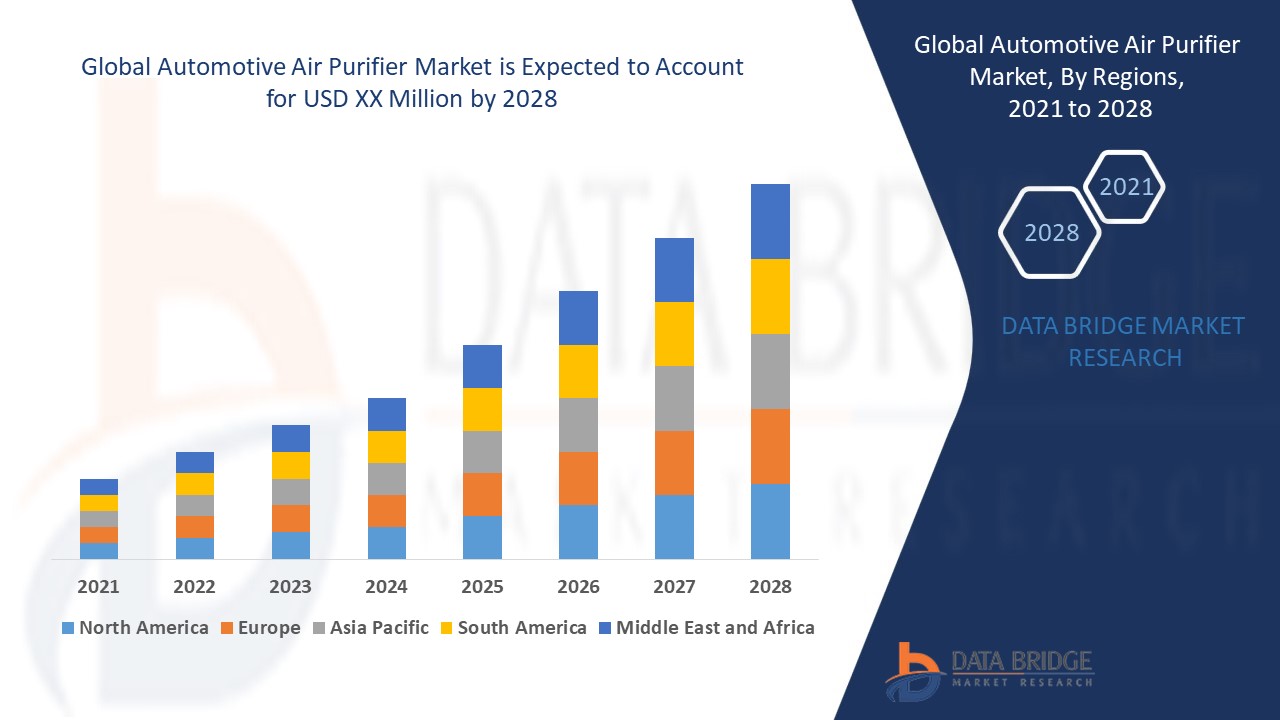
The global automotive air purifier market size was valued at USD 3.97 billion in 2024 and is projected to reach USD 29.14 billion by 2032, with a CAGR of 28.26% during the forecast period of 2025 to 2032. In addition to the market insights such as market value, growth rate, market segments, geographical coverage, market players, and market scenario, the market report curated by the Data Bridge Market Research team includes in-depth expert analysis, import/export analysis, pricing analysis, production consumption analysis, and pestle analysis.
Automotive Air Purifier Market Trends
“Integration of Smart Air Purification Systems”
The automotive air purifier market is witnessing rapid growth, driven by increasing consumer demand for in-vehicle air quality solutions amid rising pollution levels. A key trend shaping the market is the integration of smart air purification systems equipped with real-time air quality monitoring and AI-powered filtration technology. Automakers are increasingly incorporating HEPA filters, activated carbon filters, and ionizers to enhance cabin air quality, especially in electric vehicles (EVs) and premium models. For instance, Tesla’s "Bioweapon Defense Mode" in the Model X and Model S utilizes a hospital-grade HEPA filtration system to remove airborne contaminants effectively. Similarly, Mercedes-Benz’s Energizing Air Control system monitors air quality and automatically adjusts purification settings. With the growing emphasis on passenger health and comfort, smart air purification technologies are becoming a key differentiator in vehicle design, making them a crucial component in next-generation automotive air purifiers.
Report Scope and Automotive Air Purifier Market Segmentation
Attributes
Automotive Air Purifier Key Market Insights
Segments Covered
By Type: Purifier, Ionizer, and Hybrid
By Technology: HEPA, Activated Carbon, Ionic Filter, and Photocatalytic
By Vehicle Class: Economy, Mid-Priced, and Luxury
By End Market: OEM and Aftermarket
Countries Covered
U.S., Canada and Mexico in North America, Germany, France, U.K., Netherlands, Switzerland, Belgium, Russia, Italy, Spain, Turkey, Rest of Europe in Europe, China, Japan, India, South Korea, Singapore, Malaysia, Australia, Thailand, Indonesia, Philippines, Rest of Asia-Pacific (APAC) in the Asia-Pacific (APAC), Saudi Arabia, U.A.E., South Africa, Egypt, Israel, Rest of Middle East and Africa (MEA) as a part of Middle East and Africa (MEA), Brazil, Argentina and Rest of South America as part of South America
Key Market Players
DENSO CORPORATION (Japan), Ecomventures Pty Ltd (Australia), 3M (U.S.), Robert Bosch GmbH (Germany), Eureka Forbes (India), Freudenberg SE (Germany), Honeywell International Inc. (U.S.), Koninklijke Philips N.V. (Netherlands), MAHLE GmbH (Germany), MANN+HUMMEL (Germany), Panasonic Corporation (Japan), SHARP CORPORATION (Japan), TOYOTA BOSHOKU CORPORATION (Japan), Xiamen Airbus Electronic Technology Co., Ltd. (China), IQAir (Switzerland), Olansi Healthcare Co., Ltd. (China), Oransi (U.S.), and YADU Int'l Technology (Beijing) Co., Ltd. (China)
Market Opportunities
Increasing Technological Advancements
Rising Demand for Electric and Luxury Vehicles
Value Added Data Infosets
In addition to the market insights such as market value, growth rate, market segments, geographical coverage, market players, and market scenario, the market report curated by the Data Bridge Market Research team includes in-depth expert analysis, import/export analysis, pricing analysis, production consumption analysis, and pestle analysis.
Automotive Air Purifier Market Definition
An automotive air purifier is a device designed to improve in-vehicle air quality by removing airborne contaminants such as dust, pollen, allergens, bacteria, viruses, smoke, and harmful gases. These purifiers utilize various filtration technologies, including HEPA filters, activated carbon filters, ionizers, and photocatalytic oxidation, to effectively cleanse the air inside a vehicle’s cabin
Automotive Air Purifier Market Dynamics
Drivers
Rising Air Pollution Levels
The increasing pollution caused by vehicle emissions, industrial activities, and urbanization has significantly impacted air quality, leading to a heightened demand for in-vehicle air purification systems. Urban centers, especially in countries such as India and China, experience severe air pollution and smog, which can penetrate vehicle cabins, exposing passengers to harmful pollutants such as PM2.5, nitrogen oxides (NOx), and volatile organic compounds (VOCs). This growing concern has prompted automakers to integrate advanced air filtration systems to enhance passenger safety. For instance, Tesla’s Bioweapon Defense Mode, equipped with a hospital-grade HEPA filtration system, effectively removes airborne contaminants, ensuring cleaner in-cabin air. As air pollution worsens globally, the demand for automotive air purifiers is expected to rise, making it a crucial market driver.
Growing Health Awareness
Consumers are becoming increasingly aware of the adverse health effects of airborne contaminants, such as allergens, bacteria, viruses, and mold spores, especially after the COVID-19 pandemic. Prolonged exposure to poor air quality inside vehicles can lead to respiratory issues, allergies, and reduced driver concentration, impacting both comfort and safety. This rising health consciousness has led to a surge in demand for automotive air purifiers, particularly those equipped with HEPA filters, activated carbon filters, and ionizers to eliminate harmful particles. For instance, Mercedes-Benz’s Energizing Air Control system actively monitors air quality and adjusts purification levels automatically, offering enhanced protection to passengers. As more consumers prioritize health and wellness, automakers and aftermarket players are introducing smart air purification technologies, further driving the growth of the automotive air purifier market.
Opportunities
Increasing Technological Advancements
Innovations in air purification technology are significantly enhancing the efficiency and appeal of automotive air purifiers, creating new market opportunities. Advanced HEPA filters, capable of capturing 99.97% of airborne particles, are now widely used to remove dust, pollen, and fine particulate matter (PM2.5 and PM10) from vehicle cabins. In addition, activated carbon filters are being integrated to neutralize odors, smoke, and harmful gases, providing a more comfortable driving experience. The use of ionizers and photocatalytic oxidation technology further enhances air purification by eliminating bacteria, viruses, and VOCs. A notable instance is Panasonic’s nanoe X technology, which uses hydroxyl radicals to inhibit airborne pollutants, now incorporated into Toyota and Lexus vehicles. Furthermore, smart air quality monitoring systems with real-time pollution detection allow drivers to track in-cabin air quality and adjust settings accordingly. As consumers seek high-performance, tech-driven solutions, these advancements present a lucrative opportunity for automakers and aftermarket players to differentiate their products and capture a growing market segment.
Rising Demand for Electric and Luxury Vehicles
The increasing adoption of electric vehicles (EVs) and luxury cars is driving demand for built-in automotive air purification systems, creating a key growth opportunity for the market. Luxury automakers such as Mercedes-Benz, BMW, and Audi are equipping their high-end models with advanced cabin air filtration systems to offer premium comfort and safety. For instance, the Mercedes-Benz EQS features an advanced HEPA filtration system, ensuring superior air quality for passengers. Similarly, Tesla’s Bioweapon Defense Mode in the Model S and Model X has set a new benchmark for in-car air purification by effectively filtering particulate matter, allergens, and hazardous gases. With governments worldwide promoting EV adoption and consumers willing to invest in high-tech vehicle features, integrating next-generation air purifiers into EVs and luxury cars represents a significant market opportunity for automakers to enhance vehicle appeal and increase customer satisfaction.
Restraints/Challenges
High Cost of Advanced Air Purification Systems
The integration of HEPA filters, activated carbon filters, and ionizers in vehicles significantly raises manufacturing costs, making automotive air purifiers less accessible for budget-friendly and mid-range cars. High-quality air purification systems require multi-stage filtration and smart monitoring technologies, which increase production expenses and, in turn, vehicle pricing. This cost barrier is particularly evident in price-sensitive regions such as India, Southeast Asia, and parts of Africa, where affordability is a key concern for car buyers. For instance, while luxury brands such as Tesla, Mercedes-Benz, and BMW offer built-in air purification systems, mainstream automakers hesitate to include such features in economy-class vehicles due to cost constraints. As a result, the adoption of high-efficiency automotive air purifiers remains largely limited to premium and electric vehicles (EVs), posing a major market challenge in achieving widespread accessibility and affordability.
Competition from Alternative Technologies
The growing adoption of electric vehicles (EVs) and next-generation HVAC systems is reducing reliance on aftermarket automotive air purifiers, creating a significant market challenge for standalone air purification products. Modern EVs and high-end vehicles are being designed with advanced ventilation systems that feature built-in air filtration, climate control, and cabin air circulation enhancements, making separate air purifiers less necessary. For instance, Lucid Air and Tesla vehicles are equipped with high-performance filtration systems capable of removing fine particles and harmful gases without the need for external purifiers. Similarly, automakers such as Volvo and Audi are investing in intelligent air purification solutions integrated directly into the car’s HVAC system. As automotive climate control technology continues to advance, the demand for standalone air purifiers may decline, posing a long-term challenge for aftermarket players and slowing market growth in certain vehicle segments.
This market report provides details of new recent developments, trade regulations, import-export analysis, production analysis, value chain optimization, market share, impact of domestic and localized market players, analyses opportunities in terms of emerging revenue pockets, changes in market regulations, strategic market growth analysis, market size, category market growths, application niches and dominance, product approvals, product launches, geographic expansions, technological innovations in the market. To gain more info on the market contact Data Bridge Market Research for an Analyst Brief, our team will help you take an informed market decision to achieve market growth.
Automotive Air Purifier Market Scope
The market is segmented on the basis of type, technology, vehicle class, and end market. The growth amongst these segments will help you analyse meagre growth segments in the industries and provide the users with a valuable market overview and market insights to help them make strategic decisions for identifying core market applications.
Type
Purifier
Ionizer
Hybrid
Technology
HEPA
Activated Carbon
Ionic Filter
Photocatalytic
Vehicle Class
Economy
Mid-Priced
Luxury
End Market
OE
Aftermarket
Automotive Air Purifier Market Regional Analysis
The market is analysed and market size insights and trends are provided by country, type, technology, vehicle class, and end market as referenced above.
The countries covered in the market report are U.S., Canada and Mexico in North America, Germany, France, U.K., Netherlands, Switzerland, Belgium, Russia, Italy, Spain, Turkey, Rest of Europe in Europe, China, Japan, India, South Korea, Singapore, Malaysia, Australia, Thailand, Indonesia, Philippines, Rest of Asia-Pacific (APAC) in the Asia-Pacific (APAC), Saudi Arabia, U.A.E, South Africa, Egypt, Israel, Rest of Middle East and Africa (MEA) as a part of Middle East and Africa (MEA), Brazil, Argentina and Rest of South America as part of South America.
Asia-Pacific dominates the automotive air purifier market, driven by the rapid expansion of the automobile industry in emerging economies. The increasing demand for cleaner in-car air quality further fuels market growth in the region. However, the market in developing nations remains highly fragmented due to the strong presence of numerous local and unorganized manufacturers. This intense competition among small-scale players poses a challenge for established brands to gain a strong foothold.
Europe is projected to witness fastest growth in the automotive air purifier market during the forecast period, driven by the increasing production of automobiles and widespread adoption of advanced automotive technologies. The region's fast-paced modernization and industrial development contribute to the rising demand for innovative in-car air purification systems. In addition, growing consumer preference for enhanced comfort and convenience features in mid-range vehicles further accelerates market expansion. The integration of high-tech air purification solutions in modern cars is expected to strengthen Europe’s position in the global automotive air purifier market.
The country section of the report also provides individual market impacting factors and changes in regulation in the market domestically that impacts the current and future trends of the market. Data points such as down-stream and upstream value chain analysis, technical trends and porter's five forces analysis, case studies are some of the pointers used to forecast the market scenario for individual countries. Also, the presence and availability of global brands and their challenges faced due to large or scarce competition from local and domestic brands, impact of domestic tariffs and trade routes are considered while providing forecast analysis of the country data.
Automotive Air Purifier Market Share
The market competitive landscape provides details by competitor. Details included are company overview, company financials, revenue generated, market potential, investment in research and development, new market initiatives, global presence, production sites and facilities, production capacities, company strengths and weaknesses, product launch, product width and breadth, application dominance. The above data points provided are only related to the companies' focus related to market.
Automotive Air Purifier Market Leaders Operating in the Market Are:
DENSO CORPORATION (Japan)
Ecomventures Pty Ltd (Australia)
3M (U.S.)
Robert Bosch GmbH (Germany)
Eureka Forbes (India)
Freudenberg SE (Germany)
Honeywell International Inc. (U.S.)
Koninklijke Philips N.V. (Netherlands)
MAHLE GmbH (Germany)
MANN+HUMMEL (Germany)
Panasonic Corporation (Japan)
SHARP CORPORATION (Japan)
TOYOTA BOSHOKU CORPORATION (Japan)
Xiamen Airbus Electronic Technology Co., Ltd. (China)
IQAir (Switzerland)
Olansi Healthcare Co., Ltd. (China)
Oransi (U.S.)
YADU Int'l Technology (Beijing) Co., Ltd. (China)
Latest Developments in Automotive Air Purifier Market
In January 2024, researchers at the University of Bath introduced an innovative air purifier design featuring FOAM3R filter technology, which effectively blocks viruses and eliminates harmful waste. This patented technology is a versatile solution for removing microbial contaminants, CO₂, and volatile organic compound (VOC) odors
In January 2023, Panasonic Automotive Systems Company of America, a leading tier-one automotive supplier, unveiled its nanoe X portable in-vehicle air cleaner for the North American market. Designed to enhance cabin air quality, this air purifier helps neutralize odors and inhibit airborne and surface-level viruses, bacteria, mold, and allergens
In June 2022, Hyundai launched the facelifted Venue SUV, incorporating an air purifier exclusively in its top-end variant. This move highlights the gradual adoption of in-vehicle air purification technology in the Indian automotive market
In June 2022, the 2022 Perodua Myvi facelift was reintroduced as the Daihatsu Sirion in Indonesia. The updated model features a 4.2-inch multi-info display, a reverse camera, front parking sensors, and a built-in air purifier system for enhanced in-cabin air quality
In June 2021, BlueAir introduced its Cabin P1 and P2i in-car air purifiers, engineered to remove over 99% of fine particles and vehicle exhaust emissions. These air purifiers have been rigorously tested to meet or exceed international air quality standards
SKU-
Get online access to the report on the World's First Market Intelligence Cloud
Interactive Data Analysis Dashboard
Company Analysis Dashboard for high growth potential opportunities
Research Analyst Access for customization & queries
Competitor Analysis with Interactive dashboard
Latest News, Updates & Trend analysis
Harness the Power of Benchmark Analysis for Comprehensive Competitor Tracking
Research Methodology
Data collection and base year analysis are done using data collection modules with large sample sizes. The stage includes obtaining market information or related data through various sources and strategies. It includes examining and planning all the data acquired from the past in advance. It likewise envelops the examination of information inconsistencies seen across different information sources. The market data is analysed and estimated using market statistical and coherent models. Also, market share analysis and key trend analysis are the major success factors in the market report. To know more, please request an analyst call or drop down your inquiry.
The key research methodology used by DBMR research team is data triangulation which involves data mining, analysis of the impact of data variables on the market and primary (industry expert) validation. Data models include Vendor Positioning Grid, Market Time Line Analysis, Market Overview and Guide, Company Positioning Grid, Patent Analysis, Pricing Analysis, Company Market Share Analysis, Standards of Measurement, Global versus Regional and Vendor Share Analysis. To know more about the research methodology, drop in an inquiry to speak to our industry experts.
Customization Available
Data Bridge Market Research is a leader in advanced formative research. We take pride in servicing our existing and new customers with data and analysis that match and suits their goal. The report can be customized to include price trend analysis of target brands understanding the market for additional countries (ask for the list of countries), clinical trial results data, literature review, refurbished market and product base analysis. Market analysis of target competitors can be analyzed from technology-based analysis to market portfolio strategies. We can add as many competitors that you require data about in the format and data style you are looking for. Our team of analysts can also provide you data in crude raw excel files pivot tables (Fact book) or can assist you in creating presentations from the data sets available in the report.
Claudio Rondena
Group Business Development & Strategic Marketing Director, C.O.C Farmaceutici SRL
"This morning we were involved in the first part, the data presentation of MKT analysis, selected abstract from your work. The board team was really impressed and very appreciated, as well."
David Manning - Thermo Fisher Scientific
Director, Global Strategic Accounts,
Dear Ricky, I want to thank you for the excellent market analysis (LIMS INSTALLED BASE DATA) that you and your team delivered, especially end of year on short notice.
Sachin and Shraddha captured the requirements, determined their path forward and executed quickly.
You, Sachin and Shraddha have been a pleasure to work with – very responsive, professional and thorough.
Your work is much appreciated.
Manager - Market Analytics,
Uriah D. Avila - Zeus Polymer Solutions
Thank you for all the assistance and the level of detail in the market report. We are very pleased with the results and the customization. We would like to continue to do business.
Business Development Manager,
(Pharmaceuticals Partner for Nasal Sprays) | Renaissance Lakewood LLC
DBMR was attentive and engaged while discussing the Global Nasal Spray Market. They understood what we were looking for and was able to provide some examples from the report as requested. DBMR Service team has been responsive as needed. Depending on what my colleagues were looking for, I will recommend your services and would be happy to stay connected in case we can utilize your research in the future.
Business Intelligence and Analytics,
Ipsen Biopharm Limited
We are impressed by the CENTRAL PRECOCIOUS PUBERTY (CPP) TREATMENT report - so a BIG thanks to you colleagues.
Competition Analyst,
Basler Web
I just wanted to share a quick note and let you know that you guys did a really good job. I’m glad I decided to work with you. I shall continue being associated with your company as long as we have market intelligence needs.
Marketing Director,
Buhler Group
It was indeed a good experience, would definitely recommend and come back for future prospects.
COO,
A global leader providing Drug Delivery Services
DBMR did an outstanding job on the Global Drug Delivery project, We were extremely impressed by the simple but comprehensive presentation of the study and the quality of work done. This report really helped us to access untapped opportunities across the globe.
Marketing Director,
Philips Healthcare
The study was customized to our targets and needs with well-defined milestones. We were impressed by the in-depth customization and inclusion of not only major but also minor players across the globe. The DBMR Market position grid helped us to analyze the market in different dimension which was very helpful for the team to get into the minute details.
Product manager,
Fujifilms
Thankful to the team for the amazing coordination, and helping me at the last moment with my presentation. It was indeed a comprehensive report that gave us revenue impacting solution enabling us to plan the right move.
Investor relations,
GE Healthcare
Thank you for the report, and addressing our needs in such short time. DBMR has outdone themselves in this project with such short timeframe.
Market Analyst,
Medincell
We found the results of this study compelling and will help our organization validate a market we are considering to enter. Thank you for a job well done.
Andrew - Senior Global Marketing Manager,
Medtronic (US)
I want to thank you for your help with this report – It’s been very helpful in our business planning and it well organized.
Amarildo - Manager, Global Strategic Alignment
MasterCard
We believe the work done by Data Bridge Team for our requirements in the North America Loyalty Management Market was fantastic and would love to continue working with your team moving forward.
Tor Hammer
Green Nexus LLc
Thank you for your quick response to this unfortunate circumstance. Please extend my thanks to your reach team. I will be contacting you in the future with further projects
I acknowledge the difficulty given by the very short warning for this report, and I think that its quality and your delivering time have been very satisfying.
Obviously, as a provider Data Bridge Market Research will be considered as a plus for future needs of Nippon Gases.
Yuki Kopyl (Asian Business Development Department)
UENO FOOD TECHNO INDUSTRY, LTD. (JAPAN)
Xylose report was very useful for our team. Thank you very much & hope to work with you again in the future